
How to Choose the Right Teapot for Oolong Tea (and Why Your Current One Isn't Working)
The Teapot That Quietly Ruined My Love for Oolong
I still remember the afternoon everything clicked into place for me. I had been brewing oolong tea for almost a year at that point, buying increasingly expensive leaves from a vendor I trusted, steeping them carefully at the temperature I had read about online, and yet every cup tasted the same to me. A little flat. A little muted. Sometimes a touch bitter on the finish. I kept blaming the water. Then the leaves. Then my kettle. Then my whole approach to tea.
It wasn’t any of those things.
It was my teapot. A generic ceramic number I had picked up because it looked nice on the kitchen shelf. The day I swapped it for something built specifically for what oolong actually needs, the difference wasn’t subtle. The same leaves, the same water, the same temperature, but suddenly there were flavors in my cup I had never tasted before. Honey. Stone fruit. A whisper of toasted bread. The tea I had paid good money for finally showed up.
If you have been nodding along to any of this, I want to walk you through everything I have learned since then. Choosing a teapot for oolong isn’t about finding the most beautiful object in the shop. It is about matching the vessel to the way oolong actually behaves, and to the way you actually drink tea. Let me share what ten-plus years of brewing has taught me.
Why Oolong Asks More From Your Teapot Than You Think
Most people treat oolong like a stubborn green tea or a forgiving black tea. It is neither. Oolong sits in a vast middle ground that traditional Chinese tea culture has refined over centuries, and the leaves themselves are doing some complicated work during steeping.
Oolong leaves are often rolled or twisted into tight balls or strips. As they hit hot water, they unfurl slowly, releasing different compounds at different rates. The water temperature matters more than for almost any other tea. Too hot, and you pull out bitterness before the sweet, aromatic notes have a chance to bloom. Too cool, and the tea tastes thin and vegetal. Most good oolong wants water somewhere between 90 and 95 degrees Celsius, and it wants that water held steady throughout the infusion.
Then there is the question of infusions. Oolong is rarely a one-and-done tea. The best examples, especially the rolled Taiwanese and Wuyi mountain varieties, reward multiple short steepings. Two steeps in a row. Five steeps. Sometimes ten or more, depending on the leaf. This is the heart of what we call gongfu brewing, and it puts specific demands on the vessel you are using.
The single biggest mistake I see tea drinkers make with oolong is treating it like a forgiving Western-style tea. Oolong does not forgive the way black tea does. It asks for attention, and it rewards attention with flavor you simply cannot get any other way.
This is exactly why your current teapot might be quietly sabotaging your oolong. If it cannot hold heat well, the water temperature drops mid-steep and the flavor flattens. If the infuser basket is too large, the leaves have too much room to swim and you lose the concentrated extraction gongfu is designed to create. If there is no easy way to separate the leaves from the liquid at exactly the right moment, you end up over-steeping and the bitterness you taste is not the tea’s fault at all.
The Three Materials Worth Considering, and Why Most Others Miss the Mark
Walk into any tea shop, online or otherwise, and you will find teapots in every material imaginable. Stainless steel. Cast iron. Porcelain. Earthenware. Each has its devotees. For oolong specifically, after years of experimentation, I have narrowed it down to three materials that consistently deliver.
Glass: The Visual Experience
Glass teapots are wonderful for oolong for reasons that go beyond looks. Because you can see the leaves as they open, you learn what your specific tea actually does during steeping. You watch the color of the liquor deepen. You notice when the leaves have fully unfurled, which tells you your extraction is near its peak. For someone still learning to brew oolong well, this visual feedback is honestly more useful than any thermometer or timer.
Glass also has a neutral flavor profile. It does not absorb oils or scents from previous teas, it does not add anything of its own, and it lets the leaf speak for itself. If you rotate between different oolongs, a glass pot means you can brew a roasted Dong Ding in the morning and a green High Mountain in the afternoon without any flavor carryover.
The main drawback is heat retention. Plain glass loses temperature faster than clay, so if you are doing long infusions or brewing in a cold room, the water can drop below the sweet spot by the end of the steep. Solutions exist, though, and I will get to one shortly.
Porcelain: The Quiet Workhorse
A good porcelain pot holds heat better than glass, does not interfere with flavor, and is easy to clean. For many oolong drinkers, porcelain is the everyday choice. It does everything reasonably well without any dramatic personality. I keep a porcelain gaiwan on my desk at all times for quick solo sessions, and it has never let me down.
Unglazed Clay: The Specialist
Traditional Yixing-style clay pots are famous in tea culture for good reason. The microporous clay absorbs tea oils over time and develops a patina that some say enhances flavor, especially with heavily roasted oolongs. The trade-off is significant: an unglazed clay pot should be dedicated to one type of tea. If you brew a roasted oolong in it once and a green oolong in it the next day, the flavors will muddle together. Clay pots also require more care, and a quality one is not cheap.
For most people reading this, my honest recommendation is to start with glass or porcelain, then explore clay later if you find yourself reaching for oolong specifically every single day.
Glass Teapots: When Watching the Leaves Dance Changes Everything
If you are just beginning to take oolong seriously, I would start with a glass pot. The reason is simple: glass teaches you. Every other material hides information from you, and when you are still figuring out your preferences and technique, that information matters.
About two years ago, I added the Glass Tea Maker Wooden Base to my brewing setup, and it genuinely changed how I understand oolong. The semi-automatic drip system lets you control the moment the brewed liquor separates from the leaves with a simple magnetic release. No tipping, no guessing, no awkward pouring through a strainer that splashes the table. You set the steeping time, hit the release, and the tea drains cleanly into the lower chamber.
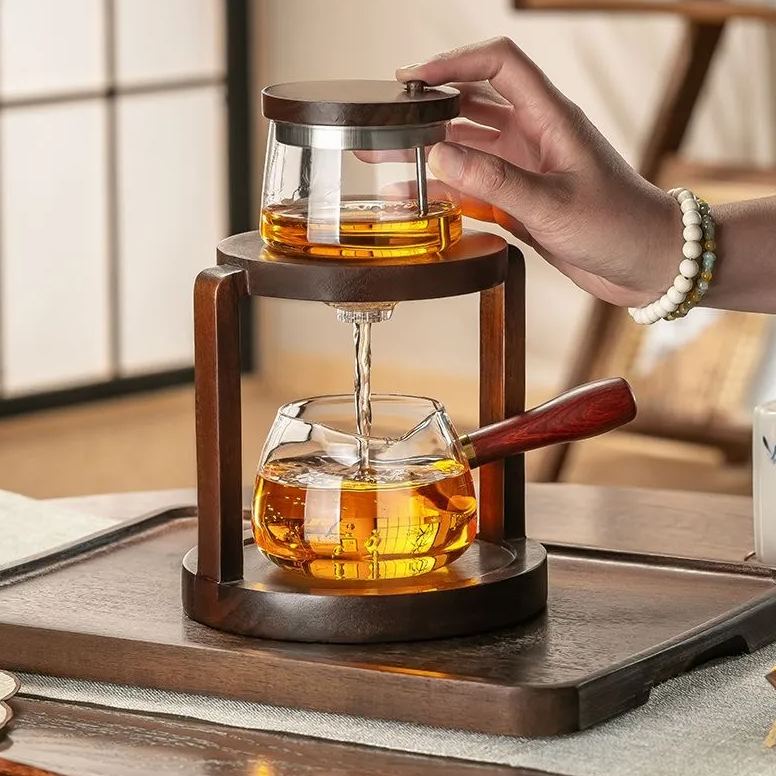
What I appreciate most about this particular pot is the wooden base. It does double duty. It insulates the bottom of the glass chamber, which helps with that heat-retention issue I mentioned earlier, and it turns the whole brewing process into something that feels intentional. The wooden warmth under the glass looks beautiful on a table, and the slight thermal buffer means my second and third infusions stay closer to the temperature they should be.
If glass appeals to you, you can browse the full Glass Teapot Collection and find variations in size and style that fit your space. For oolong, anything from about 350ml up to 800ml works beautifully for solo or small-group sessions.
A Quieter Alternative for the Modern Minimalist
Not everyone wants a wooden base and a visible drip mechanism. Some of us want our tea equipment to disappear visually, to do its work without drawing attention to itself. If that sounds like you, a clean, minimalist drip set might be the better match.
The Minimalist Drip Set is what I reach for on busy mornings when I want the oolong experience without any ceremony about it. It is a streamlined glass-on-glass system with a magnetic release that does exactly what the wooden-base version does, but in a tighter, more architectural form. There is nothing on it that does not need to be there. It looks like a piece of design, not a piece of tea equipment.
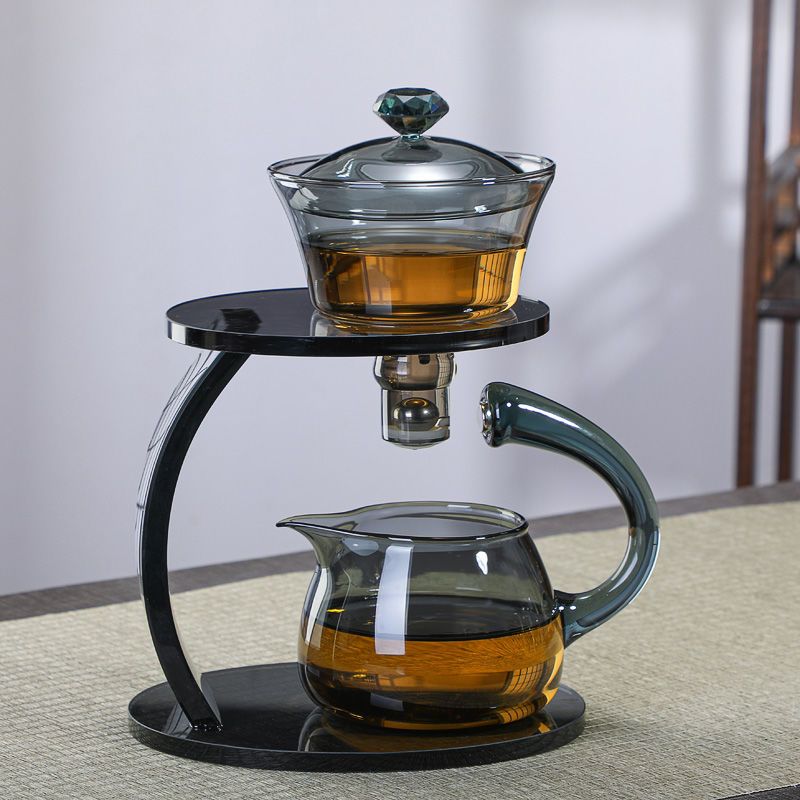
Functionally, both drip systems solve the same problem: separating leaves from liquor at exactly the right moment without the sloshing and over-extraction you get from a conventional infuser basket. For oolong, where timing matters more than almost anything else, this kind of control is a quiet luxury. You set your steep, you walk away to do something else, and you come back to tea that has stopped extracting exactly when you wanted it to.
When You Want Technology to Handle the Timing
I have a confession. For a long time, I was skeptical of “smart” tea equipment. It felt like overkill. Tea has been brewed in clay pots for centuries without electronics, so why complicate it?
Then I tried the Smart Magnetic Tea Maker on a particularly hectic workweek, and I understood the appeal. The magnetic timing system removes the one variable that throws off even experienced tea drinkers: attention. Sometimes you start a steep, get pulled into an email or a kid needs something, and by the time you come back the oolong has been sitting in hot water for twice as long as it should have. With a magnetic system, you set the time and let physics handle it.
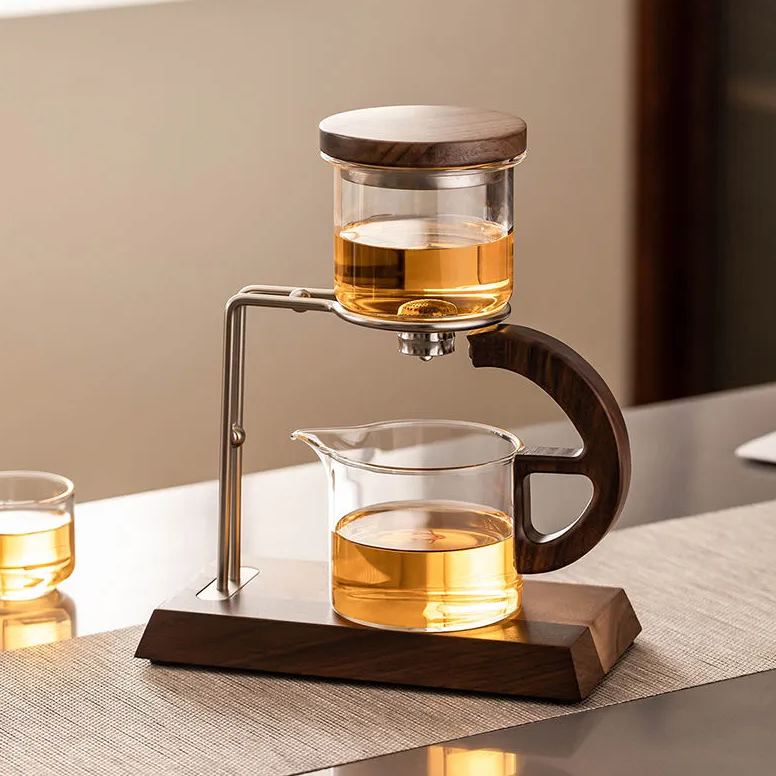
For oolong specifically, this kind of precision matters because the difference between a 20-second infusion and a 45-second infusion can be the difference between bright, layered flavor and a flat, tannic cup. The smart system also tends to be more efficient with leaf, because the magnetic release is so consistent that you can dial in exactly how long each infusion runs without trial-and-error.
If you had asked me five years ago whether tea equipment needed electronics, I would have laughed. Now I keep a smart brewer on my desk because my attention is the bottleneck, not the equipment. Sometimes the right tool is the one that admits you are a busy human.
Sizing Your Teapot to Your Ritual
Material is half the decision. Size is the other half, and people get it wrong constantly. The right size depends entirely on how you actually drink tea, not how you wish you drank tea.
For gongfu-style oolong brewing, where you do many short infusions and pour into small cups, you want a small vessel. Between 100ml and 250ml is the sweet spot. This concentrates the leaf-to-water ratio and creates the layered, evolving flavor profile that makes oolong worth the effort. Most of the dedicated gongfu pieces in our Gongfu Tea Set Collection fall into this range.
For Western-style brewing, where you make one larger pot and drink it across a morning, a 500ml to 1L pot makes more sense. The leaf-to-water ratio drops, the infusions get longer, and the tea tends to taste more uniform from cup to cup. Both approaches are legitimate. They just produce different experiences.
Couples and small households often land somewhere in the middle. A 350ml to 500ml pot is enough for two generous cups with a second infusion to follow. If you entertain, look at the 700ml and up range, keeping in mind that larger glass pots lose heat faster and you may need to warm the vessel before brewing.
The Mistakes I Made So You Don’t Have To
I have made nearly every mistake there is to make with oolong equipment. Some of them cost me real money, and all of them cost me good tea. Here is what I wish someone had told me earlier.
The first mistake was buying a beautiful teapot before I understood how I actually drank tea. I bought a 1.2L cast iron pot because it looked stunning on the shelf. I used it maybe four times. It was too big for solo sessions, too heavy for daily use, and the cast iron held heat so aggressively that by the end of a long steep the leaves were essentially cooked. Beautiful object. Wrong tool.
The second mistake was choosing a pot with a built-in metal infuser basket. Metal can react subtly with certain teas, and the basket design almost always leaves leaves in contact with water after you have stopped steeping. Drip systems and gravity-based separation are simply more reliable for oolong because they actually remove the leaves from the liquor.
The third mistake was underestimating how much my environment mattered. Brewing oolong in a cold kitchen in winter is genuinely different from brewing in a warm room. Cold ambient temperature pulls heat out of glass faster than you would expect. If you are a cold-room brewer, look for setups that insulate the brewing chamber or pre-warm your pot with hot water before adding leaves.
The fourth mistake was assuming expensive meant better. Some of the most expensive teapots I have owned were the least practical for daily oolong use. Price often reflects craftsmanship, rarity, or aesthetics, not necessarily functional superiority for your specific tea habit.
Matching the Teapot to Your Tea Life
After all this exploration, the question most readers actually want answered is some version of, “So which one is right for me?” Let me try to make this simple.
If you are someone who is still building your oolong habit and wants to learn what the tea is actually doing during steeping, start with a glass system. The visual feedback is irreplaceable when you are learning. The Glass Tea Maker Wooden Base is the one I recommend most often to friends who are starting out, because it gives you that learning experience while also handling the temperature issue reasonably well.
If you already know how you like your oolong and you want a clean, architectural piece that gets out of the way, look at the Minimalist Drip Set. It does everything the wooden-base version does in a tighter footprint, and it pairs especially well with a modern kitchen or workspace.
If your problem is consistency, or you are a busy person who wants the flavor without the focus, the Smart Magnetic Tea Maker takes over the part of brewing that requires your attention. It is not for the traditionalist who wants every step to be manual, but for everyone else, it quietly solves a real problem.
If you rotate between many types of tea and want to brew them all well, glass and porcelain are your friends. If you have found the one oolong you plan to drink for the rest of your life, consider a quality unglazed clay pot dedicated to it. Otherwise, save clay for later.
Bringing It All Together
Choosing the right teapot for oolong is less about finding a perfect object and more about removing the obstacles between you and your tea. The reason your current teapot isn’t working is probably not that it is a bad pot. It is that it was not designed for the specific demands of oolong, and oolong happens to be more demanding than most teas we brew at home.
Start with clarity about how you actually drink tea. Then pick a material that supports that habit. Then pick a size that matches the number of cups you actually pour. Then look at systems that give you control over the steep timing, because control is what oolong is really asking for.
Once you find the right vessel, the same leaves you have been brewing all along will start showing you things you did not know were in there. That is the moment tea stops being a beverage and starts being a practice. I have been at this for over a decade, and I still get surprised by what a properly chosen teapot reveals in a familiar tea.
If you are ready to look around, our Glass Teapot Collection is a good place to start, and the Gongfu Tea Set Collection covers everything you need for a more traditional, multi-infusion approach. Brew a pot of something good, take your time with it, and trust me: the right teapot is closer than you think.
 EN
EN  DE
DE  ES
ES  PT
PT  FR
FR  JA
JA