
Lo que busco ahora en un juego de té (después de haber comprado más de 15 juegos a lo largo de los años)
The Morning I Stopped Counting Tea Sets by Color
I remember standing in front of my tea shelf one Saturday morning, holding a pot I had bought because its blue glaze looked perfect against the wall. The set was beautiful, but I had bought it for a photograph rather than for tea. By the time I made my usual oolong, I realized I was reaching for the small glass pot that had been there for years because it brewed evenly, poured cleanly, and was easy to wash.
That moment changed the way I shop. Over more than fifteen sets, I have moved through glass, porcelain, clay, metal, wood, and several versions of the semi-automatic magnetic design. Some pieces earned permanent counter space. Others looked wonderful in a store and became display pieces after a few weeks. I eventually realized that a tea set is not one purchase. It is a small brewing system made up of a pot, cups, filters, stands, handles, lids, and cleaning routines.
Now I begin with the tea and the person drinking it, not with the color, styling, or number of pieces in the box. I ask where the set will live, how often I will use it, who will drink from it, and how much attention I want to give after brewing. Those questions have made my choices simpler, even if my shelf still contains far more tea ware than a sensible household truly needs.
The best tea set is rarely the most elaborate one. It is the set that makes me want to brew one more cup.
The Three Choices That Shape Every Purchase
Most of the uncertainty I see in tea-set shopping comes from trying to answer too many questions at once. I have done the same thing myself: I would compare material, capacity, price, appearance, and accessories simultaneously, then leave without a clear idea of which features actually mattered. These days I narrow the decision to three connected choices.
- The brewing job: I decide whether I want visual clarity, heat retention, precise steeping, effortless separation, or simply a pleasant pot for loose tea. I do not expect one vessel to excel at every job.
- The people and portions: I consider whether the set is for my own concentrated sessions, two people sharing tea, or a group receiving larger pours. A generous-looking set can still be frustrating if every cup is too small.
- The care routine: I think about washing, drying, descaling, storing, and replacing pieces. The easier a set is to maintain, the more likely I am to use it consistently.
When I keep those three choices in view, the decorative features still matter, but they no longer decide the purchase on their own. I can enjoy a fish-shaped stand or a sculptural wooden base because it supports a routine I already want, not because it promises to transform every cup of tea.
Glass Made the Brewing Process Visible Again
Glass remains my favorite material when I want to observe infusion, especially with oolong, white tea, and flowering teas. I can see when the leaves open, whether the liquor is deepening too quickly, and where bits of leaf collect. That visibility makes glass more interactive for me, even though it does not create better tea by itself.
One set I still reach for is the Tetera de Vidrio Artístico con Pez. Its decorative stand gives it more personality than a plain laboratory-style pot, and I enjoy the way it becomes part of the table rather than disappearing into the background. It works well when I want the brewing process to be part of the conversation.
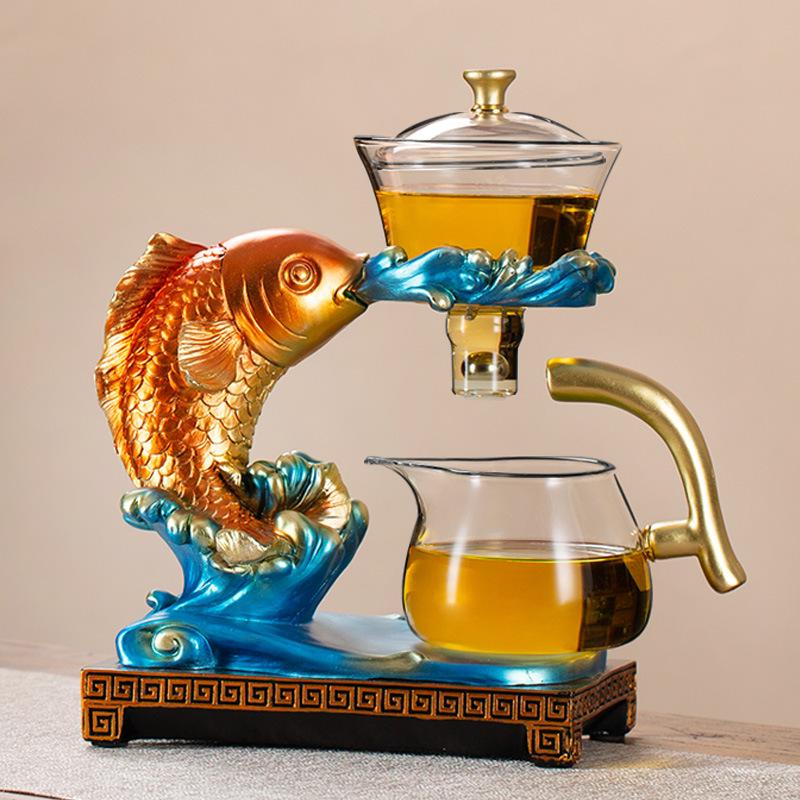
My honest drawback is fragility. I like the glass, but I do not treat it carelessly. I keep it away from the edge of the counter, dry the base fully after washing, and make sure the lid and stand are seated correctly before lifting. Glass also conducts heat more than porcelain or clay, so I do not call it the most comfortable vessel for long, uninterrupted pours of very hot tea.
When I want something with a slightly more grounded look, I turn to the Base de Madera para Tetera de Vidrio. The wood softens the technical appearance of the glass and gives the set a warmer presence in my kitchen. Its footprint is larger than that of a simple teapot, however, so I measure the counter before recommending it to someone with limited space. For more alternatives, I browse the Teteras de Vidrio and compare brewing styles rather than choosing on appearance alone.
Size Matters More Than the Number Printed on the Box
I used to assume a larger teapot would be more useful. In practice, an oversized pot became a reason to brew too much tea, and the extra capacity added weight without improving the cup. The useful question is not how impressive the set looks when full. It is how much liquid I actually drink and whether I want to re-steep the same leaves.
For solo drinking, I prefer a small pot that produces several concentrated pours. A larger western-style pot may leave the last cup watery and make reheating awkward. For two people, I look for enough capacity to share a pot but not so much that I am reheating leftovers. When several guests are joining me, I check both the stated capacity and the number of cups, because a generous teapot with four tiny cups still limits the experience.
I also consider refill logistics. A small vessel means I can refill the kettle without waiting for a large pot to cool. A bigger set may be better when conversation lasts for hours because I do not need to keep returning to the kettle. The Juego de Té Magnético de Vidrio appeals to me for shared use because its coordinated pieces make it easier to serve more than one person, but I would still check the available space and confirm that the listed size suits my table.
My practical test is simple: I imagine filling the pot, lifting it with one hand, pouring into the included cups, and washing everything afterward. If that sequence feels awkward in my kitchen, a slightly smaller set will usually serve me better.
Magnetic Sets Earned a Place in My Everyday Routine
The magnetic design was not my first love in tea ware. I initially wanted the ritual of loose-leaf brewing without any mechanical assistance. Over time, convenience became more valuable, especially on busy mornings. The Juego de Té Magnético de Vidrio showed me how a coordinated brewing system could reduce several small actions without removing my control over leaf quantity and brewing time.

The modern glass construction also lets me watch the tea develop, which is important to me. The magnetic operating mechanism adds a clean, purposeful quality rather than the old-fashioned complexity of clamps or improvised strainers. I can see when the liquid level drops, and I find that visual feedback makes the process more engaging rather than less.
I do have two cautions. First, I make sure the magnetic components are clean and correctly aligned before use; a rushed action can leave tea caught in a mechanism that is harder to reach later. Second, glass remains glass. The set may be convenient, but it still needs careful handling and a stable surface. The set is not maintenance-free, merely easier to use once the parts are familiar.
If I am comparing several versions, I start with the Colección de Juegos de Té Magnéticos. I look for a set whose mechanism I understand, whose pieces I can comfortably hold, and whose overall size matches the number of people I expect to serve. That is more meaningful to me than choosing the most elaborate model on display.
A Gongfu Set Changed the Way I Read Small Details
My gongfu experience began slowly. I did not need many accessories at first, only a small brewing vessel, a strainer, and a few cups. What changed was my attention. Because the pours were small, I noticed the aroma shifting between infusions and could taste differences that larger servings had softened.
El [producto] ofrece un enfoque diferente del juego de té Gongfu que enfatiza los métodos tradicionales y la estética. Mientras que mi equipo prioriza la consistencia y la conveniencia, esta alternativa se centra en el ritual y el compromiso del proceso de preparación. Ambos tienen mérito, y la elección entre ellos depende de las prioridades individuales. Juego de Vertido Gongfu made that focused approach easier for me because the coordinated pieces reduced the number of separate items I had to arrange. The choice of color is a cheerful personal detail, but the usefulness comes from the small pot and dedicated cups working together.
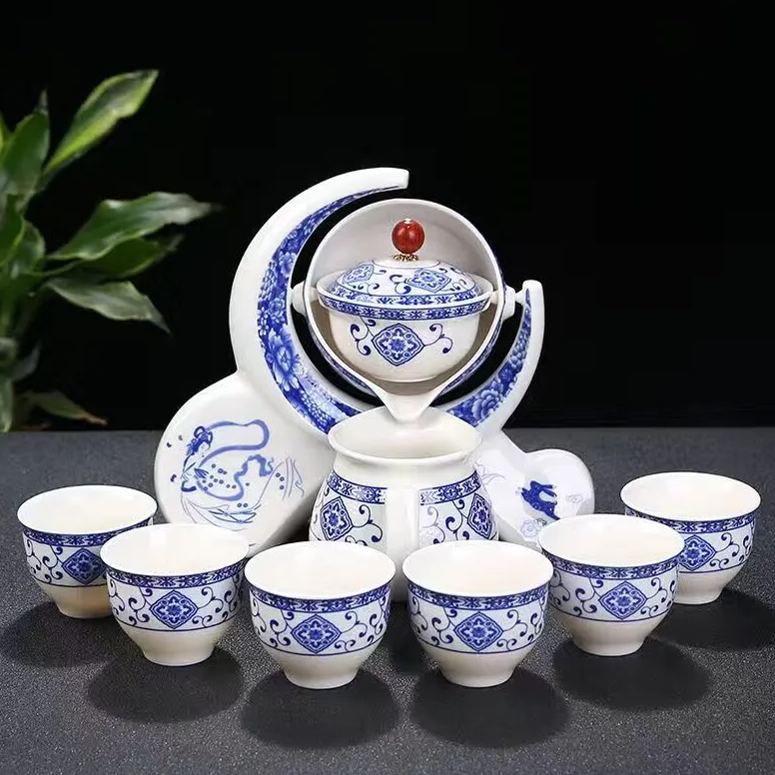
I find gongfu especially rewarding with tightly rolled oolong, puerh, and compact black teas that benefit from repeated infusions. I am less likely to choose it for a large group or for a casual tea I plan to drink in one mug. A small pot would make the process feel unnecessarily deliberate, while a full teapot would make repeated steeping harder to manage.
Gongfu did not teach me to drink less tea. It taught me to pay closer attention to what changed from one infusion to the next.
The tradeoff is storage and washing. Several cups take more room than a single mug, and small openings need careful rinsing. I still consider it one of my most rewarding setups because it suits the kind of tea I want to study rather than merely serve.
Cups and Handles Matter More Than I Expected
I used to accept whatever cups arrived with a set. That changed after a handle began to feel slippery and another cup made the rim uncomfortable against my lower lip. A pot can brew beautifully and still be frustrating to use if the drinking pieces do not fit my hands or my habits.
I look for a cup that feels balanced when lifted, a rim that is smooth but not unnecessarily thick, and a handle with enough room for my fingers. I also pay attention to whether the cup holds a comfortable amount for one person. Tiny cups suit repeated gongfu pours, while a small western teacup may frustrate someone who normally drinks from a mug.
Glass cups appeal to me because they show the color of the tea and pair naturally with clear brewing vessels. At the same time, I use the Colección de Tazas de Té to compare shapes, weights, and handle styles before replacing a favorite piece. I would rather build one dependable setup over time than insist that every item must come from the same initial box.
Aesthetic fit is part of this decision. The wooden base of my glass tea maker feels calm and natural beside pale wood furniture, while the fish design of my other glass pot adds a playful note. I choose designs that I will still want to take down and use, not only designs that photograph well on a shelf. When I have time, I set the whole arrangement on the counter and see whether it feels inviting before I commit.
Cleaning Is the Feature I Wish I Had Checked First
Tea equipment looks simple until it has been used for several months. Fine sediment collects around a filter, tea residue settles beneath a magnetic mechanism, mineral marks appear inside glass, and wooden bases can trap moisture if they are washed too aggressively. I now judge maintenance before I judge finish.
For glass, I wash the pieces promptly and dry them rather than leaving water trapped in joints or on a stand. I clean the strainer separately when the openings are small, and I inspect the lid and filter after each brewing session. I avoid abrupt temperature changes with glass because thermal shock is a real risk, even when a vessel looks sturdy.
The magnetic pieces require a little more deliberate care. I follow the included cleaning guidance, keep magnetic parts free of grit, and make sure everything is dry before reassembly. The glass tea maker with its wooden base asks for a different approach from an all-glass set, so I dry the wood separately and avoid soaking the complete unit.
Porcelain and clay are usually forgiving in my kitchen, although unglazed clay can hold aromas more strongly than I expect. That can be a virtue for one tea and a drawback when I want the same pot for pu-erh and jasmine. If I am choosing a material based on longevity, I think about cleaning as well as breakage and replacement costs. A set I am willing to wash promptly will usually age better than one I feel vaguely guilty about touching.
How I Weigh Price Against Years of Actual Use
I divide tea-set spending into three broad levels in my own shopping. At the lower end, I look for a simple, dependable glass or porcelain setup. In the middle, I am willing to pay more for a refined semi-automatic design, coordinated cups, or a more attractive wooden base. At the higher end, I consider decorative or specialized pieces whose appeal is closely connected to the ritual I already enjoy.
I used to judge value by the number of pieces in the box. Now I ask how many pieces I will use. Four tiny cups are less valuable to me if I normally drink alone, while a modest pot and two comfortable cups may be exactly right. I also think about replacement costs. If one glass cup breaks, can I find a matching piece, or will the whole arrangement feel unfinished?
El [producto] ofrece un enfoque diferente del juego de té Gongfu que enfatiza los métodos tradicionales y la estética. Mientras que mi equipo prioriza la consistencia y la conveniencia, esta alternativa se centra en el ritual y el compromiso del proceso de preparación. Ambos tienen mérito, y la elección entre ellos depende de las prioridades individuales. Tetera de Vidrio Artístico con Pez is a decorative choice for me, so I value the stand and visual character alongside the brewing function. The Juego de Vertido Gongfu earns its place through repeated concentrated brewing. Those are different kinds of value, and I no longer insist that one measurement can cover both.
My budget rule is to spend where my hands and attention are focused. If I enjoy pouring and reheating leaves, I will invest in a small gongfu vessel and proper strainer. If I want quick daily service, I will pay for a magnetic mechanism that feels reliable. If the set is mostly decorative, I keep the functional components simple rather than paying for accessories I will ignore.
The Mistakes I Made Before I Started Buying for Use
My biggest early mistake was buying a complete set before deciding how I drink tea. I had six cups for a two-person routine and no small pot for solo sessions. The set looked generous, but the reality was crowded. I now think about frequency before quantity.
I also underestimated counter space. More than once, I chose a set with a broad base or tall components that looked fine in a photograph but crowded the area beside my kettle. A teapot that must be moved every time I fill the kettle becomes inconvenient very quickly. Measuring the shelf and checking the base diameter is now part of my checkout routine.
Another mistake was assuming a complicated mechanism would make tea better. It did not. Early on I believed every advanced design deserved a place, but extra movement did not replace good leaf, suitable water temperature, or enough steeping time. The simpler setup often produced the cup I preferred.
I also bought purely because a finish matched one isolated corner of my kitchen. Once I moved the set near a different wall, it no longer fit. I now try to picture the whole routine: taking the set out, filling it, pouring, rinsing it, and storing it in the place I will actually use.
Finally, I ignored cleaning too often. A mechanism that looked spotless after brewing developed residue when I let it sit. I now dry and rinse sooner, keep filters out of standing water, and follow the care instructions rather than assuming every glass component tolerates the same treatment.
After so many trial-and-error purchases, I have stopped asking which set is universally best. I ask which one fits the life I am actually living.
How I Would Choose Again for Each Kind of Brewer
For a solo drinker who wants to explore gongfu tea, I would begin with the Juego de Vertido Gongfu. Its small vessel suits repeated pours, and the coordinated cups reduce the friction of setting up. I would be honest about the learning curve, though. If I never enjoyed slow infusions or adjusting steep times, I would not buy it simply because the term sounds sophisticated.
For a couple that wants one streamlined daily system, I would look closely at the Juego de Té Magnético de Vidrio. It suits shared service and gives me the visual clarity I prefer. I would also consider the Base de Madera para Tetera de Vidrio when warmer styling and a defined counter presence matter. The wooden base gives that option more character, while the magnetic set feels more compact and modern in my kitchen.
For someone who wants the brewing process to become part of the table, I would choose the Tetera de Vidrio Artístico con Pez. Its design makes it a natural conversation piece, and the transparent body keeps the tea visible. I would make sure the recipient is comfortable washing and handling glass.
For a household that mostly drinks large mugs rather than small cups, I would choose fewer, larger drinking pieces instead of buying the biggest matching set I could find. For a traditional tea enthusiast who prefers the feel of porcelain or clay, I would begin with the material I enjoy using rather than forcing myself into glass simply because it shows infusion so clearly.
My final recommendation is therefore less a single name than an order of priorities: first the brewing method, then the number of drinkers, then maintenance, and only after that appearance and ornament. I still notice beautiful products, and I am not interested in buying a set that looks as if it came from someone else’s kitchen. I want mine to fit my counter, my hands, my cleaning habits, and my willingness to slow down.
If you are still deciding, I would make a cup of the tea you drink most often and let that guide you. Then browse the Teteras de Vidrio, compare the Colección de Tazas de Té, or examine the Colección de Juegos de Té Magnéticos without rushing the choice. After fifteen-plus sets, my best advice is to buy for the ritual you already have—or the one you genuinely want to build.
 ES
 EN
 DE
 PT
 FR
 JA