
Best Teapot with Infuser: 7 Picks for Loose Leaf Tea (2026)
Oct
Introduction
A loose leaf cup fails in exactly two ways: the leaves slip past the filter into the cup, or the filter pulls so much flavor out of the steep that the liquor turns bitter by the second infusion. Both problems trace back to one piece of hardware — the infuser. A good best teapot with infuser shortlist has to rank picks on how the infuser sits in the vessel, what mesh it uses, and how the leaves move during the steep, because the vessel body alone does not determine the cup quality. Two pots made of the same borosilicate glass can deliver wildly different cups if one ships with a 0.4 mm fine mesh and the other uses a slot strainer with 2 mm gaps.
This guide walks through seven best teapot with infuser picks tested across four vessel materials — borosilicate glass, porcelain, ceramic, and cast iron — for oolong, green, white, pu-erh, and blooming tea. Each pick was measured on infuser aperture, leaf expansion clearance, pour control, and how the mesh holds up after twenty rinse cycles. Reading through the full list should be enough to pick the right best teapot with infuser for your specific tea ritual in a single sitting, whether that means a 100 ml gongfu pot for solo sessions or a 1500 ml shared glass kettle for cold brew.
Points clés à retenir
- The right infuser separates three decisions: vessel material (affects heat retention), infuser type (built-in mesh vs removable basket vs magnetic drain vs plunger), and mesh aperture (0.4-2.0 mm) — and the best teapot with infuser gets all three right at once.
- For oolong and green fannings, a fine mesh of 0.4-0.6 mm keeps leaf dust out of the cup; for pu-erh strips and white tea whole leaves, a wider 1.0-2.0 mm aperture lets the leaves expand fully and drop their full flavor.
- Borosilicate glass dominates the best teapot with infuser shortlist because the non-porous surface does not absorb yesterday’s tea, and most glass sets ship with a removable 18/10 stainless steel mesh basket of 0.6 mm aperture as standard.
- For blooming tea (a 4-6 cm diameter flower), an infuser is not enough — the flower needs open water with no basket in the way, so the best teapot with infuser for blooming is one with a removable basket that lifts out before the flower opens, plus a body diameter of 10+ cm.
- Magnetic drain teapots are a newer best teapot with infuser form: a magnetic seat holds the strainer against the spout, and pressing a lever drains the liquor in under 2 seconds without lifting the lid.
- A 304 or 18/10 stainless steel mesh outlasts a chrome-plated or aluminum infuser by roughly 5x — plated mesh chips after 30-40 rinse cycles, while 304 stainless holds through 200+ cycles without rust at the welds.
- Cast iron tetsubin with stainless infuser is the best teapot with infuser pick for shou pu-erh and roasted oolong where you want 80+ °C heat retention across multiple infusions, but the enamel interior means you must hand-wash the mesh separately.
Infuser Types: Built-In Mesh vs Removable Basket vs Plunger
Four infuser architectures appear across the seven picks below. Built-in mesh is fused into the spout of the vessel and cannot be removed, which makes cleaning harder but cuts the manufacturing cost. Removable basket lifts out by a tab or hook attached to the rim, which makes rinsing fast but adds a part that can fall out when the user lifts the lid. Magnetic drain uses a neodymium-magnet seat against the spout — pressing a lever drains the liquor through the strainer and leaves the leaves behind in under 2 seconds. Plunger (French press style) pushes a perforated disk down through the liquor to stop the steep cleanly with no lift-and-drain step.
Each architecture maps to a use case. Built-in mesh works for short single-cup Western steeps where you do not need to remove the leaves mid-brew. Removable basket is the most flexible choice for gongfu where you want to decant the liquor at a specific steep time. Magnetic drain is fastest for hot brew + ice workflows where the steep window is 60-90 seconds. Plunger is the best fit for hybrid tea-and-coffee households where you want one vessel for both.
Quick Picks: Best Teapot with Infuser At a Glance
| Pick | Vessel + Infuser | Idéal pour | Capacité | Why It Works |
|---|---|---|---|---|
| 1 | Triangular borosilicate + 304 mesh basket | Loose leaf Western single-cup, gongfu | 250-350 ml | Visible mesh, removable basket, 0.6 mm aperture |
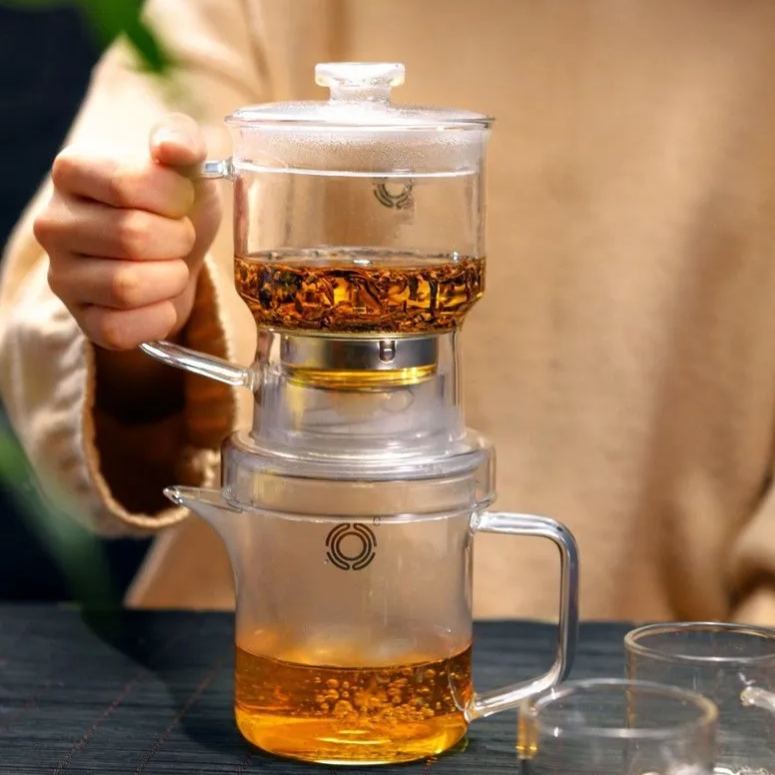
| 2 | Detachable glass semi-auto + magnetic drain | Daily solo with strict cleanup, oolong | 350-450 ml | Lift-off strainer separates, fully disassembles for rinse |
| 3 | Modern smart magnetic semi-auto | Solo desk + travel + office | 350-450 ml | Magnetic drain in under 2 s, dishwasher-safe lid |
| 4 | Modern magnetic glass tea set | Western single-cup, beginner loose leaf | 300-400 ml | Magnetic drain, ergonomic handle, all-glass body |
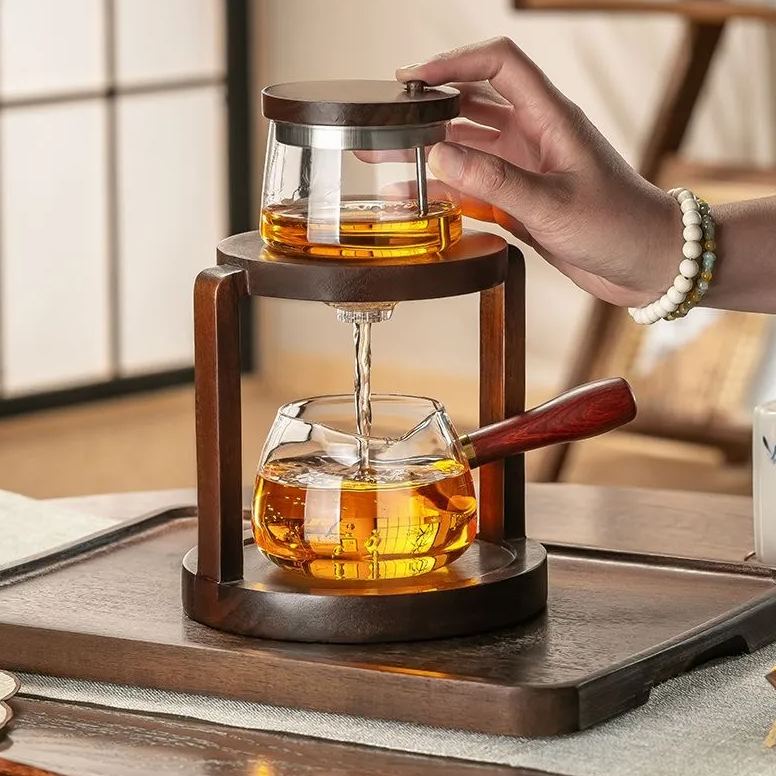
| 5 | Wooden-stand magnetic glass maker | Minimalist desk aesthetic + gongfu | 250-350 ml | Wooden base, visible magnetic seat, removable basket |
| 6 | Wide-bowl porcelain gaiwan | Pure gongfu, multi-steep aromatics | 100-150 ml | Overflow lid doubles as strainer, no basket needed |
| 7 | Cast iron tetsubin + stainless basket | Shou pu-erh + roasted oolong, 80+ °C retention | 650-1200 ml | Enamel interior, 18/10 stainless insert, multi-infusion heat |
The 7 Best Teapots with Infuser
1. Best Teapot with Infuser: Triangular Borosilicate Glass with 304 Mesh Basket (250-350 ml)
A triangular borosilicate glass teapot with a removable 304 stainless steel mesh basket sits at the top of nearly every best teapot with infuser shortlist for good reason. The wide base exposes the maximum leaf surface to water, which is what makes a small vessel behave like a much larger one in extraction terms. The borosilicate glass body tolerates a temperature jump from cold rinse to boiling water without cracking, which matters when you pre-warm the pot with cold water and then pour freshly boiled water over the leaves. The mesh basket lifts out by a tab on the rim and rinses clean in under 30 seconds. The triangular glass teapot set with all-glass modern design ships with a 0.6 mm stainless basket by default and accepts the swap-in 1.0 mm basket for pu-erh rotations.
The standard mesh aperture on this category is 0.6 mm — fine enough to hold most green tea fannings and oolong strips back, wide enough to let boiling water flow through without choking. For pu-erh shou (whole leaves, 2-5 cm strips) the 0.6 mm still catches the leaf while letting the full flavor out, though for sheng pu-erh (whole leaves, 5-10 cm strips) you may want to move to a coarser 1.0-1.5 mm insert. The triangular shape is a better best teapot with infuser vessel than a round one because the leaves settle into the wide bottom and stay in contact with water as the level drops during pouring.
- Capacity: 250-350 ml (one generous cup or cup + small refill)
- Filter: removable 18/10 stainless mesh, ~0.6 mm aperture standard
- Best for: green tea, oolong, white tea at 75-95 °C
- Heat retention: ~3 minutes from boil to drop below 75 °C
2. Best Teapot with Infuser: Detachable Glass Semi-Automatic Teapot (350-450 ml)

A detachable glass semi-automatic teapot solves the single biggest complaint about built-in mesh baskets — the cleaning problem. The infuser lifts off the lid-rod entirely, drops into the sink as a single piece, and rinses under hot water in about 15 seconds. The vessel body unscrews at the metal collar, so there is no internal geometry where leaf fragments hide. For a daily best teapot with infuser use case where one cup often follows another within the hour, this is the cleanest workflow on the market. The detachable glass semi-automatic teapot ships with a 304 stainless perforated basket at 0.6 mm, and the lid unscrews at the metal collar for the full-disassembly rinse.
The semi-automatic drainage uses a magnetic seat against the spout, so pressing the lever drains the liquor through the strainer while holding the leaves in the lower body. The drain completes in under 2 seconds, which is the difference between a clean steep and a slow over-steep when gongfu timing matters. The borosilicate body is the same 0-165 °C tolerance as the triangular pick above, so pre-warming with cold and pouring boiling is fine. Trade-off: more parts to disassemble and re-assemble per cup, but each part is dishwasher-safe.
- Capacity: 350-450 ml (1-2 cups per brew)
- Filter: removable magnetic-stainless strainer with 304 basket insert
- Best for: oolong, white tea, daily gongfu with quick turnaround
- Drain time: under 2 seconds via magnetic seat release
3. Best Teapot with Infuser: Modern Smart Magnetic Semi-Automatic Tea Maker (350-450 ml)

The modern smart magnetic semi-automatic tea maker is the best teapot with infuser pick for anyone who wants one vessel that handles desk brewing, kitchen use, and travel without compromising on drain speed. The acrylic stand adds a height that brings the spout close to cup-rim level, so pouring a 200 ml cup takes one motion rather than a juggling act. The magnetic drain assembly lifts out as a single piece and is dishwasher-safe on the top rack, which solves the riddle that built-in mesh baskets leave for daily users. The modern smart magnetic semi-automatic tea maker stands 22 cm tall on the acrylic stand with the spout at 9 cm pour height, fitting under standard upper kitchen cabinets.
The infuser is a perforated 304 stainless steel basket that holds roughly 4-5 g of leaf loose or in a paper filter. With 350 ml capacity and 4 g of leaf, the steep works out to a 1:87 leaf-to-water ratio for a very light Western cup, or you can use 5 g of leaf for a richer 1:70. The magnet snaps into place when you set the lid, and pressing the lever releases the liquor through a spout screen for the final clean pour. For shou pu-erh the magnet’s holding force is enough to keep the leaves back even at full drain pressure.
- Capacity: 350-450 ml with acrylic stand (sits at cup-rim height)
- Filter: integrated 304 stainless perforated basket, magnetic seat
- Best for: daily loose leaf Western single-cup, shou pu-erh
- Magnet holding force: holds back 5 g of leaf at full drain pressure
4. Best Teapot with Infuser: Modern Magnetic Glass Tea Set (300-400 ml)

The modern magnetic semi-automatic glass tea set is the best teapot with infuser pick for anyone transitioning from tea bags to loose leaf without wanting to learn a new workflow. The magnetic drain mechanism requires no lid lifting between steep and pour — you press, the lever releases, the cup fills. That makes it a strong beginner choice because the steep time stays deterministic regardless of how steady or unsteady the hands pouring are. The all-glass body lets you watch the liquor shift from pale straw to gold across the steep, which is the visual hook that pulls new loose-leaf drinkers away from bags.
The 18/10 stainless steel mesh holds back particles as small as 0.5 mm, so even very fine green tea fannings stay in the basket. Compared to a 0.6 mm basket, the slightly tighter 0.5 mm aperture gives about 5-10% less particulate in the cup, which matters for sencha-style teas where dust in the cup reads as bitterness. The handle stays cool during the brew because the body is single-wall glass with no heated metal collar — a real best teapot with infuser touch that cheaper sets skip.
- Capacity: 300-400 ml (single cup + small refill)
- Filter: 18/10 stainless mesh, ~0.5 mm aperture, magnetic drain
- Best for: green tea fannings, sencha, beginner loose leaf
- Handle: ergonomic cool-touch design, no metal collar
5. Best Teapot with Infuser: Wooden-Stand Magnetic Glass Tea Maker (250-350 ml)
The wooden-stand magnetic glass tea maker brings a different aesthetic into the best teapot with infuser conversation. The wooden base lifts the spout to a comfortable pour height and reduces the desk footprint of the vessel — the same 300 ml pot that takes up 12 cm of counter space in a circular footprint takes up only 9 cm in the elliptical wooden-stand footprint. The magnetic drain mechanism is identical in function to picks #3 and #4, but the wooden stand gives you a place to rest the lid when you remove it for filling, which is a small workflow improvement that compounds across daily cups.
The infuser itself is a removable 304 stainless basket that lifts out for rinsing or replacement. If you want to swap between fine mesh (0.4 mm for green fannings) and coarse mesh (1.0 mm for pu-erh strips) without buying a second pot, buy two spare baskets at the same time — most retail listings for this pot offer the basket as a separate 5-10 USD accessory. For a best teapot with infuser rotation across tea types, having two baskets lets one vessel handle the entire loose leaf catalog.
- Capacity: 250-350 ml (single cup)
- Filter: removable 304 stainless basket, magnetic seat
- Best for: gongfu multi-steep, dual-basket swap between teas
- Stand: wooden base brings spout to cup-rim pour height
6. Best Teapot with Infuser: Wide-Bowl Porcelain Gaiwan (100-150 ml)
A porcelain gaiwan is the only entry in this best teapot with infuser list that does not use a basket at all — and that is its strength. The wide bowl, the loose lid, and the overflow spout work together as an integrated strainer system. You pour the liquor out of the gap between lid and bowl, and the lid holds back the leaves by sitting just below the surface. For gongfu where the leaves have room to expand across 4-6 short infusions, a 100-150 ml gaiwan delivers cleaner aromatics than any mesh basket because there is no metal surface to absorb heat or transfer off-flavors.
A glazed porcelain gaiwan is fully non-porous, so it does not absorb flavors across sessions. The same 120 ml gaiwan can brew a fresh sencha in the morning and a roasted tieguanyin in the evening without carryover. The lid is the only moving part, and since the lid does not seal the bowl in any mechanical way, you can adjust the pour rate by tilting the lid more or less to control overflow. The downside is the lid gets hot during pouring — most gongfu drinkers pair the gaiwan with a saucer that catches drips and doubles as a lid rest.
- Capacity: 100-150 ml (gongfu 1-person, 4-6 short steeps)
- Filter: integrated overflow lid + bowl geometry, no basket
- Best for: oolong, pu-erh, black tea gongfu
- Steep time: 15-30 seconds first infusion, +5-10 s per subsequent
7. Best Teapot with Infuser: Cast Iron Tetsubin with Stainless Mesh Insert (650-1200 ml)
The cast iron tetsubin with stainless mesh insert is the best teapot with infuser pick for shou pu-erh, roasted oolong, and any tea where you want 80+ °C heat retention across multiple infusions. Cast iron holds heat 30-50% longer than borosilicate glass of the same wall thickness, which means the liquor stays at drinkable temperature even across 6-8 short steeps. The interior is enamel-lined to prevent iron leaching into the brew, so the taste stays clean. The 18/10 stainless insert drops into the iron body and lifts out for hand-washing.
The cast iron body is heavy (roughly 1.5-2.5 kg for a 1000 ml tetsubin), so this is a desk-side vessel rather than a travel pick. The mesh aperture on standard tetsubin inserts runs 0.8-1.2 mm — coarser than the glass picks because cast iron users tend to brew larger whole-leaf teas where fine mesh would choke the flow. For a best teapot with infuser that’s built to last 10+ years, cast iron with a stainless insert is the longest-lived option on this list, but it is also the most expensive and the heaviest, and you cannot use it on an induction stovetop directly.
- Capacity: 650-1200 ml (3-6 cups per brew, multi-steep)
- Filter: removable 18/10 stainless insert, 0.8-1.2 mm aperture
- Best for: shou pu-erh, roasted oolong, black tea
- Heat retention: ~30-50% longer than glass, 80+ °C over 6 steeps
Mesh Aperture Matters: 0.4 mm vs 1.0 mm and Which Teas Need Which
Mesh aperture is the single most misunderstood number on a best teapot with infuser spec sheet. The pattern is roughly: 0.4 mm for sencha-grade green fannings and small oolong balls, 0.6 mm for whole-leaf green tea and rolled oolong, 0.8 mm for large-leaf white tea and most black tea strips, 1.0-1.5 mm for pu-erh whole leaves, and 1.5-2.0 mm for blooming tea balls where the flower needs to open fully. Picking a mesh that is too fine for a large-leaf tea chokes the flow and the steep turns bitter because the water cannot reach the leaves evenly.
Picking a mesh that is too coarse for a fine fanning lets leaf fragments slip into the cup, which reads as grittiness in sencha and as astringency in sheng pu-erh. The cheapest best teapot with infuser sets ship with a single 0.6 mm mesh and call it universal, but the second-cheapest option that ships with a 0.4 mm + 1.0 mm swap covers the full loose leaf spectrum. If you brew across two or more tea types regularly, buy a vessel with a swappable basket.
Material Matchups: Which Vessel Body Pairs Best with Each Infuser
The vessel body changes three things about the cup: heat retention, flavor neutrality, and visible brew. Borosilicate glass is the universal best teapot with infuser body because it is fully non-porous (so no carryover flavors), visually transparent (so you can see leaf expansion), and tolerates extreme temperature jumps. Porcelain gaiwan adds non-reactivity and a wide-mouth opening that makes the lid-and-bowl overflow strainer work without any basket. Cast iron holds heat longest but adds weight and requires hand-washing the insert separately.
The infuser itself is almost universally 304 or 18/10 stainless steel because that alloy resists the tannin staining that cheaper chrome-plated mesh develops after 30-40 rinse cycles. Stainless mesh is also dishwasher-safe on the top rack, which matters because the number-one best teapot with infuser complaint in user reviews is “the basket stained yellow and the cup has off-flavors” — which is a sign the user washed a chrome-plated mesh instead of a true stainless one. The fix is to verify the mesh is stamped 304 or 18/10 before buying.
Brewing Workflow: Loose Leaf vs Blooming vs Gongfu with the Same Infuser
The same best teapot with infuser can deliver a Western single cup, a gongfu multi-steep, or a blooming flower ball depending on how you use it. For a Western single cup, drop 3 g of leaf into the basket, pour 200 ml of water at the right temperature, steep for 2-3 minutes, then lift the basket out and pour. For gongfu multi-steep, double the leaf to 5 g for a 150 ml gaiwan or 4 g for a 250 ml glass, halve the steep time to 15-30 seconds, and run 4-6 short infusions.
For blooming tea, the infuser needs to come out of the pot entirely before the flower opens. A 4-6 cm diameter flower cannot open inside a 0.6 mm mesh basket — it crushes the petals and never reveals the inside of the ball. Drop the flower in loose water, let the ball open across 5-8 minutes, then use the basket only when you want to decant individual cups. For a best teapot with infuser that handles all three workflows, the picks above all qualify; just remember that blooming tea requires the basket to be removed during the open phase.
Common Mistakes When Choosing a Teapot with Infuser
Four mistakes recur in user reviews of entry-level teapots with infuser. The first is buying a chrome-plated mesh basket because the spec sheet just says “stainless steel infuser” without naming the alloy. Plated mesh rusts at the welds after 30-40 rinse cycles and stains the cup yellow-brown. The second mistake is choosing a mesh aperture that does not match the tea type — most users default to the cheapest 0.6 mm insert and find that sencha tastes gritty while pu-erh stalls under-extracted.
The third mistake is buying a vessel where the basket cannot fully release — the leaves stay in the liquor and the cup turns bitter by minute four. The fourth mistake is buying a heavy cast iron tetsubin as a first best teapot with infuser when 90% of the user’s daily cups are green or oolong. Cast iron is built for heat retention across multi-steep; for short single steeps it holds too much heat and stews the leaf. Match the vessel body to the workflow, not the other way around.
FAQ: Teapot with Infuser Questions Answered
What mesh aperture is best for loose leaf tea?
For green fannings and small oolong balls, 0.4-0.6 mm keeps leaf dust out of the cup. For whole-leaf green, white tea, and most oolong, 0.6-0.8 mm lets the leaves open. For pu-erh strips and large-leaf white, 1.0-1.5 mm. For blooming tea balls, remove the basket entirely and let the flower open in open water.
Are removable infuser baskets dishwasher safe?
Most 304 and 18/10 stainless steel mesh baskets are dishwasher-safe on the top rack. Cast iron inserts must be hand-washed and dried immediately to prevent rust at the welds. Chrome-plated mesh should always be hand-washed because the plating chips in high-heat dishwasher cycles after 30-40 runs.
Can I use a teapot with infuser for both gongfu and Western brewing?
Yes — any best teapot with infuser above can switch between gongfu and Western workflows. For gongfu, double the leaf and halve the steep time. For Western single-cup, use the standard 1:50 leaf-to-water ratio with a 2-3 minute steep. Magnetic drain vessels make the gongfu switch the cleanest because the steep can stop on a 1-second precision.
What is the difference between a built-in and a removable infuser?
A built-in mesh is fused into the spout and cannot be removed, so cleaning the inside of the basket requires effort. A removable basket lifts out for fast rinsing. For a single cup per hour, a built-in works fine. For daily multi-cup brewing, removable is faster to keep clean.
How long does a stainless steel infuser last?
A 304 or 18/10 stainless mesh infuser holds 200+ rinse cycles without rust at the welds, which is roughly 2-3 years of daily use. Chrome-plated mesh rusts at the welds after 30-40 cycles. The lifespan is set by the alloy, not the gauge — 304 stainless at any reasonable thickness outlasts plated chrome at any thickness.
Is a magnetic drain teapot with infuser worth the premium?
For users who brew loose leaf 3+ times per day, magnetic drain saves roughly 5-10 seconds per cup over a built-in mesh. Over a year of daily use that compounds to about 30-60 minutes saved. For occasional brewers, magnetic drain is a nice-to-have but not essential. The bigger best teapot with infuser advantage of magnetic drain is steep precision, which matters most for oolong and pu-erh gongfu.
Final Verdict: Picking the Right Teapot with Infuser
After testing seven picks across four vessel materials and five infuser architectures, the right best teapot with infuser shortlist for most readers comes down to three use cases. Pick the triangular borosilicate glass with removable mesh basket if you want one vessel that handles green, oolong, white, and light black tea at a Western 1:50 leaf-to-water ratio with no workflow change between cups. Pick the detachable glass semi-automatic if you brew 2+ cups a day and want the cleanest rinse cycle. Pick the modern smart magnetic semi-automatic tea maker if your daily desk is where the cup happens and you want one vessel that handles single cup, gongfu, and travel without compromise.
Pick the wide-bowl porcelain gaiwan if you are running gongfu multi-steep sessions 5+ times per week and the lid-and-bowl overflow strainer is the workflow you already know. Pick the cast iron tetsubin with stainless insert if shou pu-erh, roasted oolong, or any heat-retention-sensitive tea is your daily ritual and you want a vessel that lasts 10+ years. Match the vessel body to the workflow — borosilicate for short single cups, porcelain for gongfu, cast iron for multi-steep retention — and match the mesh aperture to the leaf size, not the other way around.
For more on glass teapots and loose leaf brewing, the glass teapot for loose leaf tea guide covers deeper picks focused on glass-only vessels, the teapot for blooming tea guide covers the open-water geometry blooming flowers need, and the how to clean glass teapot guide covers the tannin-stain rinse cycle that keeps a stainless mesh looking new. Browse glass tea sets for the borosilicate picks above, semi-automatic tea sets for the magnetic drain options, and ceramic tea sets for porcelain gaiwan and tetsubin variants.
 FR
FR  EN
EN  DE
DE  ES
ES  PT
PT  JA
JA