
Lucky Cat Teapot: 6 Maneki-Neko Picks for Tea and Display

Oct
Introduction
Ask a shopkeeper in Osaka which object on the counter is doing the most work and the answer is rarely the cash register. It is a ceramic cat with one paw in the air. The lucky cat teapot takes that object and gives it a job: it brews tea, holds a filter, and pours into a cup without a single drip on your table.
That sounds like a small idea, but it changes what you have to buy. A maneki-neko ornament and a lucky cat teapot are not the same product. The ornament is glazed and hollow. The teapot is glazed and hollow and has a lid that seals, a spout that pours on target, a body that holds heat, and a base that does not slide across a wet table. Get those five things right and the luck motif is free. Get them wrong and you have paid for a ceramic cat that cannot make tea.
This guide ranks six real lucky cat teapot designs that are actually available, scored on ceramic body, serving mechanism, published capacity, and how faithfully the colour scheme follows the traditional symbolism. Every third-party number carries its source and retrieval date. Where a specification is not published, the guide says so rather than guessing.
Points clés à retenir
- Un lucky cat teapot is a working brewing vessel first. The cat is the pot body, the head is the lid, and the thing you are really buying is a seal, a spout, a heat-retaining body and a stable base.
- The motif is documented, not invented. The earliest written record of the maneki-neko figurine appears in a chronicle of Edo dated 1852, and an advertisement for them appears by 1902 (per the Wikipedia maneki-neko reference).
- The colour of a lucky cat teapot is not decoration. Traditional meanings assign white to general good fortune, black to warding off evil, red to good health, and yellow or gold to wealth (per the Wikipedia maneki-neko reference).
- Published capacity across the category runs from 120 ml for compact travel sets to 700 ml for full entertaining sets, with 300 ml the most common teapot size among the listings checked on 24 October 2026.
- Porcelain and high-fired ceramic are fired between 1,200 °C and 1,400 °C, and that vitrification is what gives a ceramic lucky cat both its translucence and its resistance to staining (per the Wikipedia porcelain reference).
- A rotating serving stand is the same mechanism as a lazy Susan, the turntable better known from Chinese restaurant dining, where it lets a group share dishes without passing plates (per the Wikipedia lazy Susan reference).
- Left paw raised is traditionally read as attracting customers and right paw raised as attracting money, and the significance is said to shift with time and place (per the Wikipedia maneki-neko reference).
Table des Matières
- What a Lucky Cat Teapot Actually Is
- Reading the Maneki-Neko Symbols
- Six Picks, Ranked
- Pick 1: The Rotating Maneki-Neko Ceramic Set
- Pick 2: Monkey King Magnetic Glass Teapot Set
- Pick 3: Cartoon Girl Magnetic Drip Teapot
- Pick 4: Blue & White Rotating Ceramic Set
- Pick 5: Persimmon Tomato Rotating Ceramic Set
- Pick 6: Magnetic Ceramic Set with Metal Frame
- Capacity: What the Market Actually Sells
- 5-Point Buying Checklist
- Our Recommended Lucky Cat Teapots
- FAQ
- Options en Céramique
What a Lucky Cat Teapot Actually Is
Strip the motif away and three things distinguish a real lucky cat teapot from a cat-shaped ornament. The first is the lid seal. On the better sets the cat’s head lifts off to form the lid, which means the brew sits in a cavity with a defined rim rather than in an open dish that goes cold in four minutes. The second is the spout, which on a proper ceramic teapot is a short pouring lip cut into the shoulder rather than a decorative nub.
The third is the base. Ceramic is heavy, and a glazed cat shape is top-heavy. If the teapot has no foot ring, no recessed base or no weighted stand underneath it, you will be holding it with both hands instead of pouring with one. That single design decision separates the sets that get used daily from the ones that end up on a shelf holding dry oranges.
Three ways the cat gets onto the pot
Looking across the category, the cat arrives in three distinct arrangements. In the first, the cat is the entire pot: the head is the lid and the body holds the tea, which is how the ceramic maneki-neko sets on the market are built. In the second, the cat is a lid or a handle, with the brewing vessel underneath it, which is the approach several travel tea sets take. In the third, the cat is scenery, and the brewing mechanism is a glass or ceramic assembly mounted next to it.
Only the first arrangement gives you a lucky cat teapot in the literal sense, because only there is the cat the vessel, and it is the form most people picture when they think of a tea ceremony piece. The other two are lucky cat tea sets, and they are perfectly good products, but they solve a different problem: they keep the motif visible while the brewing happens somewhere else. Our guide to the best rotating tea sets covers the mechanism side of this in more depth.
Why ceramic dominates this category
Maneki-neko are made in ceramic, resin, plaster and plastic today, and antique examples were carved in wood, stone and metal, but the tea set version is almost always fired ceramic. That is not a stylistic accident. Porcelain is fired between 1,200 °C and 1,400 °C, and the vitrification that happens at those temperatures is what gives the finished body its hardness and its resistance to tea staining (per the Wikipedia porcelain reference).
There is a practical bonus. A glazed ceramic body holds heat noticeably longer than a thin glass one, which matters for the short repeated infusions that gongfu-style brewing depends on. If you plan to use this pot for gongfu brewing rather than a single western-style steep, the material difference shows up in your second and third infusions.
Reading the Maneki-Neko Symbols
The maneki-neko, written 招き猫 and translated as beckoning cat, is a common Japanese figurine often believed to bring good luck to its owner. It is traditionally depicted seated, holding a koban coin, with one paw raised. Wikipedia’s maneki-neko reference notes that the figurine is usually made of ceramic or plastic today, and that maneki-neko have long been produced in forms including keychains, piggy banks, air fresheners and pots.
That last detail matters for buyers. Pots are not a modern novelty for the motif. The category has a precedent, and the reason a ceramic cat can work as a teapot is that the shape was always partly functional. A good lucky cat teapot is therefore not a joke applied to a teapot. It is an old shape pointed at a new job.
The raised paw: left for customers, right for money
Which paw is up carries meaning. The Wikipedia maneki-neko reference records that a cat with the left paw raised is for getting more customers, while the right paw raised is for getting more money, and adds that the significance of the two shifts with time and place. It also notes that the beckoning gesture is made palm down with the fingers folding down and back, which is why the pose can be mistaken for a wave by people outside the culture.
This gives you a genuinely useful buying question. If the listing photo shows a cat with both paws down, you are looking at a decorative piece. If it shows one paw up, ask which one before you order, because the answer changes who the gift is actually for. A shop owner and a household buyer do not want the same paw.
The koban, the collar and the five colour meanings
The traditional colour set is fixed. White is for good luck and overall good fortune, black is for warding off evil, red is for good health, yellow or gold is for wealth, and pink is for romance. These are the standard attributions recorded in the Wikipedia maneki-neko reference, and they come from the combination of Feng Shui with older Japanese practice.
The top-ranked set comes in four colourways: white, yellow, black and cyan. Three of them map directly onto the traditional meanings, with white as general good fortune, black as protection and yellow as wealth. The fourth, cyan, is a modern addition and carries no traditional reading at all. Buying for the symbolism rather than for the shelf is a different purchase, so it is worth knowing which colours are doing cultural work and which are simply finishing options.
From Edo-period Imado ware to a modern teapot
The history is documented in a way that makes the motif a serious cultural object rather than a trend. The maneki-neko is generally traced to Imado ware sold in Asakusa during the Edo period of 1603 to 1868. The earliest known written record of the figurine appears in a chronology of Edo dated 1852, and an ukiyo-e print from the same year depicts one being sold at a temple in Tokyo. By 1902 the subject was appearing in advertisements.
The motif also travels well. In Chinese communities the same figure is called 招财猫 or 招財貓, read as zhāocáimāo, and is sometimes called jīnmāo, the golden cat. Because it spread so widely through Chinese communities, including Chinatowns in the United States, it is frequently mistaken for Chinese in origin rather than Japanese. If you are buying this as a gift for someone in Asia, the Chinese and Japanese readings are close enough that either will land, but the Japanese lineage is the original one.
Six Picks, Ranked
Six sets are compared below on the criteria that actually decide whether a novelty vessel survives contact with a tea table, starting with the only literal lucky cat teapot in the range. The category details come from the product pages and gallery images on teapotsetshop.com, retrieved on 24 October 2026. Published capacities from other retailers in this category are marked as market range, since our own sets do not publish a capacity figure.
| Set | Material | Serving mechanism | Published capacity | Best for |
|---|---|---|---|---|
| Rotating Cat Style Ceramic Tea Set | Glazed ceramic | Rotating stand, 6 cups and fairness pitcher | Not published | Group serving and display |
| Monkey King Magnetic Glass Teapot Set | Glass with sculpted figure | Magnetic suction release | Not published | Collectors and gift buyers |
| Cartoon Girl Magnetic Drip Teapot | Heat resistant glass | Magnetic suction with drip | Not published | Character pieces and slow brewing |
| Rotating Ceramic Tea Set, Blue and White | Glazed ceramic | Rotating stand with matching pitcher | Not published | Traditional table service |
| Persimmon Tomato Rotating Ceramic Tea Set | Glazed ceramic | Rotating stand with separate pitcher | Not published | Single service and decor |
| Magnetic Ceramic Tea Set with Metal Frame | Ceramic with metal frame | Magnetic suction release | Not published | Minimalist, heat-holding setups |
| Market range, other retailers | Ceramic and porcelain | Varies | 120 ml to 700 ml | Reference for sizing |
Pick 1: The Rotating Maneki-Neko Ceramic Set
This is the direct answer to the search term, and the only literal lucky cat teapot in this guide. The cat is the pot, with a red collar across the chest, one paw raised holding a gold tablet, and a full serving set arranged in front of it. The gallery images show six teacups and a matching fairness pitcher that pours from the same cat-shaped body, and the product page describes the set as a rotating dispensing mechanism for serving tea.
Four colourways ship from this set: white, yellow, black and cyan. The green variant photographed in the gallery carries a gold tablet printed with 招财进寶, the four-character blessing that asks wealth and treasure to arrive, which is the most explicit statement of the theme anywhere in the range (source: the product gallery images for the Rotating Cat Style Ceramic Tea Set).

What the rotation actually changes
The rotating element is a lazy Susan, the same turntable category that Chinese restaurant dining made famous for sharing hot dishes across a table without passing plates (per the Wikipedia lazy Susan reference). Applied to a teapot, it lets the pot stay put while the pouring position moves toward the cup, which is the exact problem a ceramic cat with a fixed spout creates.
This is the mechanical reason the top pick works as a group vessel rather than a display piece. Six cups and a separate pitcher mean the set serves a table rather than one drinker, and our guide to teapots for a group of four covers the capacity thinking behind that choice.
Where it falls short
Two honest limitations. First, no capacity is published for this set on the product page, so if you need a precise millilitre figure for dosing, you have to ask before ordering. Second, the cat is a fixed spout rather than a free-pour vessel, which is exactly why the rotating mechanism is there, but it also means the pour is less forgiving than a conventional spout when the pot is overfilled.
Pick 2: Monkey King Magnetic Glass Teapot Set
The Monkey King, known in Chinese as Sun Wukong, is the other half of the East Asian lucky-figure family, and the second route into the lucky cat teapot market after the cat itself. Where the deer and the cat are auspicious companions, the Monkey King is a fighter, and this set leans into the gold cast-metal sculpture: the figure holds the brewing assembly above a glass server on a silver-toned base.

Functionally this is a magnetic semi-automatic system: water goes in the upper bowl, a filter sits inside it, and the magnetic release lets the brewed tea fall into the vessel below without anyone tilting a hot full glass across a table. If that workflow is unfamiliar, our guide to semi-automatic tea sets walks through the mechanism properly.
The sculpture route
Where the cat set is the tea, this one is the sculpture and the tea sits inside it. That is a legitimate trade for a display piece, and it also carries the glass advantage: you can watch the colour of the liquor deepen as it steeps. For a collector building a shelf rather than a single working pot, the difference matters more than it does for a daily brewer.
Pick 3: Cartoon Girl Magnetic Drip Teapot
The third pick belongs to the same character family as the Monkey King, but the figure is a girl in a blue dress holding a pink blossom, leaning against a sculpted green leaf that doubles as the stand for the glass brewing bowl. It is the most contemporary of the figurative sets and the one that reads least as a religious or folkloric object, which is why it sits third rather than first.
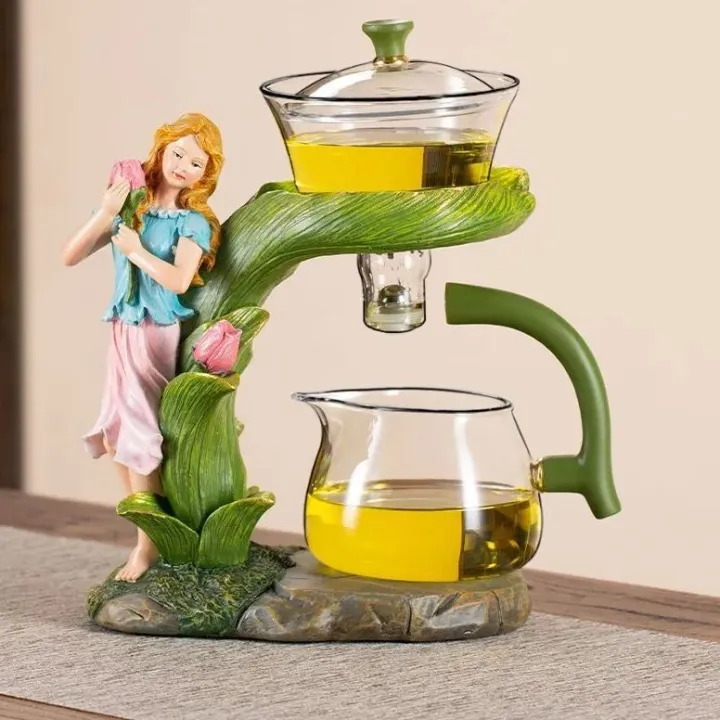
The product page describes it as a heat resistant, magnetic suction, semi-automatic drip teapot, and the drip mechanism is the detail worth understanding. A drip system releases tea gradually rather than all at once, which suits teas that benefit from slower contact with the water and suits a single long session rather than fast repeated pours.
Drip versus pour
If you plan to brew gongfu style, where a pot is served through many short infusions, drip and pour are not interchangeable. The rotating and magnetic sets suit that rhythm better. If you brew one large pot of tea and want to walk away from it, a drip mechanism suits that better. The guide to teapots with infusers covers the filtration side of this in more detail.
Pick 4: Blue & White Rotating Ceramic Set
If the idea of a cat on the table is one step further than you want to take, this is the same machine with a different face: the mechanism a lucky cat teapot uses, without the lucky cat. A blue and white patterned ceramic vessel sits on a matching sculpted stand, with a second blue and white pitcher beside it carrying a wooden handle. The colour scheme is the classic Chinese ceramic one, so it reads as tableware rather than as novelty.

The traditional route
This is the option to choose if the recipient is a tea drinker first and a collector second. It keeps the mechanical advantage that makes the cat set work, a rotating stand that serves a group without anyone pouring, and drops the joke. It is also the easiest of the six to pair with an existing blue and white service already in the cupboard.
Pick 5: Persimmon Tomato Rotating Ceramic Tea Set
Object-shaped teapots are their own line, and they borrow the trick that makes a lucky cat teapot work. A persimmon is a round fruit with a green calyx on top, and that geometry makes an unexpectedly good pot form: the rounded body holds a generous volume, and the calyx reads as a lid knob from any angle. The set includes a teapot, a rotating stand and a separate serving pitcher, and the interior filter is a removable ceramic element rather than a glued metal mesh.

Why object shapes work
A removable ceramic filter matters more than it sounds. It rinses clean, it will not take a permanent tea stain the way a bonded mesh can, and it does not leave a metallic edge in the cup. If you buy a novelty ceramic pot, check whether the filter comes out. Plenty of them do not, and that is the single most common reason a novelty pot ends up as a display piece.
Pick 6: Magnetic Ceramic Set with Metal Frame
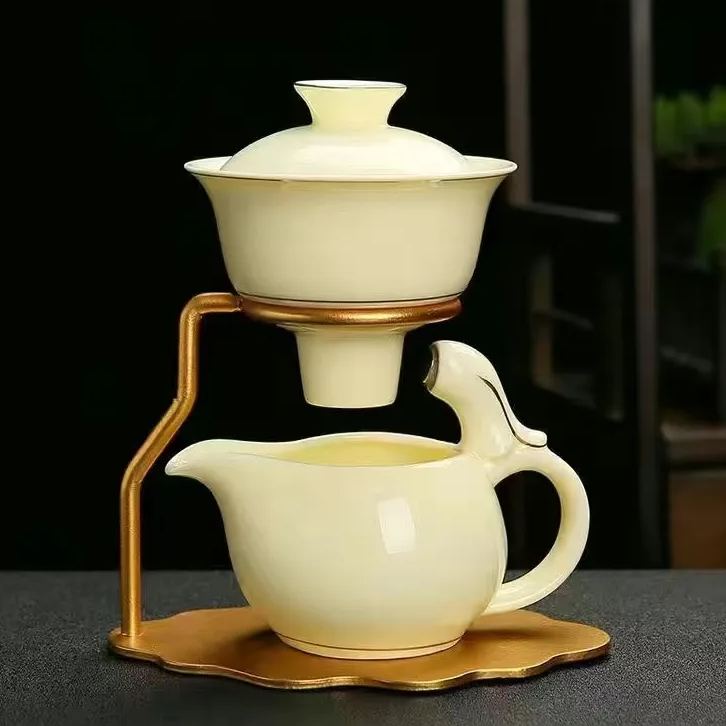
The last pick is the most restrained of the six. A cream ceramic brewing bowl with a fitted lid sits on a gold metal frame above a matching ceramic server with a curved spout and a loop handle. Four finishes are offered. There is no figurative element at all, which is exactly the point of including it here: it is the deliberate opposite of a lucky cat teapot.
The practical route
Ceramic holds heat better than thin glass, and a metal frame solves the stability problem that comes with a heavy glazed body. The result is the most practical of the six for someone who wants the ceramic warmth and the mechanism but no theme. It is also the closest match to the material reasoning in our guide to the best material teapot for daily use.
Capacity: What the Market Actually Sells
None of the six sets above publishes a capacity figure on its product page, so the honest way to size a lucky cat teapot is to read the market. Retailers in this category do publish capacities, and the listings checked on 24 October 2026 cluster into a few clear sizes.
Published capacities across the category
The most common full-size teapot figure is 300 ml. That is the capacity published for the handcrafted ceramic maneki-neko set at gaiwan.shop, whose matching cup holds 120 ml, and it is also the figure listed by otakukami.com for a lead-free ceramic maneki-neko set fired at 1,200 °C with a removable stainless steel infuser. The ceramic maneki-neko set sold by oko-oko.com is published at 300 ml for the pot and 120 ml for the cup, and the same 300 ml and 120 ml pairing appears in the cloudanimestudio.com listing.
Above that, the entertaining sets go higher. The ceramic maneki-neko set with four cups at shop-chopsticks.com is published at 700 ml for the pot with four 120 ml cups, and it carries a rating of 4.9 out of 5 from 8 customer reviews on that listing (retrieved 24 October 2026). The lucky cat teapot at shop.russborough.ie is published at 650 ml with external dimensions of 19.5 by 11.7 by 17.5 cm.
Below that sit the travel and single-serving sets. The portable maneki-neko travel tea set at umiteasets.com is published at 175 ml with two 75 ml cups, the travel set at teainfusermug.com is published at 200 ml with two 60 ml cups inside a case measuring 20 by 13.5 by 10.5 cm, and the compact Japanese travel set at japaneseteaset.shop is published at 120 ml. The borosilicate and porcelain set at teatsy.com sits between them at 170 ml, with 40 ml guest cups and a 70 ml host cup that doubles as the cat lid.
How to size for your table
The practical rule follows from those numbers. Treat 120 ml as a single drinker, 170 ml to 200 ml as a personal or travel pot, 300 ml as a one-to-two person pot, and 650 ml to 700 ml as a serving set for four or more. A 300 ml pot at a typical 40 ml cup gives roughly 7 servings before refill, and a 700 ml pot gives closer to 17.
If your own set does not publish a number, count the cups and estimate from them. Six cups at the 40 to 50 ml a small ceramic cup holds puts a typical serving set in the 300 ml to 350 ml range. Treat that as an estimate rather than a specification, and confirm before buying if dosing accuracy matters to you.
5-Point Buying Checklist
Before you order any lucky cat teapot, run it against these five points. They are ordered by how often they decide the outcome.
- Does the filter come out? A removable ceramic or stainless filter can be rinsed properly. A bonded mesh cannot, and it will stain permanently and leave a metallic edge in the cup.
- Which paw is raised? Left paw is traditionally read as attracting customers and right paw as attracting money. It takes 10 seconds to check the listing photo, and it changes who the gift suits.
- What colour is it, and does the colour mean something? White, black, red, yellow and pink all carry traditional readings. Cyan and other modern shades carry none, so buy them for the finish rather than the symbolism.
- Is the base stable? A foot ring, a recessed base or a weighted stand. Glazed ceramic on a wet table is a slip hazard, and a top-heavy cat shape magnifies the problem.
- Is a capacity published? If not, count the cups and treat the estimate as an estimate. Published capacities in this category run from 120 ml to 700 ml.
One more practical note on care. Several listings in this category specify hand washing only, and some state that the piece is not suitable for a microwave or dishwasher. Glazed ceramic with applied decoration and gold detailing is the usual reason, since the decoration and any metallic element do not belong in either environment. Our guide to cleaning tea ware covers the general method.
Our Recommended Lucky Cat Teapots
If you would rather skip the manual research, the rotating tea set collection has already been narrowed to the mechanisms that actually serve well. A lucky cat teapot is one option among them, and the deciding question is whether you want the motif on the table or only the machine. Every set in the ceramic tea sets range uses a heavy glazed body that holds heat through repeated infusions, and the creative design glass collection covers the sculptural and character-shaped pieces for buyers who want the motif as the main event.
For the specific case of a cat on the table, the rotating maneki-neko ceramic tea set is the direct match, and the blue and white rotating ceramic set is the same mechanism without the theme. If the gift is for someone who collects figures rather than brews tea, the Monkey King magnetic glass teapot set and the cartoon girl magnetic drip teapot carry the strongest sculptural presence. The persimmon rotating ceramic set and the magnetic ceramic set with metal frame complete the range.
FAQ
Is a lucky cat teapot actually a teapot?
It depends entirely on which one you buy, which is the central point of this guide. In the best of them the cat body is the pot, the head lifts off as the lid and the tea pours from a spout cut into the shoulder, so it brews exactly like any other pot. In the cheapest of them the cat is a hollow ornament with a hole in the base. Always check that the piece has a removable filter and a defined pouring lip before ordering.
What does the raised paw mean?
Traditionally, a maneki-neko with its left paw raised is said to attract customers, while one with the right paw raised attracts money, and the significance is understood to change with time and place. Some pieces raise both paws. The gesture itself is palm down with the fingers folding down and back, the Japanese beckoning motion, which outsiders often misread as a wave.
Is a lucky cat teapot Japanese or Chinese?
The figurine is Japanese, and the earliest known record of it dates to 1852. It is also extremely popular in Chinese communities, where it is called 招财猫 and sometimes jīnmāo, the golden cat, and because of that spread it is often mistaken for Chinese in origin. Either reading works for a gift; the Japanese lineage is the original.
How to clean a ceramic lucky cat teapot
Remove the filter and wash it separately, rinse the pot body with warm water, and dry the foot ring rather than setting the pot down wet. Several listings in this category specify hand washing only and rule out dishwashers and microwaves, usually because of applied decoration and gold detailing. Avoid thermal shock as well: never pour boiling water into a cold ceramic pot, and let the pot warm through a first rinse before it takes full heat.
Can a lucky cat teapot handle gongfu brewing?
Yes, and the ceramic body is an advantage for it. The short repeated infusions that gongfu style depends on reward a vessel that holds heat, and a fired ceramic body holds it better than thin glass. What matters more is the mechanism. A rotating or magnetic set suits the rhythm of many short pours, while a drip mechanism is built for a single slow draw rather than a quick sequence of infusions.
How big should a two-person teapot be?
For two drinkers you want roughly 300 ml. That is the most commonly published teapot size in this category across the retailers checked on 24 October 2026, and it delivers about 7 servings at a 40 ml cup. If you want more than two cups per round, step up to the 650 ml and 700 ml serving sets, which are built around 4 to 6 matching cups.
Options en Céramique
L' lucky cat teapot is worth buying, but only because of three decisions that have nothing to do with luck. A removable filter that can be rinsed, a stable base that does not slide, and a colourway that either follows the traditional symbolism or openly does not. Get those right and the motif is the cheapest, longest-lasting part of the purchase.
Pick the rotating maneki-neko ceramic set if you want the literal object and a table of six. Pick the blue and white rotating ceramic set if you want the mechanism without the theme. Pick the Monkey King or cartoon girl magnetic sets if the figure is the point and the brewing is secondary. Pick the persimmon rotating set if you want a removable ceramic filter and an object shape that works as well as the cat. Pick the magnetic ceramic set with metal frame if you want ceramic heat retention and a stable base with no motif at all.
Pick the white colourway if you want general good fortune, black if you are buying against bad luck, yellow if the gift is about money, and red if it is about health. Check which paw is raised before you order, and confirm the capacity if dosing accuracy matters to you. The direct match for the cat itself is the rotating maneki-neko ceramic tea set, and the full range sits in the rotating tea set collection. For the related beast motif in the same family, see our guide to deer glass teapots.
 FR
 EN
 DE
 ES
 PT
 JA