
Minimalist Glass Teapot: 6 Picks for Uncluttered Brewing
Okt.
Einführung
Two glass teapots can sit on the same counter, hold the same tea and cost the buyer the same amount. One carries a carved figure, a dyed rim and a second serving vessel on a wooden base. The other is a single clear body on a single clear stand, and that is the entire design. Both are borosilicate.
That gap is what the phrase minimalist glass teapot actually names, and it is narrower than the word suggests. A minimalist glass teapot is not a plain pot, and it is not a cheap one. It is a pot where the maker removed things until nothing was left competing with the tea, and where every part that remains is still doing a job. The risk in buying one is the opposite of the risk in buying an ornate pot. An ornate pot hides its cheapness in the carving. A minimal pot shows you its engineering immediately, because there is nowhere to hide it.
Six minimalist glass teapots from the Elysian catalogue are sorted below by four reduction tests: how many parts, how many materials, how many seams, and how much of the brew you can see. The borosilicate under all of them is the same material, and that part is worth understanding first.
Wichtige Erkenntnisse
- Borosilicate glass has a coefficient of thermal expansion of about 3 × 10⁻⁶ K⁻¹ at 20 °C, and can take a temperature differential near 330 °F (166 °C) without fracturing, which is what lets a minimalist glass teapot be both thin and heat-proof (per the Wikipedia borosilicate glass reference).
- A minimalist glass teapot in borosilicate is harder to break than ordinary soda-lime glass, holds a higher transparency over a longer period, and is slightly more expensive to make (per the Wikipedia borosilicate glass reference).
- The store catalogue holds 11 products in the modern minimalist glass tea set category, 8 in transparent streamlined glass tea sets, 21 in glass tea sets and 24 in semi-automatic tea sets, so a reduced-design pot is now a category rather than a rarity (source: product category counts retrieved from the store API on 26 October 2026).
- All six minimalist glass teapot picks in this guide are magnetic or detachable semi-automatic sets whose published feature lists name the same four things: a magnetic suction joint, clear glass, a single secondary material, and no applied ornament (source: the published product feature lists, retrieved 26 October 2026).
- Western brewing baseline is a 500-1500 ml pot, a leaf-to-water ratio of roughly 1:50 to 1:100 by weight, water near 95-100 °C and a single infusion of 3-5 minutes, which is the load a minimalist glass teapot has to be sized for.
- A glass body sheds heat about 30-50% faster than ceramic, so a clear pot can fall from 80 °C to 70 °C in roughly 90 seconds, and a pot that shows you the colour of the brew is also the pot that cools fastest in front of you.
- None of the six minimalist glass teapot picks publishes a price in the product record, so this guide ranks them on design, parts and function rather than on price tiers (source: the product records retrieved 26 October 2026).
Inhaltsverzeichnis
- What a Minimalist Glass Teapot Actually Removes
- The Four Tests of a Minimalist Teapot
- Side-by-Side Comparison
- Pick 1: The Modern Minimalist Magnetic Glass Tea Set
- Pick 2: The Modern Minimalist Drip Glass Tea Set
- Pick 3: The Glass Tea Set with an Acrylic Stand
- Pick 4: The Glass Tea Maker with a Wooden Stand
- Pick 5: The Two-Tier Glass Tea Maker with a Wooden Base
- Pick 6: The Detachable Glass Semi-Automatic Teapot
- How a Minimalist Glass Teapot Changes Daily Brewing
- 5-Point Buying Checklist
- Our Recommended Minimalist Glass Teapots
- FAQ
- Endurteil
What a Minimalist Glass Teapot Actually Removes
Less, but better: the working definition
Minimalism as a design idea is usually traced to the post-war reaction against ornament, and the reference point most often quoted is the German designer Dieter Rams, born 20 May 1932 and long associated with Braun and the functionalist school of industrial design. His phrase for it is four words in German, Weniger, aber besser, usually rendered in English as less, but better (per the Wikipedia Dieter Rams reference). The rule it implies is not about size and it is not about price. It is that every element of the object has to justify itself, and anything that cannot justify itself goes.
Applied to teaware, that produces a definition you can test rather than argue about. A minimalist glass teapot is a brewing vessel in which the maker has removed everything that does not serve pouring, brewing or cleaning, and has kept nothing that merely decorates. The test is whether the object still works after you take the tea out of it. If the second material under the pot is a stand that holds the pot steady, it stays. If it is a carved animal that carries no load, it goes.
Why subtraction is harder than decoration
Adding an ornament to a glass pot is a solved problem. A moulded figure, a dyed rim or a suspended charm takes one extra decision and no extra tolerance. Removing something from a working vessel means the remaining parts have to do the jobs the removed ones were doing. If a base is deleted, the pot needs a footprint that will not tip. If a handle is deleted, the wall needs to carry the pour. That is why the history of minimal glass runs through designers who were engineers as much as artists.
Alvar Aalto, the Finnish architect and designer who worked from 1898 to 1976, is the clearest example. His output covered architecture, furniture, textiles and glassware, and he built the whole interior of a building as a single composed work, lamps and glassware included (per the Wikipedia Alvar Aalto reference). His furniture is described as Scandinavian Modern, an aesthetic built on elegant simplification and a close concern with materials, wood especially.
The glass side of his work ran through the Iittala glassworks, founded as a glassworks in 1881, which still lists his Savoy Vase from 1936, Tapio Wirkkala’s Tapio from 1952 and Oiva Toikka’s Kastehelmi from 1964 among its classics (per the Wikipedia Iittala reference). The glass side of his work is also the clearest argument that a minimalist glass teapot is a lineage rather than a style.
The word is already on retail shelves
Minimalist is not a marketing invention here, and a buyer searching for the phrase will hit real product pages built around it. Retailers list glass and steel kettles under minimalist glass kettle and minimalist glass teapot names, with the word sitting in the product title rather than in a description (checked against retail listings on 26 October 2026). The signal that matters is the same one the furniture trade uses: the word describes a reduction in the product, not a price bracket and not a colour scheme.
On this store the equivalent is a category, not a description. The modern minimalist glass tea set category holds 11 products and the transparent streamlined glass tea set category holds 8, drawn from a catalogue of 34 (source: product category counts retrieved from the store API on 26 October 2026). A minimalist glass teapot in that catalogue is not hard to find. It is a filter you apply, because plenty of clear glass pots are sold on the word glass and none of them are reduced designs.
The Four Tests of a Minimalist Teapot
Sorting an aesthetic category by adjectives produces mush. Sorting it by counts produces a decision, and the four tests below are what the picks are ranked on. Any of them can be applied to a minimalist glass teapot in a shop by turning it over.
Test 1 — Part count
Count the pieces that have to be washed after a session. Not the pieces that came in the box, the pieces that hold tea. A single body and a lid is two. A body, a lid, a drip cup and a stand is four. Every part above two adds a join, and a join is where leaf residue dries and where a pot starts to smell of the last steep. This is the single most useful test, because it costs nothing to run and it predicts which minimalist glass teapot will still be in use in a year.
Test 2 — Material count
Name the materials. A reduced design allows one hero material and at most one counterweight, and the counterweight has to earn its place. Glass paired with wood is defensible, because wood is warm to the hand and stable to stand on. Glass paired with wood and painted metal and resin is three materials, and each one brings its own care rules. On a minimalist glass teapot, a wood base must never soak, a metal spout needs separate rinsing, and a resin figure can chip at the edge.
Test 3 — Seam count
Follow the join between the handle and the body with a fingertip. If the handle is fused to a continuous wall there is no seam to trap anything. If it is fixed with a metal collar, there is a collar to rinse. Minimalist glass design pushes seams towards invisible because a visible seam is also a visible joint in the design, and the same reasoning that removed the ornament removes the clutter of a hardware line. A minimalist glass teapot judged on seams is a pot judged on its joints.
Test 4 — Sightline count
Look through the pot. Count the things you can see that are not tea. A clear body shows the leaf, the colour and the unfurling, and that is the whole argument for buying glass at all. A tinted rim or a coloured foot sits in that sightline and takes attention away from the brew. A minimalist glass teapot keeps that sightline clear, which is why every pick in this guide is described by its maker as allowing a clear view of the brewing process or the tea steeping (source: the published product feature lists, retrieved 26 October 2026).

Side-by-Side Comparison
| Set | Strongest reduction axis | Materials | Published feature | Parts holding tea | Functional trade-off |
|---|---|---|---|---|---|
| Modern Minimalist Magnetic Glass Tea Set | Part count | Glass body with magnetic joint | Modern and minimalist, sleek contemporary aesthetic | One body | No secondary stand, so the footprint must be stable on its own |
| Modern Minimalist Drip Glass Tea Set | Part count | Glass body with magnetic joint | Convenient drip system, controlled tea dispensing | One body and a drip cup | Controlled dispensing needs the magnetic joint to stay aligned |
| Glass Tea Set with Acrylic Stand | Material count | Glass body, acrylic stand | Modern acrylic stand, sleek and contemporary look | One body | Acrylic scratches at the base and shows fingerprints |
| Glass Tea Maker with Wooden Stand | Material count | Glass body, wooden stand | Stylish wooden stand, natural elegance | One body | Wood must not soak and must be kept out of the dishwasher |
| Two-Tier Glass Tea Maker with Wooden Base | Seam count | Two clear glass chambers, wooden base and handle | Elegant two-tier design, brewing chamber above serving pot | Two chambers | Two chambers to rinse, and the lidded chamber holds heat for longer |
| Detachable Glass Semi-Automatic Teapot | Seam count | Glass body, detachable sections | Detachable design, easy to separate for cleaning | One body in two sections | More joint area to wash, offset by the fact that it comes apart for it |
| Borosilicate reference material | Applies to all six | Silica and boron trioxide glass | Higher clarity maintained over a longer period | Not applicable | Expansion near 3 × 10⁻⁶ K⁻¹ at 20 °C, tolerating about 330 °F (166 °C) |
Pick 1: The Modern Minimalist Magnetic Glass Tea Set
The clearest statement of the category on this catalogue, and the one to start from. The [Magnetic Glass Tea Set in the Modern Minimalist Design](https://teapotsetshop.com/product/magnetic-glass-tea-set-modern-minimalist-design/) is published with four feature claims, and they are unusually honest ones: magnetic suction for a secure and stable assembly, an elegant glass design that offers a clear view of the brewing process, a modern and minimalist look described as a sleek contemporary aesthetic, and durable construction in high-quality glass (source: the published product feature list, retrieved 26 October 2026).
What makes this the lead pick is what the feature list leaves out. There is no second material, no stand, no applied decoration and no second vessel, so the reduction goes all the way to a single body. A minimalist glass teapot at this end of the scale is also the one that is easiest to keep clean, because there is no part count above two and therefore no joint that a bottle brush is needed for.
The trade-off is stability, and it is worth checking before buying. A minimalist glass teapot with no base under it has to carry its own centre of mass, so stand the empty pot on the surface where it will live and push the centre gently with a finger. If it wants to tip, it is a one-hand pot in a two-hand session. This is also the pick with the least published specification of the six, so treat capacity and temperature limits as unconfirmed and confirm them before committing to a minimalist glass teapot.
Pick 2: The Modern Minimalist Drip Glass Tea Set
The [Modern Minimalist Magnetic Semi-Automatic Drip Glass Tea Set](https://teapotsetshop.com/product/modern-minimalist-magnetic-semi-automatic-drip-glass-tea-set/) takes the same single-body idea and adds one function to it. Its published feature list names magnetic suction for secure and easy assembly, semi-automatic operation to simplify the brewing process, an elegant glass design that allows clear viewing of the tea steeping, a convenient drip system that provides controlled tea dispensing, and inclusion of all the pieces needed for brewing and serving (source: the published product feature list, retrieved 26 October 2026).
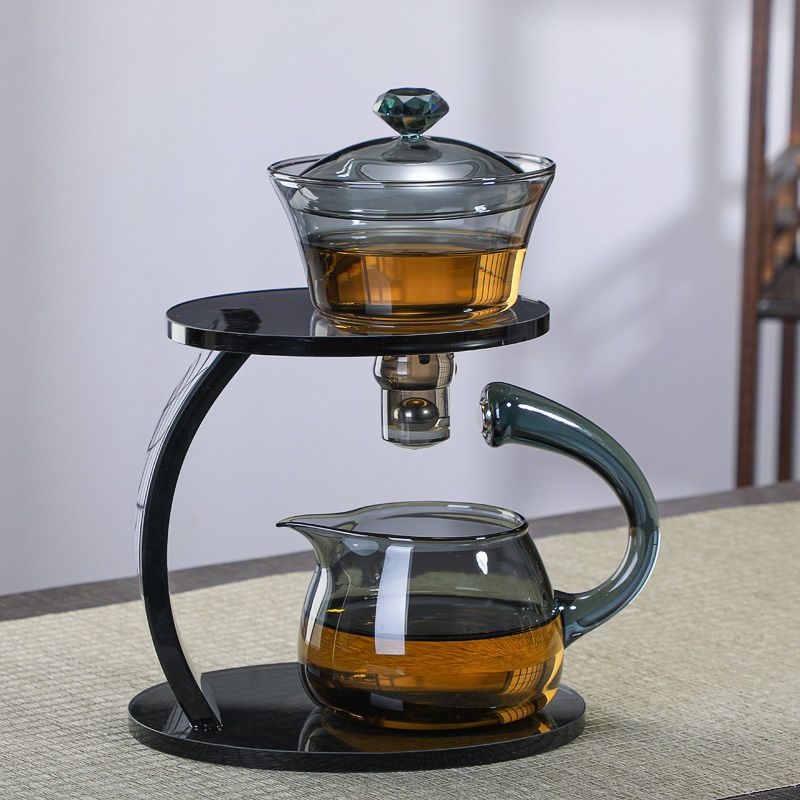
Controlled dispensing is the one addition here that is genuinely minimal, because it replaces a second serving vessel rather than adding one. The Western brewing baseline runs on a large pot of 500-1500 ml, a leaf-to-water ratio of roughly 1:50 to 1:100 by weight, water near 95-100 °C and a single long infusion of 3-5 minutes. A drip arrangement lets the same leaf be drawn down in a controlled way, so a minimalist glass teapot of this type can hold a smaller working volume without the leaf sitting in water and going flat.
Watch the joint rather than the glass. A magnetic valve only works while the two faces are aligned and clean, and that is the part of this design that fails first if it is used carelessly. The glass itself is the durable part; the joint is the consumable one, and a minimalist glass teapot is only as good as the joint it is fitted with.
Pick 3: The Glass Tea Set with an Acrylic Stand
The [Magnetic Semi-Automatic Glass Tea Set with Acrylic Stand](https://teapotsetshop.com/product/magnetic-semi-automatic-glass-tea-set-with-acrylic-stand/) is the most reduced pick that still solves a real problem, because acrylic is invisible. Its published features are magnetic suction for a secure and effortless assembly, semi-automatic brewing offering hands-free preparation, a clear glass design that allows visual enjoyment of the steeping process, a modern acrylic stand that provides a sleek and contemporary look, and an easy-to-use format (source: the published product feature list, retrieved 26 October 2026).
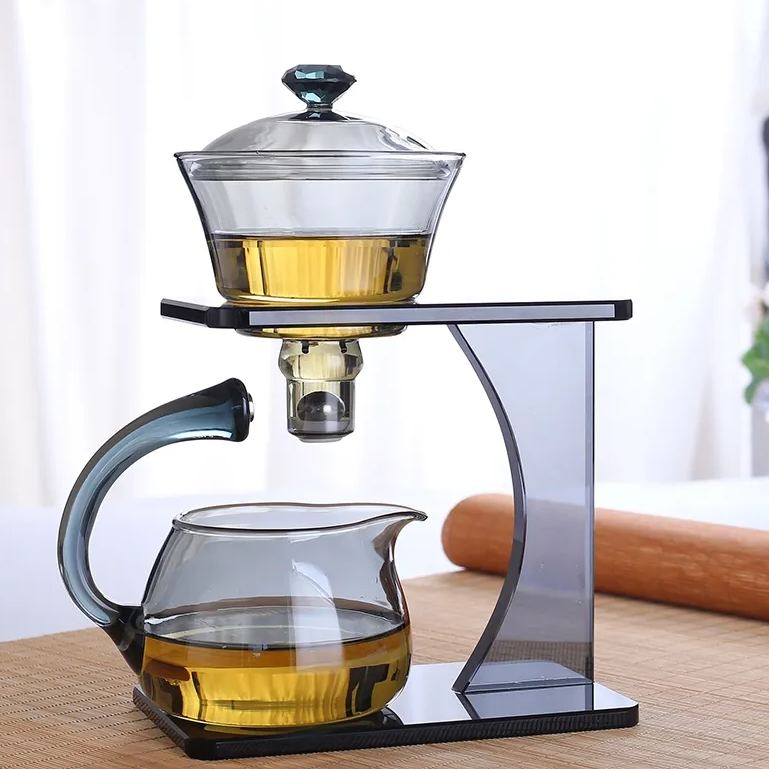
Material count is the axis this pick wins on, because acrylic reads as a second material functionally and as nothing visually. A wooden base adds warmth and a grain that the eye follows; acrylic adds a support that disappears against a pale counter. The trade is care. Acrylic at the base will scratch, and it shows fingerprints in a way that glass never does, so this is the minimalist glass teapot for a kitchen where the pot is handled with dry hands and wiped down.
It is also the clearest demonstration of why the term minimalist glass teapot is not a synonym for plain. There is nothing plain about the engineering, there is simply nothing on the outside of it that is doing anything except being looked at.
Pick 4: The Glass Tea Maker with a Wooden Stand
The [Magnetic Semi-Automatic Glass Tea Maker with Wooden Stand](https://teapotsetshop.com/product/magnetic-semi-automatic-glass-tea-maker-with-wooden-stand/) takes the same base idea and puts a warm material under a cold one. Its published features are magnetic suction for a secure and stable assembly, semi-automatic brewing for hands-free preparation, an elegant glass design that allows clear viewing of the tea steeping, a stylish wooden stand that adds a touch of natural elegance, and an easy-to-use format for the tea making process (source: the published product feature list, retrieved 26 October 2026).

Wood is the most defensible second material for a minimalist glass teapot because it is the only common one that solves two problems at once. It is warm, which matters on a glass body, and it is stable, which matters on a magnetic joint. Aalto’s furniture is described in the same terms, an elegant simplification with a close concern for materials and wood especially (per the Wikipedia Alvar Aalto reference).
The cost of choosing wood is one rule: it does not get wet. The stand should be wiped, not washed, and it should never go into a dishwasher. A wooden base that has been soaked will swell and crack, and once it does, the minimalist glass teapot loses the stability that made the wood worth choosing in the first place, and it will wobble on a wet counter.
Pick 5: The Two-Tier Glass Tea Maker with a Wooden Base
The [Semi-automatic Glass Tea Maker with Wooden Base](https://teapotsetshop.com/product/semi-automatic-glass-tea-maker-with-wooden-base/) is the most generous pick of the six, and the one where the reduction happens inside the design rather than across the whole object. Its published feature list runs to eight claims, starting with semi-automatic brewing with an automatic draining system and an elegant two-tier design with a brewing chamber on top and a serving pot below.
The remaining six describe high-quality glass in both chambers so the brewing process and the tea’s colour can be watched, a sophisticated wooden stand that adds to the aesthetic and provides stability, an ergonomic wooden handle on the serving pot for easy and safe pouring, a lid on the top chamber that helps retain heat and aroma during brewing, a compact and convenient footprint ideal for personal use or small gatherings, and an easy-to-operate and maintain design (source: the published product feature list, retrieved 26 October 2026).
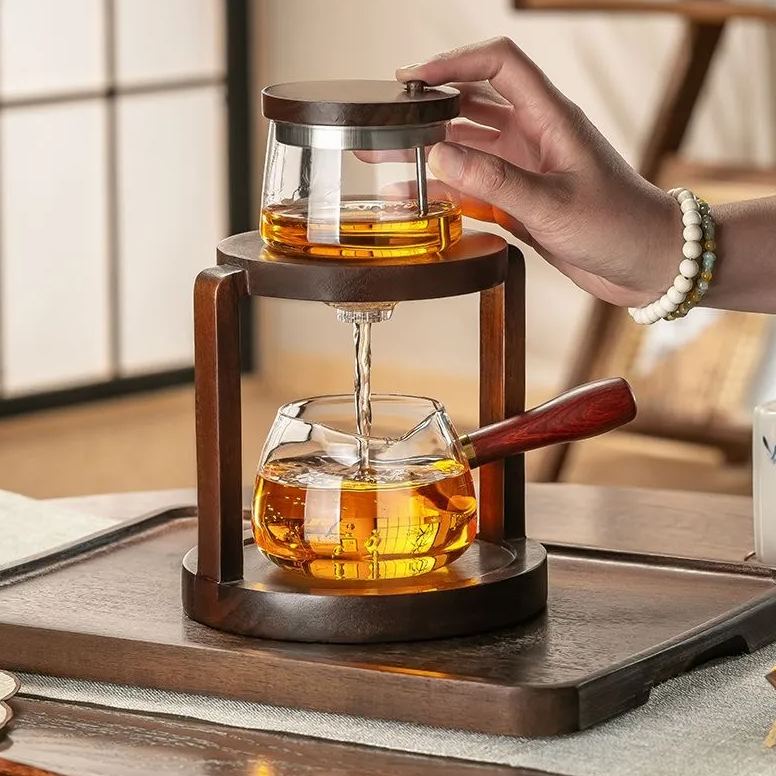
Two clear glass chambers is more parts than the other five picks, and that is the honest cost of this design. What it buys is heat retention: the lidded upper chamber holds warmth and aroma during the brew, and the lower pot receives the liquor directly, so the tea is poured once into a vessel that keeps it hot. For a small table that serves tea in a pot rather than a jug, that is a real functional gain rather than an ornamental one.
It is also the pick that most rewards the part count test being applied honestly. A two-chamber pot with a lid, a handle, a stand and a drain is five or six pieces to rinse, which makes it the least minimal of the group by part count even though it is the most useful by function. If the pot will be used daily by two people, that trade is worth taking on a minimalist glass teapot. If it will be used occasionally and stored away, the single-body picks are better value.
Pick 6: The Detachable Glass Semi-Automatic Teapot
The [Detachable Glass Semi-Automatic Teapot](https://teapotsetshop.com/product/detachable-glass-semi-automatic-teapot/) is the pick that reduces for a different reason: it reduces the washing. Its published features are a detachable design that is easy to separate for cleaning and use, a clear glass material that allows full visibility of the brewing process, a semi-automatic function that simplifies brewing and serving, a modern and minimalist style with a sleek and contemporary look, and a convenient and practical format for everyday tea enjoyment (source: the published product feature list, retrieved 26 October 2026).
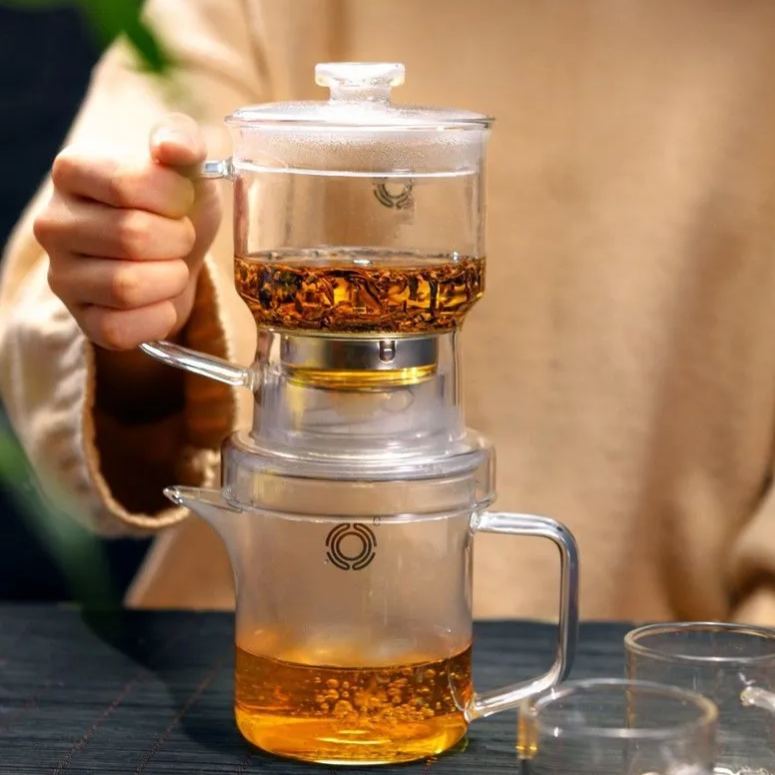
Detachable is not the same as minimal in the strict sense. It adds a joint rather than removing one. What it does is make the joint honest, because a seam you can open is a seam you can wash, and that is the failure mode which decides whether a clear glass pot is still pleasant to use after a year of daily brewing. A minimalist glass teapot of this type gives up a little visual purity and buys back the thing that matters most, which is a pot that does not smell of the previous session.
For a buyer who has already had a clear glass pot go stale because the leaf dried in a crevice, that is the trade to take. For a buyer buying a first clear pot, the single-body picks are simpler and a minimalist glass teapot with one part will be easier to live with.
How a Minimalist Glass Teapot Changes Daily Brewing
Reduction is usually argued as a visual preference. On a minimalist glass teapot it has three practical consequences that decide whether the design survives daily use, and they are worth checking before any of the picks above goes into a cart.
Cleaning and the number of parts
Parts are the running cost of any designed teapot. A single glass body washes in seconds. The two-tier set is a brewing chamber, a lid, a serving pot, a drain and a wooden base, and each of those is a place that has to be rinsed rather than wiped. None of it is difficult if the pot is taken apart straight after use. All of it is difficult if the leaf is left to dry in the joins, which is the actual failure mode rather than any hardness of the material.
The same discipline is what the detachable pick is built around, and it is why the [guide to cleaning glass teapots](https://teapotsetshop.com/guide/how-to-clean-glass-teapot/) is worth reading before choosing a body. Mineral deposit and tea stain both work into the joins, and a clear body shows them sooner than an opaque one. Visibility is the argument for glass and also the reason it demands more care, which is the trade every minimalist glass teapot makes.
Heat retention and pour timing
Glass has a low specific heat compared with ceramic, and the practical effect is that a clear pot cools faster. A glass body can shed heat about 30-50% faster than ceramic, so a clear vessel can drop from 80 °C to 70 °C in roughly 90 seconds. That is the trade in a minimalist glass teapot: you see the colour of the tea change as it cools, and you also watch the usable brewing window close.
The fix is not a thicker pot, which would defeat the point of a clear body. It is a lid, a two-chamber arrangement or a warmer second vessel, and it is why the two-tier pick gains its extra parts. Our [guide to what gongfu tea actually is](https://teapotsetshop.com/guide/what-is-gongfu-tea/) sets out the two brewing regimes in full, including the 70-100 °C range, the 60-200 ml vessel and the 8 to 15 infusions of 5 to 45 seconds that the small-vessel method runs on, which is the opposite of the 3-5 minute Western infusion a large minimalist glass teapot is built for.
5-Point Buying Checklist
- Check the glass, not the styling. The body should be borosilicate. A coefficient of thermal expansion near 3 × 10⁻⁶ K⁻¹ at 20 °C survives a temperature differential of about 330 °F (166 °C) where ordinary soda-lime glass is far more fragile, and borosilicate also holds a higher transparency over a longer period (per the Wikipedia borosilicate glass reference).
- Count the parts that hold tea, not the parts in the box. One body is a minute of washing. Two chambers, a drain, a lid and a stand is five, and every one of them has to be rinsed with a brush rather than wiped, which is the whole difference between a minimalist glass teapot that stays pleasant and one that does not.
- Stand the empty pot where it will live and push the centre. A body with no base under it has to carry its own centre of mass. If it wants to tip, it needs two hands every single time, and no photograph shows that cost.
- Look through the pot and count what is not tea. If a rim tint, a coloured foot or a printed logo sits in the sightline, the pot is competing with the brew it was bought to display, which is the one thing a minimalist glass teapot should never do.
- Decide whether the second material is a solution or a theme. Wood is defensible because it is warm and stable. Acrylic is defensible because it is invisible. A painted metal frame is neither, and it is the first thing to appear in an otherwise reduced design.
Our Recommended Minimalist Glass Teapots
If the analysis above is more than the decision needs, the [modern minimalist glass tea set category](https://teapotsetshop.com/product-category/modern-minimalist-glass-tea-set/) holds all 11 reduced-build sets, and the [transparent streamlined glass tea set category](https://teapotsetshop.com/product-category/transparent-streamlined-glass-tea-set/) holds the 8 pieces closest to a single-material, single-body design. For the wider range of clear brewing vessels, the [glass tea sets category](https://teapotsetshop.com/product-category/glass-tea-sets/) covers 21 products. Every minimalist glass teapot in this guide sits in one of those three.
- Best starting point for a reduced build: the Modern Minimalist Magnetic Glass Tea Set, because it is the only pick here published with a single body and no second material at all, which makes it the purest minimalist glass teapot in the catalogue.
- Best for actual daily brewing: the Two-Tier Glass Tea Maker with a Wooden Base, because the lidded upper chamber holds heat and the lower pot removes the need for a separate jug.
- Best if the previous glass pot went stale: the Detachable Glass Semi-Automatic Teapot, because a joint that opens is a joint that can be rinsed.
For the opposite approach, the guide to [creative design glass teapots](https://teapotsetshop.com/guide/creative-design-glass-teapot/) works through what a designer adds to a pot rather than what they remove, and the guide to [the best material teapot for daily use](https://teapotsetshop.com/guide/best-material-teapot-for-daily-use/) covers the four-material decision framework. That one is about which material to buy; a minimalist glass teapot is about how little a design needs once the material is settled.
FAQ
Is a minimalist glass teapot cheaper or more expensive than a decorated one?
None of the six picks in this guide publishes a price in its product record, so this guide does not rank them by price and does not quote a range it cannot source (source: the product records retrieved 26 October 2026). The general principle still holds. Minimalism is not a way to cut cost. The material is still borosilicate, and the tolerance on a thin, even-walled body that has to survive a temperature swing is tighter, not looser. What minimalism removes is the second material and the ornament, not the engineering.
Does a minimalist glass teapot break more easily than a ceramic one?
Borosilicate glass is described as harder to break when dropped than ordinary soda-lime glass, and as more resistant to cracking from significant changes in temperature, which is the failure that actually matters in a kitchen (per the Wikipedia borosilicate glass reference). The real risk is thermal shock on a thin wall, which is exactly what the 166 °C (330 °F) differential figure describes, and it is why a hot empty pot should be rinsed in warm rather than cold water.
Is a transparent minimalist glass teapot a good choice for green tea?
It depends on temperature, not on transparency. Green teas are best brewed around 75 to 80 °C, and shaded varieties lower, around 50 to 60 °C, while a standard Western pot of 500-1500 ml typically runs at 95-100 °C. A clear body is good for green tea precisely because it lets you watch the colour change and stop before the leaf turns, but a large minimalist glass teapot is the wrong size for the job. A smaller single-body set used at a lower temperature is the right pairing.
Do minimalist glass teapots need an infuser?
That depends on the leaf, and it is a separate decision from the design. The semi-automatic picks in this guide separate leaf and liquor by draining rather than by a filter basket, which handles rolled oolong and pu-erh well and handles loose leaf less cleanly if the pot is wide. Our [guide to teapots with infusers](https://teapotsetshop.com/guide/best-teapot-with-infuser/) covers the four separation systems in detail, including mesh aperture and the cases where a magnetic drain is the better answer for a minimalist glass teapot.
Is minimalist the same as Scandinavian design?
No, and the overlap is a common source of confusion. Minimalism as an art movement emerged in the post-war era in Western art, reducing art to its essentials and focusing on the object itself and the viewer’s experience, with as little mediation from the artist as possible (per the Wikipedia minimalism reference). Scandinavian Modernism, as in Aalto’s furniture and Iittala’s glass, is a separate and earlier tradition built on material honesty and warm natural materials rather than on reduction for its own sake. A minimalist glass teapot belongs to the second tradition, not the first.
What breaks first on a minimalist glass teapot?
Almost never the glass, which is why the earlier picks are graded on their joints. A magnetic valve that is not aligned or not clean stops sealing, and it is the consumable part of the design. An acrylic base scratches at the edge and shows fingerprints. A wooden base swells and cracks if it is soaked. None of these is a design fault, but all of them are decisions about care, and a minimalist glass teapot that arrives without a note on how to look after the wood or the acrylic is the one to think twice about.
Endurteil
Pick a minimalist glass teapot by what it has removed. If the priority is the fewest possible parts and the easiest wash, choose the single-body Modern Minimalist Magnetic Glass Tea Set, because nothing on it needs a brush and nothing on it can go out of alignment. If the priority is tea that stays hot through a shared session, choose the two-tier glass maker with a wooden base, because the lidded upper chamber and the serving pot below remove the jug and hold the warmth. If the priority is a pot that has already failed you once through stale joins, choose the detachable teapot, because a joint that opens is a joint that gets rinsed. If the priority is a single material with no visual weight at all, choose the acrylic stand set, accepting that acrylic marks. If the priority is warmth under the hand, choose the wooden stand, and keep it away from the sink.
Whatever the pick, verify the glass first, because it is the only part that cannot be replaced. Borosilicate at around 3 × 10⁻⁶ K⁻¹ at 20 °C tolerates a swing of roughly 166 °C (330 °F) and keeps a higher transparency for longer than soda-lime glass, and it is slightly more expensive to make (per the Wikipedia borosilicate glass reference). Then count the parts, stand the empty pot where it will live, and look straight through it. A minimalist glass teapot earns its place on a counter by being used every morning, and the [modern minimalist glass tea set collection](https://teapotsetshop.com/product-category/modern-minimalist-glass-tea-set/) is the fastest way to work through the range.
 DE
 EN
 ES
 PT
 FR
 JA