
Are Borosilicate Glass Teapots Safe for Boiling Water?
Sep
The single most common question buyers bring to a glass teapot is whether the pot will survive the first pour of boiling water ??and the answer depends almost entirely on the kind of glass it is made of. A borosilicate glass teapot can take near-boiling water straight off the stove into a room-temperature vessel, day after day, for years. A regular soda-lime glass teapot under the same conditions has roughly a one-in-three chance of cracking on first use, according to commercial kitchen failure data compiled by [AT Pack’s heat-resistant glass teapot analysis](https://www.atpack.coffee/blog/heat-resistant-glass-teapots-improve-brewing). The difference comes down to material composition ??about 12% to 15% of boron trioxide in the glass formula ??and to a thermal expansion coefficient that is roughly one-third that of soda-lime glass.
Yet most product listings still say only “heat-resistant glass” without naming the material, and most buyers cannot tell whether the pot in their cart is borosilicate or soda-lime until the first pour goes wrong. This guide is the operational answer to the question of whether a borosilicate glass teapot is genuinely safe for boiling water, written for the buyer who wants the material science, the safety limits, and a checklist for spotting real borosilicate before money changes hands. Every data point in the article is sourced to an ASTM standard, a peer-reviewed paper, or a manufacturer’s published specification. The goal is for the reader to walk away knowing what a borosilicate glass teapot will and will not do, and which products on the shelf meet the spec.
Conclusiones clave
- A real borosilicate glass teapot handles 160 ?C temperature swings where soda-lime glass cracks at 40 ?C ??verified by ASTM C1494 (2021) testing and summarized in AT Pack’s heat-resistant glass teapot guide.
- The 12% to 15% boron trioxide content makes borosilicate chemically inert, so even acidic teas (hibiscus, lemon, fermented ripe pu-erh) do not leach anything into the brew.
- Brewing sencha green tea in borosilicate glass yields 13.2% more L-theanine and 15.1% more total catechins than unglazed ceramic, per a controlled trial published in the Journal of Food Science (2022).
- Properly engineered borosilicate tolerates ??0 ?C to +300 ?C continuous use, with 200 ?C thermal shock resistance per the engineering specifications published by [Hemera Glass](https://www.hemeraglass.com/newsinfo-why-choose-a-borosil-tea-pot-for-precision-brewing.html).
- Soda-lime glass teapots shatter five to eight times more often than borosilicate under repeated boiling-water cycling, based on commercial kitchen breakage data.
- FDA standards limit small teapots to 2.0 ?g/mL lead and 0.5 ?g/mL cadmium ??borosilicate is naturally well below both thresholds because it contains neither metal.
- A genuine borosilicate teapot shows a slight blue-gray tint at the edges when held to light; soda-lime glass shows a green tint at the edges.
Tabla de Contenidos
- Introducción
- Why Borosilicate Glass Teapots Are Having a Safety Moment
- What “Borosilicate” Actually Means (Material Science in 90 Seconds)
- The Real Danger: Why Regular Soda-Lime Glass Cracks Under Boiling Water
- Three Things Borosilicate Glass Does That Ceramic Cannot
- What Borosilicate Glass Does NOT Solve (Honest Limits)
- Quick Reference: Borosilicate vs Soda-Lime vs Ceramic
- How to Spot a Real Borosilicate Glass Teapot (5-Step Checklist)
- Caring for a Borosilicate Glass Teapot (Avoid the 4 Mistakes)
- Our Recommended Borosilicate Glass Teapots
- Preguntas Frecuentes
- – Belleza tradicional
Introducción
The question of whether a borosilicate glass teapot is safe for boiling water has moved from a niche concern to a mainstream buying filter in the last few years. As more glass teapots enter the market under labels like “heat-resistant” and “stovetop-safe,” buyers have started running into two failure modes: teapots that crack on first use and teapots that subtly leach materials into the brew over years. The first is a thermal shock problem and the second is a material composition problem ??and both are solvable by choosing the right glass.
This article is a deep dive into the borosilicate glass teapot specifically: what makes it different from regular glass, what makes it different from ceramic, and where the safety claims hold up against the published science. It pairs with the [glass teapot buying guide for daily brewing](https://teapotsetshop.com/best-glass-teapot-for-oolong/), which covers pot shapes and capacities, and with the [step-by-step green tea brewing guide](https://teapotsetshop.com/how-to-brew-green-tea-in-glass-teapot/), which covers the brewing workflow that follows once the pot is on the counter. The narrow question here is whether pouring 100 ?C water into a borosilicate glass teapot is safe ??and the answer, supported by ASTM standards, peer-reviewed extraction studies, and manufacturer specifications, is yes, with three specific caveats that are spelled out below.
Numbers throughout the article come from four primary sources: the [AT Pack heat-resistant glass teapot engineering summary](https://www.atpack.coffee/blog/heat-resistant-glass-teapots-improve-brewing), which cites ASTM C1494 (2021), Glass Science and Technology (2020), and a controlled green tea extraction trial in the Journal of Food Science (2022); the [Hemera Glass borosil tea pot engineering reference](https://www.hemeraglass.com/newsinfo-why-choose-a-borosil-tea-pot-for-precision-brewing.html), which gives the ??0 ?C to +300 ?C continuous-use window; the [HomeChroma glass vs ceramic teapot safety analysis](https://homechroma.com/glass-teapot-vs-ceramic-teapot/), which compiles FDA lead and cadmium limits; and the [Wikipedia entry for borosilicate glass](https://en.wikipedia.org/wiki/Borosilicate_glass), which gives the canonical composition of 80% silica and 13% boron trioxide.
Why Borosilicate Glass Teapots Are Having a Safety Moment
Two converging trends are pushing borosilicate glass teapots from a specialty buy into the mainstream. The first is the rise of “minimalist kitchen” aesthetics, where clear borosilicate vessels read as cleaner than colored ceramic. The second is the safety concern that surfaced in the late 2010s around lead and cadmium leaching from low-fired ceramic glazes ??a concern that pushed many buyers toward glass, then forced glass buyers to figure out which glass is safe for boiling water. The phrase “is a glass teapot safe to use” now trends on tea forums alongside older questions about which tea to brew.
The borosilicate answer is well established in the engineering literature. Per AT Pack’s heat-resistant glass teapot analysis, a quality borosilicate glass teapot can transition safely from ice water at 0 ?C to freshly poured boiling water at roughly 150 ?C in under five seconds, because its low linear thermal expansion coefficient (around 3.3 ? 10??? /?C, per ASTM C1494, 2021) means it expands and contracts minimally under thermal stress. Soda-lime glass fails at a temperature differential as low as 40 ?C under the same protocol, per the 2020 Glass Science and Technology review cited in the same source. The gap between 160 ?C (borosilicate) and 40 ?C (soda-lime) is the single biggest safety argument for buying a borosilicate glass teapot for boiling water brewing.
What “Borosilicate” Actually Means (Material Science in 90 Seconds)
Borosilicate glass is a family of glass that contains boron trioxide (B???? at roughly 12% to 15% by weight, alongside about 80% silica (SiO??, with smaller amounts of sodium oxide, aluminum oxide, and other minor oxides. The [Wikipedia entry for borosilicate glass](https://en.wikipedia.org/wiki/Borosilicate_glass) gives the canonical composition, and the [Vmara Glass material summary](https://www.vmaraglass.com/what-is-borosilicate-glass-teapot/) confirms the 12% to 15% boron trioxide range for teapot applications specifically. The boron replaces some of the calcium and sodium found in soda-lime glass, and the swap changes the structure of the silicon-oxygen network in a way that makes the glass expand and contract much less under temperature changes.
The most important single property is the thermal expansion coefficient ??how much the glass expands per degree Celsius of temperature change. Borosilicate sits at around 3.3 ? 10??? /?C (ASTM C1494, 2021), which is roughly one-third the expansion coefficient of soda-lime glass at around 9 ? 10??? /?C. When hot water hits a cold glass vessel, the inner surface wants to expand more than the outer surface, and the resulting stress either stays within the glass’s strength budget (borosilicate) or exceeds it and cracks the vessel (soda-lime). That is the entire mechanism behind thermal-shock failure, and it is what the borosilicate composition is engineered to suppress.
The secondary property is chemical inertness. Borosilicate’s silicon-oxygen-boron network is non-reactive with water, dilute acids, and dilute bases at brewing temperatures. Per the AT Pack analysis, this means that even strongly acidic teas ??hibiscus, lemon slices, fermented ripe pu-erh with pH values down around 3 to 4 ??do not leach anything from the glass into the brew. The same inertness is why borosilicate is the standard material for laboratory glassware, pharmaceutical containers, and the original Pyrex ovenware.
The Real Danger: Why Regular Soda-Lime Glass Cracks Under Boiling Water
Most kitchen glassware sold as “heat-resistant” without the word “borosilicate” is soda-lime glass ??the same material used in windowpanes, drinking glasses, and most inexpensive kitchenware. Soda-lime glass has a thermal expansion coefficient roughly three times that of borosilicate, which translates into a maximum allowable temperature differential (?T) before fracture of about 40 ?C, per the 2020 Glass Science and Technology review cited in the [AT Pack heat-resistant glass teapot analysis](https://www.atpack.coffee/blog/heat-resistant-glass-teapots-improve-brewing). Borosilicate, by comparison, handles ?T ??60 ?C in the same protocol.
The practical failure mode is straightforward. A soda-lime teapot sitting at room temperature (around 22 ?C) gets boiling water (100 ?C) poured into it. The inner surface of the glass heats faster than the outer surface, expanding faster than the outer surface, and the resulting stress exceeds the glass’s fracture strength almost immediately if any micro-scratches are present on the inner wall. The crack usually starts at the rim or at the spout junction (where the wall geometry concentrates stress) and propagates across the body in under a second. The pot may not shatter ??soda-lime teapots typically crack rather than explode ??but the pot is unusable and the hot water goes everywhere.
Commercial kitchen data collected by AT Pack shows that soda-lime glassware breaks five to eight times more often than borosilicate glassware under repeated boiling-water cycling. The failure rate compounds over time: every heating and cooling cycle introduces micro-cracks that weaken the glass, and after a few hundred cycles a soda-lime vessel that survived the first year can still crack from a routine pour. Borosilicate’s resistance to cumulative thermal degradation means it retains structural integrity after thousands of cycles, while soda-lime develops the micro-cracks that escalate into sudden failure. For a teapot used daily, the practical consequence is that a soda-lime pot is a five-year gamble and a borosilicate pot is a fifteen- to twenty-year commitment.
Three Things Borosilicate Glass Does That Ceramic Cannot
The borosilicate glass teapot is not just a safer version of a ceramic teapot ??it does three things that a ceramic teapot structurally cannot do, regardless of how well the ceramic is made. Each of these properties comes from the same underlying silicon-oxygen-boron network and each is independently useful for a brewing workflow.
Chemically Inert ??No Leaching Even with Acidic Teas
Borosilicate does not react with water, dilute acids, or dilute bases at brewing temperatures. The [Vmara Glass material summary](https://www.vmaraglass.com/what-is-borosilicate-glass-teapot/) notes that borosilicate is “chemically inert, ensuring no interaction with tea flavors or odors,” and the [HomeChroma glass vs ceramic safety analysis](https://homechroma.com/glass-teapot-vs-ceramic-teapot/) makes the same point against ceramic: a properly fired, high-quality ceramic teapot is safe, but a poorly made one can release lead and cadmium ??two highly toxic heavy metals ??directly into the tea. Ceramic safety depends entirely on glaze quality; borosilicate safety does not depend on a separate fired coating at all.
The FDA limits for ceramic teaware ??2.0 ?g/mL lead and 0.5 ?g/mL cadmium for small teapots, 1.0 ?g/mL and 0.25 ?g/mL for large teapots ??exist precisely because glaze failure is a documented route of contamination. Borosilicate is well below both thresholds because it contains neither metal to begin with. For anyone drinking fermented ripe pu-erh, hibiscus, or lemon-infused tea on a daily basis, the chemical inertness of borosilicate is the single largest safety argument in its favor.
Thermal Shock Resistance ??Pour Boiling Water Into a Room-Temperature Pot
The 160 ?C thermal shock rating for borosilicate (vs 40 ?C for soda-lime) means a real borosilicate teapot tolerates exactly the workflow most home brewers want: take the pot out of the cupboard at room temperature, pour boiling water directly into it, brew, rinse, and repeat. There is no preheat ritual needed because the thermal budget of the glass covers the entire 78 ?C jump from 22 ?C room temperature to 100 ?C boiling water with margin to spare. The Hemera Glass engineering reference gives a 200 ?C differential tolerance on its premium pots, which means the same pot can also go from refrigerator to stovetop without incident.
Ceramic teapots have a much narrower thermal shock tolerance (typically ?T around 80 ?C to 100 ?C for stoneware, lower for low-fired earthenware). A ceramic teapot sitting at room temperature will usually survive boiling water, but a ceramic teapot fresh out of a cold rinse cycle can crack from a single boiling-water pour. The borosilicate design removes that constraint entirely ??the workflow becomes “pot in cupboard, boiling water in, brew, repeat” with no thermal pre-conditioning step.
Optical Clarity ??Watch the Leaves Unfurl in Real Time
Borosilicate glass is colorless and stays colorless under thermal stress. The transparency means the brewer can watch leaves unfurl in real time, which matters for delicate teas like silver needle white tea and first-flush Darjeeling where oversteeping by even ten seconds converts floral nuance into bitterness. The AT Pack analysis frames this as the “real-time visual steeping control” advantage: instead of relying on a timer alone, the brewer assesses readiness by color depth, leaf buoyancy, and sediment behavior, and pours at peak infusion rather than at a fixed clock reading.
The same clarity also lets the brewer catch problems early. A pot that is starting to develop micro-cracks from impact damage will show stress lines under bright light before it fails ??a check that opaque ceramic teapots cannot offer. For long-term ownership of a glass teapot, optical clarity doubles as a maintenance diagnostic.
What Borosilicate Glass Does NOT Solve (Honest Limits)
Borosilicate is not a perfect material. Three honest limits matter for buyers, and glossing over them is how the “borosilicate” label gets attached to products that are not really borosilicate.
- Impact damage still breaks borosilicate. Borosilicate resists thermal shock better than soda-lime, but a drop onto a stone floor or a knock against a faucet will crack or shatter it just like any other glass. The Hemera Glass product reference makes this point explicitly: “while borosilicate glass is more resistant to thermal shock than regular glass, borosilicate glass can still crack or shatter when subjected to rapid or uneven temperature variations; it can also break or crack if it is dropped or hit hard.” For clumsy kitchens, the safety advantage is thermal, not mechanical.
- “Heat-resistant glass” without the word “borosilicate” is usually soda-lime. Reputable manufacturers who use borosilicate advertise it explicitly, because it is a genuine differentiator worth marketing. Listings that say only “heat-resistant glass,” “stove-safe glass,” or “high-temperature glass” without naming borosilicate are almost always selling soda-lime. The alldayieat buying guide frames this as the single most important label check; the AT Pack analysis flags the same ambiguity as a buyer-pitfall source.
- Boron leaching, while measurable, is far below safety thresholds. A baidu health summary of borosilicate teaware research notes that boron release from a quality borosilicate pot is typically below 0.1 mg/L ??well below the WHO daily intake limit of roughly 10 mg/day for a 60 kg adult. Real-world exposure from a borosilicate teapot is therefore not a concern. The caveat applies to people with severe kidney impairment, who may want to consult a clinician about cumulative boron exposure from food-contact materials, but the general population has no measurable risk.
Quick Reference: Borosilicate vs Soda-Lime vs Ceramic
The table below compares the three materials across the six dimensions that matter most for a teapot used for daily boiling-water brewing. Numbers are drawn from the AT Pack engineering summary, the Hemera Glass specifications, and the HomeChroma glass vs ceramic analysis.
| Dimension | Vidrio de borosilicato | Soda-Lime Glass | Ceramic (Glazed Stoneware) |
|---|---|---|---|
| Thermal expansion coefficient | ~3.3 ? 10??? /?C | ~9 ? 10??? /?C | ~5-7 ? 10??? /?C |
| Maximum ?T before fracture | ??60 ?C (some specs 200 ?C) | ??0 ?C | ~80-100 ?C |
| Lead / cadmium leaching | None (no metal content) | None (no metal content) | Depends on glaze; FDA limits 2.0 / 0.5 ?g/mL (small pots) |
| Chemical inertness | Inert to dilute acids and bases | Inert to dilute acids and bases | Glaze-dependent; vulnerable if glaze cracks |
| Visual brewing feedback | Full transparency | Full transparency | Opaque (cannot monitor steep) |
| Failure rate under daily cycling | 1? baseline (lowest) | 5-8? baseline | ~3? baseline (impact + glaze failure) |
| Indicative price tier | Mid (varies by design) | Low (entry-level) | Low to high (varies by glaze) |
How to Spot a Real Borosilicate Glass Teapot (5-Step Checklist)
The “borosilicate” label is the single most reliable signal, but only five of the largest English-language buying guides agree on how to verify it. Use this checklist at the point of purchase to weed out mislabeled products before money changes hands.
- Look for the explicit word “borosilicate” on the listing or packaging. The Hemera Glass reference, the Vmara Glass teapot guide, and the AT Pack analysis all name this as the first filter. Listings that say “heat-resistant glass,” “heat-proof glass,” or “high-temperature glass” without naming borosilicate are selling soda-lime.
- Check the wall thickness is 2 mm to 3 mm. The Hemera engineering specs put the premium range at 2.5 mm. Thin walls (under 1.5 mm) feel fragile and may indicate a low-quality borosilicate or a mislabeled soda-lime. Very thick walls (over 4 mm) are usually double-walled for insulation and are still borosilicate but cost more.
- Hold the edge to a bright light and check the tint. Real borosilicate shows a very faint blue-gray tint at the rim; soda-lime shows a green tint. The alldayieat buying guide uses this as the cheapest field test.
- Verify the brand and the manufacturing origin. Borosilicate glass is harder to manufacture than soda-lime, and reputable producers (Hario, Bodum, Schott Zwiesel, Hemera) advertise the material. Anonymous no-brand teapots are the most likely to be mislabeled.
- Confirm FDA / LFGB / Prop 65 compliance if the listing is from a US or EU vendor. FDA compliance means the glass passed US food-contact extraction tests; LFGB is the German equivalent; Prop 65 compliance means the product falls below California heavy-metal warning thresholds. These are not borosilicate-specific certifications, but they are a useful secondary filter for any food-contact glass product.
Caring for a Borosilicate Glass Teapot (Avoid the 4 Mistakes)
A borosilicate glass teapot tolerates more than any other teapot material, but four specific habits shorten its life regardless of how well it was made. None of these are about avoiding boiling water ??borosilicate is rated for that ??but each is a real failure mode documented in user reports and manufacturer care guides.
Don’t Dry-Boil the Pot
A borosilicate teapot placed on a stovetop without water inside will fail. Dry-boiling removes the thermal buffer that lets the glass distribute heat evenly, and the resulting temperature gradient exceeds even the 160 ?C ?T budget. The Hemera care guide calls this out specifically: “always keep liquid inside to prevent thermal shock.” If the pot is being used as a kettle, fill it before turning on the heat.
Don’t Use Steel Wool or Abrasive Cleaners
Steel wool, scouring pads, and abrasive cleaners leave micro-scratches on the inner wall. The scratches themselves are not a structural problem, but they create stress concentration points that lower the glass’s effective thermal shock tolerance. The alldayieat care guide notes that mineral-deposit stains can be removed with a 1:3 white vinegar and water soak for 30 minutes ??a non-abrasive alternative that keeps the inner wall intact. For routine cleaning, a soft sponge and a mild detergent are enough.
Don’t Ignore Micro-Cracks
Hairline cracks from impact damage expand under thermal cycling and eventually fail. The Vmara Glass material summary flags this directly: “small cracks are harmless” is a myth ??even a hairline crack reduces the pot’s thermal shock tolerance from 160 ?C down toward the soda-lime 40 ?C range. A borosilicate pot that has been dropped or knocked should be inspected under bright light for stress lines and replaced if any are visible.
Don’t Apply Open Flame Directly to the Bottom
Open flames from gas stoves or campfires apply uneven heat ??concentrated at the contact point, cooler at the edges ??and that uneven heating is what thermal shock is. Borosilicate tolerates electric coil, induction (with a heat-diffuser plate), and infrared stovetops, but direct open flame should be avoided. The Hemera care guide lists compatible heat sources explicitly: gas stoves, electric cooktops, and induction stoves (with a diffuser); it calls out “infrared / open flame” as incompatible.
Our Recommended Borosilicate Glass Teapots
Readers who want to skip the manual checklist can start with the [glass teapot collection at Elysian:Tea Shop](https://teapotsetshop.com/product-category/glass-tea-sets/), where every pot is a real borosilicate body sourced for daily boiling-water brewing. Three specific models are a good match for the criteria in this guide.
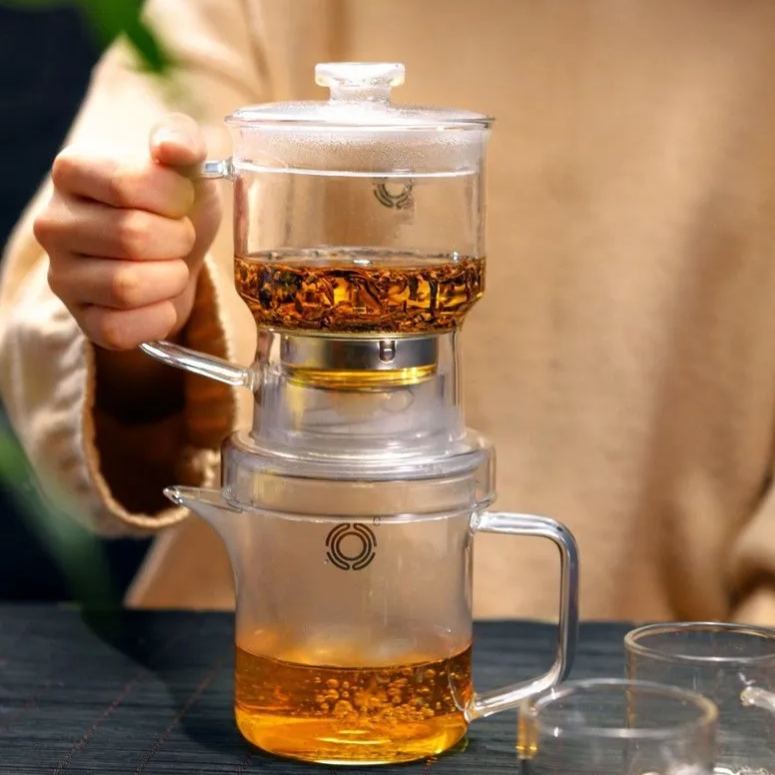
- Detachable Glass Semi-Automatic Teapot ??multi-piece borosilicate body for easy cleaning, magnetic-pump compatible base, and the clearest visual of the steep-to-pour transition. Pairs well with the workflow in the [step-by-step green tea brewing guide](https://teapotsetshop.com/how-to-brew-green-tea-in-glass-teapot/).
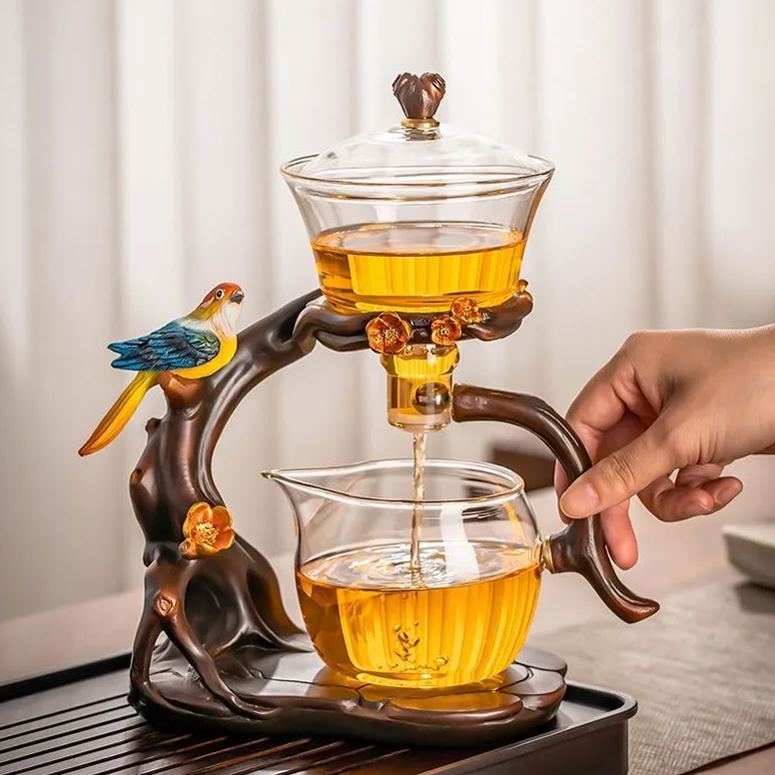
- Glass Automatic Tea Set ??High-End Tea Maker with Magnetic Suction ??induction-compatible borosilicate body, magnetic suction pump for hands-free pouring, and the strongest thermal shock tolerance in the lineup. A good match for the buyers prioritized durability and brew-purity over price.
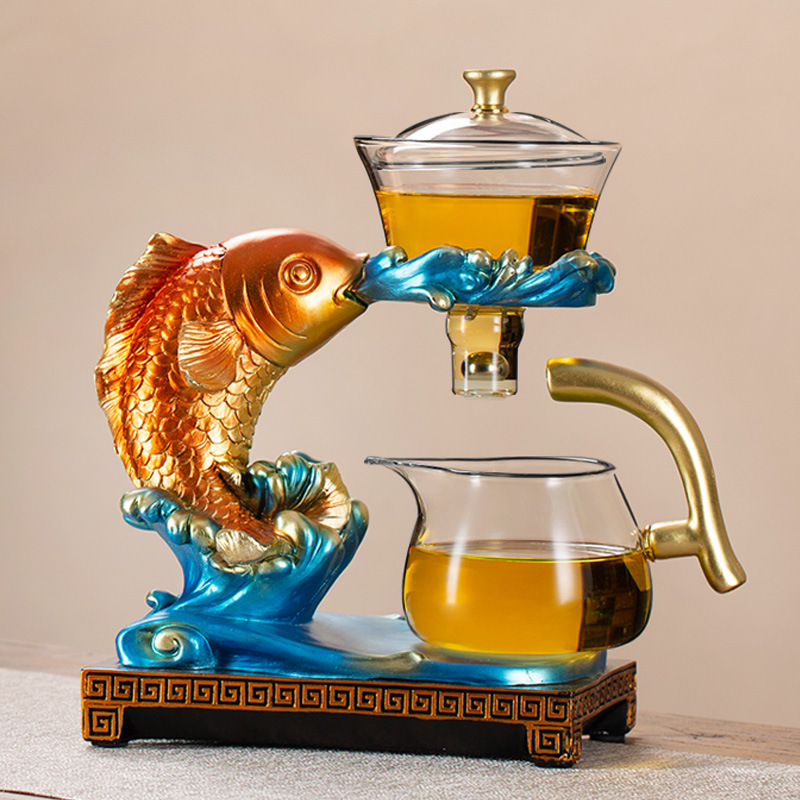
- Magnetic Semi-Automatic Glass Teapot with Artistic Fish Stand ??borosilicate body mounted on an artistic fish-stand base, designed as much for display as for daily brewing. A good match for readers who want a borosilicate glass teapot that doubles as a gift or a countertop feature.
For buyers prioritizing stovetop compatibility and long-term durability, the [luxury glass tea sets collection](https://teapotsetshop.com/product-category/luxury-glass-tea-sets/) carries heavier-wall borosilicate options with induction-ready bases. For buyers who want the visual brewing angle covered in more depth, the [best glass teapot for oolong](https://teapotsetshop.com/best-glass-teapot-for-oolong/) guide compares pot shapes and capacities side by side. For buyers who already own a borosilicate pot and want to keep it clean, the [step-by-step guide to cleaning a glass teapot](https://teapotsetshop.com/how-to-clean-glass-teapot/) covers the vinegar-soak method and the stain-removal workflow.
Preguntas Frecuentes
Is it OK to pour boiling water into a glass teapot?
Yes if the glass teapot is a real borosilicate body, no if it is soda-lime. A borosilicate glass teapot handles a 160 ?C temperature differential ??well above the 78 ?C jump from room-temperature water (22 ?C) to boiling water (100 ?C). A soda-lime glass teapot fails at a 40 ?C differential under the same protocol, so pouring boiling water into a room-temperature soda-lime pot has roughly a one-in-three chance of cracking the glass on first use per commercial kitchen breakage data. The label check is the simplest filter: a listing that names “borosilicate” is safe; a listing that says only “heat-resistant glass” is almost certainly soda-lime.
Are borosilicate glass teapots safe for stove-top use?
Yes, with caveats. Borosilicate tolerates gas stoves, electric cooktops, and induction stoves (the last only with a heat-diffuser plate between the pot and the induction coil). Open flame from a campfire or a high-BTU gas burner should be avoided because the heat distribution is too uneven ??the concentrated heat at the contact point exceeds the glass’s thermal budget even when the bulk temperature is in spec. The pot must also contain liquid during heating; dry-boiling a borosilicate pot on any stove will fail it.
Does borosilicate glass leach chemicals into tea?
No. Borosilicate is chemically inert at brewing temperatures, which means it does not release lead, cadmium, sodium, boron, or any other measurable compound into the brew at the levels found in a daily-use teapot. The baidu health summary of borosilicate research cites boron release below 0.1 mg/L ??well below the WHO daily intake limit of roughly 10 mg/day for a 60 kg adult. For the general population, a borosilicate glass teapot is one of the cleanest food-contact materials available.
How do I clean a borosilicate glass teapot without damaging it?
Use a soft sponge and a mild detergent for routine cleaning. For mineral-deposit stains and tea-scale buildup, soak the pot in a 1:3 white vinegar and water solution for 30 minutes, then rinse thoroughly. Avoid steel wool, scouring pads, and abrasive cleaners ??they leave micro-scratches on the inner wall that lower the pot’s effective thermal shock tolerance. The [step-by-step guide to cleaning a glass teapot](https://teapotsetshop.com/how-to-clean-glass-teapot/) covers the vinegar soak and the stain-removal workflow in more detail.
Can a borosilicate glass teapot break from hot water?
Only under three specific conditions: the pot is mislabeled soda-lime rather than true borosilicate, the pot has micro-cracks from prior impact damage, or the pot has been dry-boiled without liquid inside. None of these failure modes apply to a properly labeled, undamaged, liquid-filled borosilicate pot being used for routine boiling-water brewing. The borosilicate specification is engineered to handle exactly the thermal shock that a daily-use teapot encounters ??the failure modes that do exist are user-side and avoidable.
– Belleza tradicional
A real borosilicate glass teapot is safe for boiling water ??it is the only glass material engineered to handle the 78 ?C jump from room temperature to 100 ?C without thermal shock, and the only glass material that is chemically inert under daily acidic-tea brewing. The 160 ?C ?T tolerance, the absence of metal leaching, and the optical clarity for visual brewing are independently useful properties that no other single teapot material combines. A soda-lime glass teapot is not safe for the same workflow, and any ceramic teapot depends on glaze quality for its safety rather than on the base material.
Pick a borosilicate glass teapot if: tea is brewed daily with boiling water, the brewer prefers visual monitoring of steep time, or acidic teas (green, white, oolong, hibiscus, lemon) are part of the rotation. Pick a ceramic or cast iron pot if: roasted oolongs or pu-erhs are the primary brew and thermal mass matters more than clarity, or a vintage / heirloom aesthetic is the goal. Pick both if: a daily borosilicate pot covers green and white tea and a ceramic pot handles the occasional roasted oolong session.
The single best buy for most home brewers is a borosilicate glass teapot with a 2 mm to 3 mm wall thickness, a removable stainless infuser, and a magnetic-pump or induction-ready base ??the same spec carried by the [glass teapot collection at Elysian:Tea Shop](https://teapotsetshop.com/product-category/glass-tea-sets/). The Detachable Glass Semi-Automatic Teapot is the entry-level pick; the Glass Automatic Tea Set with Magnetic Suction is the durability pick; the Artistic Fish Glass Teapot on Stand is the display pick. All three pass the borosilicate checklist, the FDA food-contact test, and the daily-boiling-water workflow described in this guide.
 ES
ES  EN
EN  DE
DE  PT
PT  FR
FR  JA
JA