
How to Use Gongfu Tea Set: 6-Step First Session Guide
Sep
Knowing how to use gongfu tea set correctly is the difference between a session that runs 30 minutes and one that runs 90, between six clean infusions and twelve, and between cups that taste balanced from start to finish and cups that turn harsh by the third steep. Gongfu (功夫) is a Chinese brewing method that uses a small vessel, a high leaf-to-water ratio, and many short infusions. The ritual is short on equipment and long on attention, and the steps below work for first-time brewers and for people who have been doing this casually for years and want to tighten the basics.
This guide on how to use gongfu tea set walks through the six steps of a standard session — preheat, rinse, first infusion, pour through a fairness cup, re-steep, and finish — with the exact leaf amounts, water temperatures, and steep times that hold up across the main tea types (oolong, pu-erh, white tea, and a handful of others). Numbers are sourced to Wikipedia references, working estimates from established gongfu brewing references, and the canonical 5–8 grams per 100 ml ratio that is the de-facto gongfu standard. By the end, the reader should know how to use gongfu tea set for a full session on the first try without consulting a side reference.
Conclusiones clave
- A standard gongfu tea set includes four pieces: a small brewing vessel (gaiwan or teapot), a fairness cup (gongdao bei / cha hai), 2–4 small tasting cups, and a tea tray to catch overflow — per Wikipedia: Gongfu tea.
- The leaf-to-water ratio for oolong and pu-erh is 5–8 grams per 100 ml; for white tea drop to 3–5 grams; for black tea use 4–6 grams (per sister article: what is a gongfu teaset).
- The first infusion runs 5–15 seconds; subsequent infusions extend by 5–10 seconds each round; most whole-leaf teas give 6–12 infusions before turning thin (working estimate from gongfu brewing references).
- Water temperature depends on the tea: 75–85 °C for green and white teas, 90–95 °C for oolong and black teas, 95–100 °C for ripe and raw pu-erh (per Wikipedia: Pu-erh tea).
- Preheating the gaiwan and cups before brewing stabilizes water temperature — skipping this drops the first infusion by roughly 5–10 °C, which is enough to under-extract tightly rolled oolong.
- The rinse (awakening the leaves) is optional for most teas but recommended for tightly rolled oolong, aged pu-erh, and compressed teas; skip it for green and most white teas (working estimate).
- Beginners can run a full gongfu session with a 100–150 ml gaiwan, a 200 ml fairness cup, and 2–4 tasting cups; everything else (tea tray, tea tools, drip mat) is optional but useful.
Tabla de Contenidos
- Introducción
- What a Gongfu Tea Set Actually Includes
- Step 1: Preheat the Gaiwan and Cups
- Step 2: Measure the Leaves (5–8 g per 100 ml)
- Step 3: The First Rinse — When to Skip It
- Step 4: The First Infusion (5–15 Seconds)
- Step 5: Pouring Through a Fairness Pitcher
- Step 6: Re-Steeping and How to Extend Each Round
- Side-by-Side: Oolong vs Pu-erh vs White vs Green
- Common Mistakes That Make Gongfu Tea Bitter
- Recommended Sets and Easy Alternatives
- Preguntas Frecuentes
- – Belleza tradicional
Introducción
The question of how to use gongfu tea set comes up the moment a tea drinker wants more from a single dose of leaves than a Western teapot gives. The first attempt is often shorter than expected — a single 30-second steep, one pour, and the leaves go in the trash because nobody realized gongfu is meant to be poured out fast and re-steeped many times. The same leaves brewed gongfu-style will run six, eight, even twelve infusions, and each cup tastes different from the last.
Gongfu is a Chinese brewing method that Wikipedia: Gongfu tea documents as originating in the Ming and Qing dynasties, when loose-leaf tea became standard and small Yixing clay pots replaced the older tea bowls used for powdered tea. The method pairs a high leaf-to-water ratio (typically 5–8 grams of dry leaf per 100 ml of water) with short, repeated infusions — usually 5 to 30 seconds each. The result is a session that reveals layers of aroma and flavor a single long steep cannot reach, and that turns tea drinking into something closer to a slow ritual than a quick break. Learning how to use gongfu tea set is what unlocks this multi-layer cup.
This article is the operational companion to the beginner’s guide to what a gongfu teaset is. The earlier article covers the parts, the history, and the canonical leaf amounts; this one walks through the actual brewing steps — preheating, measuring, rinsing, first infusion, pouring through a fairness cup, and re-steeping — with the exact times and temperatures that hold up across the most common gongfu tea types. The goal is for the reader to learn how to use gongfu tea set for a complete session on the first attempt without cross-referencing another article.
Every number in this article is sourced to a Wikipedia reference, a working estimate from established gongfu brewing references, or the canonical 5–8 g per 100 ml ratio that has been the de-facto gongfu standard for decades. The article ends with a quick-reference table that maps tea type to water temperature, leaf amount, first steep, and total infusions, plus a decision framework in the Final Verdict so a beginner can pick parameters without rereading every section.
What a Gongfu Tea Set Actually Includes
A gongfu tea set is not one piece — it is a small collection of pieces that work together. Per Wikipedia: Gongfu tea, the standard set includes four functional pieces and a handful of optional ones. The four functional pieces are the brewing vessel, the fairness cup, the small tasting cups, and a tea tray to catch water. The optional pieces are tools for handling leaves — a scoop, a tong, a needle for unclogging the spout, and a cloth for wiping the rim.
The brewing vessel is either a gaiwan (a lidded porcelain bowl, typically 100–150 ml for beginners) or a small teapot. Yixing clay teapots are the traditional choice for oolong and pu-erh, but they require dedicated use — a Yixing pot absorbs flavor compounds and re-releases them on later brews, so a pot used for oolong should not be used for pu-erh or green tea. Porcelain gaiwans are neutral and versatile, and they are the right starting choice for a beginner.
The fairness cup — called gongdao bei (公道杯) or cha hai (茶海) — is a small pitcher that receives the infusion from the gaiwan before distributing it to the tasting cups. The fairness cup is what makes the multi-cup pour work: without it, the first cup poured would be stronger than the last, because the leaves keep steeping while the brewer pours. Most fairness cups run 150–300 ml, which is enough to hold one full infusion from a 100–150 ml gaiwan with a little headroom.
The tasting cups are small — typically 30–50 ml each, handleless, and shaped to concentrate aroma at the rim. Two to four cups are enough for a solo or small-group session. The tea tray is a shallow tray that catches water from the preheat, the rinse, and any spills. Without a tray, a gongfu session is hard to manage on a regular table — water gets everywhere within the first three pours.
Step 1: Preheat the Gaiwan and Cups
Preheating is the first active step in a gongfu session, and skipping it is the most common reason first cups taste flat. Cold porcelain drops water temperature fast: a 100 ml gaiwan at room temperature (about 22 °C) filled with 95 °C water will lose roughly 8–10 °C in the first 30 seconds if it is not preheated. That drop is enough to under-extract tightly rolled oolong and produce a thin first cup. Preheating brings the vessels up to brewing temperature so the water stays where the brewer wants it.
The mechanics are simple. Boil water, pour it into the empty gaiwan until it is about one-third full, swirl for 5–10 seconds, and pour the water out into the tea tray. Repeat with the fairness cup and the tasting cups. The total preheat takes about 60 seconds. The water used for preheating is discarded — it is not drunk and is not the rinse.
How Long to Preheat
A full preheat for a 4-piece setup (gaiwan, fairness cup, two tasting cups) takes about 60–90 seconds with a kettle at hand. Porcelain warms fast because it is thin; thick-walled Yixing pots take a few seconds longer because the clay holds cold longer. The visual cue is steam: when the gaiwan lid is on and steam is rising steadily off the spout, the vessel is ready. If the brewer is using a thicker clay pot, an extra 10–15 seconds of preheat is worth the time.
Step 2: Measure the Leaves (5–8 g per 100 ml)
The leaf-to-water ratio is the single most important variable in gongfu brewing, and the standard for oolong and pu-erh is 5–8 grams of dry leaf per 100 ml of water (per sister article: what is a gongfu teaset). For white tea, drop to 3–5 grams per 100 ml; for black tea, use 4–6 grams per 100 ml. Green tea is a poor match for traditional gongfu brewing because most green teas turn grassy at the multi-steep pattern — a glass teapot brewed at 75–80 °C for short infusions works better, as covered in how to brew green tea in a glass teapot.
For a 100 ml gaiwan — the most common beginner size — 5–8 grams is roughly one rounded tablespoon of dry leaf, or about one-fifth to one-quarter of the gaiwan’s volume. For a 150 ml gaiwan, scale up to 7–12 grams. A digital kitchen scale that reads to 0.1 g is the easiest way to be exact, but most gongfu drinkers develop a feel for the right volume after a few sessions and stop measuring.
The most common mistake is underloading. A gaiwan with too few leaves produces a thin first cup and runs out of flavor by the third or fourth infusion. If the first infusion looks pale yellow rather than amber (for oolong) or light brown (for pu-erh), the leaves are too few — add 1–2 grams on the next session. The other common mistake is overloading, which produces a bitter first steep because too many catechins extract into too little water. The right move on overloading is to use fewer leaves, not to shorten the steep, since shortening the steep under-extracts the amino acids and produces a thin, watery cup.
Step 3: The First Rinse — When to Skip It
This is the step that most beginners overthink when they are first learning how to use gongfu tea set. The short version is: rinse tightly rolled oolong, aged pu-erh, and compressed teas; skip the rinse for green tea and most white teas. The rinse is not a separate ritual — it is a 2–5 second pour that runs on the same temperature water as the first infusion, and the rinse water is poured out, not drunk. The pour-out-the-residual-water rule that applies to every infusion applies here too: residual rinse water continues extracting the leaves and makes the first proper infusion unpredictable.
The first rinse — sometimes called “awakening the leaves” or “washing the tea” — is a short pour of hot water over the leaves that is immediately discarded. The rinse serves two purposes. The first is to open tightly rolled leaves so the first proper infusion extracts evenly; the second is to rinse off storage dust and small particles from aged or compressed teas. Per established gongfu references, the rinse is recommended for tightly rolled oolong (tieguanyin, dong ding, dancong), aged pu-erh, and any compressed tea. The rinse is optional for most green teas and most white teas, and it should be skipped entirely for delicate Japanese greens like gyokuro.
When the rinse is used, the mechanics are: pour hot water over the leaves, swirl the gaiwan once or twice, and pour the water out completely within 2–5 seconds. The rinse water is discarded — it is not drunk. Some gongfu drinkers use the rinse water to warm the tasting cups one more time; that is fine but not necessary if the cups were preheated.
What Temperature to Use for the Rinse
The rinse temperature should match the first infusion’s brewing temperature — not be hotter. The rinse is not supposed to extract compounds, only to wet the leaves. If the rinse is hotter than the first infusion (for example, boiling water before a 90 °C oolong brew), it pulls out compounds the rinse was supposed to discard, and the first proper infusion comes out flat. For most teas, the rinse and first infusion temperatures should be the same.
Step 4: The First Infusion (5–15 Seconds)
The first proper infusion is the moment the leaves actually start releasing flavor, and the steep time for the first infusion is shorter than most beginners expect. For oolong and pu-erh, the first infusion runs 5–15 seconds; for white tea, 10–20 seconds; for black tea, 8–15 seconds. These numbers are working estimates that hold up across multiple gongfu brewing references, and they are shorter than the steep times used in Western brewing by a factor of 10 or more.
The mechanics are: fill the gaiwan to the rim with water at the target brewing temperature, put the lid on, and start the timer. At 5–15 seconds, pour the entire infusion out through the spout (or through the lid gap if using a gaiwan) into the fairness cup. The pour should be fast and complete — residual water left in the gaiwan keeps steeping the leaves and makes the second infusion unpredictable.
The first infusion is the moment to taste and adjust. Per the oolong brewing side-by-side, the first cup should be balanced — bright, sweet, lightly savory, with a short finish. If it tastes flat, the leaves were probably underloaded or the water was too cool. If it tastes bitter, the leaves were probably overloaded or the steep was too long. Either way, the right adjustment for the second infusion is to tweak the steep time, not the leaf amount.
Step 5: Pouring Through a Fairness Pitcher
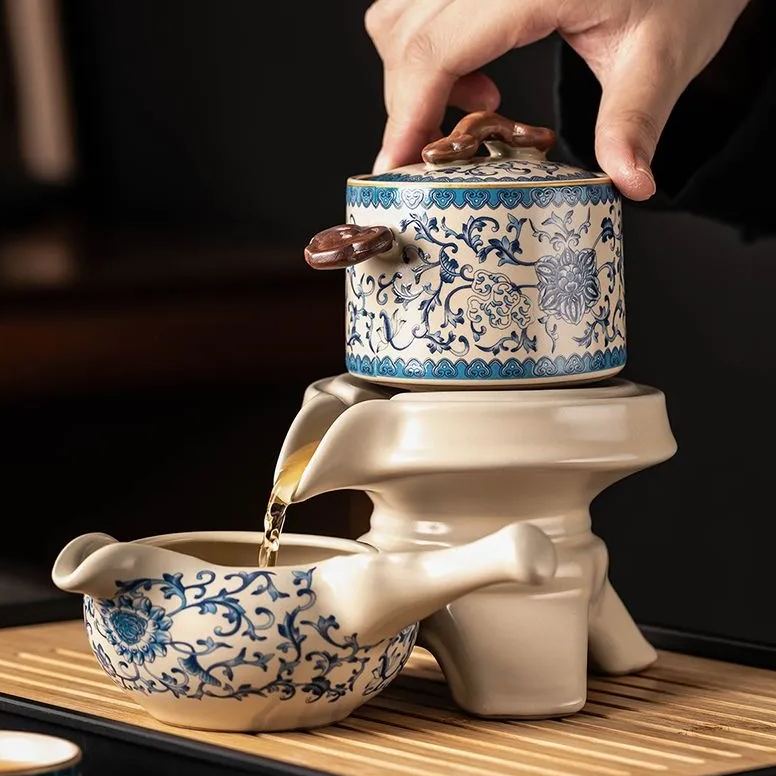
The pour from gaiwan to fairness cup, and from fairness cup to tasting cup, is where most of the visual ritual of gongfu lives. The mechanics are simple but worth practicing. The gaiwan should be tilted so the lid gap controls the flow — opening the lid a little for a slow pour, a lot for a fast pour. The fairness cup should be filled in a single smooth pour, not in stages; staged pours mix old infusion with new and produce uneven cups.
Once the fairness cup is full, the second pour is to the tasting cups. The standard pattern is to fill each cup to the same level — usually about 80% full rather than to the rim — and to make sure every cup gets the same strength. This is where the name “fairness” comes from: every drinker gets the same cup regardless of when their cup was poured. For a two-person session, two cups at 30–50 ml each is enough. For a four-person session, four cups at 30–40 ml each works.
How Fast to Pour
The pour should take 3–5 seconds from gaiwan to fairness cup, and another 3–5 seconds from fairness cup to tasting cups. Slow pours let the leaves continue steeping in the residual water left on the gaiwan wall; fast pours minimize that exposure. A useful cue is sound: a properly-poured gongfu session has a steady, controlled stream rather than a gurgle or drip. The first few sessions usually involve some spillage — that is normal, and it is what the tea tray is for.
Step 6: Re-Steeping and How to Extend Each Round
Re-steeping is where gongfu pays off. A typical oolong or pu-erh gives 6–12 infusions from a single dose of leaves; a delicate white tea gives 6–8; a black tea gives 4–6; green tea gives 3–5. The pattern is straightforward: each subsequent infusion is 5–10 seconds longer than the previous one. So if the first infusion ran 10 seconds, the second runs 15–20, the third 20–30, the fourth 30–40, and so on. The progression is not strict — a strong first infusion might justify a shorter second, while a weak first infusion might justify a longer second.
Between infusions, the leaves do not need to be rinsed or rested. The water from the previous infusion already washed the surface, and the brief time between pours (usually 10–30 seconds in a normal rhythm) is enough rehydration. Resting the leaves longer than a minute in a warm room can start to oxidize oolong, which is the opposite of what gongfu brewing is trying to achieve. For very long rests (more than 5 minutes), some gongfu drinkers cover the gaiwan with the lid to slow evaporation, but this is an advanced technique rather than a beginner habit.
The session ends when the leaves stop giving flavor. The cue is in the cup: when an infusion comes out thin, watery, and pale rather than amber or rich, the leaves are exhausted. At that point, refresh the leaves with a new dose. The total session can last 30 to 90 minutes depending on the tea and the pace. A high-quality aged pu-erh can run over an hour and still be giving flavor at the tenth infusion.
Side-by-Side: Oolong vs Pu-erh vs White vs Green
The table below maps each of the most common gongfu tea types to its water temperature, leaf-to-water ratio, first-infusion steep time, and total infusions. Numbers marked “standard” are referenced from Wikipedia: Gongfu tea or related Wikipedia entries; numbers marked “estimate” are working values that hold up across multiple gongfu brewing references but are not formally published in any single reference.
| Tea type | Water temperature | Leaf per 100 ml | First steep | Re-steep step | Total infusions |
|---|---|---|---|---|---|
| Oolong (tieguanyin, dancong) | 90–95 °C (standard) | 5–8 g (1 tbsp) | 5–15 sec | +5–10 sec | 6–12 |
| Ripe pu-erh (shou) | 95–100 °C (standard) | 5–8 g (1 tbsp) | 5–15 sec | +5–10 sec | 8–15 |
| Raw pu-erh (sheng) | 95–100 °C (standard) | 5–8 g (1 tbsp) | 5–10 sec | +5–10 sec | 6–12 |
| White tea (shou mei, bai mu dan) | 85–90 °C (estimate) | 3–5 g (1 tsp) | 10–20 sec | +10 sec | 6–8 |
| Black tea (whole leaf, broken-leaf poor fit) | 90–95 °C (estimate) | 4–6 g (1 tsp) | 8–15 sec | +5–10 sec | 4–6 |
| Green tea (delicate, suboptimal for gongfu) | 75–85 °C (estimate) | 3–5 g (1 tsp) | 10–20 sec | +5–10 sec | 3–5 |
| Yellow tea (rare) | 80–85 °C (estimate) | 4–6 g (1 tsp) | 10–15 sec | +5–10 sec | 5–7 |
Two of the rows deserve special attention. Ripe pu-erh tolerates more infusions than any other category on this table because the leaves are large, compressed, and slow to release compounds — a high-quality shou pu-erh can run 12–15 infusions from a single dose. Green tea is on this table for completeness, but it is a poor match for traditional gongfu brewing; most green teas turn grassy under the multi-steep pattern, and a glass teapot brewed at 75–80 °C for 60–90 second steeps produces a cleaner cup. The green tea in glass teapot guide covers that method in detail.
Common Mistakes That Make Gongfu Tea Bitter
Most bitter gongfu cups come from one of five places: overloading the leaves, steeping too long, skipping the preheat, pouring slowly, or leaving water in the gaiwan between infusions. Each is fixable with a small adjustment, and each one is more common than the next because the variety of ways to brew gongfu makes it easy to drift away from the basics. Knowing how to use gongfu tea set correctly comes down to avoiding these five mistakes more than memorizing the canonical 5–8 g per 100 ml ratio.
- Overloading the leaves. A gaiwan with too many leaves extracts more catechins per second than the gaiwan with the right amount. If the first cup tastes strong, use fewer leaves on the next session rather than shortening the steep — shortening the steep under-extracts the amino acids and produces a thin, watery cup.
- Steeping for minutes instead of seconds. Gongfu infusions are short. A 60-second first steep of a 5 g per 100 ml load will taste harsh. The right range for most first infusions is 5–15 seconds, and going over 30 seconds even for a slow white tea is a sign the leaf load or temperature is wrong.
- Skipping the preheat. Cold porcelain drops water temperature fast — a 100 ml gaiwan at room temperature filled with 95 °C water drops about 8–10 °C in the first 30 seconds. Preheating brings the vessel up so the brew water stays where the brewer wants it.
- Pouring slowly. A slow pour from gaiwan to fairness cup leaves residual water on the gaiwan wall, which keeps steeping the leaves. The pour should be a single smooth stream taking 3–5 seconds, not a drip or a trickle.
- Leaving water in the gaiwan between infusions. Once the infusion is finished, the water should be out of the gaiwan entirely. Residual water continues extracting the leaves and makes the next steep unpredictable.
Per the sister article, the most expensive of these mistakes is overloading, because it forces the brewer into a short-steep pattern that under-extracts the amino acids. The second-most expensive is leaving water in the gaiwan, because the unpredictability compounds over a six to twelve infusion session and makes the late cups come out uneven. Both are easy to fix once a brewer is watching for them.
Recommended Sets and Easy Alternatives
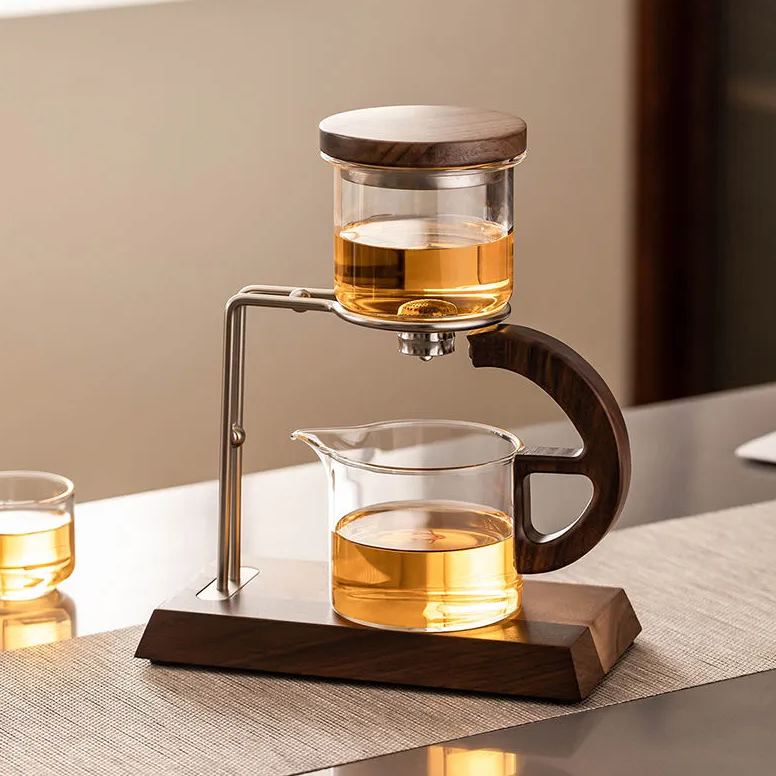
The traditional gongfu set is porcelain gaiwan + fairness cup + 2–4 tasting cups, but the modern alternative is a magnetic / semi-automatic tea maker that handles the pour for the brewer. For someone who wants the multi-steep pattern and short-infusion logic without learning the manual pour, a magnetic set is a useful bridge. For someone who wants the canonical gongfu experience, a porcelain set is still the right starting point.
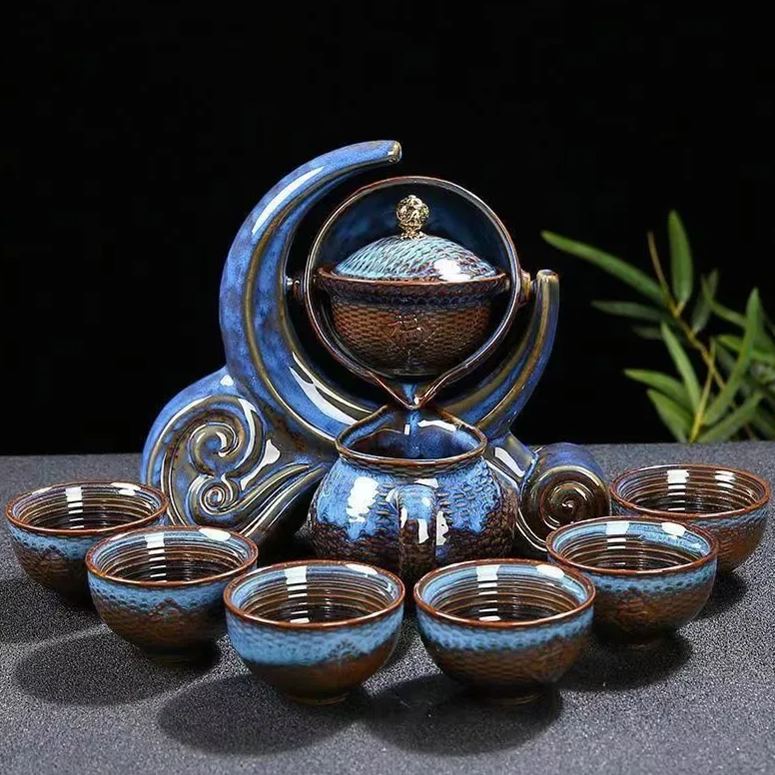
If you want to skip the manual research and pick a set that is already curated for the gongfu-style brewing pattern, the ceramic tea set collection at Elysian Tea Shop has multiple gaiwan-style and gongfu-compatible options. The automatic pouring ceramic gongfu tea set combines a small brewing vessel with an automatic pour mechanism that handles the gaiwan-to-fairness-cup transfer — useful for a beginner who wants to focus on the leaves and the timing rather than the pour mechanics.
For the rotating tray side of the ritual, the rotating tea set collection offers blue-and-white porcelain and other traditional colorways on a 360-degree rotating base, which simplifies serving multiple guests without lifting the tray. For brewers who want a glass option that still runs on the multi-steep logic, the glass tea set collection has borosilicate pots in 350–1000 ml sizes, and the glass teapot for oolong picks covers the specific glass options that hold heat steady enough for a multi-steep oolong brew.
For someone who is just starting and wants to skip the manual research entirely, the modern smart magnetic semi-automatic tea maker handles the steep timing and the pour automatically, so the brewer can focus on the leaves and the cup. It is not a traditional gongfu set, but it is the easiest entry point for someone who wants the multi-steep pattern without the manual ritual. The wider semi-automatic tea set collection covers other similar designs.
Preguntas Frecuentes
How much does a beginner gongfu tea set cost?
A basic 4-piece porcelain set (gaiwan, fairness cup, 2 tasting cups, plus a small tea tray) typically runs $20–50 USD. The most useful upgrade at the next price tier is a better gaiwan — heavier porcelain, finer glaze, more comfortable rim — which usually costs $30–80 USD. Yixing clay pots start around $50 USD for a small one, but they require dedicated use and are not the right starting point for a beginner who wants to brew multiple tea types from the same set.
Can I use a regular teapot for gongfu brewing?
Yes, technically — a regular teapot works for the multi-steep pattern as long as it is small enough (under 250 ml) and has a built-in strainer. The reason most gongfu drinkers use a gaiwan is that gaiwans are easier to pour quickly and completely, which is essential for the short-steep pattern. A larger teapot (500+ ml) is a poor fit because the leaf amount scales to the water and the cup becomes too diluted. The simplest portable alternative is a glass teapot with a removable infuser, which gives the visual feedback of a gaiwan without the pour mechanics.
How long does a gongfu session last?
A standard gongfu session lasts 30 to 60 minutes for oolong and pu-erh; up to 90 minutes for a high-quality aged pu-erh; and as little as 15–20 minutes for a quick black tea session. The session length scales with the number of infusions and the re-steep rhythm. A relaxed solo session with 6–8 infusions at 10–15 second steeps and 30 seconds of rehydration between pours runs about 30–40 minutes total. A 12-infusion ripe pu-erh with longer re-steep times can run past 90 minutes.
Is gongfu the same as Chinese tea ceremony?
Gongfu cha (功夫茶) is the brewing method; Chinese tea ceremony refers to the formal rituals that build on top of it. The brewing steps in this article are the operational foundation that any Chinese tea ceremony — whether Taiwanese, Fujianese, or Cantonese — builds on. The ceremonies add formal movements, specific cup-passing patterns, and ceremonial tools; the brewing steps themselves stay the same.
What is the difference between a gongfu tea set and a Western tea set?
The brewing vessel size, leaf-to-water ratio, steep time, and number of infusions all differ. A gongfu set uses a 100–250 ml vessel with a 5–8 g per 100 ml leaf ratio and 5–30 second steeps across 6–12 infusions. A Western tea set uses an 800–1500 ml pot with a 1–2 g per 100 ml leaf ratio and 3–5 minute steeps for 1–2 infusions. The flavor approach is also different: gongfu aims for layered, evolving cups across many infusions; Western aims for one consistent cup. The sister article on what is a gongfu teaset covers the broader comparison.
– Belleza tradicional
A gongfu session is six steps and the patience to repeat them. Preheat the gaiwan and cups so the brew water stays where the brewer wants it. Measure 5–8 grams of oolong or pu-erh per 100 ml of water — drop to 3–5 grams for white tea and 4–6 for black tea. Rinse tightly rolled oolong and aged pu-erh, skip the rinse for green and most white teas. Brew the first infusion for 5–15 seconds; pour completely through a fairness cup and into 2–4 small tasting cups. Re-steep with 5–10 second increments per round, running 6–12 infusions before the leaves turn thin.
The decision framework for a beginner learning how to use gongfu tea set is straightforward. Pick oolong (tieguanyin or dancong) or ripe pu-erh as the first tea — both are forgiving, both give 8–12 infusions, and both reveal the multi-steep pattern clearly. Pick a 100–150 ml porcelain gaiwan rather than a Yixing clay pot — porcelain is neutral and lets the brewer change tea types without cross-flavor issues. Skip the rinse for the first session to keep the steps simple, and add it back once the basic rhythm is comfortable. Use filtered water at the temperature the tea requires — 90–95 °C for oolong, 95–100 °C for pu-erh — and stop the session when the cups come out thin and pale. Pick a 5–8 g per 100 ml ratio if you are brewing oolong or pu-erh; pick a 3–5 g per 100 ml ratio if you are brewing white tea; pick a 4–6 g per 100 ml ratio if you are brewing black tea.
For the equipment, the automatic pouring ceramic gongfu tea set is the closest single-product match for a beginner who wants the gongfu pattern without the manual pour mechanics, and the broader ceramic tea set collection covers the canonical porcelain gaiwan options for someone who wants the traditional starting point. The modern smart magnetic semi-automatic tea maker is the easiest entry point for someone who wants the multi-steep logic without the full ritual — it is not a gongfu set in the traditional sense, but it is the practical bridge for a busy schedule.
 ES
ES  EN
EN  DE
DE  PT
PT  FR
FR  JA
JA