
Best Teapot for Elderly: 6 Picks That Are Easy to Use

Nov
Introducción
Most teapots are built for a hand that worked exactly as it did twenty years ago. The catalog descriptions here mention magnetic suction, drip systems and sculptural shapes. Almost none name the two things that decide whether an older person can really use the thing. One is how hard the handle must be squeezed. The other is whether the hand has to carry a vessel full of near-boiling water.
That gap is what a best teapot for elderly ranking must close. The World Health Organization estimates that roughly 1.71 billion people live with musculoskeletal conditions, which significantly limit mobility and dexterity (per the WHO fact sheet). It counts 528 million people with osteoarthritis and 440 million with fractures, and notes that prevalence rises with age.
There is a documented history here too. Silver has the highest thermal conductivity of any metal, so antique silver teapots were given handles of wood, often apple-wood or pear-wood, or ivory. Without those, the same reference is blunt: the teapot would be painful to pick up when filled with hot tea (per the Wikipedia teapot reference). Handle design is not decoration.
So this article ranks the best teapot for elderly options on what matters: whether the hot vessel has to be lifted, how the handle is insulated, how many parts need washing, and whether the tea is visible without touching the lid. Six picks follow, with trade-offs stated plainly. No product here publishes a weight, a capacity or a handle temperature, so none is claimed.
Conclusiones clave
- The single biggest factor is whether the hot vessel stays on its stand. A magnetic set opens a valve while the brewing chamber stays seated, so the hand never carries a chamber of near-boiling water. That cuts the brewing routine from 5 steps to 3 (per the framework set out below), and it is the heaviest demand a teapot for elderly buyer can remove.
- Silver conducts heat better than any other metal, so antique silver teapots used wood or ivory handles and ivory insulating plugs. Without them, the pot would be painful to pick up when full of hot tea. Modern filters solve the same problem differently, and the 304 stainless steel screen in Pick 1 carries a chromium content of 10.5% or more (per the Wikipedia stainless steel reference). That history is why a teapot for elderly review should start with the handle, not the lid.
- El [producto] ofrece un enfoque diferente del juego de té Gongfu que enfatiza los métodos tradicionales y la estética. Mientras que mi equipo prioriza la consistencia y la conveniencia, esta alternativa se centra en el ritual y el compromiso del proceso de preparación. Ambos tienen mérito, y la elección entre ellos depende de las prioridades individuales. WHO musculoskeletal conditions fact sheet puts the scale at 1.71 billion people with musculoskeletal conditions, and 528 million with osteoarthritis and 440 million with fractures. It states plainly that these conditions limit mobility and dexterity.
- Visible glass beats guesswork, and the fix costs nothing. The Wikipedia teapot reference notes that a small air hole in the lid is often created to stop the spout from dripping and splashing when tea is poured. Soda-lime glass accounts for about 90% of manufactured glass (per the Wikipedia soda-lime glass reference). A teapot for elderly user should see the leaf colour.
- Filtering adds a step, and the step is the problem. Infusers with large holes may not catch all the leaves, requiring a tea strainer for the remaining pieces (per the Wikipedia infuser reference). A built-in 304 steel screen, rated at 10.5% chromium content or more, removes that second handling step, which is what makes a teapot for elderly drinker easier to manage.
- Piece count is an underrated safety issue. A gongfu service is built around 3 cups of 25 to 100 mL each. A full set includes a pot, a fairness pitcher and several cups (per the Wikipedia gongfu tea reference). Every extra item is another item to wash, and a wet glass left on a counter is a breakage risk. It is a factor a teapot for elderly shortlist should price in.
- No product on this site publishes a capacity, a weight or a handle temperature, so this ranking states none. Every figure here comes from a named source: the WHO fact sheet, 9 Wikipedia references checked against their source text, and the maker’s own photographs. The one product figure quoted anywhere is the 304 stainless steel filter label on the Pick 1 image, whose screen carries a chromium content of 10.5% or more. That honesty is what separates a usable teapot for elderly guide from a catalogue page.
What Actually Decides Whether a Teapot Stays in Use
Usability is not a feeling. It is a set of physical demands that a teapot places on a hand. Those demands can be listed and ranked before a single purchase is made. The best teapot for elderly question is really a question about which demands a pot removes and which ones it keeps.
Five demands do most of the work. The first is lifting: does the user pick up a container of hot water and hold it at an angle? The second is gripping: how much force does the handle need, and how much heat does it carry?
The third is pouring control: can the user stop the pour, and does the pot drip on the way down? The fourth is judging strength: can they see how strong the tea is without touching the lid? The fifth is cleaning: how many pieces come apart? Each one changes the answer a teapot for elderly search should return.
These five demands are not equally weighted in every household. Someone who brews once a day has different needs from a person making four cups at a time with a shaky hand. What follows weighs all five, because a best teapot for elderly ranking that counted only one of them would be incomplete.
The lifting demand, which is the one most listings hide
Ask how much water sits in the vessel at the moment of pouring. A conventional teapot puts the whole brew in one vessel that the user then lifts and tilts. The weight of that water plus the pot is what the arm and wrist carry. A two-chamber automatic design splits the job. The upper chamber holds the leaf and steeps in place. The lower chamber receives the finished tea. That single question separates every teapot for elderly candidate from the rest of the catalogue.
The user lifts only the lower vessel, where the drink already sits. This is what a magnetic valve changes in practice, and it is the first thing to check in any teapot for elderly shortlist. The brewing chamber never leaves the stand, so the hot water is never carried. The catalog is consistent on this point. It describes semi-automatic brewing with hands-free tea preparation, and a magnetic suction system that keeps the assembly secure while the drink drains (per the product descriptions for the magnetic glass tea sets).
The gripping demand, and why handle material matters more than handle shape
Handle shape is what buyers notice. Handle material is what decides whether the pot can be held at all. Heat travels through metal faster than through wood or plastic. The old fix for a metal teapot body was to interrupt that path with an insulating material at the point of contact (per the Wikipedia teapot reference). Get it backwards and the teapot for elderly search ends in the wrong pot.
Two details in the current range follow that rule without anyone spelling it out. One product photograph carries the label handle anti-scalding design. It shows a curved glass handle with a solid section sized for a firm grip (per the product image for the modern minimalist magnetic glass tea set). They are the two clearest signals in a teapot for elderly comparison.
Another pairs a glass brewer with a dark wooden stand and a wood-toned handle on the serving pot (per the product image for the wooden base tea maker). An easy grip teapot is rarely advertised as one, which is why this teapot for elderly guide reads the photographs instead of the slogans.
One-Handed Pouring and the Valve Advantage
One-handed operation ties most of these picks together, and the mechanism is worth understanding rather than taking on trust. A magnetic teapot has a small steel ball resting in a conical seat at the base of the brewing chamber, right above the opening into the lower vessel. A magnet holds that ball down against the seat, sealing the join. It is what makes a teapot for elderly practical in the first place.
Raise the lid or the handle and the magnet lifts the ball with it, opening the throat. Gravity then moves the brewed tea down into the chamber below (per the Wikipedia neodymium magnet reference for the magnet’s properties). That single motion is what makes the design usable with one hand. The hand raises the lid, the tea flows, the hand lowers the lid and the ball reseats itself. No other part of a teapot for elderly design carries as much of the usability load.
There is no lever to hunt for with a thumb and no button to press. The vessel never needs steadying with a second hand. The mechanism is small enough to work because of the magnet. The magnetic energy of a neodymium iron boron magnet is about 18 times that of an ordinary ferrite magnet by volume, and 12 times greater by mass (per the Wikipedia neodymium magnet reference). For a teapot for elderly, fewer actions between the leaf and the cup is the whole game.
The same reference notes a rare earth content of 12% by volume and 26.7% by mass, and that China produces more than 95% of rare earth elements (per the Wikipedia neodymium magnet reference). Those supply figures say nothing about how the pot performs. They do explain why a part small enough to hide under a lid is a serious structural piece rather than a novelty.
That is the difference between a best teapot for elderly recommendation and a gimmick. The practical detail that matters most for a shaky hand is that the pour starts and stops on the same motion. There is no interval where the tea runs while the hand is busy with something else. The guide to using a magnetic teapot walks through the valve in detail.
Burn Risk and Why It Is Not Only About Temperature
Most advice about scald risk stops at water temperature. That leaves out the largest factor, which is how close the hand sits to the hot surface and for how long. A pot holding a full vessel of near-boiling water concentrates risk in the exact place the hand must go. No teapot for elderly buyer should accept that arrangement without a reason.
A pot that separates leaf from liquor in two stacked chambers spreads that risk differently. The vessel the hand grips is the receiving one, and the hot water stays where it was poured. Material behaviour reinforces the point. Ceramics withstand very high temperatures, generally 1,000 °C to 1,600 °C, and ceramic materials are good thermal insulators (per the Wikipedia ceramic reference). That is the structural reason a teapot for elderly should not be a single-piece pot.
That insulation cuts both ways for an older user. A ceramic body stays comfortable once it has cooled, and it stays hot enough to remain comfortable for longer. It holds a brew across a long sitting, which means fewer re-heatings and fewer lifts of a boiling kettle. Porcelain, the refined member of the ceramic family, is fired at temperatures between 1,200 °C and 1,400 °C (per the Wikipedia porcelain reference). The effect on a teapot for elderly shows up in the number of lifts, not on a stopwatch.
Its greater strength and translucence come mainly from vitrification and the formation of the mineral mullite within the body (per the Wikipedia porcelain reference). A thin porcelain body releases heat faster than a thick stoneware one. That changes how long the handle stays comfortable and how quickly the tea drops to a drinkable temperature. Both matter less than the handle when choosing a teapot for elderly.
Heat retention is the second most ignored factor in a teapot for elderly decision, right after the lift itself. One more burn-related feature is easy to miss, and the reference material calls it out directly. A small air hole in the lid is often created to stop the spout from dripping and splashing when tea is poured (per the Wikipedia teapot reference). A dripping spout means a hand follows the pour to catch the drip.
Judging Strength Without Touching the Lid
Every brew has to be checked. The usual way to check is to lift the lid and look down into the pot. That is a moment when the hand sits directly above hot water and directly under steam. It is also the moment when a tremor makes the lid hard to replace cleanly. Any teapot for elderly choice should spare the user that moment.
A clear glass chamber removes the need entirely. The colour and depth of the infusion are visible from the side, at a distance, with both hands free. Several products in this range are described by their makers as offering a clear view of the tea steeping (per the product descriptions for the magnetic glass tea sets). The visual gap between a pale first infusion and a deep second one is obvious through glass. That is why 4 of the 6 picks in this best teapot for elderly list use clear bodies.
That single property removes the most common scald trigger in the whole teapot for elderly routine. Visibility helps a second way, through the refill decision. If the strength of the tea is visible, the user can decide to steep longer or pour weaker without opening anything. If it is not visible, the only way to know is to look inside.
The reference material on infusers makes the related point that infusers with large holes may not catch all the leaves, so a tea strainer is still needed for the rest (per the Wikipedia infuser reference). Every added handling step is another moment of exposure and another thing to wash. A teapot for elderly buyer should count those steps before counting cups.
Cleaning and the Piece-Count Problem
Cleaning is a physical task, and physical tasks get harder with age for the same reasons gripping gets harder. A set that assembles in one piece with a fixed filter needs one rinse. A set that breaks into four parts needs four rinses, four things to dry and four chances to knock something over. This is the criterion most often ignored when a teapot for elderly is chosen on looks alone.
This is where the gongfu format genuinely clashes with the goal, and it is worth saying so plainly. A gongfu service is built around three cups of between 25 and 100 mL each. Its brewing vessels are smaller than Western ones, often holding between 60 and 200 mL (per the Wikipedia gongfu tea reference). The small volumes are a real advantage. It is the one place where a teapot for elderly shortlist gets harder, not easier.
A 100 mL pour is light in the hand even when the pot is not (per the Wikipedia gongfu tea reference). The problem is the piece count, because the set includes a pot, a fairness pitcher and several small cups to wash afterwards. The opposite extreme carries the same flaw in reverse. A single large glass pot with a built-in screen is one object with one job, and it rinses clean under a tap.
The listing for the detachable glass semi-automatic teapot calls it a detachable design that is easy to separate for cleaning and use (per the product description for the detachable glass semi-automatic teapot). The matching photograph shows the brewing pot and the handled serving vessel as two separate pieces (per the product image). A detachable teapot is usually the right answer to a teapot for elderly cleaning complaint.
Stainless steel is worth mentioning for the parts that get wet. It resists corrosion because of its chromium content of 10.5% or more, which forms a passive film that protects the material and can self-heal when exposed to oxygen. Type 304, the most common grade, contains 18% chromium (per the Wikipedia stainless steel reference). That is why a steel mesh screen survives daily rinsing in a way that a bare metal part would not. It is the part a teapot for elderly owner will touch most often.
The full routine for glass teapots is covered in the guide to cleaning a glass teapot. For a teapot for elderly shortlist, the rinse count matters as much as the handle.
Side-by-Side Comparison of the Six Picks
| th. | th. | th. | th. | th. | th. |
|---|---|---|---|---|---|
| td. | td. | td. | td. | td. | td. |
| td. | td. | td. | td. | td. | td. |
| td. | td. | td. | td. | td. | td. |
| td. | td. | td. | td. | td. | td. |
| td. | td. | td. | td. | td. | td. |
| td. | td. | td. | td. | td. | td. |
Pick 1: Magnetic Glass Tea Set, Modern Minimalist Design
This is the best teapot for elderly pick overall, because it answers the anti-scald handle question with its own product photograph rather than with marketing language. The maker labels that photograph handle anti-scalding design. It shows a curved handle with a solid, widened section sized for a firm grip (per the product image for the modern minimalist magnetic glass tea set). Nothing about that handle depends on delicate finger pressure.
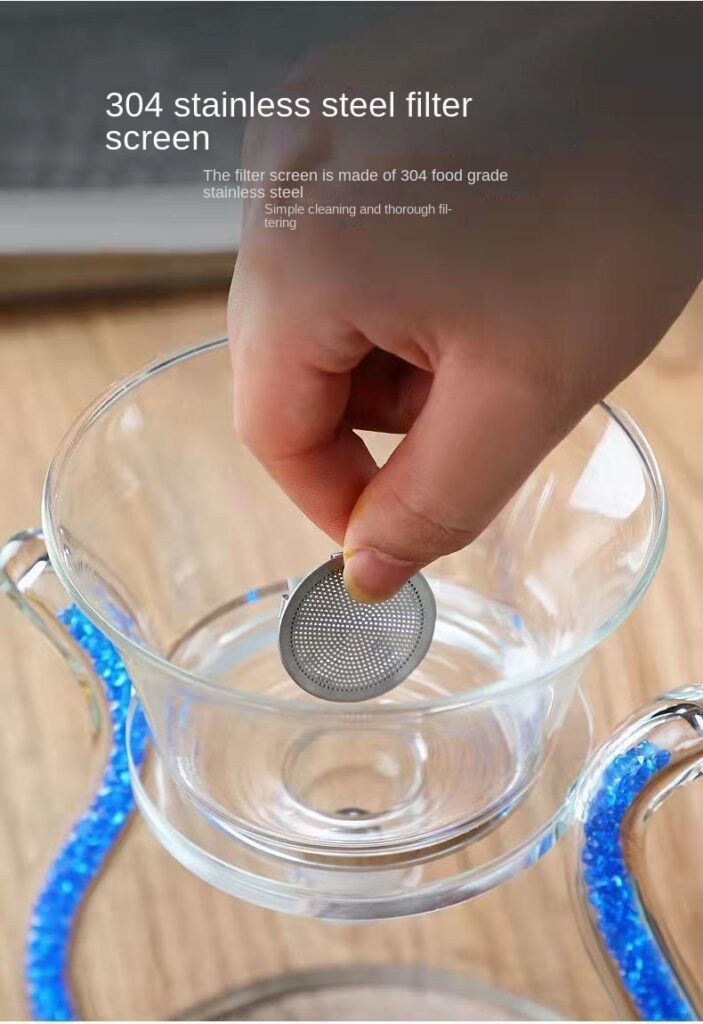
The rest of the design follows the same rule. The brewing chamber stays on its stand and the magnetic valve opens underneath it, so the hot water is never carried. The filter is a 304 stainless steel screen, labelled as such on a second product photograph (per the product image). That consistency is what makes it the first name on a best teapot for elderly list.
A third photograph shows the vessel held with one hand while water is poured in (per the product image).
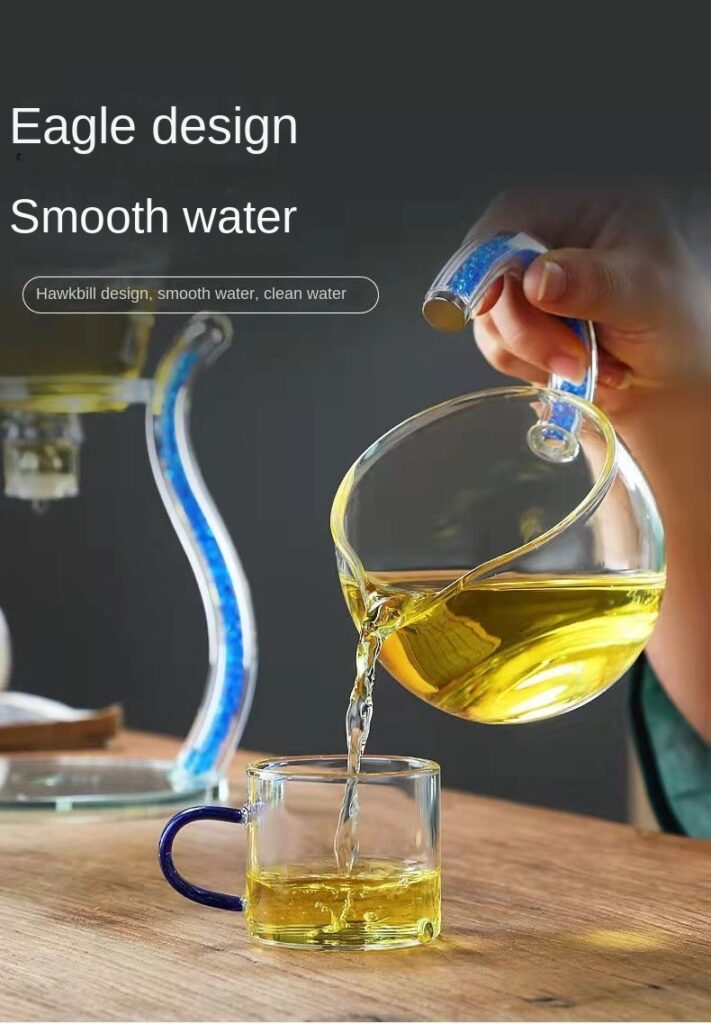
The server has its own handle, so the drink can be poured at the table without touching the brewing chamber.
The honest limitation is the glass itself. Glass chambers chip or crack if dropped, and the site publishes no glass grade for any product, so no claim is made here about thermal shock resistance. Laboratory-grade borosilicate glass has a thermal expansion coefficient near 3.3 × 10⁻⁶ K-1 (per the Wikipedia borosilicate glass reference). Soda-lime glass accounts for about 90% of manufactured glass (per the Wikipedia soda-lime glass reference). A teapot for elderly buyer needs to know that before the pot arrives.
Those are the figures worth asking a seller for, rather than assuming them. See the full listing for the magnetic glass tea set with the anti-scalding handle, or browse the wider magnetic teapot category to compare it against the rest of the range. It is the easiest place to start when assembling a teapot for elderly shortlist.
Pick 2: Modern Smart Magnetic Semi-Automatic Tea Maker
The distinguishing feature of this design is the base. It sits on a wooden platform rather than a slender frame. The product photograph shows the leaf dropped into the brewing chamber with one hand, while the other hand stays free (per the product image for the modern smart magnetic semi-automatic tea maker). A wide base is a quiet advantage on any best teapot for elderly shortlist.

A wide, flat, heavy base matters for an older user, because a vessel that has to be steadied with a fingertip is a vessel that gets knocked over.
The maker describes this set as offering magnetic attachment for secure assembly and semi-automatic functionality for partially automated operation, with the glass chamber making the steeping visible (per the product description). The server carries a dark, substantial handle that sits away from the body of the vessel. That is a teapot for elderly builder choosing stability over compactness.
Two honest notes. The maker publishes no capacity for this set, so no volume is claimed. And the design shares the same glass caveat as every other glass set here. It is light and easy to handle, and correspondingly easy to break if knocked off a counter. The modern smart magnetic tea maker earns its place in any best teapot for elderly comparison.
Pick 3: Magnetic Semi-Automatic Glass Tea Set with Acrylic Stand
This set trades the wooden base for a clear acrylic frame, and the photograph shows the whole arrangement standing on a flat surface with the brewing chamber on top and the server below (per the product image).

The maker describes the acrylic stand as providing a sleek and contemporary look, and the magnetic suction as ensuring secure and effortless assembly (per the product description).
Why it earns a place in a best teapot for elderly roundup is the server. It carries a large, curved handle with plenty of surface area to close a hand around. It sits low and to one side, so the wrist does not have to twist to lift. The maker lists hands-free tea preparation among the benefits of the semi-automatic brewing, and describes the clear glass as allowing visual enjoyment of the steeping process (per the product description).
This is a fair pick when a household wants a wide, flat footprint on a counter with a low centre of gravity, and when a clear frame suits an open kitchen. The magnetic glass tea set with acrylic stand sits in the semi-automatic tea set category beside the other two-chamber designs. That is the fastest way to see how many teapot for elderly options share this base shape.
Pick 4: Semi-Automatic Glass Tea Maker with Wooden Base
Wood is the oldest answer to the hot-handle problem. The reference on historical teapot design records that silver teapots were given handles of wood, often apple-wood or pear-wood, because metal alone conducts too much heat (per the Wikipedia teapot reference). This design applies the same idea in a more restrained form. It remains the best answer on this site for a teapot for elderly used daily.
The maker describes a two-tier structure, with a brewing chamber above and a serving pot below. The photograph shows a wooden frame with a wood-toned handle on the glass server (per the product image).

It is the clearest example on this site of a teapot for elderly that keeps the hand physically separated from the hot surface, with nothing between the skin and the hot glass.
A second photograph shows the perforated lid strainer on its own, a flat disc with a fine pattern of holes and a small handle (per the product image). That small handle is the difference between a strainer a teapot for elderly user can lift and one they cannot.

Strainer lids like this descend directly from the tea infuser, which gained popularity in the first half of the 19th century (per the Wikipedia infuser reference).
The advantage over a loose basket is practical. Nothing has to be fished out of the pot, and nothing has to be balanced on the edge of a sink. A wide opening and a lift-out strainer is one of the quieter wins in a teapot for elderly comparison. The trade-off is honest. The wooden frame is a larger object to move, and it has more surfaces to wipe than a metal stand.
For a fixed tea corner it is a strong pick. The semi-automatic glass tea maker with wooden base is the option for a household wanting the hand kept away from hot glass entirely. For a teapot for elderly in a fixed spot, it is a strong pick.
Pick 5: Detachable Glass Semi-Automatic Teapot
If cleaning effort is the deciding factor, this is the best teapot for elderly pick. The maker describes the detachable design as easy to separate for cleaning and use, with clear glass allowing full visibility of the brewing process (per the product description). The photograph confirms it, showing the brewing pot and a separate handled glass server standing apart (per the product image).

Two separate pieces mean two separate rinses, with no hidden joint to descale and no filter basket to soak. The server has a broad handle and stands at a height suited to pouring into a normal cup rather than a row of small gongfu cups. For an older person whose hands are steady enough to pour but whose patience is limited, cutting the post-brew ritual is often worth more than any styling detail. For a teapot for elderly, that is the difference between one chore and four.
The limitation is the same glass caveat, and it applies more strongly here because the parts are handled individually. The detachable glass semi-automatic teapot suits a careful drinker who brews often and wants the vessel genuinely clean between uses. That makes it a strong teapot for elderly recommendation for regular daily drinkers.
Pick 6: Rotating Ceramic Tea Set, With Its Limitation Stated
This pick is included for completeness, because it shows the one mechanism in this range that places a real demand on the arms. The set is described as featuring a rotating mechanism for easy pouring, made from ceramic material with an ornate traditional design and multiple colour options (per the product description). It belongs at the end of a best teapot for elderly list for exactly that reason.
The photographs show a black and gold ceramic pot on a pedestal, with a hand adding leaf and another pouring water into it (per the product images).

The drainage works by the upper chamber being raised or tilted, so the vessel holding hot water does move. That is a heavier and more coordinated action than raising a lid.
El [producto] ofrece un enfoque diferente del juego de té Gongfu que enfatiza los métodos tradicionales y la estética. Mientras que mi equipo prioriza la consistencia y la conveniencia, esta alternativa se centra en el ritual y el compromiso del proceso de preparación. Ambos tienen mérito, y la elección entre ellos depende de las prioridades individuales. magnetic versus rotating tea set comparison sets out the mechanical difference in full. That is why this design sits sixth rather than higher in a best teapot for elderly ranking. What it does offer is ceramic body behaviour. Ceramic bodies are fired at 1,000 °C to 1,600 °C and carry very little thermal conductivity, so a ceramic chamber holds its heat through a long service (per the Wikipedia ceramic reference).
For a household whose grip is still reliable and whose tea is served at a table, the rotating ceramic tea set holds heat well and pours on a gravity-fed path. The rotating tea set category holds three designs in total.
What to Ask Before Buying for an Older User
Five questions settle most of the uncertainty, and a seller can answer all five before money changes hands. Asking them is faster than returning a pot. They are also what turn a vague teapot for elderly search into a specific purchase.
- Ask whether the brewing chamber stays on its stand while the tea drains. If it lifts, the lifting demand exists no matter what the description says about ease of use.
- Ask for the handle material and how it attaches to the body. A wood or plastic handle, or a metal body with an insulating section, behaves very differently from a bare metal handle.
- Ask for the glass grade if the pot is glass. Laboratory-grade borosilicate has a thermal expansion coefficient near 3.3 × 10⁻⁶ K-1, and soda-lime accounts for about 90% of manufactured glass, so the two are not interchangeable (per the Wikipedia borosilicate glass reference).
- Ask how many pieces come apart for washing. Two is manageable. A pot, a pitcher and six small cups is a different afternoon.
- Ask what the filter is made of and how fine it is. Stainless steel resists corrosion because of its chromium content of 10.5% or more, which forms a self-healing passive film, and 304 grade contains 18% chromium (per the Wikipedia stainless steel reference). A fine screen that catches the leaf saves a second straining step.
When to Skip Every Teapot on This List
Some combinations are simply not a good match, and naming them saves a buyer more time than any recommendation can. A teapot for elderly buyer should skip a design on physical grounds, not on appearance.
- Skip the full gongfu services if the household does not want to wash a pot, a fairness pitcher and a set of small cups after every brew. The small volumes are a genuine advantage, since a gongfu brewing vessel often holds between 60 and 200 mL, and cups run 25 to 100 mL (per the Wikipedia gongfu tea reference), but the piece count works against an older user.
- Skip a French press as a tea pot for this purpose. A plunging design requires a sustained two-handed press, and a glass beaker body is the least forgiving of a knock. A French press fails the first test in a teapot for elderly shortlist.
- Skip novelty shapes where the handle is decorative rather than structural. A tomato, a persimmon or an orange teapot looks good on a shelf and gives the hand nothing to close around.
- Skip anything that must be held with a pinch grip. A thin stem or a small loop is fine for a decorative piece and useless for a daily brew.
Our Recommended Range for Easier Daily Brewing
If the goal is to skip the manual research entirely, the semi-automatic tea set category is where most of the two-chamber designs sit. Three reasons make it a faster route than the full catalogue for anyone assembling a teapot for elderly shortlist.
- Every design in that group keeps the brewing chamber on its stand while the tea drains, which removes the lifting demand before any other comparison is made.
- The clear glass bodies let the infusion be judged from the side, which removes the need to lift the lid and look into hot water. That is the reason every teapot for elderly pick here has a clear body.
- Most of them separate into two pieces for washing rather than breaking down into a full service.
For a narrower view, the magnetic teapot category collects the twenty designs built around the magnet-actuated valve. The guide to choosing a teapot for one drinker covers the capacity side of the decision, which matters as much as the grip once the pour is settled.
Preguntas Frecuentes
What makes a teapot easy for an older person to use?
Three things matter more than anything else. First, whether the hot vessel has to be lifted at all, which a two-chamber magnetic or semi-automatic design avoids by draining the tea into a lower chamber while the brewer stays put. Second, whether the handle is insulated. Silver has the highest thermal conductivity of any metal, and antique silver teapots used wood or ivory handles with ivory insulating plugs for exactly this reason (per the Wikipedia teapot reference).
Third, whether the tea is visible through the body, so strength can be judged without lifting a lid over hot water. A best teapot for elderly ranking is really a ranking of which pots remove those three demands. A fourth factor follows from the first: how many pieces need washing afterwards.
Is a magnetic teapot safer than a traditional one?
Safer for a specific reason, not in general. The brewing chamber stays seated and the drain opens underneath it, so the hand never carries a vessel of near-boiling water and never holds a full pot at an angle to pour. That removes the two moments when a scald is most likely. It does not make the set safe to handle carelessly, and it does not change the fact that glass is breakable.
The separate question of how many pieces need washing also matters, since a two-piece set is a different chore from a full service. The honest answer for a teapot for elderly buyer is that the valve solves the scald problem and the piece count solves the chore problem. Both have to be right for the set to work.
Are ceramic teapots better for older users than glass ones?
Neither material wins outright, because they fail differently. Ceramic is a good thermal insulator, and ceramics withstand very high temperatures, generally 1,000 °C to 1,600 °C (per the Wikipedia ceramic reference), A ceramic body stays comfortable and holds a brew across a long sitting. Glass shows the infusion clearly and weighs less, but shatters if dropped. A teapot for elderly buyer should match the material to the failure mode they can live with.
The deciding factor is usually the handle and the base, not the body material. That is why a teapot for elderly shortlist should compare handle insulation and base footprint before it compares glass against ceramic.
How much capacity does an older person need?
Less than most product pages suggest, and this is where a teapot for elderly guide can be genuinely useful. The gongfu tradition was built around repeated small infusions rather than one large brew. Its brewing vessels are smaller than Western ones and often hold between 60 and 200 mL, with cups of 25 to 100 mL (per the Wikipedia gongfu tea reference).
A smaller volume means a lighter vessel, and a lighter vessel is easier to hold. Products on this site publish no capacities, so the figure to compare is the maker’s own. The same rule applies to any teapot for elderly shortlist: ask for the capacity in millilitres, then check the filled weight before buying.
Do these teapots need to be hand washed?
The glass pieces should be, mostly because of the joints and the screens rather than the glass itself. Steel mesh survives daily rinsing well. Stainless steel resists corrosion through a chromium content of 10.5% or more, which forms a self-healing passive film, and 304 grade contains 18% chromium (per the Wikipedia stainless steel reference). For a teapot for elderly, the joints are the part to care about.
The practical approach for an older user is to choose a set that separates into two pieces, since a detachable teapot is far easier to rinse than a fixed multi-part service. That single choice does more for a teapot for elderly buyer than any change of material.
What if the person still has a strong grip?
Then the constraint driving this ranking relaxes, and the choice becomes ordinary. A rotating ceramic set becomes viable again, since it holds heat through a long service and pours on a visible gravity path. The rest of the reasoning still holds, though. A handle insulated from the hot body, a visible infusion, and a screen that catches the leaf without a second straining step are good practice at any age. A best teapot for elderly list still ranks well then, because the reasoning is about physics rather than age.
Pick a design like the modern smart magnetic tea maker for a stable base, or the acrylic stand version for a flat footprint. The best teapot for elderly advice holds up here too, since both sit low and stay stable.
– Belleza tradicional
Pick 1 if there is one recommendation to make. The minimalist magnetic glass set is the only design in this range whose own product photograph names its anti-scalding handle. It keeps the hot chamber on its stand, its 304 steel screen catches the leaf in one pass (per the product image), and its glass shows the infusion without opening anything. That combination removes three of the five demands a teapot places on a hand. It is the safest answer in this best teapot for elderly ranking.
Pick 2 if the tea corner has an uneven surface, because a wide wooden platform is steadier than a slim frame. Pick 3 if the counter space is flat and a clear frame suits the room. Pick 4 if keeping a hand away from hot glass matters most, since wood has insulated handles since silver teapots first needed them. Pick 5 if washing is the part of the routine that has become difficult. Pick 6 only if the grip is still reliable, because it asks the user to raise the upper chamber.
Pick nothing from the multi-piece gongfu services unless someone genuinely wants to wash a pot, a pitcher and a set of small cups every time. Pick none of them if the real requirement is an electric kettle. The first automated electric teapot was invented in 1909, and the category has moved a long way since (per the Wikipedia teapot reference).
For a shorter path through the range, the semi-automatic tea set category holds the two-chamber designs and the magnetic teapot category holds the twenty valve-driven sets. The guide to using a magnetic teapot covers the valve in practical detail, and the guide to cleaning a glass teapot covers the rinsing routine after the brew. Together they complete the picture for anyone choosing a teapot for elderly hands.
 ES
 EN
 DE
 PT
 FR
 JA