
Deer Glass Teapot: 6 Auspicious Design Picks Ranked
Oct
Introducción
The deer did not arrive in the tea world by accident. Male deer of almost all species grow and shed new antlers every year (per the Wikipedia deer reference), and that annual renewal is exactly what East Asian decorative arts turned into a wish. The result is a deer glass teapot: a borosilicate brewer sitting on a sculpted deer, so the pot itself becomes the gift and the brewing function stays intact.
juego de té también es un instrumento visual. Observar cómo se abren las hojas en una tetera de vidrio, o ver cómo se oscurece el color al verterlo en el vaso de la equidad, activa los mismos canales sensoriales que el aroma y el sabor. Según una investigación resumida por la deer glass teapot is really a three-part system with three separate failure points. The glass brewer, the resin deer base that carries it and the magnetic ball valve that releases the water are made by three different processes, and buyer complaints on the best-selling versions cluster into exactly those three places. Get the mechanism right and you own a very good pot. Get it wrong and you own a beautiful ornament with a loose valve.
This guide ranks six designs on resin craft, glass specification, stated working range, capacity, the magnetic mechanism and what the shipping box does to a fragile sculpture. Every third-party number carries its source and retrieval date; where a figure would be a guess, the guide says so. The two deer designs lead, then four sibling auspicious-beast pieces.
Conclusiones clave
- juego de té también es un instrumento visual. Observar cómo se abren las hojas en una tetera de vidrio, o ver cómo se oscurece el color al verterlo en el vaso de la equidad, activa los mismos canales sensoriales que el aroma y el sabor. Según una investigación resumida por la deer glass teapot is three components, not one: a borosilicate glass brewer, a sculpted resin deer that carries it, and a magnetic ball valve. The first two rarely fail; the third does.
- The best-selling deer version on Amazon carries a rating of 4.2 out of 5 stars from 57 ratings and a category rank of 1,126 in Teapots, and the competing listing sits at 4.0 out of 5 from 31 ratings (Amazon listings, retrieved 23 October 2026).
- Both leading deer designs state a working range of -20 °C to 150 °C or 151 °C. Borosilicate glass itself is rated to take a temperature differential of about 166 °C without fracturing (per the Wikipedia borosilicate glass reference).
- Published capacities for deer teapots run from 200 ml up to 400 ml in the lower pot, with the upper brewing bowl quoted between 300 ml and 350 ml. A 300 ml brew bowl is an estimate of 6 to 8 small cups at 40 to 50 ml each.
- The deer base is resin, not ceramic, with a hand-painted gold finish and a gold lotus pattern on the antler shelf (source: the product gallery images for the Golden Deer Design set).
- The filter is assembled without glue, so it can be disassembled and cleaned rather than rinsed (source: the product gallery images for the Golden Deer Design set).
- Across the deer listings on Amazon, the recurring complaints are a missing magnetic ball, a valve that does not open, and glass described as thinner than expected. Ask about the ball before you pay, not after.
Tabla de Contenidos
- What a Deer Glass Teapot Actually Is
- Why Deer: The Gift Logic Behind the Shape
- Six Picks, Ranked
- Side-by-Side Comparison
- Capacity, Height and How Many Drinks You Get
- Materials and Thermal Shock
- The Magnetic Valve: Where Deer Teapots Fail
- What You Can Brew in a Deer Glass Teapot
- Buying Checklist Before You Order
- Our Recommended Deer Glass Teapots
- FAQ
- – Belleza tradicional
What a Deer Glass Teapot Actually Is
Strip the styling back and a deer glass teapot is a magnetic semi-automatic brewing system. Hot water goes into the upper glass bowl, a removable mesh filter sits inside it, and pressing the handle brings a magnetic ball valve into position so the brewed tea drops into the lower fair cup below. No lifting, no tilting, no pouring a scalding full glass across a table. That workflow is the same one described in our best semi-automatic tea set guide, and the deer version simply dresses it. A deer glass teapot is therefore a brewing system first and a sculpture second, and the buying decisions follow in that order.
The three parts, and what each one is made of
The upper brewing bowl and the lower fair cup are glass, and on the better builds they are borosilicate rather than soda-lime. The body is hand blown, with the maker’s own claim visible on the competitor listings: high borosilicate with a hand-blown finish, and a filter in food-grade 304 stainless steel (Amazon listing B0C85NPF7Y, retrieved 23 October 2026). The handle is resin, described on the product gallery as a curved anti-scalding shape in resin material that is easy to handle and comfortable (source: the product gallery images for the Golden Deer Design set).
The third part is the deer itself, and it is the part most buyers misread. It is resin: the product gallery describes it as resin material in a fulu style with clear facial features, hand-painted gold and a gold lotus pattern on the antler shelf (source: the product gallery images for the Golden Deer Design set). Resin means the sculpture is lighter and more detailed than fired ceramic would allow, and it means the antler shelf that holds the glass bowl is doing structural work. That matters when you look at the failure data in the valve section.
Why the deer carries the pot instead of sitting beside it
Putting the animal under the bowl rather than next to it solves a real problem. A brewing bowl full of hot water has to sit somewhere, and a separate coaster is one more object on a tea table. On the deer designs the antlers form a cradle that holds the bowl directly above the fair cup, so the pour is vertical and gravity-fed with no stand to assemble. The alternative approach on the market is a horizontal one: the fish design rests the glass on a wave-form bracket where the fish mouth becomes the landing point for the spout.

Why Deer: The Gift Logic Behind the Shape
Deer have been drawn by people for a very long time. They appear in art from Paleolithic cave paintings onwards, and they have played a role in mythology, religion and literature throughout history (per the Wikipedia deer reference). What separates the deer from a dragon or a phoenix in gift terms is that it carries a longevity association that travels with it: spotted deer are believed in China to accompany the god of longevity (per the same reference).
Fulu: blessing and prosperity in one shape
The product gallery for the Golden Deer Design set names the style directly as fulu, and describes a gold lotus pattern on the shelf. That is not decorative labelling for its own sake. Fulu combines the blessing of happiness with prosperity and official standing, so the deer carries both readings in one object, and the lotus pattern reinforces the Buddhist auspicious register. If a deer glass teapot is going to be given to someone rather than bought for yourself, this is the vocabulary it speaks in, and it is worth asking a seller which characters are on the base if you want to be sure.
Longevity, and the annual antler shed
There is a second layer to the motif that works precisely because it is a real animal rather than an invented one. Male deer of almost all species grow and shed new antlers each year, and those antlers are bony extensions of the skull (per the Wikipedia deer reference). A creature that renews its antlers every year is an unusually tidy symbol for continued vitality. Add the longevity association and you have a shape that works for a birthday, a new year, a housewarming, or a promotion, which is why a deer glass teapot gift stays in demand well outside the Christmas window.
The practical test for any of this is simpler than the symbolism. A sculptural piece earns its shelf space if it looks good empty, because it will spend most of its life on a tea table not in use. The deer designs that survive buyer scrutiny tend to be the ones where the head, antlers and body read clearly as a deer from across a room, rather than as a generic brown ornament. That is a workmanship question, and it is answered by looking at the gallery images before you buy, not by the product name.
Six Picks, Ranked
Two deer designs lead because the motif is the reason for the search. Four siblings follow, because the same buyer who lands on a deer teapot page will usually also be shown a fish, a cat, a pig and a citrus tree, and those four are the realistic alternatives. All six are stocked by Elysian Tea Shop’s artistic glass tea set collection, and each entry links to the exact product.
Pick 1: Golden Deer Magnetic Semi-Automatic Glass Tea Set
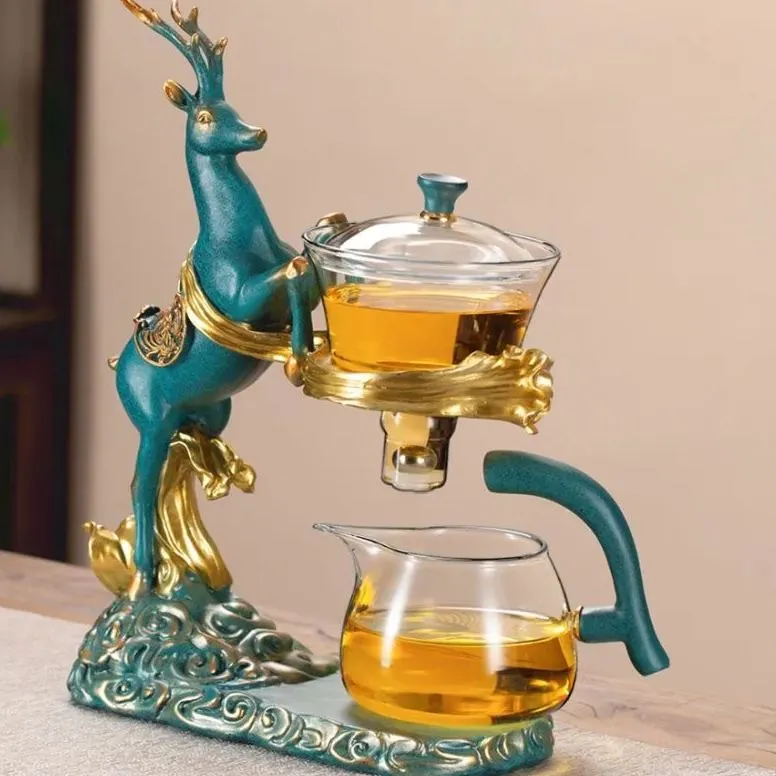
The teal and gold version with the deer standing upright and the glass bowl resting on a gold antler shelf, plus a matching fair cup with a curved resin handle. It is the most complete picture of the concept on the market, and the geometry is what sells it: the bowl sits directly on the antler cradle, so the whole assembly is one vertical column. Product gallery images give the construction details, including the removable glue-free filter and the magnetic ball valve at the base of the bowl (source: the product gallery images for the Golden Deer Design set).
This is the version to pick if the piece has to read as a deer in a photograph, because the antlers are exaggerated and the gold paint is deliberately loud. It is also the version where the weight distribution matters most: a heavy glass bowl sitting on a resin sculpture means the base must be broad enough to stay stable. If you want this specific look, the Golden Deer Magnetic Semi-Automatic Glass Tea Set is the deer glass teapot to order, because the antlers carry the read at a distance.
Pick 2: Golden Deer Design Magnetic Semi-Automatic Glass Tea Set
The seated blue-speckled deer with a mottled teal finish, a gold collar detail and a gold lotus pattern on the base. The product gallery describes the stand as a golden lotus deer shelf in resin material, fulu style, with hand-painted gold. This is the more discreet of the two deer builds and the better one for a working tea table: the seated posture gives it a low profile, and the anti-scalding resin handle sits close to the body rather than out on a spout.

The listing also documents the part that most listings skip. The filter is assembled without glue, which means it can be disassembled, installed and cleaned instead of being rinsed under a tap (source: the product gallery images for the Golden Deer Design set). That is the single most practical difference between a deer glass teapot that stays clean and one that ends up with a tea film welded into the mesh. Order the Juego de Té de Vidrio Semiautomático Magnético con Diseño de Ciervo Dorado if the seal detail and the lotus pattern are what you are buying.
Pick 3: Magnetic Semi-Automatic Glass Teapot with Artistic Fish Stand
The strongest alternative if the deer reads too folksy for the recipient: a gold-and-teal fish on a wave bracket with a Greek-key patterned base. The horizontal bracket means the glass pot sits to one side rather than on top, so the whole footprint is wider and lower. The same magnetic mechanism and three-part separation apply, which makes it a direct substitute for anyone who wants the sculptural base without the animal symbolism.

Choose this one when the tea table is wide and shallow rather than narrow and tall. The Magnetic Semi-Automatic Glass Teapot with Artistic Fish Stand is the pick for that shape, and it is the closest stand-mounted alternative to a deer glass teapot, sharing a design language with the deer builds without repeating their symbolism.
Pick 4: Magic Semi-Automatic Teapot, Novelty Pig Shaped
The pig is the least formal of the auspicious animals and the funniest as a gift. This version keeps the glass brewing body and the magnetic semi-automatic action but wraps it in a rounded novelty body that reads as a character rather than a sculpture. It is a good pick for a colleague or a family member who would find the deer too ceremonial, and it is one of the few designs where the vessel is deliberately compact enough to sit in the middle of a desk.
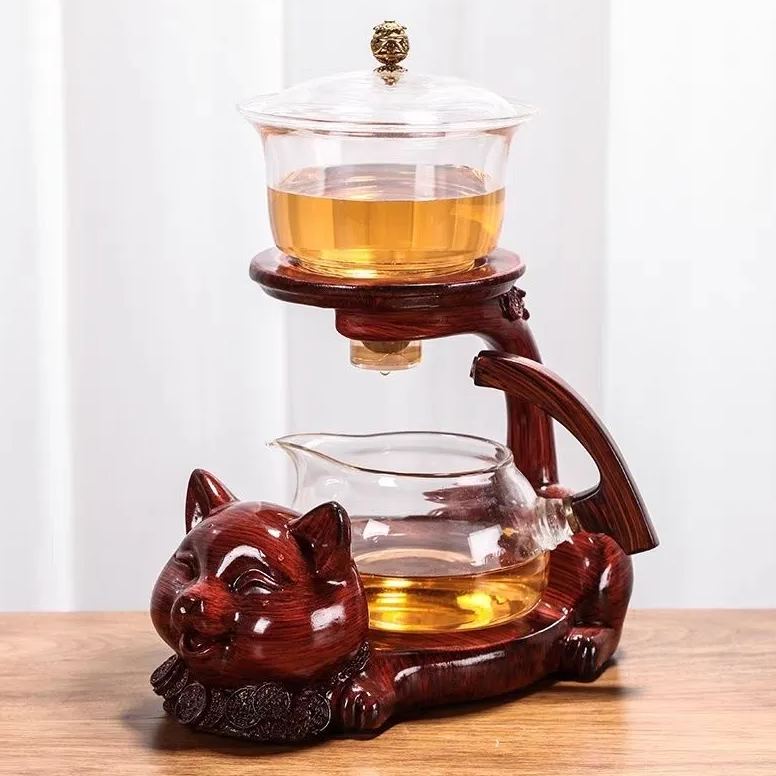
The trade-off is that a novelty body cannot double as decor the way the resin deer can. If the vessel has to work on a shelf and a tea table, skip it. If it only has to work on a desk, the Magic Semi-Automatic Teapot, Novelty Pig Shaped Tea Set is the pick that gets a reaction.
Pick 5: Rotating Cat Style Ceramic Tea Set
The lucky cat, and the most serviceable set on this list. It arrives as a full ceramic set: a pale green waving cat with a red scroll bearing the characters for attracting wealth and treasure, six matching cups, and a fair cup for sharing. The material change matters. Ceramic holds heat longer than glass and does not shatter if it is knocked, which makes it the right answer for a shared table where the pot travels between hands.

It also works differently. A rotating base means the tea is decanted by turning the tray, not by pulling a valve, so there is no magnetic part to fail. That makes it the lowest-risk gift in the group, and it comes with six cups rather than one. The Rotating Cat Style Ceramic Tea Set is the pick for a shared table, and for anyone whose priority is that nothing can break.
Pick 6: Orange Teapot on Tree Trunk Base
Not an auspicious animal, but the best pure gift idea here, and the cheapest-looking one is not the reason. A citrus fruit sitting in a rustic trunk base reads as a harvest and abundance symbol without carrying religious or mythological weight, which makes it comfortable to give to anyone. It is a semi-automatic design with the same detachable brewing body as the deer builds, so the workflow is identical.

The limitation is decorative rather than functional: a tree trunk base is a wider footprint than a deer, and the trunk texture does not photograph as cleanly as the gilt antlers on a deer glass teapot. The Orange Teapot on Tree Trunk Base is the pick when the recipient is hard to read.
Side-by-Side Comparison
| Pick | Motif | Body material | Capacity (published) | Mechanism | Fragile part |
|---|---|---|---|---|---|
| 1. Golden Deer Magnetic | Deer | Borosilicate glass, resin stand | 350 ml brew bowl, 400 ml fair cup | Magnetic ball valve | Resin antler shelf |
| 2. Golden Deer Design | Deer | Borosilicate glass, resin stand | 300 ml brew bowl, 400 ml drip pot | Magnetic ball valve | Filter mesh |
| 3. Artistic Fish Stand | Fish | Glass, ornament stand | 300 ml | Magnetic ball valve | Bracket joint |
| 4. Novelty Pig | Pig | Glass body, novelty shell | 300 ml brew bowl, 350 ml drip pot | Magnetic ball valve | Glass body |
| 5. Rotating Cat Style | Lucky cat | Ceramic | 6 cups at 50 ml, 120 ml fair cup | Rotating base | Ceramics in transit |
| 6. Orange on Tree Trunk | Citrus | Glass, rustic base | 300 ml | Magnetic ball valve | Glass body |
Read that table down the capacity column rather than across it. Every deer glass teapot on this list, plus the citrus build, sits in the same band, so capacity will not decide between them. The mechanism column does: four of the six designs in this group use a magnetic ball valve, which is the component with a documented failure rate. Only the rotating ceramic set removes that variable entirely.
Capacity, Height and How Many Drinks You Get
Published capacities across the deer listings run from 200 ml on the smaller marketplace listings up to 400 ml in the lower pot, with brewing bowls quoted between 300 ml and 350 ml. One specialist listing puts the brewer at 350 ml with a fair cup of 400 ml to 500 ml and an overall height of 28 cm with a stand width of 18.5 cm (RORA product page, retrieved 23 October 2026). Another gives a 300 ml capacity at roughly 18 cm tall, with an optional six-cup set at 50 ml each (inovessa product page, retrieved 23 October 2026).
Convert that into glasses and the picture changes. At 50 ml per cup, a 300 ml bowl is 6 cups. At 80 ml for a proper small teacup, it is 3 to 4. A deer glass teapot at the top of that range is still not a family pot. Both figures are an estimate based on published bowl capacities rather than on measured pours, so treat them as a planning range. The gap between 6 small cups and 4 proper cups is the difference between a sampling pot for one person and a full pot for two, and it is why the capacity tiers in our best teapot for one and best teapot for two guides are the more useful reference for how many people you are actually serving.
Height deserves a separate note because the deer designs are tall rather than wide. At around 28 cm for the full column, a deer teapot wants a shelf or a clear section of counter, not a corner. The rotating ceramic set occupies a broader but far lower footprint, which is the trade you make when you give up the sculpture. Whichever you choose, measure the drop from your wall cabinet to the worktop before you order, because a 28 cm column and a 12 cm cabinet clearance do not coexist.
Materials and Thermal Shock
What borosilicate actually buys you
Borosilicate glass has silica and boron trioxide as its main glass-forming constituents. It is harder to break when dropped, more resistant to cracking from significant changes in temperature, and keeps a higher clarity over a longer period than ordinary soda-lime glass, at a slightly higher cost (per the Wikipedia borosilicate glass reference). That is the material case for choosing a borosilicate deer glass teapot over a soda-lime one.
The number that matters for a deer teapot specifically is the thermal shock margin. Borosilicate has a very low coefficient of thermal expansion, roughly 0.000003 per °C, which makes it more resistant to thermal shock than any other common glass and lets it take a temperature differential of about 166 °C without fracturing (per the same reference). The leading deer listings state working ranges of -20 °C to 150 °C and -20 °C to 151 °C, both well inside that margin (Amazon listings B0C7BRQCLV and B0C85NPF7Y, retrieved 23 October 2026). A single cold glass against a hot kettle is a survivable event, not a fatal one.
What the resin base means in practice
The resin deer is not a weakness in disguise. Resin is how these sculptures get their level of detail: a hand-painted gold finish, a lotus pattern and the textured surface on the body would all be harder to hold in fired ceramic at this size. It is also why the base is light enough to move with one hand and why the antler shelf needs to cradle the bowl properly rather than merely hold it.

Two practical rules follow. First, the resin base never goes in the dishwasher and never sits in boiling water. A damp cloth is enough, and that is also the standard advice for the sculptural stands across this category. Second, resin is more vulnerable to a hard knock than ceramic, so a deer glass teapot with a resin stand wants a stable surface away from the edge of a counter. Our guide to cleaning glass teapots covers the glass half of that routine.
The Magnetic Valve: Where Deer Teapots Fail
Every deer teapot on the market that uses a magnetic mechanism depends on one very small steel ball sitting in the outlet of the brewing bowl. Align the handle, the ball lifts with a magnet and lets the tea through. It is elegant, it is the reason the pour is one-handed, and it is the part that buyers report failing. The Amazon reviews for the leading deer listing, retrieved 23 October 2026, carry three recurring themes that any buyer should know about before ordering.
The ball that is not in the box
The most serious complaint on the leading deer listings is that the magnetic ball, the part the entire mechanism depends on, arrives missing or does not function. One buyer describes receiving the set twice without the magnet and calls the result non-functional. Another reports that the strainer moves enough for leaves to fall into the pot. These are individual accounts on a marketplace listing, not a failure rate, but they point at the same weakness: this is a multi-part assembly and the small parts are the ones that get lost or arrive loose.
Thin glass and transit damage
The second theme is glass thickness. One reviewer calls the glass very thin and warns buyers to be careful with the piece, and another describes the set as beautifully made but easy to break. The same listings describe a triple-reinforced packaging approach with protective cotton moulds, a colour box and a carton, which tells you the maker already expects breakage in transit. Ask for the packaging specification in writing if the gift is travelling, and check the corner protection on arrival rather than assuming.

The third theme is positive and worth noting too: the appearance draws the strongest praise on those same listings, with buyers describing the piece as an instant conversation starter and a gift that lands well. The failure modes are mechanical, not aesthetic. Which is the argument for checking three things on arrival: the ball seated in the valve, the filter sitting square without glue, and the glass showing no chips at the rim or the base.
What You Can Brew in a Deer Glass Teapot
The mechanism suits loose leaf and any tea you want to watch. The bowl is clear borosilicate, so the leaves are visible through the whole steep, which is the whole argument for a glass pot in the first place. The leading deer listings describe the set as suitable for scented tea, loose leaf tea, tea bags and fruit tea (Amazon listing B0C85NPF7Y, retrieved 23 October 2026), and one of them recommends it for blooming tea because the shape opens visibly in the water.
The workflow maps onto gongfu-style brewing without being a gongfu set. Gongfu tea is best described as a specialised technique of brewing rather than a ritualised ceremony, and it runs on smaller vessels with a more potent leaf-to-water ratio than western brewing (per the Wikipedia gongfu tea reference). A 300 ml deer bowl is closer to a single-cup infusion pot than to a family pot, so a ratio around 8 g of leaf per 100 ml of water is the useful starting point rather than a western 2 g per 100 ml. If you want the visual side of that, our guide to teapots for blooming tea covers which shapes show a blooming ball best.
What it is not good for is a long session with many rounds, because the bowl drains in one go rather than holding volume back. For anyone brewing a dense shou pu-erh through 8 to 12 infusions, the small-volume reasoning in our best teapot for pu-erh guide applies: use a proper gaiwan or Yixing pot and keep the deer piece for the tea you want to watch.
Buying Checklist Before You Order
- Confirm the body is borosilicate and that a working range is stated, normally -20 °C to 150 °C or 151 °C, rather than a vague claim of heat resistance.
- Confirm the magnetic ball is included and ask what to do if it is missing. A seller with a spare-part process is a seller who ships these regularly.
- Check the filter is described as removable and glue-free, which is the difference between a clean pot and a permanently stained one.
- Ask for the assembled height. Around 28 cm is typical for the full deer column, and it will not fit under a low wall cabinet.
- Check the base material. Resin means a damp cloth only, never a dishwasher and never boiling water.
- Confirm the packaging format if the gift is being shipped, and ask what the damage policy is on arrival.
- Match capacity to the number of drinkers. A 300 ml bowl is roughly 4 to 6 small glasses, not a full pot for six people.
- Look for the specific detail you are buying, such as hand-painted gold or a gold lotus pattern, and verify it appears in the gallery images rather than only in the product name.
Our Recommended Deer Glass Teapots
If you would rather skip the checklist and start from the shortlist, the magnetic teapot collection at Elysian Tea Shop holds every semi-automatic design on this list, and the sculptural tea set range groups the pieces where the base is the point. Three things make the deer builds worth starting with. The antler cradle means no separate stand to assemble and no second object on the table. The glue-free filter means the pot comes clean after the first session rather than the twentieth. And the seated and standing deer both read clearly from across a room, which is the actual test for a gift that spends most of its life on a shelf.
For the wider comparison on the same theme, our guide to choosing a teapot material for daily use covers glass against ceramic and cast iron, and the guide to teapots with infusers covers the four filter mechanisms you will meet across this category.
FAQ
Are deer glass teapots actually good for brewing, or only for display?
They brew properly. A deer glass teapot with a borosilicate body and a stated working range of -20 °C to 150 °C or 151 °C on the leading listings gives a clean one-handed pour into the fair cup below. What they are not is a many-round pot: the bowl holds 300 ml to 350 ml and drains in one action, so it suits a single strong infusion or a visual steep far better than a twelve-round session.
What does fulu style mean on a deer teapot?
It refers to the styling of the deer sculpture, and the product gallery for the Golden Deer Design set uses the phrase directly, alongside resin material, hand-painted gold and a gold lotus pattern on the shelf. In cultural terms fulu combines the blessing of happiness with prosperity and standing, which is why a deer motif carries a warmer reading than a purely decorative animal. If the symbolism matters to the recipient, check which characters appear on the base before ordering.
How much tea does one brew of a deer teapot serve?
Published brewing bowls run from 300 ml to 350 ml, so a fill is roughly 4 proper 80 ml cups or 6 to 7 cups at 50 ml. Both figures are an estimate based on published capacities rather than measured pours, so plan a range rather than a headcount. The lower fair cup is quoted separately at 400 ml to 500 ml on some listings, which means the served volume can exceed the brewing volume because the two vessels are filled at different stages.
What is the most common complaint about deer teapots?
Missing small parts, specifically the magnetic ball that drives the release. Buyer reviews on the leading deer listing, retrieved 23 October 2026, include accounts of a set arriving without the magnet and of a valve that never opens, alongside complaints that the glass feels thinner than expected. None of these are about the deer itself. Inspect the ball, the filter seat and the glass rim on arrival, before the first pour.
Can the resin deer base go in the dishwasher?
No. The stand is resin, and resin is not rated for a dishwasher cycle, boiling water or thermal shock from a hot glass sitting down on it. A damp cloth for the sculpture and warm water with mild soap for the glass is the whole cleaning routine. This is the same separation of materials you will meet in our glass teapot cleaning guide, applied to a piece with two materials instead of one.
Is a deer teapot better than a lucky cat tea set as a gift?
For a gift that must travel and be handled by several people, the lucky cat ceramic set is safer: it comes with six cups and a fair cup, ceramic does not shatter, and a rotating base has no valve to fail. A deer glass teapot wins on presence and on symbolism tied to longevity and renewal. If the recipient drinks gongfu-style tea regularly, the deer is the stronger choice, and the guide to what gongfu tea is explains the small-vessel logic behind it.
– Belleza tradicional
Pick the Golden Deer Magnetic Semi-Automatic Glass Tea Set if the piece has to read as a deer in a photograph and you want the antler cradle with no separate stand to assemble. Pick the Juego de Té de Vidrio Semiautomático Magnético con Diseño de Ciervo Dorado if a low, discreet profile on a working tea table matters more than height, and if the glue-free removable filter settles your mind about cleaning. Pick the Rotating Cat Style Ceramic Tea Set if the gift will be used by several people or carried between hands, because there is no magnetic valve to fail and no glass to shatter. Pick the Artistic Fish Stand teapot if you want a sculptural base without the animal symbolism, and the Orange Teapot on Tree Trunk Base if the recipient is someone you know well enough to surprise and not well enough to interpret a deer.
Skip any deer glass teapot order where the seller cannot confirm three things in writing: that the body is borosilicate, that the magnetic ball is included, and the assembled height. A listing that states the working range, the filter construction and the packaging format has already done the work this guide spends most of its length describing. Browse the creative design glass tea set range and the full glass tea set range once you know which of the six you are buying, and check the piece over the moment it arrives.
 ES
 EN
 DE
 PT
 FR
 JA