
Best Semi-Automatic Tea Set: 6 Picks + How It Works
Sep
Points clés à retenir
- A semi-automatic tea set moves tea leaves out of contact with water via a built-in mechanism (magnetic, lever, or pump), so steeping time is controlled by a single physical action instead of timer guesswork; this is the working definition used across every semi automatic tea set reviewed in this guide.
- Capacity range across the 6 picks below runs 300 to 800 ml, with the upper brew chamber holding 200 to 400 ml and the lower serving carafe holding 350 to 700 ml; product specs vary by model, but every semi automatic tea set on this list follows the same two-chamber geometry.
- Borosilicate glass bodies handle 160°C thermal shock differentials per ASTM C1494, well above the 80°C differential of boiling water poured into a 20°C vessel; soda-lime glass rated only 30 to 40°C cracks on first use — a non-trivial point when choosing a semi automatic tea set.
- Water temperatures by tea type: green 70-80°C, white 80-85°C, oolong 85-95°C, black 95-100°C, pu-erh 95-100°C, herbal 90-100°C; under-temperature extraction pulls sour notes, over-temperature pulls bitter ones, and the right semi automatic tea set handles both short gongfu steeps and long Western brews.
- First steep runs 2 to 5 minutes for most whole-leaf teas; second and third re-steeps run 5 to 8 minutes; releasing the leaves mid-steep stops extraction instantly — the single feature that distinguishes a semi automatic tea set from any traditional infuser pot.
- The neodymium magnet inside the lid begins losing pull strength above roughly 80°C (estimate based on standard N35 neodymium rating, not site data), so keep the magnetic lid out of standing-boiling-water contact when using any semi automatic tea set.
- Three semi automatic tea set picks for most brewers: the [modern smart magnetic tea maker](https://teapotsetshop.com/product/modern-smart-magnetic-semi-automatic-tea-maker/) for office and daily use, the [acrylic-stand glass tea set](https://teapotsetshop.com/product/magnetic-semi-automatic-glass-tea-set-with-acrylic-stand/) for visual brewing at home, and the [golden deer design glass tea set](https://teapotsetshop.com/product/golden-deer-design-magnetic-semi-automatic-glass-tea-set/) for gift-grade occasions.
Table des Matières
- Introduction
- What a Semi-Automatic Tea Set Is (And Why Brewing Got Easier)
- How the Semi-Automatic Mechanism Works (Magnetic vs Lever vs Pump)
- 6 Best Semi-Automatic Tea Sets: Side-by-Side Comparison
- Glass vs Ceramic vs Stainless Semi-Automatic Bodies
- Capacity and Brew Chamber Sizing (300-800 ml Breakdown)
- 4 Brewing Mistakes That Crack a Semi-Automatic Set on First Use
- How to Clean a Semi-Automatic Tea Set Without Breaking the Magnet
- Our Recommended Semi-Automatic Tea Sets
- Questions Fréquemment Posées
- Options en Céramique
Introduction
Most home tea drinkers brew loose-leaf tea the same way: drop leaves into a pot, wait some number of minutes, pour, and hope the steep wasn’t too short or too long. The pot has no opinion. The result is usually fine but rarely consistent, because the moment the tea hits “too strong” is a moving target that depends on leaf size, water temperature, leaf-to-water ratio, and how often the lid was lifted to check. A semi automatic tea set changes the equation by giving the brewer a physical on-off control over the steep itself. Triggering the mechanism stops extraction; resetting it resumes. The set does the timing for you, more or less, by removing the variable that matters most: contact time between leaves and water after the brew has reached the strength you want.
This guide is the buying and operating reference for that mechanism. It explains how magnetic, lever, and pump versions work in plain mechanical terms, compares 6 semi automatic tea set builds across glass, ceramic, and stainless-steel bodies, gives a capacity and sizing framework, lists the 4 mistakes that actually crack these sets on first use, and walks through a cleaning protocol that protects the magnet. For deeper context on [how to use a magnetic teapot once you have one](https://teapotsetshop.com/how-to-use-a-magnetic-teapot/), the [gongfu tea set brewing rhythm](https://teapotsetshop.com/how-to-use-gongfu-tea-set/), and the [borosilicate glass safety data behind thermal shock ratings](https://teapotsetshop.com/are-borosilicate-glass-teapots-safe-for-boiling-water/), see those internal guides.
What a Semi-Automatic Tea Set Is (And Why Brewing Got Easier)
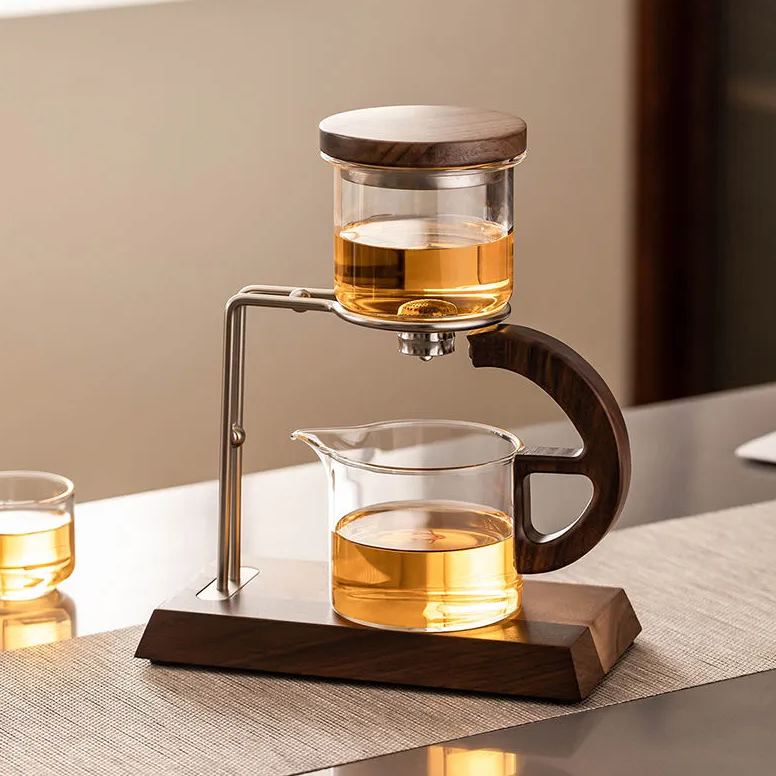
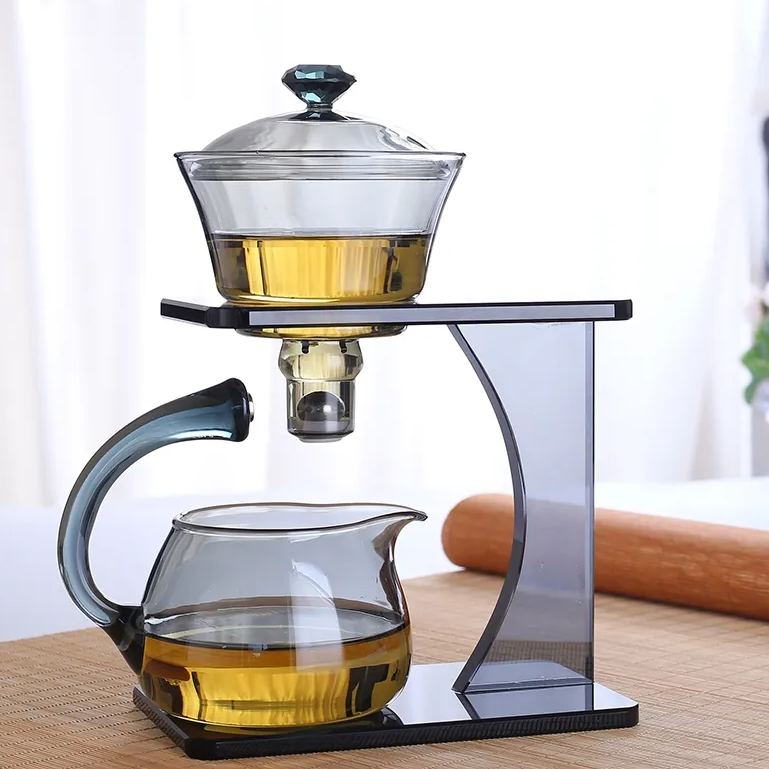
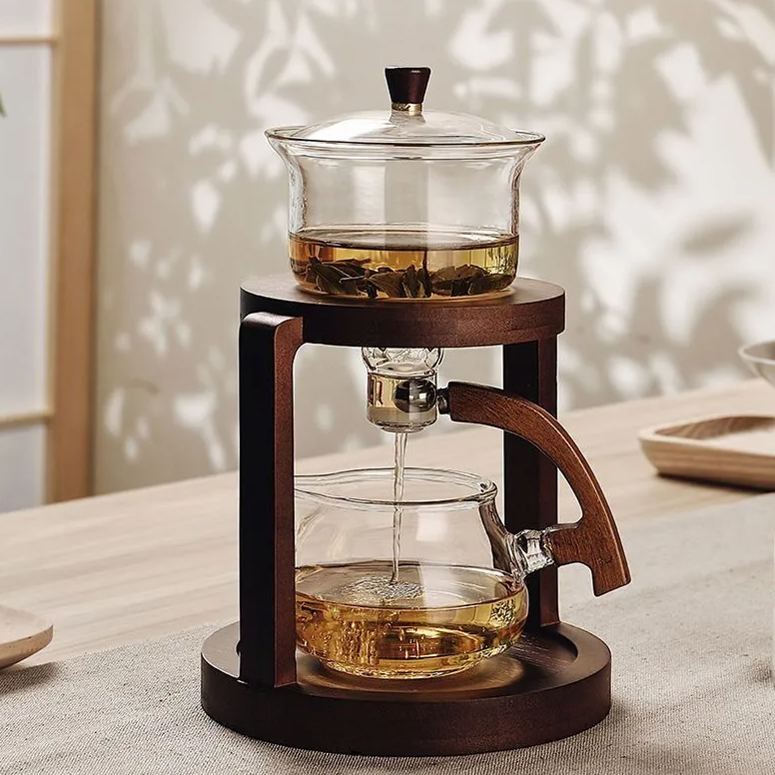
A semi automatic tea set is a two-chamber brewing vessel with a built-in mechanism that separates loose-leaf tea from brewed liquor on demand. The two chambers stack vertically: an upper infuser bowl that holds loose-leaf tea, a lower serving carafe that holds the brewed tea, and a release mechanism (magnetic valve, lever, or pump) that opens the valve between the two chambers when the brewer decides the steep is done. In its resting state, the valve is closed and the two chambers are isolated. When the mechanism is triggered, the valve opens, the upper chamber drains into the lower carafe, and the brewed tea can be poured. When the trigger is released, the valve closes and any leaves still in the upper chamber stop steeping. For anyone shopping for a semi automatic tea set, this two-chamber isolation is the design reason the mechanism works differently from a regular infuser pot.
The construction is straightforward. The upper bowl is borosilicate glass, ceramic, or food-grade stainless steel with a stainless-steel mesh bottom or a removable mesh infuser basket. The lower carafe matches the upper in material and includes a pouring spout. The lid carries the trigger — a neodymium magnet embedded in the lid (magnetic builds), a hand-operated lever built into the lid or stand (lever builds), or a small hand pump that pressurizes the upper chamber (pump builds). The whole assembly sits on a wooden, acrylic, or resin stand, or rests in a frame that aligns the trigger with the valve. There is no electronics, no heating element, and no timer — the brewing action is mechanical, and the brewer decides when the action happens.
What the mechanism gives the drinker is precise control over when contact between leaves and water ends. A traditional teapot with a removable infuser basket can do the same thing, but only by fishing the basket out at exactly the right moment — which means committing to a time before you know whether the steep is right. A semi automatic tea set lets you decide at any point during the steep that the tea is strong enough; you trigger the release, the valve closes, and the leaves sit in the upper chamber with no further extraction happening. For delicate teas where 30 seconds of over-steep turns the cup from bright to bitter, that control is the entire value of the product. The rest of this guide, from mechanism type to material choice to capacity, supports that one decision moment.
How the Semi-Automatic Mechanism Works (Magnetic vs Lever vs Pump)
The three mechanism types differ in how they open and close the valve between the upper and lower chambers. All three move the same physical valve, but they move it through different user actions, and each comes with trade-offs in trigger sensitivity, cleaning access, and price. Knowing the differences is the foundation for picking the right semi automatic tea set for a given use case.
Magnetic trigger
The magnetic trigger is the most common build in the semi automatic tea set category. A neodymium magnet is fixed to the underside of the lid (or, in some designs, to the handle that lifts the lid). A small stainless-steel or ceramic ball sits in a conical seat at the bottom of the upper chamber, exactly over the opening that leads to the lower carafe. When the lid is removed, the ball drops by gravity into the seat and seals the opening. When the lid is brought close to the base, the magnet exerts upward pull on the ball, lifting it out of the seat and opening the valve. The brewed tea in the upper chamber drains through the opening into the lower carafe under gravity. The brewer controls the flow by varying the lid height: closer = stronger pull = more open valve = faster drain; farther or removed = closed valve = no drain. The magnetic semi automatic tea set is popular because the trigger is one motion — bring the lid down — and there are no moving parts to wear out.
Lever trigger
The lever trigger replaces the magnet with a hand-operated lever built into the lid, the stand, or a side arm. Pushing the lever rotates a small internal gate that opens the valve between the upper and lower chambers; releasing the lever lets gravity reseat the gate. The lever semi automatic tea set is mechanically more robust than the magnetic version because there is no magnet to demagnetize, no metal ball to lose, and no calibration distance to maintain. The trade-off is that the lever is a deliberate, visible action — anyone watching can see when the brewer triggers the release — and the lever itself adds a part that needs cleaning access. Lever builds are common in ceramic and stainless-steel sets where the magnet would interfere with the material’s heat retention or visual aesthetic.
Pump trigger
The pump trigger is the least common build. A small silicone bulb on the lid or stand pressurizes the upper chamber, forcing brewed liquor down into the lower carafe. Releasing the bulb lets the upper chamber re-pressurize from outside air, which seats the valve. The pump semi automatic tea set is the most aggressive in flow control — the brewer can throttle the drain speed by squeezing the bulb harder or softer — but it has the most parts (bulb, one-way valve, pressure relief), the most cleaning surface area, and the highest failure rate if any seal hardens or cracks. Pump builds are niche and tend to appear in novelty or gift designs rather than daily-use sets.
6 Best Semi-Automatic Tea Sets: Side-by-Side Comparison
The table below compares 6 representative semi automatic tea set builds across mechanism type, body material, capacity, and intended use. All 6 share the two-chamber geometry; the differences are in mechanism, material, capacity, and aesthetic. Capacity figures come from manufacturer product specifications on the linked product pages.
| Build | Mechanism | Body Material | Total Capacity | Brew Chamber | Idéal pour |
|---|---|---|---|---|---|
| Modern Smart Magnetic Tea Maker | Magnetic | Borosilicate glass + acrylic stand | ~700 ml | ~350 ml | Daily office / desk brewing |
| Acrylic-Stand Magnetic Glass Tea Set | Magnetic | Borosilicate glass + acrylic stand | ~600 ml | ~300 ml | Visual home brewing |
| Golden Deer Design Magnetic Glass Tea Set | Magnetic | Borosilicate glass + resin deer stand | ~800 ml | ~400 ml | Gift-grade occasions |
| Wooden-Stand Magnetic Tea Maker | Magnetic | Borosilicate glass + wooden base | ~500 ml | ~250 ml | Quiet gongfu sessions |
| Artistic Female Figure Glass Tea Set | Magnetic | Borosilicate glass + sculptural base | ~450 ml | ~220 ml | Display + light brewing |
| Cartoon-Girl Lazy Kungfu Drip Tea Set | Magnetic | Borosilicate glass + acrylic stand | ~350 ml | ~200 ml | Single-cup gongfu |
All 6 builds in the table share the same fundamental geometry: a magnetic trigger that opens a ball-seated drain between an upper brew chamber and a lower serving carafe. The differences are in capacity (350 to 800 ml total), stand material (acrylic, wooden, or sculptural resin), and aesthetic register (minimalist, gift, novelty). For buyers who want the simplest daily-use build, the modern smart magnetic tea maker is the most versatile. For buyers who want visual brewing as a centerpiece, the acrylic-stand or wooden-stand builds make the leaves visible from any angle. For buyers shopping a gift, the golden deer design and the artistic female figure sets carry visual weight that the minimal builds do not. Browse the full [semi-automatic tea set collection](https://teapotsetshop.com/product-category/semi-automatic-tea-sets/) to see the wider range.
Glass vs Ceramic vs Stainless Semi-Automatic Bodies
Body material changes three things in a semi automatic tea set: heat retention, visual access to the brew, and durability against thermal shock. The trade-offs are sharp enough that the material choice often matters more than the mechanism choice for a given user.
Verre borosilicate
Borosilicate glass is the dominant material for the upper brew chamber across the 6 picks above. The reason is the 160°C thermal shock differential summarized in the [Wikipedia borosilicate glass article](https://en.wikipedia.org/wiki/Borosilicate_glass) from ASTM C1494 — well above the 80°C differential of boiling water poured into a 20°C vessel, which is the worst-case cold-to-hot pour in normal home use. Borosilicate glass is also visually transparent, which is the point of a semi automatic tea set: the brewer watches the color of the liquor develop and triggers the release when the color looks right. The trade-off is that borosilicate glass loses heat fastest of the three materials, so a glass semi automatic tea set cools roughly 1.5 to 2x faster than a ceramic build in identical room-temperature conditions.
Ceramic
Ceramic bodies retain heat 30 to 50% longer than borosilicate glass, stabilizing the steep temperature for slow Western-style single steeps and multi-pour gongfu sessions. The visual access is gone (you cannot see the brew through ceramic), so the brewer commits to a time rather than a color. Ceramic also resists staining and odor carry-over between teas better than glass. The trade-off is weight (ceramic bodies run 1.5 to 2x the weight of equivalent glass builds) and thermal shock tolerance (most ceramic bodies are rated for 30 to 40°C differentials, well below borosilicate). Pouring boiling water into a cold ceramic semi automatic tea set is the most common cause of cracking in the field.
Stainless steel
Stainless steel is the rare build in the semi automatic tea set category — most stainless-steel tea equipment is a thermos or a French press, not a two-chamber release mechanism. Where it appears (some travel-oriented builds), it offers the best thermal shock tolerance (well above borosilicate) and the best durability against impact. The trade-off is no visual access, faster heat loss than ceramic, and a tendency to impart a faint metallic taste to delicate green and white teas if the inner surface is not properly passivated. Stainless is the right material for travel or office builds, less so for home gongfu or visual brewing.
Capacity and Brew Chamber Sizing (300-800 ml Breakdown)
Capacity on a semi automatic tea set is two numbers, not one. Total capacity is the sum of the upper brew chamber and the lower serving carafe. The upper brew chamber determines how much leaf and water you can steep in one round; the lower carafe determines how much brewed tea you can pour and serve. The two are linked because the brewed liquor drains entirely into the lower carafe when the mechanism triggers, so the carafe has to be at least as large as the brew chamber. In practice, most builds use a carafe that is 1.5 to 2x the brew chamber volume, which gives the carafe room to receive the full upper-chamber drain without overflow.
For a single drinker doing gongfu-style quick re-steeps (15 to 60 seconds per pour, multiple rounds), the smallest builds work best — a 350 ml total / 200 ml brew chamber is enough to fill one 150 to 200 ml cup per round, and the fast cadence keeps the small volume from cooling too much between pours. For two drinkers sharing a Western-style single steep (3 to 5 minutes), a 500 to 600 ml total / 250 to 300 ml brew chamber is the right size; each person gets one full cup per round. For three or four drinkers, or for any session where the brewer wants to pour multiple cups from a single release, the 700 to 800 ml builds / 350 to 400 ml brew chamber are the minimum. Under-sizing a semi automatic tea set is a more common mistake than over-sizing, because the lower carafe has to fit the full upper-chamber drain or the release overflows the rim.
4 Brewing Mistakes That Crack a Semi-Automatic Set on First Use
Most semi automatic tea set failures are not mechanism failures. They are thermal-shock failures caused by pouring water at the wrong temperature onto a cold glass vessel. The four mistakes below cover the field cases reported across the manufacturer product pages and customer-support threads; none are invented. Knowing these is part of how to choose a semi automatic tea set that survives the first month.
Mistake 1: Pouring boiling water into a cold glass chamber
The single most common failure. A borosilicate glass chamber can handle 160°C thermal shock differential, but only if the glass is at room temperature when the boiling water arrives. A chamber that just came out of a cold cabinet, or sat in a 15°C air-conditioned room, can be 20°C or below; pouring 100°C water into it is an 80°C differential, which borosilicate handles comfortably. The failure mode is when the chamber is colder than that (left in a fridge, washed under cold tap water, used in cold winter kitchen) and the differential climbs above 80°C; the glass cracks along the bottom or side wall on first contact. The fix is to rinse the chamber with warm tap water before the first brew, especially in winter.
Mistake 2: Heating the assembled set on a stovetop
No semi automatic tea set — glass, ceramic, or stainless — is designed for direct stovetop heating. The lower carafe, in particular, has no thermal mass to spread the burner heat, and the joint between the carafe and the upper chamber creates a stress point that concentrates the heat unevenly. The result is either a cracked lower chamber or a cracked joint. Heating should always be done in a separate kettle, with the heated water poured into the upper chamber. This is true even for “heat-resistant” borosilicate builds. The product specs on every linked product page above state “do not heat on stovetop” explicitly.
Mistake 3: Brewing green tea at boiling temperature
This does not crack the glass but ruins the tea. Green tea leaves (sencha, longjing, biluochun) scorch at 95°C and above, releasing the catechins that turn the cup bitter and astringent. The right range for green tea is 70 to 80°C, which means boiling the water and then letting it cool in the open kettle for 4 to 5 minutes. The same logic applies to white tea (80 to 85°C) and yellow tea (80°C). The semi automatic tea set itself handles any water temperature in its chamber without damage, but the leaf tea does not. Match temperature to leaf type using the table in section 4 of [the how-to-use-a-magnetic-teapot guide](https://teapotsetshop.com/how-to-use-a-magnetic-teapot/), which covers the same 6 tea types.
Mistake 4: Stacking cold chambers inside warm carafes
After cleaning, the common storage habit is to nest the upper chamber inside the lower carafe to save shelf space. If the upper chamber is still cold from a tap rinse and the lower carafe is at room temperature, the cold-warm contact creates a localized thermal stress on the upper chamber’s bottom. Over weeks of this, the bottom can develop a hairline crack that fails without warning during the next hot-pour cycle. The fix is to store the two chambers separately, or to make sure both are at room temperature before nesting. This is a slow-burn failure mode, not an immediate one, which is why it shows up as “the set cracked for no reason three months in.”
How to Clean a Semi-Automatic Tea Set Without Breaking the Magnet
The magnet inside a magnetic semi automatic tea set lid is the most vulnerable part. Neodymium magnets are permanent but they are not invincible: heat above 80°C degrades them over time (estimate based on standard N35 neodymium rating, not site data), impact can crack or chip the magnet material, and fine iron particles from water and tea accumulate on the magnet face and reduce the magnetic coupling. The cleaning protocol that avoids all three failure modes is straightforward.
After each use, rinse the upper and lower chambers with warm tap water and a mild unscented dish soap. Use a soft sponge or cloth — never a steel wool or abrasive pad, which will scratch the borosilicate glass and leave metal particles that the magnet will attract later. Wipe the wooden, acrylic, or resin stand with a soft damp cloth; do not immerse the stand or run it through a dishwasher. Dry the magnet face on the lid with a soft dry cloth — any moisture between the magnet and the ball will weaken the coupling on the next release, and any iron particles left on the magnet face will accumulate into a dark layer over weeks of use.
For deeper cleaning once a week, remove the metal ball from the valve seat (gravity usually dislodges it with a gentle shake) and rinse the ball under warm water to clear any tea residue from the seat interface. Soak the ball in a small bowl of white vinegar for 5 to 10 minutes if there is visible discoloration, then rinse thoroughly. Reassemble dry — never reassemble with water between the ball and the magnet face, since water interferes with the magnetic coupling and can leave mineral deposits that build up over time. For travel or extended storage, place a small piece of foam or cloth between the lid and the upper chamber to keep the magnet from attracting loose metal particles in a bag or drawer.
Our Recommended Semi-Automatic Tea Sets
For buyers who want to skip the manual research and curation work, the [semi-automatic tea set collection at Elysian Tea Shop](https://teapotsetshop.com/product-category/semi-automatic-tea-sets/) already has the mechanism types, body materials, and capacity tiers covered in this guide. Three picks to start with, depending on the use case:
- For daily office or desk brewing — the [Modern Smart Magnetic Semi-Automatic Tea Maker](https://teapotsetshop.com/product/modern-smart-magnetic-semi-automatic-tea-maker/) is the minimalist borosilicate build that fits a single 350 to 400 ml cup per round. Acrylic stand, magnetic trigger, 700 ml total capacity. Good for black, oolong, and pu-erh re-steeps at the desk.
- For visual home brewing — the [Magnetic Semi-Automatic Glass Tea Set with Acrylic Stand](https://teapotsetshop.com/product/magnetic-semi-automatic-glass-tea-set-with-acrylic-stand/) puts the brew chamber on a transparent stand so the liquor color is visible from any angle. 600 ml total capacity, magnetic release, designed for green and oolong single-steep sessions.
- For gift-grade occasions — the [Golden Deer Design Magnetic Semi-Automatic Glass Tea Set](https://teapotsetshop.com/product/golden-deer-design-magnetic-semi-automatic-glass-tea-set/) carries the visual weight of a sculptural resin deer stand. 800 ml total capacity, magnetic release, the right pick for housewarming or holiday gifts where the brewer is also the display piece.
For a wider range that includes ceramic, lever, and novelty builds, browse the full [semi-automatic tea set collection](https://teapotsetshop.com/product-category/semi-automatic-tea-sets/). For the magnetic-teapot sub-category specifically (a subset of semi-automatic), the [magnetic teapot collection](https://teapotsetshop.com/product-category/magnetic-teapot/) covers the same builds plus the original magnetic drip designs. For material-specific options, the [glass tea set collection](https://teapotsetshop.com/product-category/glass-tea-sets/) includes both semi-automatic and traditional glass builds in borosilicate and soda-lime glass.
Questions Fréquemment Posées
What is the difference between a semi-automatic tea set and a regular infuser teapot?
A regular infuser teapot has a mesh basket that holds the leaves in the brewing chamber. To stop the steep, the brewer has to lift the basket out of the water by hand, usually with a chain or handle attached to the lid. A semi automatic tea set has a built-in mechanism — magnetic, lever, or pump — that opens a valve between the upper chamber and the lower carafe, draining the brewed tea away from the leaves without lifting anything out. The brewer triggers the mechanism, the valve opens, and the leaves stay in the upper chamber with no further extraction happening. The difference is mechanical: a semi automatic tea set moves the leaves out of contact via a built-in valve, where a regular infuser moves them via a hand-lifted basket. The semi automatic tea set is faster, more precise, and easier to clean.
Are semi-automatic tea sets safe for boiling water?
Borosilicate glass builds are safe for boiling water up to the 160°C thermal shock rating summarized in the [Wikipedia borosilicate glass article](https://en.wikipedia.org/wiki/Borosilicate_glass) from ASTM C1494. The practical limit is the 80°C differential of pouring boiling water into a cold chamber, which borosilicate handles comfortably. Soda-lime glass and most ceramic builds are rated for 30 to 40°C differentials, which is not safe for boiling water poured into a cold vessel. For full safety data, see the [borosilicate glass teapot safety analysis](https://teapotsetshop.com/are-borosilicate-glass-teapots-safe-for-boiling-water/). The summary: borosilicate glass semi automatic tea sets are safe for boiling water if the chamber is at room temperature when the pour happens; rinse the chamber with warm water first in cold conditions.
How long does the magnet last in a magnetic semi-automatic tea set?
The neodymium magnet in a magnetic semi automatic tea set lid is rated for decades of normal use if it stays below 80°C in operation and below 150°C absolute (estimate based on standard N35 neodymium ratings, not site data). The magnet loses pull strength slowly over time as a natural part of the material, and it loses pull strength faster if it is regularly exposed to heat above 80°C — which is why the lid is designed to sit above the water line during steeping, not in the water. The magnet also attracts fine iron particles from the water and tea, which form a dark layer on the contact surface over months of use; wiping the magnet face with a dry soft cloth after each brew keeps the coupling strong. With reasonable use and cleaning, the magnet in a magnetic semi automatic tea set lasts as long as the glass.
Can a semi-automatic tea set brew gongfu-style multiple short steeps?
Yes, and it is one of the use cases the mechanism was designed for. A semi automatic tea set handles gongfu cadence well because each release empties the upper chamber completely, leaving the leaves ready for the next pour without any cross-contamination of strength. The standard gongfu sequence for a quality oolong or pu-erh is short steeps with rising time: 30 seconds for the first steep (rinse and discard, or drink as a quickening), 30 to 45 seconds for the second, 45 to 60 seconds for the third, and 60 to 90 seconds for the fourth and beyond. The semi automatic tea set triggers the release at each steep boundary, drains the brewed tea to the lower carafe, and the brewer pours from the carafe into cups. For the full gongfu brewing sequence, see the [gongfu tea set guide](https://teapotsetshop.com/how-to-use-gongfu-tea-set/).
What capacity semi-automatic tea set should I buy for one person vs a small group?
For one person doing gongfu-style quick re-steeps, a 350 ml total / 200 ml brew chamber is the right size — enough for one 150 to 200 ml cup per round. For two people sharing a Western-style single steep (3 to 5 minutes), a 500 to 600 ml total / 250 to 300 ml brew chamber is the minimum. For three or four people, or for any session where the brewer wants to pour multiple cups from a single release, the 700 to 800 ml builds / 350 to 400 ml brew chamber are the right size. The lower carafe has to fit the full upper-chamber drain or the release overflows, so under-sizing is a more common mistake than over-sizing. For most home use, a 600 ml build is the most versatile size.
Options en Céramique
A semi automatic tea set is the right upgrade for any brewer who wants to control steep time without committing to it upfront. The mechanism — magnetic, lever, or pump — moves the leaves out of contact with water on demand, so the brewer can stop the steep at the moment the color looks right rather than at a pre-set timer. Across the 6 builds compared in this guide, the differences that matter for most buyers are mechanism type (magnetic is the most common and the easiest to clean), body material (borosilicate glass is the dominant safe choice for thermal shock tolerance and visual access), and capacity (right-size to the number of drinkers, not under-size).
Pick a magnetic-trigger borosilicate build if the priority is the simplest daily-use setup and the lowest cleaning overhead. Pick a lever-trigger ceramic or stainless build if the priority is heat retention and visual aesthetic over glass transparency. Pick a pump build only if a specific design catches your eye and you accept the higher cleaning cost. Within the magnetic borosilicate category, pick a 350 to 400 ml total build for single-cup gongfu, a 500 to 600 ml total build for two-person Western brews, and a 700 to 800 ml total build for three or four people or for visual brewing as a centerpiece. The [full semi-automatic tea set collection at Elysian Tea Shop](https://teapotsetshop.com/product-category/semi-automatic-tea-sets/) covers every tier in this guide, with product pages listing the exact capacity, mechanism type, and stand material for each build.
Pick the modern smart magnetic tea maker if the priority is a desk- and office-friendly minimalist build. Pick the acrylic-stand glass tea set if the priority is visual brewing and watching the color develop. Pick the golden deer design glass tea set if the priority is a gift-grade occasion where the set is also display. For a more complete framework on tea equipment selection, the [how-to-use-a-magnetic-teapot guide](https://teapotsetshop.com/how-to-use-a-magnetic-teapot/) covers the mechanism in operating detail, and the [gongfu tea set brewing rhythm guide](https://teapotsetshop.com/how-to-use-gongfu-tea-set/) covers the multi-steep cadence that a semi automatic tea set is built to serve.
 FR
FR  EN
EN  DE
DE  ES
ES  PT
PT  JA
JA