
Best Teapot for Tea Tasting: 6 Picks for Comparing Teas
Nov
Introduction
A teapot bought for daily use and one bought for tasting solve different problems. The daily pot needs to be easy for one person to handle. The tasting pot has to make two teas look and taste different to a stranger. That is why the best teapot for tea tasting is a question about fairness, not about looks.
Professional tasters work to a written standard, and every best teapot for tea tasting answer starts there. The ISO 3103 method sets out 2 g of leaf for 100 ml of water, steeping times of 6 minutes, 5 minutes and 3 minutes, and a 20 second rest after the pour (per the Wikipedia ISO 3103 reference). It also requires a white porcelain cupping set, so both the liquid and the leaf can be examined (per the Wikipedia tea tasting reference).
This shop sells no cupping set, and none of the picks below is one. What follows is the home version of that idea: clear glass, equal volumes, fixed times and a clean reset between samples. It is a purchase guide for anyone running a tea comparison at home, and it names one vessel that cannot do the job.
L' best teapot for tea tasting has to earn its place on 5 counts, and every pick below is judged on the same 5 counts. The method comes first, then the picks, then a table, then a home session. Nothing rests on a blind taste test, because none was carried out.
Points clés à retenir
- The professional benchmark is a white porcelain cupping set, and this shop does not sell one. ISO 3103 sets out a 310 ml large pot, a 150 ml small pot, a leaf charge of 2 g for 100 ml of water, and white bowls of 380 ml and 200 ml (per the Wikipedia ISO 3103 reference). Clear glass is the honest home substitute for anyone hunting for the best teapot for tea tasting.
- Strength only repeats when leaf, water and time stay fixed, and the standard fixes all three. The method steeps black tea for 6 minutes, leaf green tea for 5 minutes and loose leaf green tea for 3 minutes, with a 20 second rest after pouring water through a 4–6 mm layer (per the Wikipedia ISO 3103 reference). A pot that cannot stop the steep on command cannot repeat a result, so no best teapot for tea tasting candidate can skip that mechanism.
- Colour is the fastest signal in a tea comparison, and it only works through a transparent wall. The professional cupping set is pure white so that both the liquid and the leaf can be examined (per the Wikipedia tea tasting reference), and the home answer copies those bowls of 380 ml and 200 ml in clear glass (per the Wikipedia ISO 3103 reference), so a best teapot for tea tasting setup reads 2 samples at a glance.
- Switching samples is the hard part, because tea easily retains odours and a rinsed pot is not the same as a clean one (per the Wikipedia tea reference). Gongfu tea practice keeps the first infusions at 10–15 seconds on a scale of 0.1 g precision (per the Wikipedia gongfu tea reference), and a removable basket is what gives the best teapot for tea tasting a clean break between two samples.
- Equal volume comes from a fairness pitcher, and the cha hai in gongfu tea is where the liquor blends into a more uniform composition before it reaches the small cups (per the Wikipedia gongfu tea reference). One ceramic set in this guide ships 6 cups of the same size (per the product image), which is enough for a tea flight served in one round, and a best teapot for tea tasting needs both.
- One vessel is ruled out. A French press may be used as a tea infuser, but most teas are infused only for a limited time and then removed from the water so that the drink does not become bitter (per the Wikipedia infuser reference), so a 2 g leaf charge in 100 ml of water has no way to stop early (per the Wikipedia ISO 3103 reference).
- Heat has a hard limit in one family of picks. Neodymium magnets lose coercivity sharply above 100 °C, and their Curie temperature sits at about 320 °C, so a magnet grade marked for a maximum of 80 °C is the safe working limit (per the Wikipedia neodymium magnet reference). A magnetic teapot used for tea tasting has to stay below that mark, and the best teapot for tea tasting has to respect it.
What a Tea Comparison Actually Requires
Tasting two teas properly means judging them against each other rather than against memory. A pot that makes a single excellent cup is useless here if it pours half as much into one glass as into the next. The best teapot for tea tasting removes variation from the comparison, so any difference the taster notices comes from the leaf and not from the pot.
Two traditions cover this job. The professional one uses a white porcelain cupping set with a fixed method. The home one uses clear glass with a fixed method. The professional version is the standard to aim at, and the home version is where most readers will look for the best teapot for tea tasting.
The professional standard
Tea tasting as a formal practice goes back to the Song dynasty, when formal tea-tasting parties became comparable to modern wine tastings and the proper vessel became part of the ceremony (per the Wikipedia tea culture reference). The method still exists on paper. ISO 3103 was first published in Britain as BS 6008:1980 and was revised in December 2019 (per the Wikipedia ISO 3103 reference). The best teapot for tea tasting inherits that old idea of the right vessel for the job.
The standard is precise about the parts that matter. It uses a 310 ml large pot, a 150 ml small pot, 2 g of leaf to 100 ml of water, and pours through a 4–6 mm layer while the liquid cools for 20 seconds (per the Wikipedia ISO 3103 reference). It steeps black tea for 6 minutes, leaf green tea for 5 minutes and loose leaf green tea for 3 minutes, then serves into bowls of 380 ml and 200 ml (per the Wikipedia ISO 3103 reference). Every one of those numbers matters for a best teapot for tea tasting.
The white bowl is not a style choice. A cupping set must be pure white, because the white walls allow examination of both the liquid and the leaf (per the Wikipedia tea tasting reference). White porcelain also hides the vessel, so the taster sees the tea and nothing else. That single decision is why the home version of the best teapot for tea tasting uses a different material.
What a home setup can borrow
Most of the standard transfers directly to a kitchen table. Equal leaf charge, equal water, equal time and equal volume per cup all work at home. Only the white porcelain does not transfer, and glass covers it in a different way. A clear wall shows the liquor colour of one tea beside the liquor colour of another, so two samples can be compared in a single glance (per the Wikipedia tea tasting reference). That is the whole of the home method, and it is what makes a best teapot for tea tasting a fair test rather than a lucky one.
One catalogue fact belongs in plain sight. Not one product in this shop publishes a capacity figure or a glass grade, so no volume is claimed for any pick below and no claim is made about the glass used (per the catalogue). The only sizes quoted are the ones printed on the product photographs, and those are marked as such. A best teapot for tea tasting cannot be judged on a volume nobody publishes.
Professional tasters brew each tea the way its own producer recommends, which means a comparison across makers uses different times and different leaf charges (per the Wikipedia tea tasting reference). A home tea comparison that holds every variable fixed is stricter in some ways and looser in others. The best teapot for tea tasting for a home table is the vessel that keeps the variables fixed for the longest.
The Five Requirements of a Comparison-Ready Tea Set
Five checks decide whether a pot can carry a comparison. They are listed in the order they usually matter: volume first, then strength, then colour, then the break between samples, then heat and cups. A set that fails the first check cannot be rescued by the other four, which is why equal volume comes first in any search for the best teapot for tea tasting.
1. Equal volume in every cup
Equal volume means every person receives the same amount of liquor, not the same amount of water. Gongfu tea practice solves this with the cha hai, a fairness pitcher where the liquor blends into a more uniform composition before it reaches the small cups (per the Wikipedia gongfu tea reference). A home setup borrows the idea in a different shape, with a serving pitcher that holds the whole batch so that each cup is poured to the same level. The best teapot for tea tasting therefore has one job above all others: the same drink in every cup.
The professional method solves it with a large bowl of 380 ml and a small bowl of 200 ml (per the Wikipedia ISO 3103 reference). At home the equivalent is one pour from a pitcher into a marked line, or a set of identical cups filled to the brim. Whatever the best teapot for tea tasting turns out to be, nobody should have to guess a volume.
2. Repeatable strength
Strength repeats only when leaf, water and time stay fixed. ISO 3103 charges 2 g of leaf to every 100 ml of water, then steeps for 6 minutes, 5 minutes or 3 minutes depending on the tea (per the Wikipedia ISO 3103 reference). That leaf to water ratio and a fixed steeping time are the two numbers a home session should copy. A fixed steeping time is the second half of the best teapot for tea tasting checklist.
Gongfu tea practice pushes the same idea further, with an electronic scale of 0.1 g precision and first infusions timed at 10–15 seconds (per the Wikipedia gongfu tea reference). A pot that leaves the leaf sitting in the water until the brewer decides to pour will never repeat. The mechanism has to separate leaf from liquor on command, which is why the best teapot for tea tasting is usually the pot with a real drain rather than a strainer that stays in the brew.
3. Visible liquor
Colour is the fastest signal in a comparison and it only works through a transparent wall. That is why the professional cupping set is white porcelain for the bowls, and why the home answer is clear glass instead (per the Wikipedia tea tasting reference). A good candidate lets a taster hold 2 cups up to the light and read the difference in the strength of the colour at a glance. No wall, no comparison, and no best teapot for tea tasting can work around that.
Glass also has numbers behind it. Borosilicate glass expands at about 3 × 10⁻⁶ K⁻¹ at 20 °C, which makes it far more resistant to thermal shock than soda-lime glass, and it can take a temperature change of about 330 °F (166 °C) without breaking (per the Wikipedia borosilicate glass reference). It still shatters if the change is sudden, and no product here is claimed to be made from it. A clear wall is only useful if it survives the heat, which is the other half of the best teapot for tea tasting decision.
Visibility is also why the best teapot for tea tasting is usually a glass vessel rather than a clay one. The white cupping set hides the pot on purpose, and a home pot has to do the opposite.
4. A clean break between samples
The hardest part of a comparison is the switch from one tea to the next. Tea easily retains odours, so a pot that held a heavy oolong an hour earlier can tint the next sample (per the Wikipedia tea reference). The best teapot for tea tasting has to wash in under a minute, and it must not keep yesterday’s leaf in a chamber that rinses badly.
Infusers help here. A shut-off infuser is left in the pot after the brewing process is complete, which keeps the leaf out of the served liquor (per the Wikipedia infuser reference). A removable mesh basket, rinsed under a tap between samples, gives a clean break that a fixed internal strainer cannot. A large hole infuser also needs a second filter to hold back fine dust (per the Wikipedia infuser reference). Fewer pieces between the leaf and the cup is what the best teapot for tea tasting rewards.
5. Enough cups, and heat that survives the flight
A tea flight means several samples in a row, and the first cup must still be warm when the last one is poured. Stoneware is supposed to keep the heat better than porcelain, which is a point in favour of a ceramic tea set (per the Wikipedia teapot reference). Not having to lift a hot pot at all is the other half of the answer, and that is what a stand or a rotating base solves. A flight of 6 samples is where heat and cup count decide the best teapot for tea tasting.
Heat has a limit in one family of picks. Neodymium magnets lose coercivity sharply above 100 °C, and their Curie temperature sits at about 320 °C, so a grade marked for a maximum of 80 °C is the safe working limit (per the Wikipedia neodymium magnet reference). A magnetic teapot used for tea tasting therefore belongs below that mark, and a pot with no magnet in it has no such ceiling. That ceiling is one reason the best teapot for tea tasting is not always the most advanced mechanism on the shelf.
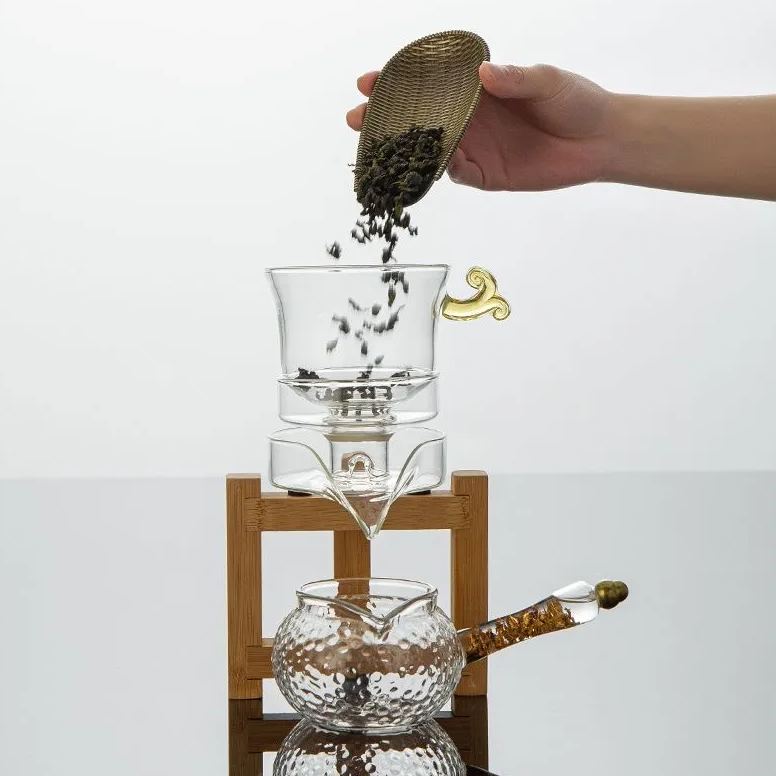
Pick 1 — Modern Minimalist Magnetic Semi-Automatic Drip Glass Tea Set
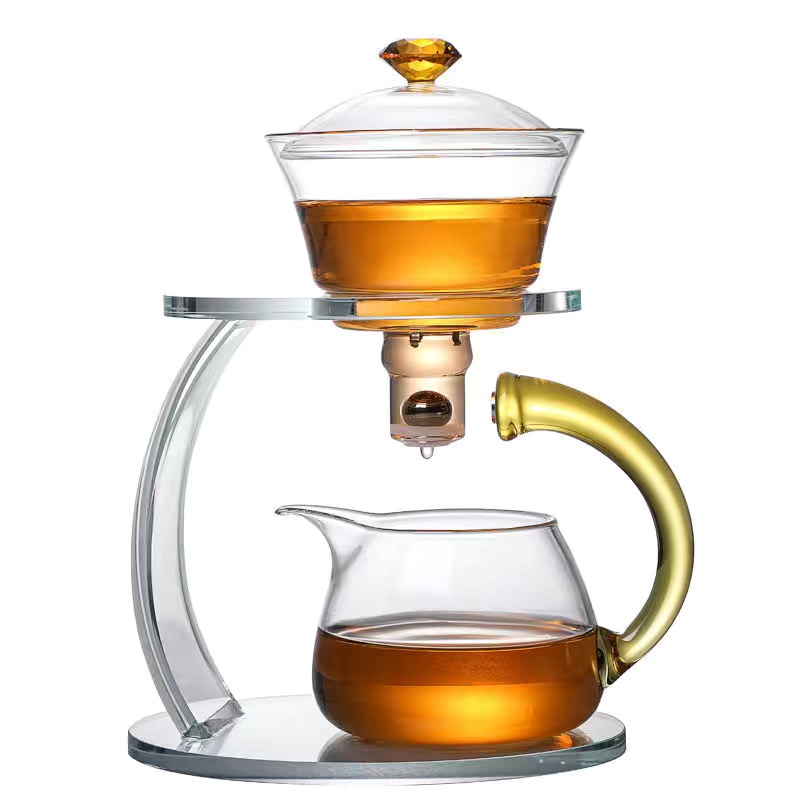
The pick that solves the two hardest requirements is the modern minimalist magnetic semi-automatic drip glass tea set. The product description names magnetic suction for secure assembly, a semi-automatic drip system for controlled dispensing, and a clear glass body that allows the steeping to be watched (per the product description). On the 5 point test, that puts it near the top of the list for the best teapot for tea tasting.
Two features make it a strong candidate for the best teapot for tea tasting. The magnet holds the brewing chamber in place and opens a drain on demand, so the leaf and the liquor separate the moment the steep ends. The chamber and the serving pitcher below it are both glass, so the colour of the brew can be read from above while the pour happens.
The lower pitcher is the part that matters in a comparison. Because the brewed liquor is decanted into a separate vessel before it reaches the cups, one batch can be divided into equal pours and set beside the next batch without touching the leaf again (per the product image). The old practice worked the same way, with tea decanted into a separate vessel and distributed into the small cups of several drinkers (per the Wikipedia teapot reference). The best teapot for tea tasting leans on that old habit rather than on any new one.
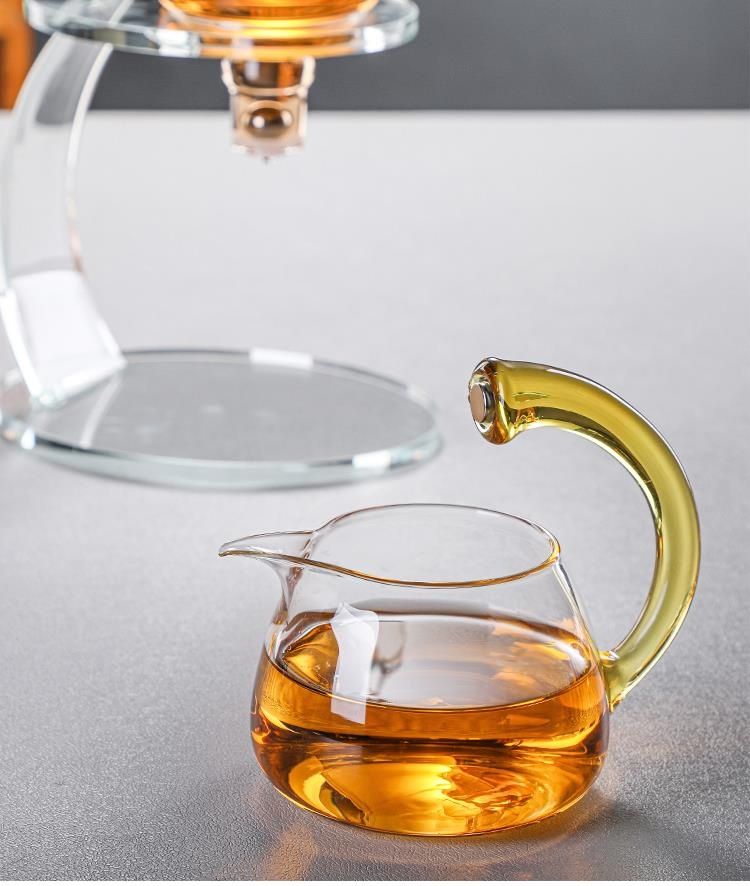
Where it falls short is heat and volume. The magnet sets the pace of the brew, and glass gives up heat faster than clay does. No capacity figure is published for this set, so the number of cups it serves has to be judged by eye. A taster who wants a printed volume spec should browse the glass tea set collection instead. That trade is worth making for anyone comparing 2 or 3 teas, and it is the trade the best teapot for tea tasting for most homes makes.
Even so, this is the best teapot for tea tasting in the shop for a first comparison rig, because it separates leaf from liquor on command and shows the colour of the brew while it happens. The mechanics are explained further in the guide to how to use a magnetic teapot.
Pick 2 — Automatic Pouring Ceramic Gongfu Tea Set
L' automatic pouring ceramic gongfu tea set is the pick for equal volume and for cups. The product description lists an automatic tilting mechanism for serving, durable ceramic, and a set that includes a teapot, a serving pitcher and multiple cups (per the product description). On equal volume and cup count, this is the strongest best teapot for tea tasting candidate in the shop.
That serving pitcher is the fairness pitcher that a comparison needs. It is the same object as the cha hai, the sharing cup in gongfu tea where the liquor blends into a more uniform composition before it reaches the small cups (per the Wikipedia gongfu tea reference). Pour the whole batch into the pitcher first, then fill every cup from the pitcher and each serving comes out the same size. Nothing else on the shelf does that job as directly, and equal volume is the first thing a best teapot for tea tasting has to deliver.
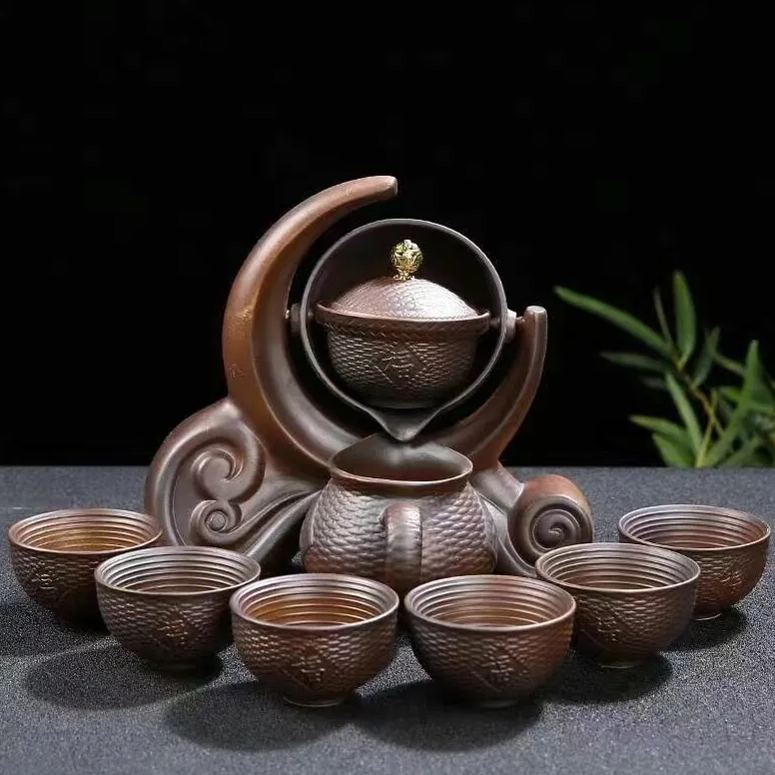
The cup count settles the flight question. The photograph of this set shows 6 matching cups around the pot (per the product image), which is enough to serve one round of samples to a small group without refilling in the middle of a comparison.
The heat and odour differences described in this guide are editorial judgement about material and wall, not laboratory measurements. Stoneware is supposed to keep the heat better than porcelain (per the Wikipedia teapot reference). For a tea flight of 5 samples in one sitting, that is worth more than any extra feature on the best teapot for tea tasting.
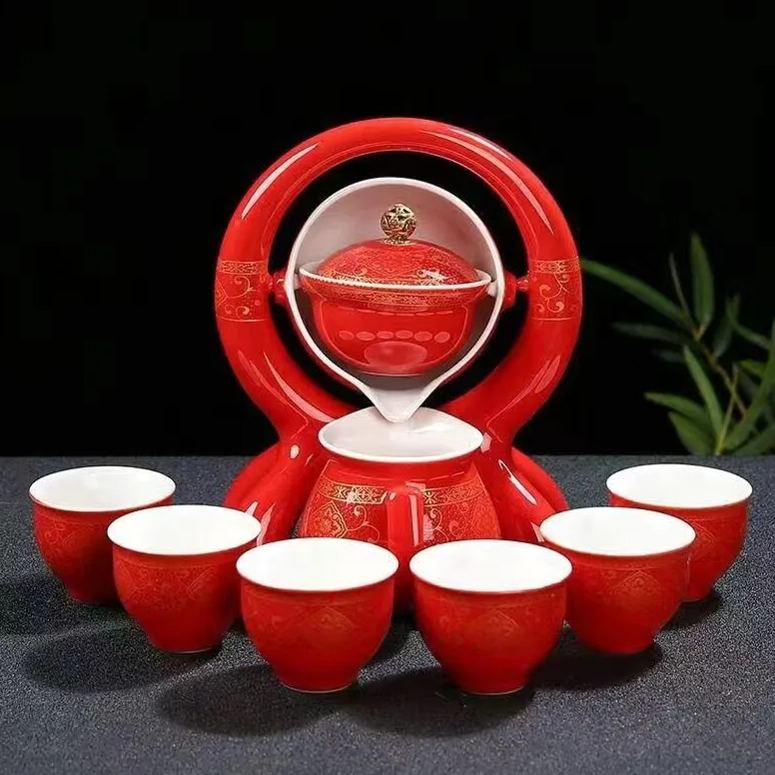
Where it falls short is colour. An opaque wall hides the liquor, so a taster cannot watch the colour deepen as the steep runs. It also asks for more care, since clay holds odours longer than glass and needs a full wash between samples. For the wider range, the ceramic tea set collection lists the rest of the shelf. Judged on colour alone, this is the weakest of the 6 candidates for the best teapot for tea tasting, and the reason is the wall.
For a session with several people and no interest in watching the brew, this is still the best teapot for tea tasting, because equal volume and cup count do more work than colour. The gongfu method behind it is set out in the guide to the best gongfu tea set.
Pick 3 — Elegant Glass Tea Brewing Set with Infuser
L' elegant glass tea brewing set with infuser is the pick for a clean break between samples. The product description describes a two-tiered system that separates tea leaves from the brewed tea, and a clear glass design that shows the whole brew (per the product description). That pair of features is why it reaches the shortlist for the best teapot for tea tasting.
The separation is the point. A shut-off infuser is left in the pot after the brewing process is complete, which keeps the leaf out of the served liquor (per the Wikipedia infuser reference). When the next sample is due, the infuser lifts out, the leaf drops straight into the bin and the pot is rinsed under the tap. That is the fastest clean break in this guide, and it is the reason this set reaches the shortlist for the best teapot for tea tasting.
The mesh strainer also solves a practical problem with fine leaf. A large hole infuser lets fragments of leaf escape, and a second filter is needed to hold back the dust (per the Wikipedia infuser reference). The metal mesh in this set does that job in one piece, which matters for powdered and broken leaf in a flight. Fine leaf is exactly where a comparison stalls, so the strainer is part of the best teapot for tea tasting judgement.
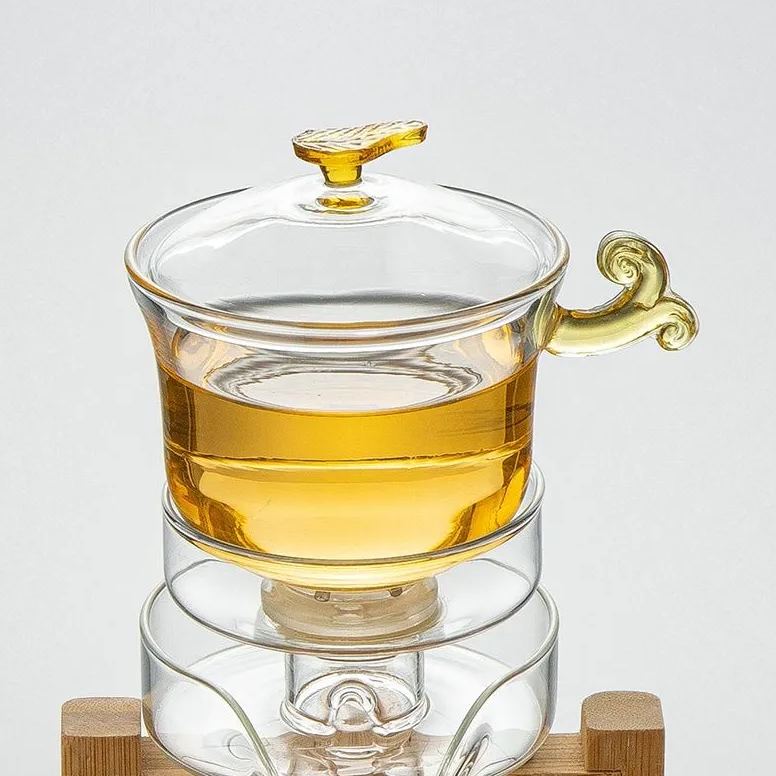
Where it falls short is equal volume. A two-tier brew sends the liquor straight into the cup below, which puts the taster back to estimating the pour by eye. The best teapot for tea tasting needs a pitcher in the chain for that reason, and this set has none. A taster who compares 4 or more samples at once should pair it with a marked cup.
The finer points of filter apertures are covered in the guide to the best teapot with infuser, and the cleaning routine matters as much as the brewing. The guide to cleaning a glass teapot explains how to keep a comparison free of yesterday’s odours. Both guides matter as much as the pot when the best teapot for tea tasting has to survive a second round.
Pick 4 — Triangular Glass Teapot Set
L' triangular glass teapot set is the pick for visible liquor. The product description states that the set is made entirely of clear glass, that the brewing process stays in full view, and that it includes a triangular teapot with 2 matching cups (per the product description). On visibility, that makes it one of the 2 strongest best teapot for tea tasting candidates here.
All glass is the point. Nothing is hidden, so the taster watches the leaves open, watches the colour deepen and watches it lighten as the pour dilutes the batch. A clear wall is the home answer to the white cupping set, and the white set exists only so that the liquid and the leaf can be examined (per the Wikipedia tea tasting reference). A glass teapot does the same job in the other direction, showing the taster everything the white set hides.
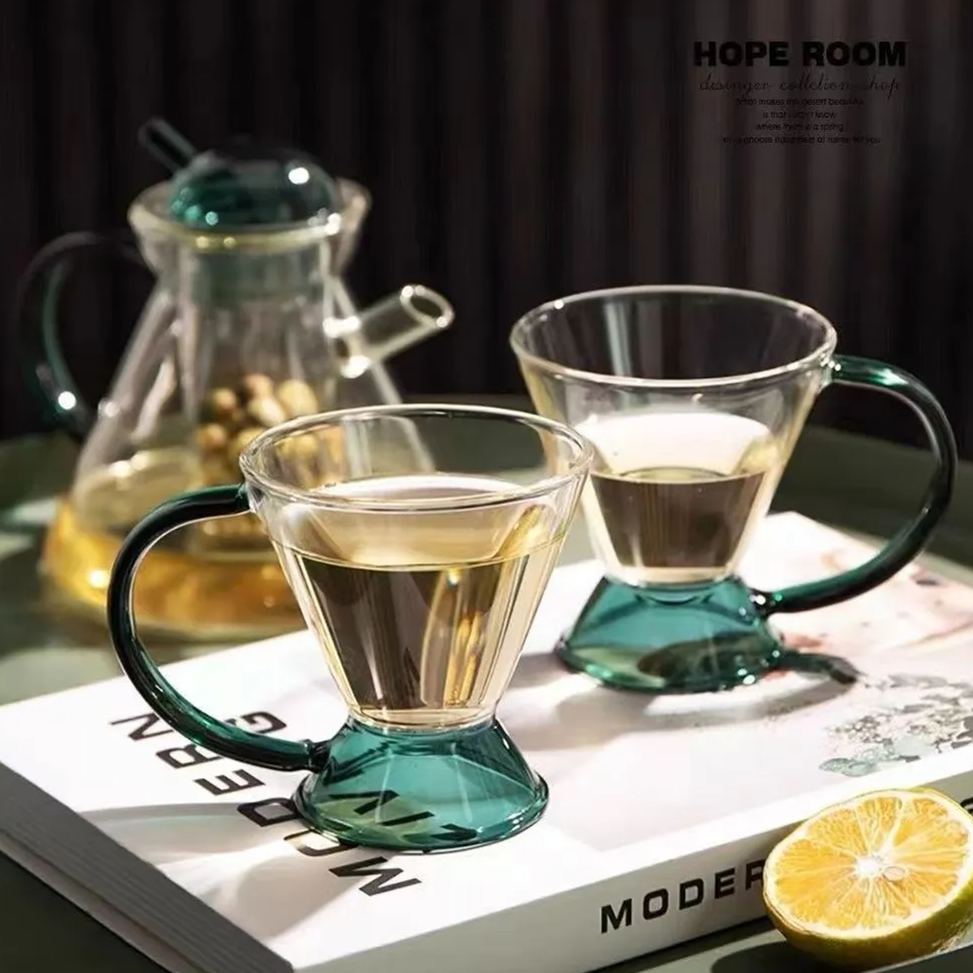
Two cups is enough for a side by side comparison, which is exactly how the colour check works. One cup holds the previous sample and one holds the new one, and the taster holds both against a light. With only 2 samples in flight at a time, a best teapot for tea tasting setup built on clear glass gives a cleaner read than any opaque pot.
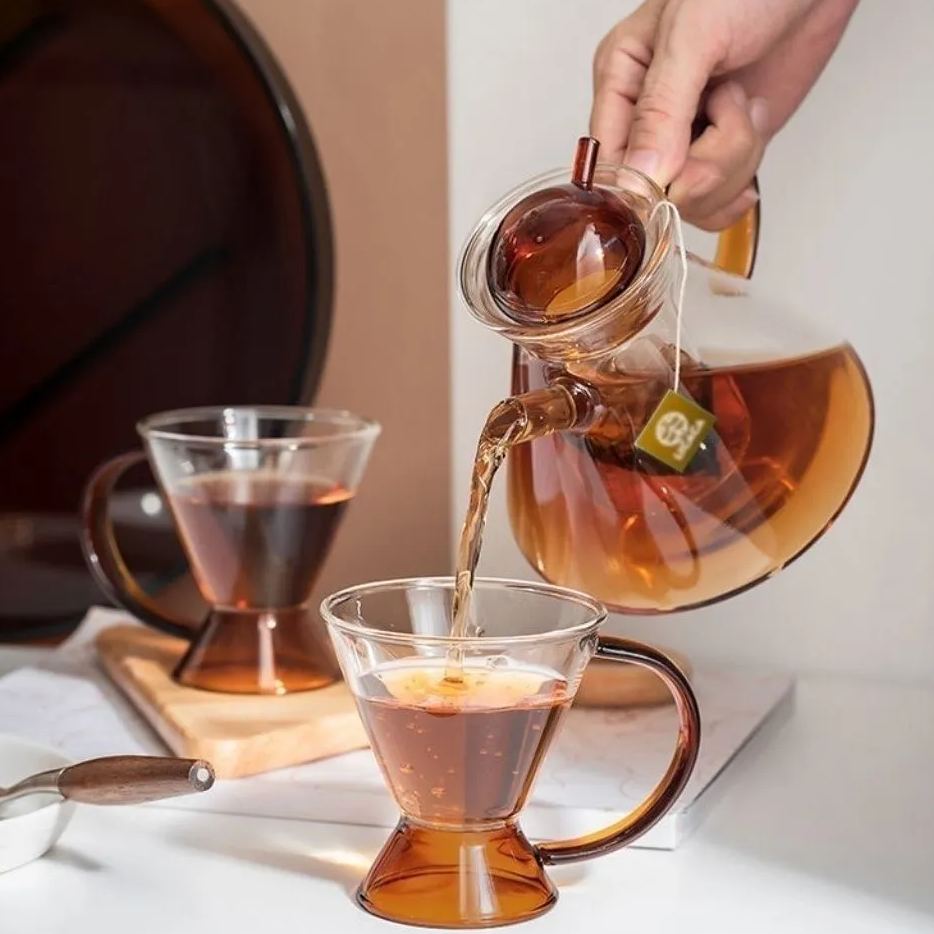
Where it falls short is control. There is no drain valve and no fixed timer, so the steeping time is judged by eye and the strength of a sample depends on the patience of the person pouring. Glass also cools faster than clay, so the last cup of a flight arrives cooler than the first. For a tea comparison with many rounds, that matters. Control is the price of visibility, and it is the price paid by most best teapot for tea tasting candidates built in clear glass.
For 2 or 3 teas compared in one round, this is the best teapot for tea tasting on colour alone, and the simplest to buy from the glass tea set collection. The trade is control for visibility, and for a colour check that is a fair trade.
Pick 5 — Modern Glass Two-Part Teapot with Metal Stand
L' modern glass two-part teapot with metal stand is the second clean-break pick. The product description names a two-part glass teapot that separates brewing from serving, a metal support, a clear body that allows full visibility of the steeping, and simple cleaning (per the product description). Simple cleaning is not a minor point for the best teapot for tea tasting, because a comparison is only as good as the last rinse.
Separating brewing from serving is what a comparison needs most after colour. When the upper chamber pours straight into the cup and the leaf stays in the chamber, switching samples takes one lift and one rinse. The old practice worked the same way, with tea decanted into a separate vessel and distributed into the small cups of several drinkers (per the Wikipedia teapot reference). The same habit still makes a best teapot for tea tasting easy to use.
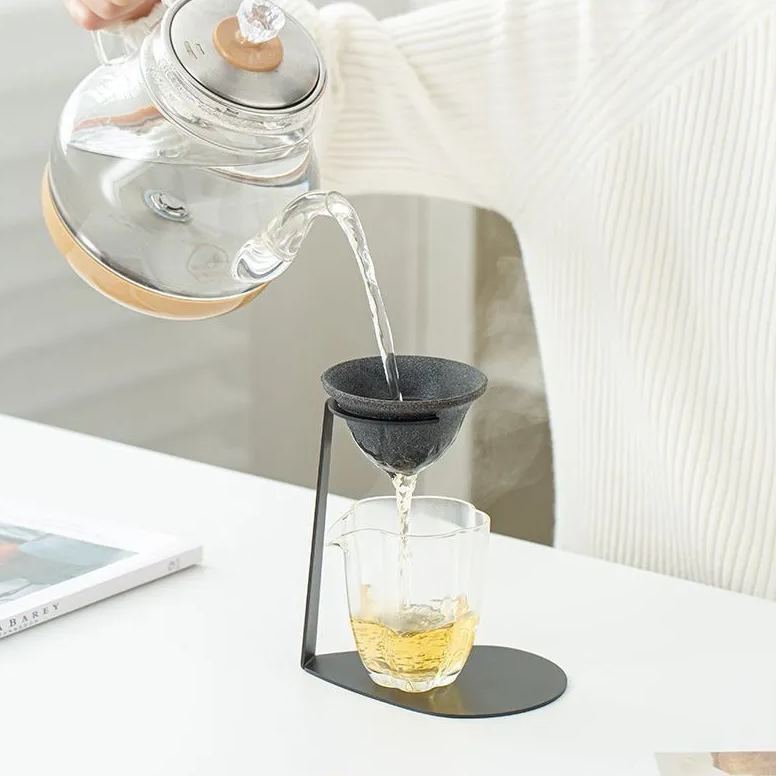
The stand keeps the hot pot off the table and keeps the pour steady, which helps when the same leaf charge is being brewed 4 times in a row. A metal cone strainer also holds back broken leaf without the fine mesh of a basket infuser (per the Wikipedia infuser reference). Fewer parts to rinse means more samples in a session, which is the practical test for the best teapot for tea tasting.
Where it falls short is volume. The pour goes into a cup rather than into a pitcher, so equal volume is left to the person pouring, and there is no fairness pitcher to correct it. Glass gives up heat quickly too, so a long flight cools down. For a single pot used by one taster, this remains the best teapot for tea tasting of the small batch sets.
The choice between this mechanism and a magnetic one is set out in the guide to magnetic versus rotating tea sets, and the teapot versus kettle question is covered in the guide to teapot versus electric kettle. Both comparisons matter when the best teapot for tea tasting has to justify its place on the table.
Pick 6 — Rotating Ceramic Tea Set, Blue and White
L' rotating ceramic tea set, blue and white is the pick for serving many samples without lifting a hot pot. The product description names a rotating dispensing mechanism for easy serving, ceramic construction with a traditional feel, and a blue and white design (per the product description). For a group session, that makes it the last candidate for the best teapot for tea tasting rather than a first one.
The rotating base is the same idea as the lazy susan, the turntable that lets a group share dishes without passing them around (per the Wikipedia lazy susan reference). Here it means the pot stays on its cradle and the pour happens at the table, so the person tasting never handles a full pot of near boiling water. Comfort at the table is part of what makes a best teapot for tea tasting usable for a whole sitting.
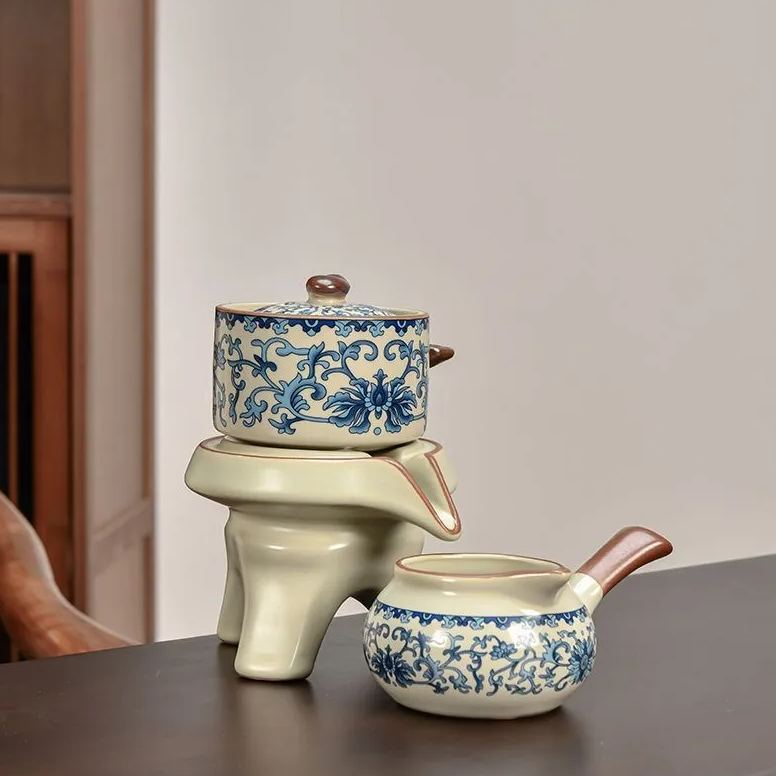
A ceramic body solves the heat problem of a glass flight. Stoneware is supposed to keep the heat better than porcelain (per the Wikipedia teapot reference), and a cup that stays warm while the next sample is poured gives a fairer taste test. The set also carries a fairness pitcher, which handles the equal volume requirement. That covers 2 of the 5 requirements at once, which is why the best teapot for tea tasting often sits next to a glass pot.
Where it falls short is visibility and control. The body is opaque, so the liquor colour cannot be watched, and there is no drain valve, so the steeping time is judged rather than timed. For a group tasting with many rounds of a finished tea, this is still the best teapot for tea tasting of the serving sets, and the wider range sits in the rotating tea set collection.
Side-by-Side Comparison
Each pick answers a different part of the same tea comparison. Reading the table as 6 separate answers rather than as one winner is the point, because most tasters need 2 of these vessels on the table at once. One pot steeps, and one pot holds the finished liquor while the next sample is brewed. The best teapot for tea tasting is usually two vessels rather than one.
| Pick. | Best at. | Weakest at. | Requirement it serves best. |
|---|---|---|---|
| Pick 1, magnetic drip glass tea set. | Separates leaf from liquor on demand and shows the brew while it happens. | Holds less heat than clay and publishes no volume figure. | Repeatable strength, the mark of the best teapot for tea tasting. |
| Pick 2, automatic pouring ceramic gongfu tea set. | Holds a full batch in a fairness pitcher and serves 6 matching cups. | Hides the liquor colour and holds odours longer than glass. | Equal volume, with a cha hai to blend the batch. |
| Pick 3, glass brewing set with infuser. | Lifts the leaf out for a fast clean break and keeps the brew visible. | Pours straight into the cup with no pitcher in the chain. | A clean break between samples. |
| Pick 4, triangular glass teapot set. | Shows the liquor colour with 2 matching cups for a side by side read. | Has no drain valve and no fixed timer. | Visible liquor, with nothing hidden in the wall. |
| Pick 5, two-part glass teapot with metal stand. | Separates brewing from serving and keeps the pot off the table. | Pours into the cup directly, so volume is left to the pourer. | A clean break, with a short rinse between samples. |
| Pick 6, rotating ceramic tea set, blue and white. | Serves many rounds without lifting a hot pot, and keeps heat in clay. | Hides the colour and has no drain valve. | Enough cups, with heat that survives the flight. |
No single row wins every column, and that is the useful part. A taster who cares about colour reaches for Pick 4, while a taster who cares about equal pours reaches for Pick 2. The best teapot for tea tasting for a full flight of 5 or 6 samples is usually Pick 1 brewing beside Pick 2 serving, because the two cover the requirements that do not overlap.
The Vessel to Skip for a Comparison
One product in this shop cannot do this job, and it is worth naming because it looks like the obvious answer. The french press coffee and tea maker is a dual-use glass and stainless steel vessel with a plunger (per the product description). It brews coffee well and it is a common way to make tea at home. It is also the vessel most often bought by mistake for the best teapot for tea tasting.
It still fails as the best teapot for tea tasting. A French press may be used as a tea infuser, but most teas are infused only for a limited time and then removed from the water so that the drink does not become bitter (per the Wikipedia infuser reference). The leaf sits in the water for the whole brew, and the only way to stop it is to plunge, which ends the infusion at one moment and cannot be undone.
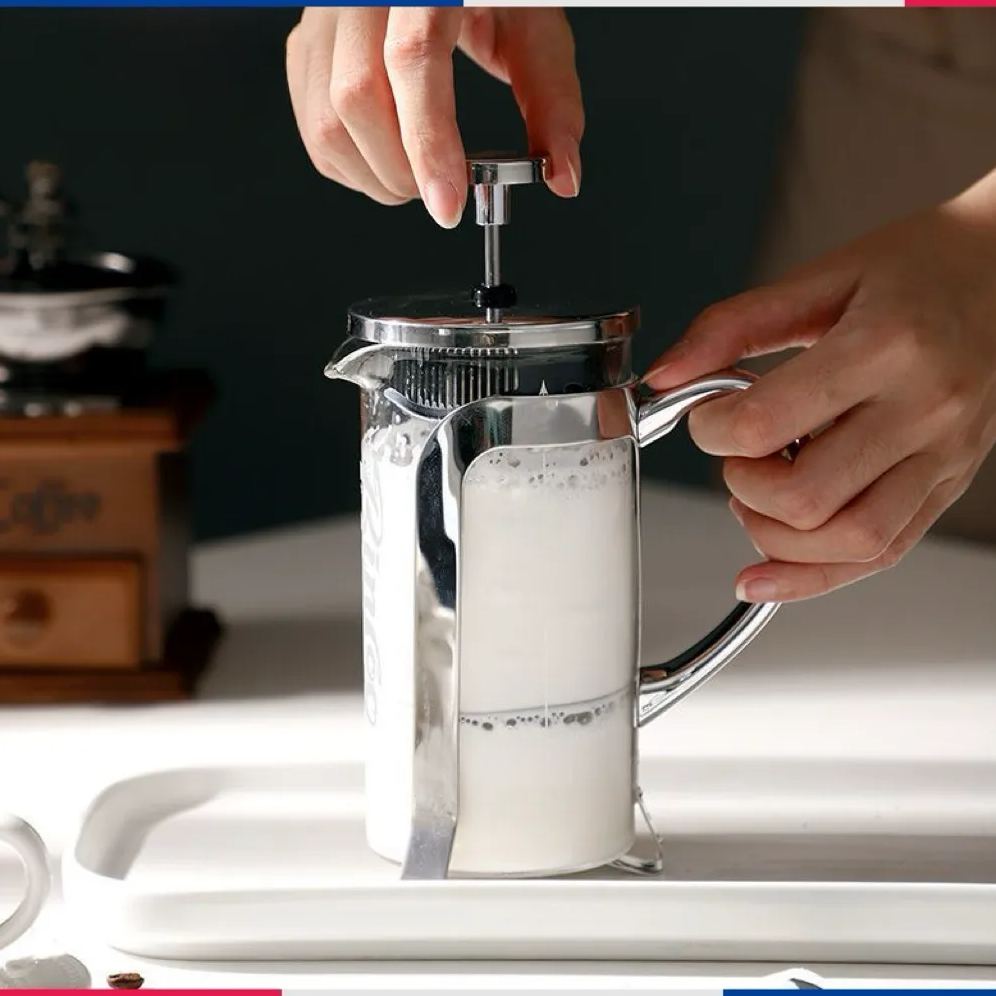
A comparison needs the opposite of that. The steeping time of 3 minutes for loose leaf green tea and 6 minutes for black tea are fixed points in the standard (per the Wikipedia ISO 3103 reference), and a press can only reach them by accident. It also pours a muddy leaf into the cup, so the liquor colour cannot be read cleanly, and it holds the leaf against the steel wall after plunging. Timing, not taste, is what rules it out of the best teapot for tea tasting shortlist.
There is one honest exception. A press works for a long cold brew or for a single tea that the household drinks every day, where repeatability does not matter. The best teapot for tea tasting is never a press, and the reason is timing rather than taste.
How to Run a Comparison at Home
A comparison session takes 20 minutes of setup and about 5 minutes per sample. The method below keeps every variable fixed, which is the whole point. It borrows the leaf to water ratio and the steeping times from the standard and drops the porcelain bowl for clear glass. Run it with a best teapot for tea tasting candidate and the samples stay comparable.
- Step one, set the table. Put 2 identical clear glasses in front of each taster, plus a small jug of hot water for rinsing, and place a plain white sheet under the glasses so the colour has a neutral background (per the Wikipedia tea tasting reference).
- Step two, fix the leaf charge. Weigh 2 g of leaf for every 100 ml of water, and use the same weight for every sample, because the leaf to water ratio decides the strength of the whole comparison (per the Wikipedia ISO 3103 reference).
- Step three, fix the water temperature. Boil once, then pour the same temperature for every sample, because a change in water temperature changes the strength faster than any other variable (per the Wikipedia ISO 3103 reference).
- Step four, fix the steeping time. Steep black tea for 6 minutes, leaf green tea for 5 minutes and loose leaf green tea for 3 minutes, and let the liquid rest for 20 seconds after the pour (per the Wikipedia ISO 3103 reference).
- Step five, pour to the same level. Decant the batch into a fairness pitcher first, then fill each cup to the same line, so the best teapot for tea tasting works as a measuring tool as well as a brewer.
- Step six, note the colour before the taste. Write down the colour of each sample while it is still hot, because a colour fades as the sample cools and the note is worth more than the memory (per the Wikipedia tea tasting reference).
- Step seven, reset between samples. Lift the infuser, drop the leaf, rinse the chamber under the tap and dry it, then brew the next sample with the same numbers (per the Wikipedia infuser reference).
- Step eight, taste in the same order. Compare the newest sample against the oldest one at the end, because a tea flight loses its edges after 4 cups, and the best teapot for tea tasting cannot fix a tired palate (per the Wikipedia tea culture reference).
Two numbers carry the method. The leaf to water ratio of 2 g to 100 ml decides the strength, and the steeping time decides the extraction, so changing either one changes the sample and invalidates the comparison (per the Wikipedia ISO 3103 reference). Everything else in the room can stay as it is. The best teapot for tea tasting simply has to keep those two numbers honest.
For the vessel side of the session, the guide to the best teapot with infuser explains the filter choices, and the guide to cleaning a glass teapot keeps the reset step honest. A rinse that skips the strainer leaves the next sample carrying the last one. A best teapot for tea tasting is only as good as the rinse that follows it.
Where to Start
If the manual comparison above feels like too much setup for a first attempt, the shortcut is a single vessel that does 3 of the 5 requirements at once. The magnetic teapot category holds the picks that separate leaf from liquor on command, and the glass tea set collection holds the picks that show the colour of the liquor. The shortcut picks 3 of the 5 requirements for the best teapot for tea tasting.
A note on what is not here. The ceramic tea set collection is the right shelf for cups and heat, and the rotating tea set collection is the right shelf for serving a group. Neither group replaces a clear wall when the task is judging colour, and no price is quoted for any set because none is published (per the catalogue). The best teapot for tea tasting is chosen on what it does, not on what it costs.
The decision framework in the final section below points at one pick for each kind of session. That framework is the best teapot for tea tasting shortcut: skip the 5 requirement test and start from the kind of session being run.
Questions Fréquemment Posées
What is the difference between a tasting teapot and a normal teapot?
A normal teapot is built to make 1 good cup. A tasting teapot is built to make several cups that can be compared fairly, which means equal volume per cup, a repeatable steeping time, and a clean reset between samples. The best teapot for tea tasting adds a drain that ends the steep on command, because a pot that runs until the leaf is removed cannot repeat a result (per the Wikipedia infuser reference).
Is a white porcelain cupping set needed to taste tea at home?
No. The white cupping set exists so that the liquid and the leaf can be examined (per the Wikipedia tea tasting reference), and clear glass serves the same purpose at home, since 2 cups of pale liquor can be held up to the light and compared. The white set also uses a fixed method, with 2 g of leaf for 100 ml of water and steeping times of 6, 5 and 3 minutes (per the Wikipedia ISO 3103 reference). Copying those numbers is what turns a best teapot for tea tasting search into a real comparison.
Is a glass teapot better than a ceramic one for comparing teas?
For colour, yes. Clear glass shows the liquor and the leaf as they develop, and an opaque ceramic body hides both. For heat, the ceramic set wins, because stoneware is supposed to keep the heat better than porcelain (per the Wikipedia teapot reference). The best teapot for tea tasting is usually a glass pot for brewing and a ceramic pot for serving.
How many cups does a comparison session need?
Enough for the number of samples in flight, plus 1 spare per taster for a second look. The standard serves into white bowls of 380 ml and 200 ml (per the Wikipedia ISO 3103 reference), and the ceramic set in this guide carries 6 matching cups (per the product image). 4 samples in one flight is comfortable, and 6 samples is the practical ceiling before the first cup goes cold. A set that carries 6 cups is the best teapot for tea tasting for a group, and a smaller set suits 2 or 3.
Can a French press be used to compare teas?
Not for a fair comparison. A French press may be used as a tea infuser, but most teas are infused only for a limited time and then removed from the water so that the drink does not become bitter (per the Wikipedia infuser reference). The leaf sits in the water for the whole brew, so the 3 minutes and 6 minutes of the standard cannot be hit twice in a row (per the Wikipedia ISO 3103 reference). A best teapot for tea tasting needs a second sample that matches the first.
Options en Céramique
Pick 1 if the session needs repeatable strength, because the magnetic drain ends the steep on command and the glass shows the brew. Pick 2 if the session needs equal volume for a group, because the fairness pitcher and 6 cups serve a whole round without refilling. Pick 3 if the session changes leaf often, because the removable mesh infuser lifts out and rinses in seconds. Pick 4 if the session is about colour, because 2 clear cups side by side read better than opaque pots. Those 4 lines are the best teapot for tea tasting in one line each.
Pick 5 if one person is brewing small batches alone, because the two-part glass teapot separates brewing from serving and rinses fast. Pick 6 if a group is tasting many rounds of a finished tea, because the rotating ceramic set serves without anyone lifting a hot pot. The best teapot for tea tasting for most homes is Pick 1 brewing beside Pick 2 serving, since the two cover equal volume and repeatable strength without overlapping.
Skip the French press, whatever else is bought. The starting point for most readers is the modern minimalist magnetic semi-automatic drip glass tea set in Pick 1, because a drain that stops the steep is the one feature that no other vessel in the shop can replace. That single mechanism is what separates a best teapot for tea tasting from an ordinary teapot.
Sources
Every figure quoted in this guide comes from one of the references below, or from a product photograph in this catalogue. Nothing else is used as evidence, and the best teapot for tea tasting judgement rests only on those sources.
- Wikipedia: tea tasting, for the white cupping set and the tasting procedure.
- Wikipedia: ISO 3103, for the pot sizes, leaf charge, steeping times and bowls.
- Wikipedia: tea, for odour retention and brewing behaviour.
- Wikipedia: tea culture, for the history of formal tea-tasting parties.
- Wikipedia: gongfu tea, for the cha hai, the 0.1 g scale and the 10–15 second infusions.
- Wikipedia: infuser, for shut-off infusers and the French press limitation.
- Wikipedia: teapot, for decanting, heat retention and the history of the strainer.
- Wikipedia: borosilicate glass, for the thermal expansion figure and the temperature change it survives.
- Wikipedia: neodymium magnet, for coercivity, Curie temperature and working limits.
- Wikipedia: lazy susan, for the rotating table.
L' best teapot for tea tasting is a vessel that makes the next sample as fair as the last one. Clear glass, a fixed leaf charge, a fixed steeping time, a clean reset and enough cups are the whole of it, and the 6 picks above each answer a different part of that list.
 FR
 EN
 DE
 ES
 PT
 JA