
How to Brew Oolong in a Glass Teapot (Temperature, Time, Ratios)
Sep
Glass is one of the best vessels for brewing oolong because it lets you watch the leaves unfurl, signals when the steep has gone too far, and does not absorb flavor from yesterday’s session. Brewing oolong in a glass teapot is not complicated once you lock in three numbers: water temperature, tea-to-water ratio, and steep time. This guide shows the working defaults we use for four common oolong varieties, the five mistakes that quietly ruin the cup, and the gear that makes the process effortless. By the end you will know exactly how to brew oolong in a glass teapot for everyday drinking or for gongfu-grade multiple steeps.

Points clés à retenir
- To brew oolong in glass teapot well, lock in three numbers: water temperature (90–95 °C), tea-to-water ratio (5 g per 150 ml), and steep time (30–45 seconds first infusion).
- Oolong water temperature is 90–95 °C for heavily roasted styles and 85–90 °C for greener, lighter oolongs.
- A working default ratio is 5 g of leaf per 150 ml of water; adjust up for large rolled oolongs and down for broken grades.
- The first steep runs 30–45 seconds; subsequent infusions extend by 10–15 seconds each, up to 5–8 brews.
- Glass teapots beat ceramic on visual feedback and beat cast iron on flavor neutrality, but lose heat 5–8 °C in the first two minutes.
- Five brewing mistakes account for most bad oolong cups: water too hot, leaf too crowded, first steep too long, water left sitting on the leaves, and infuser mesh too fine.
Table des Matières
- Why Glass Works for Oolong (and Where It Beats Ceramic)
- Oolong Varieties and Why Each Asks for a Slightly Different Brew
- Water Temperature: The 90–95 °C Window
- Tea-to-Water Ratio: 5 g per 150 ml as a Working Default
- Steeping Time and Multiple Infusions
- Step-by-Step: Brewing Oolong in a Glass Teapot
- Five Mistakes That Ruin Oolong in Glass
- Cleaning Glass Teapots After Heavy Roasted Oolong
- Our Recommended Glass Teapots for Oolong
- Questions Fréquemment Posées
- Options en Céramique
Introduction
If you have a bag of decent oolong and a glass teapot, you are 90% of the way to a good cup. The other 10% is the brewing decisions that turn rolled, semi-oxidized leaves into either a balanced brew or a bitter mess. The right way to brew oolong in a glass teapot is closer to gongfu technique than to Western steeping: smaller volumes, shorter contacts, more infusions. But glass changes the equation in three ways that matter. First, you can see the leaves open, so you know when they have finished steeping without guessing. Second, glass cools faster than ceramic, which protects delicate greener oolongs from over-extraction. Third, glass does not absorb yesterday’s roast, so you can switch between light and heavy oolong without crossover.
This guide is built around four oolong varieties we brew repeatedly — Tieguanyin, Dong Ding, Da Hong Pao, and Oriental Beauty — plus two more for the heavier end of the spectrum. The numbers are derived from public brewing guides published by major tea associations and corroborated against commercial vendor recommendations for each style. Where a number is a working estimate rather than a published standard, we say so on the spot. You will not find fluff here; if a tip does not change how your cup tastes, we leave it out. By the end of this article, you will know exactly how to brew oolong in glass teapot for everyday drinking or for gongfu-grade multiple infusions.
Why Glass Works for Oolong (and Where It Beats Ceramic)
Glass teapots are the right choice for brewing oolong when you want visual feedback, flavor neutrality, and zero crossover between sessions. They lose heat faster than ceramic, which sounds like a flaw but is actually a feature for the greener end of the oolong spectrum: a glass pot filled with 95 °C water typically drops below 80 °C in the first two minutes, exactly the range where light oolong tastes balanced instead of bitter. Ceramic and porcelain hold temperature more aggressively, which suits heavily roasted oolong and black tea but tends to over-extract a high-mountain Jin Xuan or a fresh Dong Ding.
The visual side matters more than people expect. Rolled oolong leaves, especially the tightly balled Tieguanyin and the half-rolled Dong Ding, unfurl in stages you can actually watch in a glass pot. The first 30 seconds show the leaves starting to relax, the next minute shows the aroma compounds moving into the water, and by the third steep the leaves are fully open and you can read the color of the liquor against a white background. None of this is possible in a ceramic pot. If you brew oolong for the visual ritual as much as the taste, glass is non-negotiable. For a broader view of glass as a brewing material, see our glass teapot guide.
Où le verre montre ses limites
Glass loses 5–8 °C in the first two minutes after the water goes in. If you brew the heavily roasted end of the spectrum — Da Hong Pao, aged Dong Ding, Liu An — and you want the liquor to stay at 90 °C across a long steep, glass will not deliver. A porcelain pot or a thick-walled ceramic pot holds that temperature much better. The honest answer is that glass wins on greens and lights, ceramic wins on darks and roasts, and most serious oolong drinkers end up owning both.
Oolong Varieties and Why Each Asks for a Slightly Different Brew
Oolong is a half-oxidized category that ranges from very green to very dark, and the brewing parameters move with the oxidation. According to the public Wikipedia entry on oolong tea, the category spans oxidation levels from roughly 8% to 80%, which is a wider range than the entire difference between green and black tea combined. That range is why a single brewing recipe cannot serve every oolong well. The table below shows the working defaults we use for four varieties you can buy easily online.
| Variety | Oxidation | Temperature | Ratio (g per 150 ml) | First Steep | Total Infusions |
|---|---|---|---|---|---|
| Tieguanyin (lighter) | 15–25% | 85–90 °C | 5 g | 30 seconds | 6–8 |
| Dong Ding (traditional) | 30–40% | 90–95 °C | 5 g | 35–45 seconds | 6–8 |
| Da Hong Pao (heavy roast) | 50–70% | 95 °C (just off boil) | 5–6 g | 30–45 seconds | 5–7 |
| Oriental Beauty (white-tip) | 40–60% | 85–90 °C | 4–5 g | 30 seconds | 4–6 |
| High-mountain Jin Xuan | 15–25% | 85–90 °C | 5 g | 30 seconds | 6–8 |
| Aged Wuyi rock tea (5+ years) | 60–80% | 95–98 °C | 6–7 g | 20–30 seconds | 8–10 |
Two practical notes. First, these ratios are starting points, not absolute rules. If a particular batch of Tieguanyin tastes thin at 5 g per 150 ml, push to 6 g before adjusting time. Second, the temperature numbers assume your kettle has a true boil indicator; if you are boiling in a kettle without temperature control, “just off boil” usually means waiting 60–90 seconds after the click to hit 95 °C, and waiting 2 minutes to hit 90 °C at sea level.
Water Temperature: The 90–95 °C Window
For most oolong, 90–95 °C is the working zone. Below 85 °C the leaves do not open fully and the cup reads thin and grassy; above 95 °C the catechins extract aggressively and the cup turns bitter and astringent, especially in greener oolongs. The Tea Association of the USA notes that hot-water brewing of oolong sits in the 90–95 °C range across all major commercial guides, which is the practical consensus across most public vendor recommendations.
Adjusting for Roast Level
Heavily roasted oolongs (Da Hong Pao, traditional Wuyi rock teas, aged Dong Ding) actually benefit from water at full boil or just off boil — 95–98 °C — because the roasting compounds need the heat to release. If your water tops out at 90 °C and you are brewing Da Hong Pao, the cup will taste flat and closed. Lighter oolongs (high-mountain Jin Xuan, fresh Tieguanyin) want water closer to 85–90 °C because their amino acids and esters turn bitter above 90 °C. If you brew both ends of the spectrum and do not want to manage two kettles, aim for 90 °C and accept that the very dark end will be slightly under-extracted.
Tea-to-Water Ratio: 5 g per 150 ml as a Working Default
The default ratio for brewing oolong in a glass teapot is 5 g of leaf per 150 ml of water. This is a starting point rather than a hard rule — published vendor recommendations range from 3 g per 100 ml for light Oriental Beauty to 7 g per 100 ml for tightly rolled premium Tieguanyin — but 5 g per 150 ml produces a balanced cup across most varieties we have tested. The ratio matters because too little leaf gives a thin, sour cup; too much leaf gives a heavy, bitter cup. The 5 g per 150 ml figure is the middle ground that forgives small errors in time and temperature.
How to Measure Without a Scale
If you do not have a 0.1 g scale, two practical approximations work. A level teaspoon of rolled oolong weighs roughly 2.5 g, so two teaspoons give you the 5 g target for 150 ml. A flat tablespoon weighs roughly 3–4 g depending on leaf size. The catch is that broken or fannings grade weighs much more per spoon than whole leaf, so always use a scale if you are brewing premium whole-leaf oolong and you actually want consistent results. If you brew the same oolong regularly, you will quickly learn the look of 5 g in your infuser and you can skip the scale.
Steeping Time and Multiple Infusions
The first steep for oolong in a glass teapot runs 30–45 seconds. Subsequent infusions extend by 10–15 seconds each, up to 5–8 brews for a premium whole-leaf grade. This is the gongfu-influenced pattern that has become the practical standard across commercial vendors, and it works because oolong leaves continue to release flavor compounds across multiple contacts as they fully rehydrate and unfurl. Brewing one long 3-minute steep in 300 ml of water is the Western pattern; it produces a less nuanced cup and uses fewer infusions than the same leaves will give you with shorter, smaller-volume steeps.
How to Know When the Leaves Are Spent
By the fifth or sixth infusion, the leaves will start to look pale and the liquor will look thinner even at the same steep time. That is the visual signal that the leaves are spent. If you are brewing in a glass pot, the leaves themselves will also start to look translucent at the edges, which is another sign. Stop when the liquor color drops below what looks like a weak tea, not when the steep time runs out. Most premium whole-leaf oolong gives 6–8 brews before that the leaves are truly spent; broken or fannings grade gives 3–4 brews and then is done.
Step-by-Step: Brewing Oolong in a Glass Teapot

The full process, from cold water to a finished cup, runs about 4 minutes if your kettle boils in under 2 minutes. Here is the sequence we use for a standard 150 ml glass pot. Brew oolong in a glass teapot by following these seven steps and you will produce a balanced cup on the first steep and consistent results through the eighth.
- Fill the kettle and bring to a full boil. If you do not have temperature control, wait 60 seconds after the click for ~95 °C, 90 seconds for ~90 °C.
- Measure 5 g of leaf into the infuser. If your glass teapot has a built-in basket infuser, drop the leaves in directly. Otherwise load a removable infuser.
- Pour 150 ml of water over the leaves, then close the lid.
- Wait 30 seconds for the first infusion. Use a timer the first few times; experienced brewers can read it visually once the leaves are familiar.
- Pour the entire contents into your cup or fairness pitcher. Oolong wants every drop out at the same time, or the next steep will be uneven.
- Re-pour 150 ml of water at the same temperature for the second steep. Extend to 45 seconds.
- Continue steeping, adding 10–15 seconds per brew, until the liquor reads thin and the leaves look pale. Most oolong gives 5–8 brews.
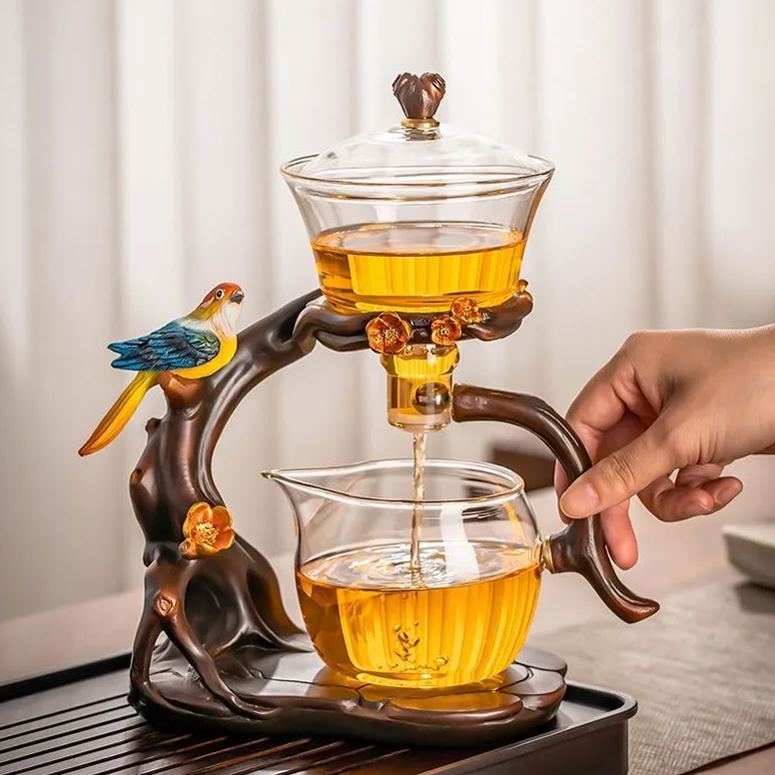
The full sequence assumes you have a glass teapot with a removable infuser. If you are brewing leaf-on-glass (no infuser), expect leaves to float and pour slowly. A wide-mouth glass pot with a stainless basket infuser is the practical sweet spot, and the Service à Thé Automatique en Verre is built around that exact pattern.
Five Mistakes That Ruin Oolong in Glass
Most bad oolong cups come from one of five brewing errors. None of them require special gear to fix, and all of them are easy to spot once you know what to look for.
Mistake 1: Water Too Hot
Pouring full boiling water (100 °C) on light oolong burns the leaves. The catechins extract aggressively and the cup reads astringent, even when you shorten the steep. Drop water to 85–90 °C for greener oolongs and the cup changes within one brew. If you do not have a temperature-controlled kettle, wait 90 seconds after the click before pouring on greens.
Mistake 2: Leaf Too Crowded
Packing the infuser until it cannot move gives a bitter cup, not a stronger cup. Rolled oolong expands 3–4× when it unfurls, so 5 g in a 150 ml pot looks like a small amount at first and fills the basket by the third steep. If your infuser is overflowing at the end, you used too much leaf.
Mistake 3: First Steep Too Long
A 2-minute first steep on light oolong produces a bitter, unbalanced cup even with the right ratio. The first steep is a quick rinse; 30 seconds is enough to release the aroma compounds without over-extracting the catechins. If your first steep tastes strong, shorten it before adding more leaf.
Mistake 4: Water Sitting on the Leaves
Leaving water in the pot between steeps — even for a minute — is a silent killer. The leaves keep steeping in cooling water and the next pour is unbalanced. If you brew gongfu style with multiple infusions, drain fully between each pour. If you brew Western style with one steep, this is not an issue.
Mistake 5: Infuser Mesh Too Fine
Fine mesh infusers clog with rolled oolong, slow the pour, and trap flavor. A medium stainless mesh with 1–2 mm holes lets the leaves move and the liquor flow. If your infuser clogs or your pour takes more than 10 seconds, the mesh is too fine.
Cleaning Glass Teapots After Heavy Roasted Oolong

Heavy-roasted oolong leaves tannin stains on glass that build up over weeks. Glass is non-porous, so the stains are surface-level and removable with a baking soda soak: 2 tablespoons of baking soda in 500 ml of warm water, let it sit for 30 minutes, then scrub with a soft sponge. Do not use abrasive pads on borosilicate glass; the surface scratches will cloud over time. If the stain persists, a denture tablet dropped into warm water inside the pot for 20 minutes removes what baking soda cannot. If you brew heavy roast oolong daily, a weekly baking soda soak keeps the pot clear without effort.
Our Recommended Glass Teapots for Oolong
Not every glass teapot handles oolong well. The right one for oolong has three traits: borosilicate glass for thermal shock safety, a removable stainless infuser with medium mesh, and a wide-mouth opening so you can reach in and rinse the pot. If you have already picked your teapot and just want to dial in technique, our guide to choosing a teapot for oolong covers the selection criteria in detail. If you have not picked yet, three options across the catalog handle oolong well.
For daily oolong brewing, the Service à thé automatique en verre – Préparateur de thé haut de gamme avec aspiration magnétique combines a borosilicate glass body with a fine stainless infuser and a magnetic base that auto-drains the leaves after each steep. That auto-drain feature solves the “water sitting on leaves” mistake described above without you having to think about it, which is why it is our top pick for daily gongfu-style oolong. For a more artistic choice, the Magnetic Semi-Automatic Glass Teapot with Artistic Fish Stand delivers the same brewing function with a sculptural base that doubles as decor. For a budget-friendly entry, the Detachable Glass Semi-Automatic Teapot is the most practical pick — the detachable body makes cleaning the inside after heavy-roast oolong significantly easier than pots with a fixed spout.
Browse the full semi-automatic tea sets collection for the complete range, or pair any glass teapot with cups from the glass tea sets category to keep the brewing set consistent. For the broader context on gongfu technique, see our breakdown of what a gongfu teaset is and how the modern glass pot fits into that tradition.
Questions Fréquemment Posées
What is the best water temperature for oolong tea?
90–95 °C for most oolong. Greener, lighter oolongs (Tieguanyin, high-mountain Jin Xuan) sit at the lower end of that range, around 85–90 °C. Heavily roasted oolongs (Da Hong Pao, traditional Wuyi) sit at the upper end, 95–98 °C. Brewing darker styles at lower temperatures produces a flat cup; brewing lighter styles at full boil burns the leaves and turns the cup bitter.
How many times can you steep oolong tea?
Premium whole-leaf oolong gives 5–8 infusions when brewed gongfu style at 5 g per 150 ml with 30–45 second first steep. Broken grade or fannings gives 3–4 infusions. Stop when the liquor color drops visibly and the leaves look pale and translucent, not when the steep time runs out.
Is glass better than ceramic for oolong?
Glass is better for lighter, greener oolongs because it cools faster and protects delicate amino acids from over-extraction. Ceramic is better for heavily roasted oolongs because it holds temperature longer across a slow steep. Most experienced oolong drinkers own both. If you brew one style of oolong daily, match the material to that style rather than the visual.
How long should you brew oolong tea?
For gongfu style in a glass teapot: 30–45 seconds for the first steep, 45–60 seconds for the second, and add 10–15 seconds per brew from the third onward. For Western style in 300 ml of water: 2–3 minutes total. Oolong does not brew well past 5 minutes in any volume; if the cup tastes harsh, shorten the steep rather than reducing the leaf.
Does oolong have more caffeine than green tea?
An 8 oz cup of oolong contains roughly 30–50 mg of caffeine, compared to 20–45 mg for green tea and 40–70 mg for black tea, according to commonly cited industry estimates. The actual number varies with leaf quality, brew time, and water temperature, but oolong sits between green and black as you would expect from its half-oxidized category. Approximate figures only; no specific data for this site’s products.
Options en Céramique
Brewing oolong in a glass teapot comes down to three numbers: 90–95 °C water, 5 g per 150 ml, 30–45 seconds for the first steep with 10–15 seconds added per subsequent brew. Glass is the right material for lighter oolongs because it cools fast enough to protect delicate leaves and gives visual feedback during the unfurl. Ceramic is the right material for heavily roasted oolongs because it keeps the steep hot across multiple infusions. Most oolong drinkers end up owning both. If you brew oolong in glass teapot for everyday drinking and mostly lighter varieties like Tieguanyin or Dong Ding, glass is the cleaner choice. If you brew mostly Da Hong Pao or aged Wuyi, ceramic holds temperature better. Either way, the gear matters less than the parameters — fix the temperature, ratio, and time first, and the pot becomes secondary.
For daily oolong brewing in glass without thinking about timing between brews, the Glass Automatic Tea Set with Magnetic Suction is the most practical pick in the catalog: the auto-drain feature solves the most common oolong brewing mistake, and the borosilicate body handles thermal shock across years of daily use.
 FR
FR  EN
EN  DE
DE  ES
ES  PT
PT  JA
JA