
Choosing a Travel Tea Set: What Actually Matters After Using 10+ Sets on the Road
The Night I Realized Travel Tea Sets Are Their Own Category
I was sitting in a tiny guesthouse in Kyoto, three weeks into a six-week trip through Japan, staring at a pile of broken porcelain at my feet. The teacup had slipped out of my hand while I was drying it with a scratchy hotel towel, and now there were four jagged pieces sitting in the sink like a reminder that I’d made a bad purchase. The teapot itself was fine. But the cup I’d brought from home was gone, and the matching saucer was chipped in a way that made me embarrassed every time I poured from it.
That was the moment I started taking travel tea gear seriously. Not as “the cute teapot I bring on trips” but as its own category of equipment, with its own rules, its own compromises, and its own weird little rewards. Since then I’ve gone through more travel tea sets than I’d like to admit. I’ve packed them in carry-ons, checked luggage, hiking backpacks, and once, embarrassingly, a tote bag that got rained on during a train transfer in Switzerland. Some have lasted a decade. Others didn’t survive the first trip.
This guide is everything I wish someone had told me before that Kyoto night. It’s not about what’s pretty on a product page. It’s about what actually holds up when you’re 6,000 miles from your kitchen and your only water source is a hotel kettle that hasn’t been descaled since 2014.
Size Matters More Than Beauty When You’re Packing Light
The first big mistake I see travelers make with tea gear is falling in love with a beautiful full-size set and then wondering why their suitcase feels like a brick. A traditional gongfu setup with a teapot, fairness pitcher, two cups, and a tea tray is wonderful at home. On the road, it is a punishment.
I learned this the hard way dragging a ceramic set across three European capitals. By the time I reached Vienna, I had stopped using it entirely because the effort of unpacking, brewing, washing, and repacking was eating into my sightseeing time. Now I travel with a setup that fits in a single padded pouch no bigger than a paperback novel.
When I shop for travel sets now, I look for three size-related things: total packed volume, number of components, and whether the cups nest inside the teapot. That last one matters more than people realize because it cuts your footprint in half. If you’re curious what’s out there, the Travel Tea Set collection has plenty of nesting options that solve this exact problem.
If you can’t fit your entire tea setup into one hand when you’re packing, you’ve already overpacked. Travel tea gear should feel like a small luxury, not a commitment.
Why Material Choice Becomes a Real Decision on the Road
At home, you can choose a teapot based on aesthetics, tradition, or how it complements your kitchen. On the road, material is a survival decision. Each option comes with real tradeoffs that I only understood after breaking enough gear.
Porcelain and ceramic feel great in the hand and hold heat beautifully. They’re also the most likely to chip, crack, or shatter when dropped, kicked, or jostled in transit. They are heavier than alternatives. But they make the best-tasting tea, in my experience, especially for green and white teas where temperature stability matters.
Glass is the showstopper. Watching leaves unfurl inside a glass vessel is half the pleasure. The downside is that glass is fragile, and most travelers assume all glass travel sets are impractical. That used to be true. It’s not anymore. Some modern borosilicate sets handle road abuse far better than the delicate cups I used to bring.
Metal and cast iron are nearly indestructible but they change the flavor of your tea in ways some people love and others hate. Cast iron in particular can make lighter teas taste flat if it’s not properly seasoned.
Plastic and silicone are the lightest option but they can hold odors, stain, and feel cheap in a way that ruins the contemplative ritual of tea. I’ve used them for backcountry camping and never enjoyed the experience.
For most road trips, I’ve landed on ceramic and glass as my two preferred materials, and I’ll explain why with specific products below.
Ceramic Travel Sets: The Magnetic Option I Keep Coming Back To
After that Kyoto incident, I went on a hunt for something ceramic enough to brew properly but durable enough to survive airline handling. I tried several. Some had clever silicone sleeves that helped. Others used thick-walled clay. The one that has stayed in my travel bag the longest is the Magnetic Ceramic Tea Set, and I want to be honest about both why it works and where it falls short.
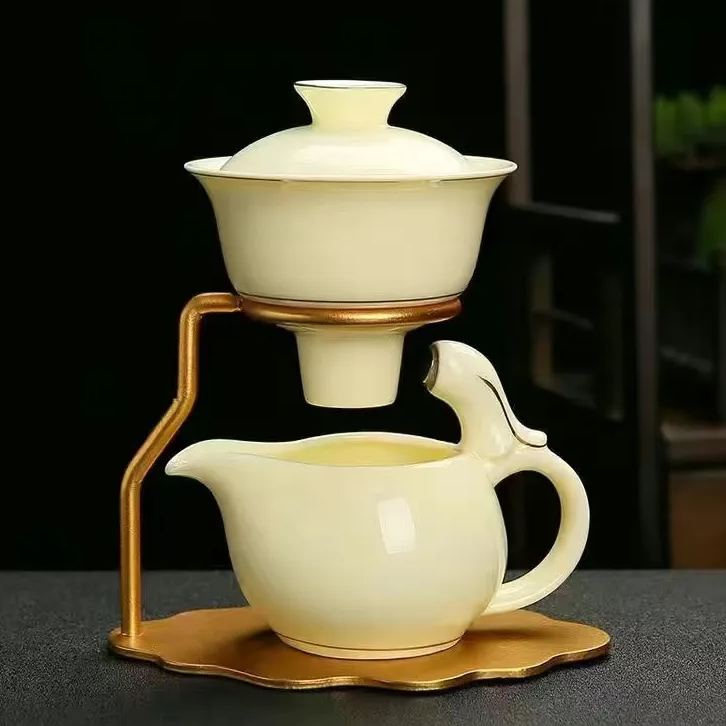
The metal frame around the ceramic body is the genius of this design. It’s not just decorative. The frame holds everything together if you bump the set against a suitcase wall or accidentally drop it on a hotel bathroom tile. I tested this once, very unintentionally, when the set slipped off a hostel sink. The ceramic got a tiny scuff. The frame kept every piece in one piece.
The magnetic brewing mechanism is a quieter benefit. On travel days when I’m exhausted and my brain is mush, having a setup that basically guides me through the infusion step means I don’t end up over-steeping an oolong into bitterness at 11 p.m. in some European hotel. There’s a real ergonomic argument here. When you’re jet-lagged, simplicity isn’t lazy, it’s essential.
Where it isn’t perfect: it’s heavier than glass or silicone alternatives, and the metal frame means I have to hand-wash it carefully to avoid water spots. But for hotel and Airbnb travel, where I’m brewing in a real sink with real space, it has been my workhorse for over two years now.
Glass Sets Sound Fragile But This One Survived Three Continents
I avoided glass for years because I assumed it would be a death wish for travel. Then a friend handed me her Glass Brewing Set on a trip through Portugal and told me to stop being dramatic. She had carried it across three continents and it was still intact. I borrowed it for two weeks, and by the end I had ordered my own.
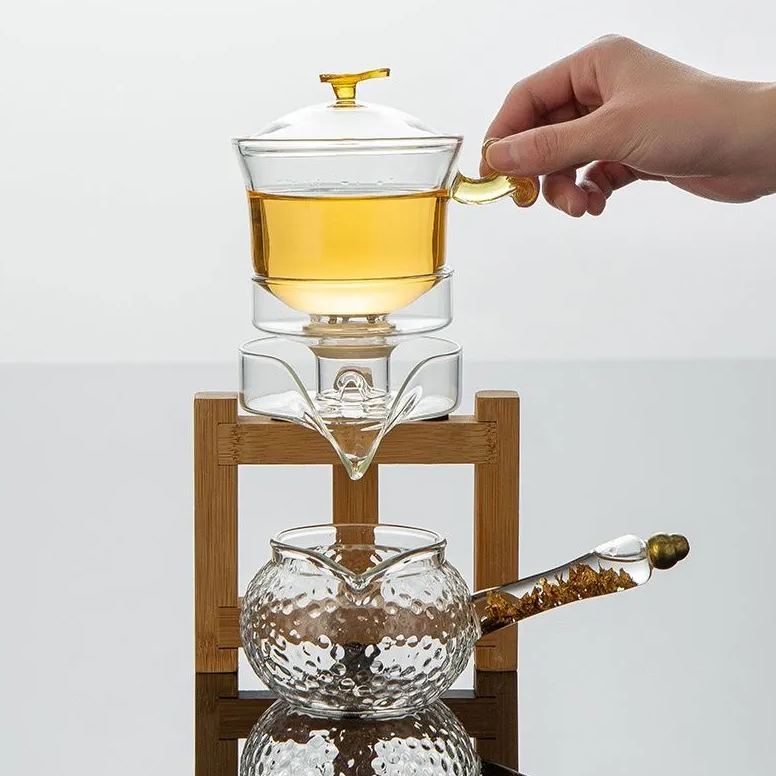
The first thing I noticed was that this isn’t delicate barware glass. It’s borosilicate, which means it tolerates temperature changes that would shatter ordinary glass. I poured boiling water into it cold once, on purpose, after reading the manual. It didn’t flinch. That was the moment I trusted it.
The second thing was how much I enjoyed watching tea brew while traveling. Sitting in a Lisbon apartment at sunrise with leaves unfurling in clear glass turned a routine caffeine moment into something that felt grounding and intentional. On the road, when everything is unfamiliar, that visual anchor matters more than I expected.
The honest drawback: even good borosilicate glass needs more care than ceramic. I wrap it in a microfiber cloth inside a hard case, and I’ve learned to never pack it next to shoes or anything with a hard edge. If you’re the kind of traveler who throws things into a duffel without much thought, this isn’t your set. If you’re the kind who packs carefully, the Glass Teapot collection has options that genuinely hold up to road life.
Glass isn’t the impractical choice it used to be. The new borosilicate sets are real tools, not display pieces. But they still need respect on the road, and that respect has to come from you.
Smart Magnetic Tea Makers: When Convenience Trumps Tradition
I want to address the elephant in the room for tea traditionalists: the smart, semi-automatic, magnetic tea maker. I’ve heard the argument that this isn’t “real” tea. I disagree, gently. When I’m on a business trip with back-to-back meetings, or on a train with a tiny fold-down tray, the question isn’t whether my brewing method is traditional enough. It’s whether I’ll actually sit down and drink a proper cup of tea at all. Convenience is what gets me to drink tea instead of grabbing another airport coffee.
The Smart Magnetic Tea Maker has been a quiet revelation for high-stakes travel days. The magnetic brewing system is similar in principle to what I described above, but streamlined for speed and consistency. You load the leaves, set the strength, and the device handles timing and water separation without me hovering over it.
What I appreciate most is the predictability. Hotel kettles vary wildly in temperature. Some barely reach a simmer. Others scald water to a useless degree. A smart setup compensates for the inconsistency of travel environments, which means I get the same cup of tea in a Tokyo capsule hotel that I get at home. That consistency, for me, is part of what makes tea feel like tea.
Is it more expensive than a basic ceramic set? Yes. Does it have more parts to clean? Yes, slightly. But if you travel for work and find yourself skipping tea because the ritual feels impossible in a hotel room, this is the answer.
The Cleaning Reality Nobody Talks About
Every glossy product photo of a travel tea set shows it brewing beautifully in a sunlit window. Nobody shows the cleanup at 9 p.m. after a long day, in a tiny sink, with questionable water pressure and a single thin hotel towel. Cleaning is where travel tea sets live or die, and it’s the thing I never thought about until I was scrubbing matcha stains out of a narrow hotel bathroom at midnight.
Here’s what I’ve learned through years of awkward sink encounters. Wide-mouthed vessels are easier to clean than narrow ones. Infusers that come out entirely clean faster than built-in filters. Smooth ceramic surfaces release tannins more easily than textured ones. And pieces with too many small crevices will eventually host a science experiment, especially in humid climates.
I also learned that the cups matter as much as the teapot. A teapot that pours beautifully into a tiny cup you can barely fit your finger into is a setup you will stop using. After years of frustrating two-fingered sipping, I started paying more attention to the Tea Cup collection and choosing sets that included cups wide enough to actually enjoy.
One more cleaning truth: bring a small microfiber cloth. A real one, not a face towel. It costs almost nothing and adds a level of polish to your daily brew that makes the whole setup feel intentional rather than improvised.
Solo Travel vs. Couple Travel vs. Group Travel
One question I get constantly from readers is whether they should buy for one, two, or four. The honest answer is that almost nobody traveling with a group actually wants to brew for the whole group using a portable setup. Even a “big” travel set gets exhausting when you’re pouring for five people over twenty minutes. So match the size to your most common use case, not your largest.
If you mostly travel solo, a single-cup setup is plenty. The ritual of brewing for yourself, slowly, is half the point. A small gaiwan or a compact teapot with one cup is plenty of ceremony for one person.
If you travel with a partner or close friend, look for a set that includes exactly two cups. This sounds obvious but many travel sets ship with one or four, which leaves you awkwardly sharing or washing constantly.
If you’re traveling with family or a small group, consider buying two travel sets rather than one giant one. You can brew simultaneously and the cleanup is faster. Plus, if one breaks mid-trip, you’re not stranded.
I’ve made the mistake of over-buying for hypothetical group use and ending up with a clunky setup that I personally resented carrying. Match your real life, not your imagined life.
What I’d Skip If I Were Starting Over
If I could go back to my pre-Kyoto self and offer three pieces of advice, this is what I’d say.
First, skip the beautiful artisan cup you love at home. It’s not coming back in one piece. Travel cups need to be thicker, slightly heavier, and a little less elegant than your home favorites. They are a different category.
Second, skip the travel kettle unless you really need one. Most accommodations have some kind of water heating option, and bringing a kettle doubles your luggage bulk for marginal benefit. The exception: if you’re camping or going somewhere truly remote.
Third, skip the “compact” tea tray. Most travel tea trays are still too big for a real suitcase, and they scratch easily. A folded cloth napkin gives you the same function, weighs nothing, and fits anywhere.
What I’d bring instead: one solid ceramic or glass teapot, two nesting cups, a small infuser, a microfiber cloth, and a handful of individually wrapped tea samples. That’s it. The whole setup fits in a single zippered pouch the size of a paperback.
Building Your Personal Travel Tea Setup
After years of trial and error, here’s the framework I actually use when recommending a setup to friends.
Start with your most common trip. Not your dream trip. Not your last trip. The trip you take most often. If that’s hotel-based leisure travel, lean toward ceramic for taste and ritual. If it’s outdoor or adventure travel, lean toward a single durable piece that won’t ruin your trip if it breaks. If it’s business travel where time is the bottleneck, lean toward a smart, automated setup that removes decisions from your morning.
Then test it once before you commit. Brew with it at home for a week. Drink your morning tea from it. Clean it in your real sink. If it annoys you in your comfortable kitchen, it will be unbearable in a hotel.
Finally, accept that your first travel set won’t be your last. Mine wasn’t. The point isn’t to find the perfect set on the first try. The point is to learn what you actually value when you’re away from home. That changes over time, and your gear should change with it.
Your travel tea set is a tiny ambassador for your daily ritual. It will never be as good as your home setup. But the right one makes you slow down for ten minutes in a foreign city, and that ten minutes is worth the suitcase space.
Final Thoughts From Someone Who’s Spilled Plenty of Tea
I still think about that broken cup in Kyoto. Not because it was valuable. It wasn’t. But because it taught me that travel tea gear deserves the same care and consideration as the gear I use at home, even though it costs less, packs smaller, and gets used harder.
Whatever you end up choosing, choose something you’ll actually use. The most beautiful travel set in the world is useless if it’s too heavy, too fussy, or too fragile to leave your suitcase. The best travel set is the one that becomes part of your morning, wherever you wake up.
If you’re starting your search now, the Travel Tea Set collection is a good place to begin, and the three pieces I’ve mentioned here have served me well across many trips, many countries, and many mornings when tea was the only familiar thing in the room. May your next trip include a quiet cup, a sunlit window, and no broken porcelain at your feet.
 EN
EN  DE
DE  ES
ES  PT
PT  FR
FR  JA
JA