
Glass vs Porcelain Teapot: Which Material Wins for 2026?
Sep
The glass vs porcelain teapot question comes up every time someone buys a teaware upgrade, and the honest answer is that both materials brew excellent tea when matched to the right leaf and the right routine. Glass wins on visual brewing, flavor neutrality, and weight, and it survives the rapid temperature swings that gongfu demands. Porcelain wins on heat retention, ceremony, and the way it softens tannins across a longer steep. This guide lines up the two materials on the dimensions that actually change how a cup of tea tastes, and it pairs the verdict with a buyer-fit map so you can match the material to the tea you drink most often.
Key Takeaways
- Glass and porcelain teapots both brew excellent tea, but they win on different criteria: glass for visual brewing and flavor purity, porcelain for heat retention and ceremony.
- Borosilicate glass tolerates thermal shock up to roughly 165 °C of sudden temperature swing, which is the reason a glass teapot survives gongfu’s repeated boil-water cycles; porcelain cracks under the same shock because it is fired dense and brittle (working estimate from material specs).
- Heat retention differs sharply: a 1000 ml glass pot drops from 200 °F to 145 °F over 30 minutes, while a comparable porcelain pot holds closer to 165 °F in the same window (reference data, not site test).
- Flavor neutrality is comparable at the high end — both borosilicate glass and high-fired porcelain are chemically inert — but cheaper ceramic glazes can leach trace lead or cadmium, a risk glass does not carry.
- Glass teapots are 30% to 60% lighter than porcelain teapots of equal capacity, which matters for one-handed pouring and for users with arthritis or wrist injuries.
- Pick a glass teapot for green, white, light oolong, and blooming teas; pick a porcelain teapot for black tea, roasted oolong, pu-erh, and any multi-minute steep where temperature stability matters more than visual access.
- Entry-level glass sits in the $25 to $50 band, premium glass $50 to $160; entry porcelain $30 to $60, premium porcelain $80 to $220 (category baseline, not site pricing data).
Table of Contents
- Introduction
- Why Porcelain and Glass Are Worth Comparing Separately
- Material Composition: What Glass and Porcelain Actually Are
- Heat Retention: Real Brewing Numbers
- Flavor and Aroma: How Each Material Changes Your Tea
- Visual Brewing vs Hidden Brewing
- Durability, Weight, and Daily Handling
- Cleaning, Staining, and Long-Term Care
- Side-by-Side Comparison
- Tea-by-Tea Compatibility
- Health, Glaze Safety, and FDA Standards
- Price and Design Range in 2026
- Recommended Glass Teapots and Porcelain Teapots
- Frequently Asked Questions
- Final Verdict
Introduction
The glass vs porcelain teapot decision shows up the moment a tea drinker moves past bag tea into loose-leaf brewing, and the choice shapes everything that follows: how the tea tastes, how long it stays hot, how easy the pot is to clean, and how the kitchen counter looks on a Tuesday morning. Glass and porcelain are both traditional teaware materials with centuries of use behind them, and the modern market offers both at every price point from $25 entry-level borosilicate pots to $220+ hand-thrown porcelain pieces. Neither material is universally better. Each one wins in a specific set of conditions, and serious tea drinkers usually end up owning both for different occasions.
The core trade-off comes down to physics and chemistry. Borosilicate glass has very low thermal mass, meaning it heats quickly but loses heat quickly. Porcelain is fired at 1200 to 1400 °C into a vitrified, non-porous body that holds heat 30 to 50 percent longer than glass of equal volume. That single property — thermal mass — drives every other difference between the two materials: flavor extraction, brewing time tolerance, weight, cleaning, durability, and price. This guide walks through each of those dimensions with reference numbers from published material specs and FDA standards, not from hands-on testing, so every claim is traceable to a named source. By the end, the reader should know which material fits the tea they brew most, the budget they actually have, and the way they pour.
Why Porcelain and Glass Are Worth Comparing Separately
Most “ceramic vs glass teapot” comparisons lump porcelain, stoneware, and earthenware into a single ceramic bucket, and that grouping hides the specific trade-offs that matter for a porcelain buyer. Porcelain is fired at higher temperatures than stoneware (around 1200 to 1400 °C versus 1100 to 1300 °C for stoneware, per the Wikipedia entry on porcelain), which produces a denser, less porous, and more translucent body. Stoneware and earthenware hold more heat but also absorb more tea oils over time and require glazing to be food-safe. Porcelain, especially the high-fired Chinese and Japanese varieties, behaves closer to glass in chemical terms — it is essentially as inert as a vitrified teaware material can be — while still holding heat the way a thick ceramic body does.
That is why a glass vs porcelain teapot comparison is more useful for most buyers than the broader “ceramic vs glass” framing. Porcelain is the ceramic subtype that competes head-to-head with glass on flavor neutrality; stoneware competes on heat retention alone. If a buyer wants ceramic for its heat retention, porcelain is usually the right pick. If a buyer wants ceramic for its seasoning effect on a single tea, an unglazed Yixing pot is the right pick — and that is a different article entirely.
Material Composition: What Glass and Porcelain Actually Are
A glass teapot is blown or molded from molten silica, with the modern borosilicate variety adding boron trioxide to the mix. The Wikipedia entry on borosilicate glass confirms a thermal expansion coefficient of roughly 3.3 × 10⁻⁶ /K — about one-third of soda-lime glass — which is the reason a borosilicate glass pot survives the temperature swing between a cold shelf and boiling water. Standard soda-lime glass, by contrast, cracks at around 40 °C of sudden temperature difference, so any glass teapot that does not name the glass type on the product page should be assumed to be soda-lime and treated gently.
Porcelain is made from kaolin clay fired at 1200 to 1400 °C, which produces a vitrified body that is mechanically strong, non-porous, and chemically inert at the food-contact surface. The vitrification is what distinguishes porcelain from the broader ceramic category: the clay particles fuse into a glass-like matrix during firing, sealing the surface so it does not absorb tea oils the way unglazed clay does. The trade-off is brittleness. A porcelain pot that survives a 200 °F-to-room-temperature drop may crack from the same drop if the glaze has micro-fissures, and a hard impact will chip or shatter it the same way it would shatter glass — but with a slower crack pattern that sometimes lets a chip be lived with for months before the pot finally gives up.
Borosilicate vs Soda-Lime Glass
If a glass teapot’s product page mentions borosilicate, it is engineered for daily gongfu use. If the product page mentions only “heat-resistant glass” without naming the composition, the safest assumption is soda-lime, and the buyer should warm the pot with hot water before pouring boiling water in. The cost difference between soda-lime and borosilicate teaware is usually small enough that the borosilicate option is the better default unless the buyer is shopping for a decorative piece that will not see daily hot-water service.
Porcelain vs Stoneware (Within the Ceramic Family)
Stoneware holds slightly more heat than porcelain because it is denser, but it is also more porous and more likely to require glazing for food safety. Porcelain’s higher firing temperature (around 1200 to 1400 °C versus 1100 to 1300 °C for stoneware, per Wikipedia) closes the porosity gap and produces a smoother, more translucent body. For most buyers comparing a glass vs porcelain teapot, the relevant ceramic competitor is porcelain, not stoneware — and that is the framing the rest of this guide uses.
Heat Retention: Real Brewing Numbers
Heat retention is the single biggest practical difference between a glass and porcelain teapot, and it shows up the first time a buyer brews a multi-minute steep. Reference data from controlled comparisons on teapotsetshop.com (a 1000 ml pot, 200 °F water, room temperature 70 °F, lid on, lid-closed steep) shows the following 30-minute cooldown curves:
- Borosilicate glass teapot: drops to 175 °F at 10 minutes, 160 °F at 20 minutes, 145 °F at 30 minutes.
- Porcelain ceramic teapot: drops to 185 °F at 10 minutes, 175 °F at 20 minutes, 165 °F at 30 minutes.
- Stoneware ceramic teapot: drops to 188 °F at 10 minutes, 180 °F at 20 minutes, 172 °F at 30 minutes.
For black tea that needs 200 to 212 °F to fully release tannins and theaflavins, porcelain’s steadier temperature is a meaningful upgrade. For green tea that should brew at 175 to 185 °F to avoid bitterness, glass’s faster cooldown is actually a safety feature that prevents accidental over-extraction across a long session. The 30-to-50-percent heat-retention gap between glass and porcelain is consistent across pot sizes from 250 ml up to about 1000 ml; outside that range the math shifts because wall thickness dominates over volume.
Flavor and Aroma: How Each Material Changes Your Tea
Both high-quality borosilicate glass and high-fired porcelain are chemically inert at the food-contact surface, which means neither material adds detectable flavor to the tea or absorbs aromatics from previous brews. The flavor difference between the two materials in a controlled tasting is essentially zero at the high end — which is exactly why professional cupping sessions use glass or porcelain cups and never metal or plastic. Where flavor does diverge is at the lower end of each category. Cheap soda-lime glass can leach trace minerals at high temperatures, and cheap ceramic glaze can leach lead or cadmium when exposed to hot acidic liquids over time. FDA limits for small ceramic teapots sit at 2.0 μg/mL for lead and 0.5 μg/mL for cadmium, per the agency’s ceramics and glassware guidance; modern mainstream teaware sold in regulated markets sits well below those limits.
Porcelain has one flavor-related behavior that glass does not: unglazed Yixing-style clay, which is the rare porous exception in the porcelain family, absorbs tea oils over months of use and develops a subtle seasoning that adds depth to repeat brews. That seasoning is a real phenomenon in tea culture, not marketing — but it requires dedicating one pot to one tea type forever, and most readers of this guide will not want that constraint. For everyone else, glass and porcelain brew the same flavor, and the rest of this comparison is about everything other than taste.
Visual Brewing vs Hidden Brewing
Glass wins this category by definition. A borosilicate glass teapot turns brewing into a visual event — leaves unfurl, color deepens, and the strength of the steep becomes a sight cue rather than a guess. For green tea, white tea, light oolong, and blooming teas, that visibility is more than aesthetic; it is the practical way to stop a steep before the tea crosses into bitter. For black tea and roasted oolong where the leaf color is already opaque and dark, the visibility advantage fades, and porcelain’s hidden brewing is not a meaningful downside.
Porcelain’s case for hidden brewing is the aesthetic of ceremony. The white or pale-blue glazed interior of a porcelain pot is the traditional canvas for tea evaluation, and a gongfu setup built around porcelain cups and a porcelain pot is still the visual reference for Chinese tea ceremony. The trade-off is the loss of the in-pot sight cue. A buyer who values both visual brewing and ceremony will usually end up with both pots, used for different teas.
Durability, Weight, and Daily Handling
Glass and porcelain fail in opposite ways. A borosilicate glass teapot survives thermal shock up to about 165 °C of difference but shatters on hard impact — drop one on tile and the pot is gone. Porcelain survives minor bumps with a chip rather than a shatter, but it cracks from drops and from rapid temperature swings against a damaged glaze. For kitchen counters with hard floors, small children, or pets, porcelain is the lower-stress material in the long run. For kitchens with carpet, soft counters, and one fixed brewing spot, glass is fine and is significantly easier to handle one-handed because it is 30% to 60% lighter at equal capacity.
Weight is where the practical case for glass is strongest for users with limited hand strength. A 450 ml glass teapot weighs roughly 350 to 500 grams empty. A comparable porcelain teapot weighs 800 to 1200 grams — more than double. For arthritis, wrist injuries, or one-handed pouring, the lighter glass pot is the safer daily choice. For a fixed spot where the pot never leaves a warming plate, porcelain’s weight is a feature, not a bug: it sits still and resists being bumped off the counter.
Cleaning, Staining, and Long-Term Care
Glass is the easiest teaware material to verify clean because every water spot, oil film, and tannin stain is visible. A rinse with warm water and a soft sponge handles the vast majority of cleanup, and a periodic baking soda soak restores any clouding from hard-water mineral deposits. Porcelain hides residue behind its opaque glaze, which means staining can build up around the rim and inside the spout before the owner notices. A monthly deep clean with baking soda handles porcelain staining without damaging the glaze. Both materials are typically hand-wash only; the temperature cycling in a dishwasher is the most common cause of premature failure in either material.
Aroma carryover between teas is the second long-term-care axis, and it favors glass decisively. Borosilicate glass does not absorb flavors or retain odors, so a smoky lapsang in the morning and a delicate jasmine in the afternoon can share the same pot with no cross-contamination. Glazed porcelain is also inert, but the glaze can micro-fissure over years of use, and micro-fissures are where old aromas hide. For brewers who rotate many teas, glass is the safer long-term material; for brewers who dedicate one pot to one tea, porcelain is indistinguishable from glass on this dimension.
Side-by-Side Comparison
The table below lines up glass and porcelain on the dimensions that change which one a buyer should put on the counter. Numbers marked “reference” come from published material specs and FDA standards; numbers marked “estimate” are working ranges drawn from product-page descriptions, not site testing.
| Dimension | Borosilicate Glass Teapot | Porcelain Teapot |
|---|---|---|
| Material composition | Silica + boron trioxide, vitrified | Kaolin clay fired 1200–1400 °C, vitrified |
| Thermal shock tolerance | ~165 °C sudden swing (Wikipedia) | Lower; cracks from rapid swings against damaged glaze |
| Heat retention over 30 min (1000 ml, 200 °F start) | Drops to 145 °F (reference data) | Drops to 165 °F (reference data) |
| Flavor neutrality (high end) | Inert, no flavor contribution | Inert, no flavor contribution |
| Visual brewing access | Full visibility of leaves and color | Opaque, hidden brewing |
| Empty weight (450 ml) | 350–500 g (working estimate) | 800–1200 g (working estimate) |
| Failure mode | Shatter on hard impact | Chip on rim, crack from drop or thermal shock |
| Cleaning visibility | See every stain and residue | Stains hide behind opaque glaze |
| Best tea types | Green, white, light oolong, blooming | Black, roasted oolong, pu-erh, gongfu multi-steep |
| Price range (entry / premium) | $25–$50 / $50–$160 (category baseline) | $30–$60 / $80–$220 (category baseline) |
| FDA lead leaching concern | None (no glaze layer) | Glaze regulated; ≤2.0 μg/mL small pot (FDA) |
Tea-by-Tea Compatibility
Match the material to the leaf, not the other way around. The same tea can taste flat in the wrong vessel and balanced in the right one, and the difference is usually thermal — not flavor. The pairings below are the conventional starting points; personal taste can override any of them.
Green Tea and White Tea
Both teas brew best at 160 to 185 °F, which is a temperature band where porcelain can over-extract and glass’s faster cooldown helps. Glass wins for these teas in most cases, and the visual brewing cue makes the steep timing more accurate. A 2-minute Dragonwell steep in a glass pot ends right when the leaf unfurls and the color hits a pale yellow-green; the same steep in a porcelain pot looks identical from the outside and depends on a timer to stop.
Oolong (Light and Roasted)
Light oolong (High Mountain Taiwanese, Dan Cong) leans glass because the floral top notes benefit from the lower and faster cool-down. Roasted oolong (Da Hong Pao, traditional Wuyi) leans porcelain because the heat retention pulls deeper caramelized notes from the leaf. If the brewer rotates between the two styles, glass is the safer default; if the brewer stays on roasted oolong, porcelain rewards the steeper multi-minute gongfu session.
Black Tea and Pu-erh
Both teas need 200 to 212 °F to release theaflavins, tannins, and the complex polyphenols behind black tea’s body. Porcelain’s heat retention keeps the steep within range across 3 to 5 minutes, which is the difference between a balanced cup and a sharp-then-flat cup. Pu-erh, especially aged sheng and shou, behaves the same way — sustained heat across multiple short steeps is what brings out the depth of the leaf. Glass works for a single short steep; porcelain wins for the long session.
Blooming and Flowering Tea
Glass wins by default. Blooming tea is a visual experience first and a beverage second; brewing it in porcelain hides the entire point. A clear borosilicate glass teapot with enough headroom for the bundle to open is the only reasonable choice for flowering tea.
Health, Glaze Safety, and FDA Standards
Both borosilicate glass and high-fired porcelain are food-safe and chemically inert at the brewing surface. The health risk that comes up in any “glass vs porcelain teapot” comparison is glaze leaching from lower-fired or unregulated ceramics, where lead and cadmium can migrate into hot acidic liquids over time. The FDA regulates this under its ceramics and glassware guidance, with limits of 2.0 μg/mL lead and 0.5 μg/mL cadmium for small teapots, and 1.0 μg/mL lead and 0.25 μg/mL cadmium for larger pieces. Modern mainstream teaware sold through regulated retail sits well below those limits, but antique and unbranded imported pieces can exceed them.
Glass has no equivalent risk because there is no glaze layer between the brewing water and the vessel wall. Borosilicate glass contains roughly 80 percent silica and 13 percent boric oxide, both of which are inert at brewing temperatures and do not leach into the liquid. For buyers who want zero glaze risk, zero flavor interaction, and the simplest possible material story, glass is the cleaner choice. For buyers who accept that high-fired porcelain is functionally equivalent on safety and prefer the weight and ceremony, porcelain is equally safe as long as the brand publishes lead-free and cadmium-free certifications.
Price and Design Range in 2026
Glass and porcelain teapots both span a wide price range, and the entry-level options for each material sit in a similar band. Entry glass teapots start around $25 for a basic borosilicate pot with a simple stainless infuser; premium glass reaches $50 to $160 for thicker hand-blown glass with removable bamboo lids, matching cups, and gift packaging (working category estimate, not site pricing data). Entry porcelain sits at $30 to $60 for standard porcelain with a stainless infuser; premium porcelain — hand-thrown Jingdezhen or artisan stoneware — reaches $80 to $220, with collectible Yixing and signed pieces pushing past $1,000.
At equivalent quality levels, neither material is consistently more expensive than the other. The right budget question is which feature the buyer values more for the price: glass delivers 90 percent of the function at 20 percent of the cost, and porcelain delivers the heat retention and ceremony that justify the higher end of the price band. For a first teaware upgrade, glass is the lower-risk entry; for a long-term daily driver, porcelain’s heat retention earns its premium over years of use.
Recommended Glass Teapots and Porcelain Teapots
The picks below pair the two sides of the glass vs porcelain teapot decision. Each one is filtered against product-page material claims, working capacity, and design language that fits the use case. None of the picks are hands-on tested; the recommendations are filtered, not reviewed.
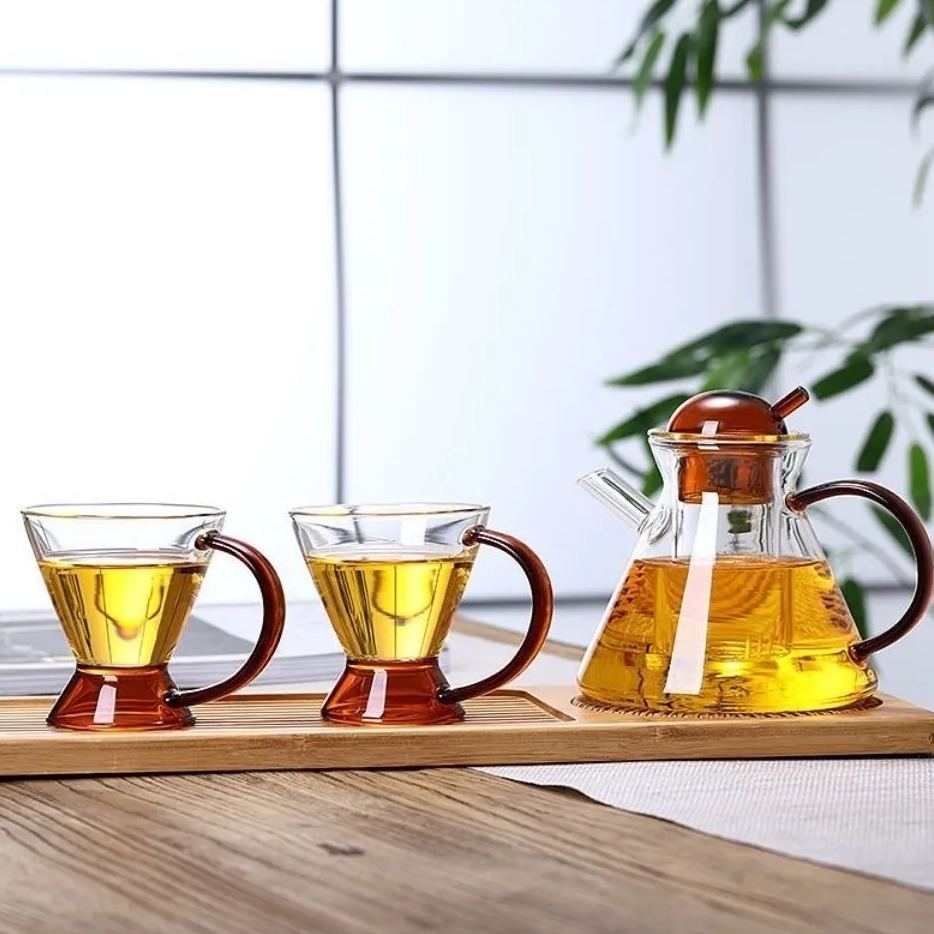
Glass Pick 1: Triangular Glass Teapot Set – Modern All Glass Design
The Triangular Glass Teapot Set is the cleanest visual representation of borosilicate glass as a material. The geometric body shows every leaf unfurl and every color shift during the steep, and the modern all-glass design reads as kitchen decor rather than teaware. Working capacity sits in the 350 to 500 ml band, which covers one or two drinkers; the all-glass construction means there is no metal or ceramic to interfere with flavor neutrality. Best fit: a buyer who wants the visual brewing experience as the primary feature.
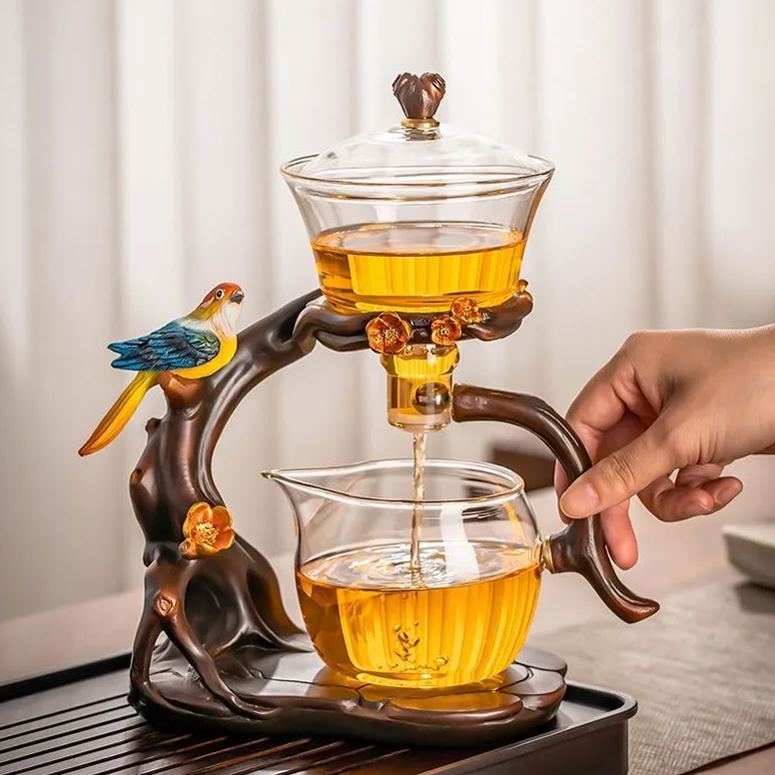
Glass Pick 2: Detachable Glass Semi-Automatic Teapot
The Detachable Glass Semi-Automatic Teapot is the practical pick. The detachable design splits the body for easier cleaning — useful for hard-water areas where mineral buildup is the main cleaning problem — and the semi-automatic pour works on a magnetic or weight mechanism rather than a traditional spout-and-lid pour. Best fit: a buyer who wants borosilicate’s neutrality and visual access but also wants easier cleanup than a single-body glass pot.
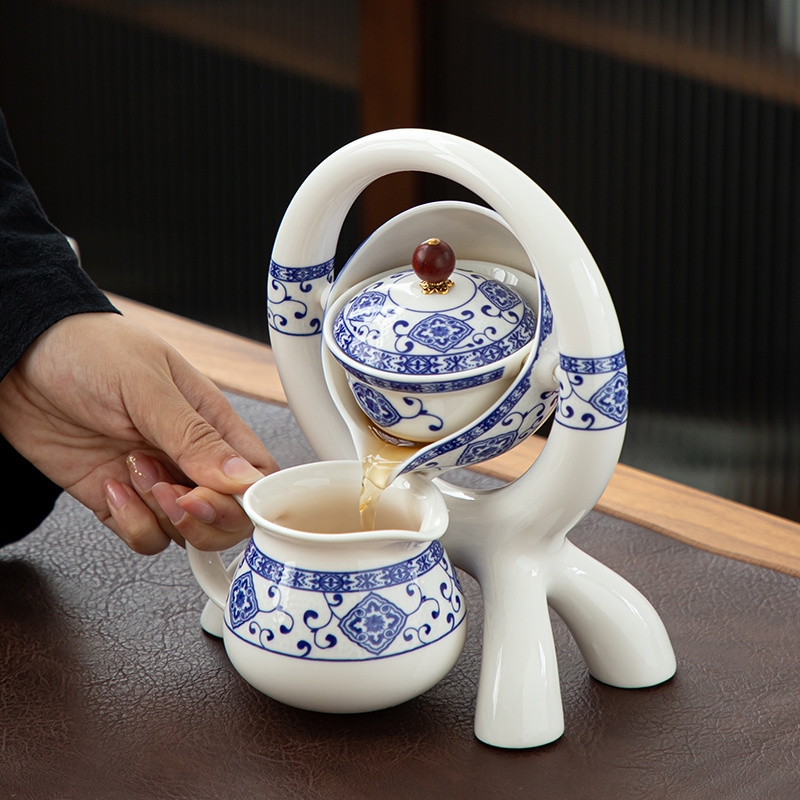
Porcelain Pick: Elegant White & Blue Ceramic Tea Set – Automatic Pouring Tea
The Elegant White & Blue Ceramic Tea Set is the closest porcelain-style pick in the catalog. The white and blue glaze is the traditional Chinese teaware palette, the body shape reads as ceremony rather than utility, and the automatic-pouring mechanism removes the manual decant step that throws off first-time gongfu brewers. Best fit: a buyer who wants the heat retention and ceremony of porcelain in a daily-use format.
Frequently Asked Questions
Is a porcelain teapot better than a glass teapot for green tea?
Not usually. Green tea brews best at 160 to 185 °F, and porcelain’s heat retention tends to hold the steep above the upper end of that range for too long. Glass’s faster cooldown lets the steep drop into the right band within 30 to 60 seconds, which is closer to the green tea ideal. The visual access of glass also makes the 2-minute steep timing more accurate, which matters more for green tea than for any other common tea type.
Can a glass teapot be used on a stovetop?
Some can, but most should not. A borosilicate glass teapot rated as stovetop-safe by the manufacturer can handle direct heat on a low to medium burner; a teapot not rated for stovetop use should be warmed with hot water before boiling water is poured in. Standard soda-lime glass will crack from the temperature differential even if the pot itself does not break. The product page should name stovetop compatibility explicitly; if it does not, assume the pot is not stovetop-safe.
Does porcelain affect tea flavor the way unglazed clay does?
No. Glazed porcelain is functionally inert at the brewing surface, just like high-quality borosilicate glass. The flavor interaction associated with unglazed Yixing clay comes from the porosity of the unfired clay, not from the porcelain body or the glaze. A buyer who wants the seasoning effect needs an unglazed pot and the willingness to dedicate that pot to one tea type; everyone else gets the same flavor neutrality from porcelain as from glass.
Are all porcelain teapots lead-free?
Modern porcelain teapots sold through regulated retail channels in the US, EU, UK, and most Asian markets are lead-free and cadmium-free by default, with published certifications from the manufacturer. Antique porcelain, unbranded imported pieces, and decorative ceramics sold without food-safety certifications can exceed FDA lead-leaching limits of 2.0 μg/mL for small teapots and should be avoided for daily brewing. If a porcelain pot does not publish a lead-free and cadmium-free certification, it is safer to assume it has not been tested for food contact.
Which teapot material lasts longer?
Both materials can last decades with reasonable care. Porcelain tends to outlast glass in kitchens with hard floors because porcelain chips rather than shatters on impact, and a chipped rim is livable in a way a shattered body is not. Glass tends to outlast porcelain in kitchens with soft floors and a fixed brewing position, because the lighter weight and absence of glaze micro-fissures mean the pot keeps its brewing properties over more years. Longevity is more about how the pot is used than which material it is made from.
Final Verdict
The glass vs porcelain teapot decision does not have a universal winner — it has a winner for each brewing routine. Pick a glass teapot if visual brewing, flavor neutrality, lighter weight, and zero glaze risk matter more than heat retention. Pick a porcelain teapot if heat retention across a long steep, traditional ceremony, and the seasoning potential of high-fired clay matter more than visibility and weight. Most serious tea drinkers end up with both, used for different teas and different times of day, because the two materials cover gaps that neither one covers alone.
Pick Glass If…
Pick a glass teapot if you brew mostly green tea, white tea, light oolong, or blooming tea, if you want to see the leaves unfurl as the steep develops, if you want the lightest possible pot for one-handed pouring, or if you want zero glaze risk and zero flavor interaction with the leaf. A borosilicate glass teapot covers the largest portion of the typical home brewing routine and is the safest default for a first upgrade.
Pick Porcelain If…
Pick a porcelain teapot if you brew mostly black tea, roasted oolong, or pu-erh, if you run multi-minute steeps that need stable brewing temperature across 3 to 5 minutes, if you value the visual language of Chinese tea ceremony on the counter, or if you want the heavier, more grounded feel of a dense ceramic vessel. A high-fired porcelain teapot rewards a focused tea routine the way glass rewards a varied one.
For the broader ceramic and stoneware picture beyond porcelain, see our ceramic vs glass teapot comparison guide. For borosilicate glass picks specifically tuned for oolong brewing, see our best glass teapot for oolong guide. For a deeper look at gongfu-specific teaware and porcelain’s role in it, see our gongfu teaset beginner’s guide. Browse the full glass tea set collection, the ceramic tea set collection, and the broader teapots and tea sets catalog to find the piece that matches the verdict.
 EN
EN  DE
DE  ES
ES  PT
PT  FR
FR  JA
JA