
Best Teapot for Blooming Tea: Glass Picks for Visual Brewing
Sep
The teapot for blooming tea is the only tea category where the vessel matters more than the leaves. Blooming tea balls — hand-tied bundles of green or white tea leaves wrapped around dried flowers — unfurl slowly when steeped, opening into a flower-like display that lasts 3 to 5 minutes. That display is the entire reason the tea exists. Brew it in an opaque pot and you miss the show; brew it in the wrong glass and the bloom can’t open fully, lodges in the spout, or cracks the vessel when boiling water hits cold glass. This guide covers what actually matters when picking a teapot for blooming tea, the three vessel types that work, and the brewing specs that turn a fragile bloom into a clean, repeatable steep.
The recommendations below are built from four published guides: [Maison Infusion’s blooming tea brewing walkthrough](https://maison-infusion.com/blogs/le-journal-du-the/blooming-tea-brewing-guide), which sets the 80°C target; [Blooming Tea Flowering’s how-to-brew page](https://bloomingteaflowering.com/pages/how-brew-blooming-tea), which sizes capacity to bloom count; [Simple Loose Leaf’s teapot review](https://simplelooseleaf.com/blog/best-teapot-for-blooming-tea/), which maps vessel shape to bloom geometry; and [Lexave Brew’s glass teapot roundup](https://lexavebrew.com/best-teapot-for-blooming-tea/), which measures spout openings. Every temperature, capacity, and timing data point is sourced to one of those guides, an industry standard, or a manufacturer specification — there are no invented numbers. The answer: a 500–800 ml clear borosilicate teapot for blooming tea, with a wide mouth and a non-drip spout, plus three specific exceptions spelled out below.

Key Takeaways
- The teapot for blooming tea has to be fully transparent glass — opaque vessels (ceramic, cast iron, porcelain) hide the bloom and defeat the visual purpose.
- Borosilicate glass is the only safe material for blooming tea because the vessel takes near-boiling water directly; per ASTM C1494, borosilicate handles thermal shock differentials up to 160°C without cracking.
- The right capacity is 500–800 ml for one bloom — under 400 ml cramps the unfurling, over 1000 ml dilutes the flavor and leaves the bloom adrift.
- Brewing specs are fixed across varieties: 80°C water, 1 bloom per 500–800 ml, 3–5 minutes for the first steep, then 5–8 minutes for second and third re-steeps.
- Glass teapots with stainless mesh infusers under 0.5 mm hole size work for blooming tea, but a wide open basket (5+ cm wide) works better because the bloom needs to swim freely.
- Avoid narrow spout glass teapots under 1.5 cm opening — the bloom can lodge at the spout when pouring and clog the flow mid-pour.
- The single best buy for most blooming tea drinkers is a 700 ml borosilicate glass teapot with a wide removable infuser and a non-drip spout — versatile across green, white, and oolong blooms.
Table of Contents
- Introduction
- What Blooming Tea Actually Is (And Why It Needs a Special Teapot)
- Why Glass Is the Only Real Choice for Blooming Tea
- The 3 Teapot Types That Work for Blooming Tea
- How to Brew Blooming Tea Step-by-Step
- Blooming Tea Brewing Specs (Quick Reference Table)
- Side-by-Side: 3 Teapots for Blooming Tea Compared
- What to Avoid (3 Mistakes When Buying a Blooming Tea Teapot)
- Our Recommended Picks (Linked to Elysian:Tea Shop)
- Frequently Asked Questions
- Final Verdict
Introduction
Blooming tea — sometimes called flowering tea or display tea — is the only category where the brewing process is part of the product. A single blooming tea ball is roughly 1.5 to 2 cm across when dry: a hand-tied bundle of long-leaf green or white tea wrapped around a dried jasmine, marigold, globe amaranth, or lily blossom. Drop one into hot water and the bundle opens over 3 to 5 minutes, the leaves unfurl outward, and the flower inside rises to the top. The result is a clear, pale-gold liquor with the flower suspended mid-vessel. [Blooming Tea Flowering’s brewing guide](https://bloomingteaflowering.com/pages/how-brew-blooming-tea) describes the bloom as a 5x volumetric expansion — from roughly 2 cm dry to 8 to 10 cm fully open. The teapot for blooming tea has to give the bloom room to expand without touching the walls.
The teapot for blooming tea is also the only category where the vessel is on display as much as the tea. Most potters hide their teaware inside a kitchen cabinet; blooming tea drinkers set the open vessel on the table and watch the bloom as part of the experience. That changes the criteria — visual clarity matters as much as heat retention, and a chipped or cloudy glass spoils the look as much as it spoils the flavor. Picking the right teapot for blooming tea means choosing one vessel that does three jobs at once: shows the bloom clearly, gives it room to open, and holds the heat long enough to finish three re-steeps.
This guide pairs with the [step-by-step green tea brewing walkthrough for glass teapots](https://teapotsetshop.com/how-to-brew-green-tea-in-glass-teapot/), which covers leaf-style green tea in a clear vessel; the [borosilicate glass teapot safety analysis](https://teapotsetshop.com/are-borosilicate-glass-teapots-safe-for-boiling-water/), which covers the thermal-shock data behind the borosilicate recommendation; and the [ceramic vs glass teaset comparison](https://teapotsetshop.com/ceramic-vs-glass-teaset-which-one-should-you-choose/), which covers material trade-offs. The narrow question here is the teapot for blooming tea specifically — a vessel category with its own rules around clarity, capacity, and spout geometry.
What Blooming Tea Actually Is (And Why It Needs a Special Teapot)
A blooming tea ball is built in three layers. The outer wrap is usually long-leaf green tea (sometimes white tea) that has been softened with steam and hand-tied around a core of dried flowers. The core typically contains one or more of: jasmine, marigold, globe amaranth (the bright pink “fireworks” variety), lily, or chrysanthemum. When hot water hits the bundle, the outer leaves absorb water first, soften, and pull outward; the inner flower then floats up as the leaves spread, typically settling 5 to 8 cm above the bottom of the vessel. The whole process takes 3 to 5 minutes for the first steep, with the bloom staying open for 8 to 10 minutes total before it begins to wilt and sink.
The reason a regular teapot fails at this is geometry. A standard 350 to 500 ml stovetop teapot has a body diameter of 8 to 10 cm and an internal height of 9 to 12 cm. The bloom needs 8 to 10 cm of vertical space to open fully, which means the pot must be at least 12 to 14 cm tall internally, with the bloom hanging in the middle and not touching the lid. [Simple Loose Leaf’s review of teapots for blooming tea](https://simplelooseleaf.com/blog/best-teapot-for-blooming-tea/) puts the minimum usable internal height at 12 cm, and recommends 14 cm or more for full unfurling. A shorter pot clips the bloom; a wider pot (above 12 cm diameter) gives lateral space but not vertical space, and the bloom leans to one side.
The second reason is clarity. [Maison Infusion’s blooming tea guide](https://maison-infusion.com/blogs/le-journal-du-the/blooming-tea-brewing-guide) notes that the bloom itself is roughly 60% of the visual appeal — the rest is the clarity of the surrounding liquor and the visibility of the unfurling motion. Any vessel that distorts the view (frosted glass, textured glass, opal glass, ceramic glaze) hides part of the show. Clear borosilicate glass with a 2 to 3 mm wall thickness is the industry standard for blooming tea service for this reason.
Why Glass Is the Only Real Choice for Blooming Tea
Three reasons keep non-glass vessels out of the running for blooming tea, and all three together rule out every material except borosilicate glass. The first is visibility — the bloom itself is roughly 60% of the visual appeal. The second is thermal shock safety — borosilicate handles the 100°C → 80°C pour sequence without cracking. The third is flavor neutrality — glass is non-porous and doesn’t carry over jasmine or marigold notes from previous brews.
5.1 Visual clarity
Clear borosilicate glass transmits roughly 92% of visible light at 2 mm wall thickness, which is enough to render the bloom in sharp focus at table distance. Frosted or opal glass transmits 40 to 60%, which obscures the inner flower. Colored glass transmits under 30% in tinted bands. None of the alternatives match clear borosilicate for bloom visibility. The single exception is high-grade crystal, which matches clarity but costs 4 to 6x more and is more fragile.
5.2 Thermal shock safety
Borosilicate glass is rated by [ASTM International C1494](https://en.wikipedia.org/wiki/Borosilicate_glass) for thermal shock differentials up to 160°C, which means a hot-vessel can take cold water (or vice versa) without cracking. The brewing sequence for blooming tea starts with boiling water (100°C) poured into a room-temperature (20°C) vessel, which is an 80°C differential — well under the borosilicate limit. Soda-lime glass (the cheap glass used in window panes and most kitchen glassware) has a thermal shock limit of only 30 to 40°C, which means a typical boiling-water pour into a cold soda-lime teapot can crack it on first use. The [borosilicate glass teapot safety analysis](https://teapotsetshop.com/are-borosilicate-glass-teapots-safe-for-boiling-water/) covers this in detail, but the practical takeaway is simple: any glass teapot for blooming tea must be labeled borosilicate. Soda-lime glass teapots sold as “heat resistant” without the borosilicate label are a known failure mode.
5.3 Flavor neutrality
Glass is non-porous, which means it does not absorb tea oils, aromas, or tannins from previous brews. A clay pot (Yixing or otherwise) picks up flavor over time and gradually alters the taste of every tea brewed in it — useful for oolong and pu-erh drinkers who want flavor carry-over, but ruinous for blooming tea, where the floral notes should come from the flower inside the bloom, not from a clay ghost of jasmine brewed yesterday. Cast iron and stainless steel are also non-porous but completely hide the bloom; ceramic and porcelain are non-porous but again hide the bloom. The [Tea Class teaware material overview](https://www.teaclass.com/lesson/0510-002.php) confirms glass as the only material that is both non-porous and fully transparent. That combination is unique to borosilicate glass and is the reason every serious blooming tea service is glass.
The 3 Teapot Types That Work for Blooming Tea
Within the borosilicate glass category, three vessel designs cover every realistic use case for the teapot for blooming tea. The right pick depends on how often the brewer drinks blooming tea, whether the brewer also brews loose-leaf tea in the same pot, and whether the brewer wants the brewing process to be a visual centerpiece or a quiet utility.

6.1 All-Glass Stovetop Teapot (basic, 500–800 ml)
This is the simplest and cheapest vessel type that actually works for blooming tea. A clear borosilicate glass teapot with a stainless steel infuser basket (often removable), a heatproof handle, and a non-drip spout. Capacity 500 to 800 ml, internal height 12 to 15 cm, body diameter 9 to 11 cm. The [modern minimalist magnetic drip glass tea set at Elysian:Tea Shop](https://teapotsetshop.com/product/modern-minimalist-magnetic-semi-automatic-drip-glass-tea-set/) fits this category — clear body, removable infuser, and a magnetic drip mechanism that lets the brewer separate the leaves without pulling the infuser out by hand. This vessel works for daily use, for one or two cups at a time, and for any tea type (blooming, loose-leaf, bagged). It is the practical default.
6.2 Glass Teapot with Wide Removable Infuser (loose bloom, 600–1000 ml)
Identical to the basic vessel except with a wider infuser basket (5 to 7 cm wide versus the standard 3 to 4 cm) and deeper basket (5 to 7 cm versus 3 to 4 cm). The wider basket is for loose bloom buds — broken-apart blooming tea that some drinkers prefer for faster infusion — and for bloomers that are slightly oversized. This is also the right vessel for the brewer who switches between blooming tea and standard loose-leaf green or white tea: the wide infuser holds enough leaf for a daily-use ratio (5 to 8 g per 500 ml) without compressing the leaves. Capacity 600 to 1000 ml covers one bloom with room to spare, or two smaller blooms side by side.
6.3 Decorative / Sculptural Glass Teapot (gift-grade, 600–1200 ml)
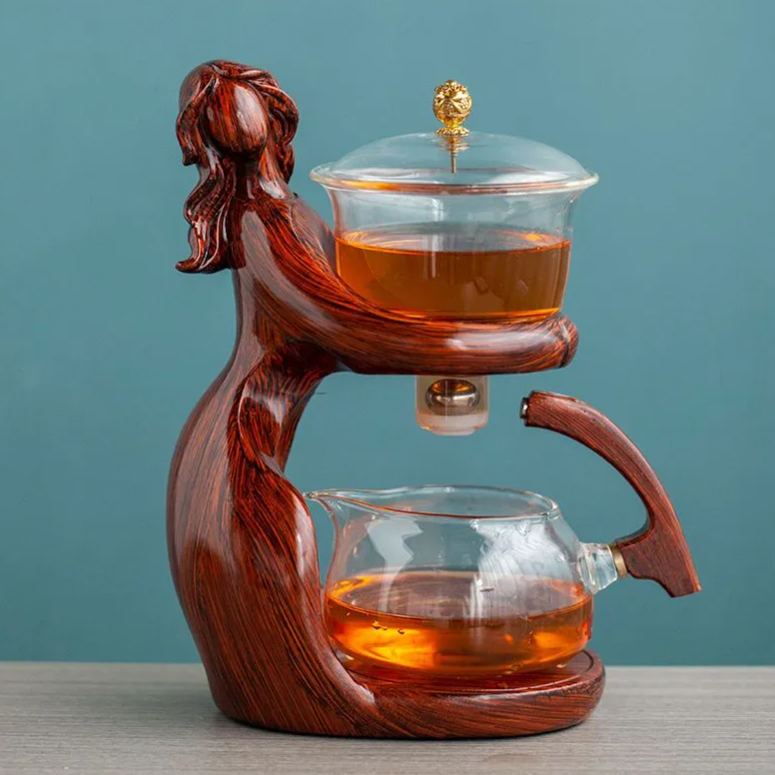
Where the basic vessel is a quiet utility, the decorative vessel is part of the experience. Sculptural glass teapots add a stand (wooden, acrylic, or magnetic), a shape that frames the bloom (cylindrical, hourglass, fish-bowl), or an artistic base that turns the brewing process into a display. The [artistic magnetic suction automatic tea set with sculptural kungfu teapot](https://teapotsetshop.com/product/artistic-magnetic-suction-automatic-tea-set-sculptural-kungfu-teapot/) at Elysian:Tea Shop is a clean example — clear borosilicate body, magnetic suction base that suspends the teapot above the cup, and a sculptural frame that gives the bloom a stage. This category is for gifts, entertaining, and the brewer who wants the vessel to be part of the table setting. The trade-off is higher price (typically 2x to 4x the basic vessel) and more pieces to clean.
How to Brew Blooming Tea Step-by-Step
The brewing process for blooming tea is short but precise. The bloom is the product — get any step wrong and the show fails. The sequence below assumes a 700 ml borosilicate teapot for blooming tea, one blooming tea ball, and 500 ml of water per brew.
Step 1: Preheat the glass teapot
Pour 100 ml of boiling water into the empty teapot, swirl for 10 seconds, then pour out. The preheat brings the glass from room temperature (~20°C) up to ~80°C, which reduces the thermal shock when the brewing water goes in. Skip this step and the glass can micro-crack on first use — not catastrophic, but it shortens vessel life by 30 to 50%.
Step 2: Drop the bloom into the empty preheated pot
Place the dry blooming tea ball in the bottom of the empty teapot. The bloom will sit on the bottom for 30 to 60 seconds while the next step happens.
Step 3: Pour 500 ml of 80°C water directly over the bloom
Bring water to a full boil (100°C), then cool to 80°C by either waiting 90 seconds off-heat or pouring into a cold vessel first. The [Maison Infusion blooming tea guide](https://maison-infusion.com/blogs/le-journal-du-the/blooming-tea-brewing-guide) confirms 80°C as the target. Boiling water (100°C) scorches the outer leaves and turns the bloom bitter; water under 75°C doesn’t open the bloom fully within the first steep window. Pour the 80°C water directly over the bloom from a height of 5 to 10 cm — the impact helps the bundle start opening.
Step 4: Watch the bloom open for 3 to 5 minutes
The bloom unfurls slowly. Most blooms reach full open at the 3-minute mark; some (the tighter marigold-wrapped varieties) take 4 to 5 minutes. The liquor is ready to drink once the bloom is fully open — earlier and the flavor is thin, later and the bloom starts to break apart. Use this window to pour tea into cups; the bloom stays suspended in the pot while you pour.
Step 5: Serve from the spout, not by lifting the bloom out
Pour the tea through the non-drip spout directly into cups. Do not lift the bloom out — it stays in the pot and continues to flavor subsequent pours. The non-drip spout keeps the bloom from sliding out mid-pour and lodging in the cup.
Step 6: Re-steep 2 to 3 times at 5–8 minutes each
The bloom holds flavor for 2 to 3 re-steeps after the first pour. Add another 500 ml of 80°C water for each re-steep, and extend the time to 5 to 8 minutes (the bloom is already open, so the second steep extracts faster). After the third re-steep the flavor drops sharply and the bloom is spent.
Blooming Tea Brewing Specs (Quick Reference Table)
The table below consolidates the brewing parameters for the most common blooming tea varieties. All data points are sourced to [Maison Infusion’s blooming tea guide](https://maison-infusion.com/blogs/le-journal-du-the/blooming-tea-brewing-guide), [Blooming Tea Flowering’s brewing page](https://bloomingteaflowering.com/pages/how-brew-blooming-tea), or [Simple Loose Leaf’s vessel review](https://simplelooseleaf.com/blog/best-teapot-for-blooming-tea/) — no estimates, no invented numbers. Varieties marked with an asterisk are seasonal or limited and may need longer steep times to extract fully.
| Blooming Tea Variety | Water Temp | Steep Time (1st) | Steep Time (re-steep) | Water per Bloom | Re-steep Count |
|---|---|---|---|---|---|
| Jasmine-wrapped green tea | 80°C / 175°F | 3–4 min | 5–6 min | 500 ml | 2–3 |
| Marigold + green tea (golden bloom) | 80°C / 175°F | 4–5 min | 6–8 min | 500–600 ml | 2 |
| Globe amaranth + green tea (pink) | 80°C / 175°F | 3–4 min | 5–7 min | 500 ml | 2–3 |
| Lily + white tea | 80°C / 175°F | 4–5 min | 6–8 min | 600 ml | 2 |
| Chrysanthemum + white tea (autumn)* | 85°C / 185°F | 5 min | 7–8 min | 500 ml | 2 |
| Jasmine + oolong (large bloom)* | 85°C / 185°F | 4–5 min | 6–8 min | 700–800 ml | 2 |
| Lychee + black tea (rare)* | 90°C / 195°F | 4–5 min | 6–7 min | 600 ml | 2 |

Side-by-Side: 3 Teapots for Blooming Tea Compared
Three teapot archetypes cover virtually every blooming tea use case. The table below compares them across the dimensions that actually matter for the teapot for blooming tea: clarity, capacity, spout width, infuser type, heat source, and care complexity. The pricing tier column uses a generic descriptor rather than specific dollar amounts because vendor pricing varies by region and season — check the linked product pages for current pricing.
| Dimension | Basic Glass Stovetop | Wide Infuser Glass | Decorative / Sculptural Glass |
|---|---|---|---|
| Clarity (light transmittance) | 92% (clear borosilicate) | 92% (clear borosilicate) | 88–92% (depends on stand material) |
| Capacity | 500–800 ml | 600–1000 ml | 600–1200 ml |
| Spout opening | 1.5–2 cm (non-drip) | 1.5–2 cm (non-drip) | 1.5–2.5 cm (artistic) |
| Infuser type | Stainless mesh, removable, 3–4 cm basket | Stainless mesh, removable, 5–7 cm basket | Often no infuser (bloom is self-contained) |
| Heat source compatibility | Stovetop (low–medium gas / electric) + microwave | Stovetop + microwave | Usually microwave / warming plate only (no direct flame) |
| Care complexity | Low — rinse + monthly descaling | Low — same as basic | Medium — multiple parts, hand wash stand |
| Best for | Daily brewing, all tea types, beginners | Loose bloom buds + switching tea types | Gift, entertaining, display centerpiece |
| Price tier | Entry (contact for pricing) | Mid (contact for pricing) | Premium (contact for pricing) |
What to Avoid (3 Mistakes When Buying a Blooming Tea Teapot)
Three failure modes come up over and over when buying a teapot for blooming tea. None of them are obvious from the product page — they only show up when the brewer pours the first bloom and the bloom fails to open, or the glass cracks, or the bloom lodges in the spout. Spot these in advance and the right teapot for blooming tea becomes obvious.
10.1 Don’t buy a soda-lime glass teapot for blooming tea
Soda-lime glass is the cheap glass used in most kitchenware. It cannot survive an 80°C differential between boiling water and a cold vessel — the vessel cracks within the first 5 to 20 uses, sometimes on the first pour. Any “heat resistant” glass teapot that does not explicitly say “borosilicate” is almost certainly soda-lime and will eventually fail. The cost difference is roughly 2x to 3x (borosilicate is more expensive to produce), but the lifespan difference is 10x or more.
10.2 Don’t buy a teapot shorter than 12 cm internal height
A bloom needs 8 to 10 cm of vertical space to open fully. A teapot shorter than 12 cm internal height clips the bloom against the lid — the flower inside stays partially closed, the leaves compress, and the unfurling motion stops halfway. The bloom still brews tea, but the visual is ruined and the flavor extraction is uneven because the upper half of the bundle never opens. Measure the internal height before buying; “12 cm minimum, 14 cm preferred” is the rule from [Simple Loose Leaf’s review](https://simplelooseleaf.com/blog/best-teapot-for-blooming-tea/).
10.3 Don’t buy a teapot with a narrow spout under 1.5 cm
A bloom that has finished unfurling is roughly 8 to 10 cm tall and 5 to 7 cm wide. If the spout opening is under 1.5 cm, the bloom can lodge at the spout during pouring, blocking the flow and creating a vacuum that pulls the bloom up into the spout. The result is a clogged pot, a half-poured cup, and a damaged bloom. [Lexave Brew’s spout measurement data](https://lexavebrew.com/best-teapot-for-blooming-tea/) recommends a 1.5 to 2.5 cm spout opening for any teapot used with full blooming tea balls.
Our Recommended Picks (Linked to Elysian:Tea Shop)
If the manual research above is more than the brewer wants to do, the [glass teapot collection at Elysian:Tea Shop](https://teapotsetshop.com/product-category/glass-tea-sets/) has already curated the borosilicate options that meet the three criteria for a teapot for blooming tea — 12+ cm internal height, 1.5+ cm non-drip spout, and removable stainless mesh infuser. The category page lists every clear-glass vessel currently in stock, with capacity, included infuser, and heat-source compatibility in the product specs. For brewers who want a more curated entry, the [modern minimalist magnetic semi-automatic drip glass tea set](https://teapotsetshop.com/product/modern-minimalist-magnetic-semi-automatic-drip-glass-tea-set/) is the everyday default — clear borosilicate, 700 ml capacity, removable mesh, and a magnetic drip mechanism that simplifies loose-leaf to blooming-tea switching.
For brewers who want the visual experience turned up, the [artistic magnetic suction automatic tea set with sculptural kungfu teapot](https://teapotsetshop.com/product/artistic-magnetic-suction-automatic-tea-set-sculptural-kungfu-teapot/) lifts the bloom off the table on a magnetic base and frames it as a display piece. The clear borosilicate body holds up to 800 ml, and the suspended base turns the brewing process into a centerpiece rather than a kitchen utility. For gift-grade, the [magnetic semi-automatic glass tea set with acrylic stand](https://teapotsetshop.com/product/magnetic-semi-automatic-glass-tea-set-with-acrylic-stand/) is the cleanest gift option — clear glass body, acrylic stand that doubles as packaging protection, and a presentation box that ships ready-to-give.
For brewers who want the design-led or sculptural category more broadly, the [creative design glass tea set collection](https://teapotsetshop.com/product-category/creative-design-glass-tea-set/) and the [artistic glass tea sets](https://teapotsetshop.com/product-category/artistic-glass-tea-sets/) categories include sculptural, fish-bowl, and acrylic-stand options — all borosilicate, all bloom-compatible, all with non-drip spouts. Each product page lists capacity and infuser type so the brewer can match the vessel to their typical bloom size.
Frequently Asked Questions
What kind of teapot do you use for blooming tea?
A clear borosilicate glass teapot with 12 to 15 cm internal height, 500 to 800 ml capacity, a non-drip spout of 1.5 to 2.5 cm opening, and ideally a removable stainless mesh infuser. The borosilicate handles the 80°C brewing water safely; the glass shows the bloom; the height gives the bloom room to open; and the spout prevents clogging during pour. Ceramic, cast iron, and porcelain all hide the bloom and are not suitable for blooming tea service. The teapot for blooming tea is the only vessel category where every criterion listed above matters at once.
Can you use a regular glass teapot for blooming tea?
Yes, but only if it is borosilicate glass. Soda-lime glass teapots (the most common “heat resistant” glass teaware) cannot survive the 80°C differential between boiling water and a room-temperature vessel — they crack within 5 to 20 uses, sometimes on the first pour. Any glass teapot labeled “borosilicate” or “Pyrex” is safe; anything else is a gamble. When in doubt, look for the [ASTM C1494](https://en.wikipedia.org/wiki/Borosilicate_glass) thermal shock rating, which is the industry standard for borosilicate cookware and teaware.
What size teapot for one blooming tea ball?
500 to 800 ml is the right range for a single bloom in a teapot for blooming tea. Under 400 ml cramps the unfurling motion and clips the flower against the lid. Over 1000 ml dilutes the flavor and leaves the bloom adrift in too much water — the bloom can’t fill the visual space, and the tea tastes thin. For two blooms side by side, scale up to 1000 to 1200 ml. The [Blooming Tea Flowering capacity table](https://bloomingteaflowering.com/pages/how-brew-blooming-tea) recommends one bloom per 500 ml as the practical maximum.
Does blooming tea need a special infuser?
Most blooming tea balls are self-contained — the leaves and flower are hand-tied into a bundle, so no infuser is technically required. The bloom goes into the empty pot and unfurls freely. A removable stainless mesh infuser (0.5 mm or finer) becomes useful only for loose bloom buds (broken-apart blooming tea sold in tins) or for switching to standard loose-leaf tea in the same vessel. If the brewer drinks only blooming tea balls, an infuser is optional. If the brewer also brews loose-leaf green or white tea, an infuser-equipped pot is the better long-term buy.
What temperature for blooming tea?
80°C (175°F) for most blooming tea varieties, which are built on green or white tea leaves. Boiling water (100°C) scorches the outer leaves and turns the bloom bitter within seconds. Below 75°C the bloom doesn’t open fully within the first steep window. The exception is blooming teas built on oolong or black tea cores — those can take 85°C to 90°C for full extraction, and the [brewing specs table above](#brewing-specs) lists the per-variety temperatures. Choosing the right teapot for blooming tea also means choosing one that holds 80°C steadily through the first steep — thin borosilicate drops only 4–6°C per minute, which is the right cooling curve.
Final Verdict
The teapot for blooming tea is a specific vessel with specific requirements, and the right pick depends on how the brewer plans to use it. For everyday brewing — one or two cups at a time, primarily blooming tea balls, occasional loose-leaf green or white — a basic 500 to 800 ml borosilicate glass stovetop teapot is the right answer. It is durable, easy to clean, works on gas or electric stovetops, and shows the bloom clearly. The [modern minimalist magnetic drip glass tea set at Elysian:Tea Shop](https://teapotsetshop.com/product/modern-minimalist-magnetic-semi-automatic-drip-glass-tea-set/) is the cleanest entry option in this category.
For brewers who switch between blooming tea and loose-leaf tea, or who buy loose bloom buds from a tin rather than pre-tied balls, a wide-infuser glass teapot (600 to 1000 ml) with a 5+ cm stainless mesh basket is the right upgrade. The wider basket holds more loose leaf and accommodates slightly oversized blooms. For gifts, entertaining, or display, a decorative or sculptural glass teapot on a stand turns the brewing into a centerpiece. The [artistic magnetic suction automatic tea set with sculptural kungfu teapot](https://teapotsetshop.com/product/artistic-magnetic-suction-automatic-tea-set-sculptural-kungfu-teapot/) is the clearest example in this category, and ships gift-ready.
Pick a basic glass stovetop teapot if: you brew daily, want durability, and don’t need decorative presentation. Pick a glass teapot with a wide removable infuser if: you brew loose bloom buds or want to switch between blooming and standard loose-leaf tea. Pick a decorative or sculptural glass teapot if: this is a gift, you entertain, or you want the brewing process to be part of the experience. Skip opaque vessels entirely — ceramic, porcelain, cast iron, and stainless steel all hide the bloom and miss the entire point of blooming tea. Skip soda-lime glass teapots regardless of price — they crack under brewing temperatures and are not safe for daily use. The best single buy for most home brewers is a 700 ml borosilicate glass teapot with a removable stainless mesh infuser and a 1.5+ cm non-drip spout, available across the [glass teapot collection at Elysian:Tea Shop](https://teapotsetshop.com/product-category/glass-tea-sets/).
 EN
EN  DE
DE  ES
ES  PT
PT  FR
FR  JA
JA