
How to Pick the Right Size Teapot (And Why Most People Get It Wrong)
The Teapot I Bought First (and Why It Gathered Dust)
I still remember the afternoon I brought home my first “real” teapot. I was twenty-three, freshly obsessed with loose leaf oolong, and convinced that owning a proper pot would change my whole tea life. The shop I wandered into had walls lined with gorgeous ceramics, and I left with a beautiful yixing-style clay pot that held about 250ml of water. I thought it was perfect. I was wrong.
The problem wasn’t the pot itself. The problem was that I had no idea what I actually wanted from a teapot. I was brewing alone most evenings, hosting friends maybe twice a month, and somehow I had convinced myself that a small pot would teach me discipline and patience. What it actually taught me was that I was constantly refilling it, missing steeps, and getting impatient when I wanted a second cup. Within six months, I defaulted to my kettle and a plain infuser mug. The gorgeous clay pot sat on a shelf looking philosophical.
That pot taught me the single most useful lesson in my entire tea journey: size is the first decision you should make, and almost everyone gets it backwards. We agonize over clay versus glass, gongfu versus western, whether the spout has the right pour angle. But if the pot is the wrong volume for how you actually drink tea, none of those details will save your ritual. They will just frustrate you quietly, brew after brew, until you stop reaching for the thing entirely.
This article is the one I wish I had read before that first purchase. I’m going to walk you through how I think about teapot sizing now, what I keep on my own shelf, and where most buyers (myself included) go wrong.
The Three Sizes Nobody Talks About, but Everyone Needs
When tea drinkers ask me about size, they usually mean ounces or milliliters. That’s the wrong unit to start with. The right unit is how many people are drinking, and how often you want to refill. Once you frame it that way, the market basically offers you three useful categories:
- Solo pots (100–250ml) — designed for one person, often one or two small cups per steep. This is where most gongfu drinkers live, and where a lot of newcomers accidentally start.
- Couple or small gathering pots (350–600ml) — fills two to four cups comfortably, the sweet spot for date nights, slow weekends, and one or two guests.
- Group or hosting pots (700ml+) — for when friends are over, family gatherings, or any situation where you’ll be pouring repeatedly over an hour or more.
The mistake I made was assuming these were three flavors of the same thing. They are not. They are three different tools, and the way tea interacts with leaf, water, and air changes meaningfully between them. A solo pot rewards slow, attentive brewing. A group pot rewards consistency and stamina. A couple pot sits awkwardly in between, which is exactly why it ends up being the most underrated and the most useful.
If I could give my past self one piece of advice, it would be this: don’t buy the pot you wish you had. Buy the pot that matches the way you actually drink tea on a Tuesday night when nobody is watching.
Solo Brewing: The Case for Going Small (and When to Skip It)
Let me defend the small pot for a moment, because they get a bad reputation. If you genuinely love gongfu style — short steeps, multiple infusions, sitting with the tea — a 150–200ml pot is a beautiful tool. The leaf-to-water ratio stays tight, the heat holds, and the rhythm of pour, wait, drink is genuinely meditative. I use a small pot most weekday mornings with my first pot of dancong.
But here’s the trap: if your actual habit is to make one mug and walk away, a tiny pot will annoy you. You’ll brew once, pour once, and then stare at the leftover leaves wondering if you should commit to a second steep that you don’t actually want. That’s not a teapot problem; that’s a mismatch between tool and ritual.
If you are a true solo drinker and your ritual is gongfu, a small ceramic pot is glorious. Our Ceramic Teapot Collection has several that fit this exact use case, and I’d nudge most gongfu drinkers toward one in the 150–200ml range rather than anything larger. The leaf wants room to expand, but it doesn’t want to drown.
On the other hand, if you’re a “boil water, pour, walk away” person like I was when I started, do not start with a solo pot. Skip ahead.
The Couple’s Pot: My Favorite Size, and Why I Reach for It Most
About four years after my failed first purchase, I bought a 450ml glass teapot, and everything about my tea habit changed. It was the right size for two people sharing a pot, or for me alone when I wanted two mugs back to back without re-brewing. It also handled the “friend drops by unexpectedly” moment with grace, which the small clay pot never did.
This is the size I now recommend to most people as their primary pot, because it handles roughly 80% of real-life situations without compromise. A 400–500ml pot gives you:
- Two full mugs in one steep, no awkward half-pours
- Enough thermal mass to stay hot through a 10-minute conversation
- Room for two people to share without anyone waiting
- An easy buffer for one extra guest who happens to be home
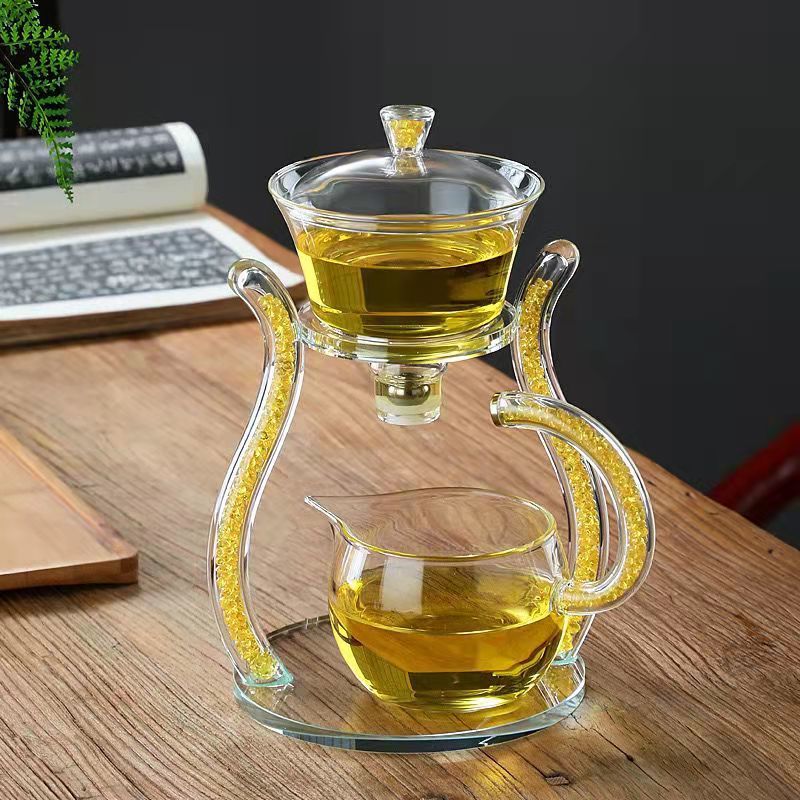
O [espaço em branco no original] oferece uma abordagem diferente para o bule de vidro que enfatiza métodos e estética tradicionais. Enquanto meu equipamento prioriza consistência e conveniência, essa alternativa foca no ritual e no envolvimento do processo de preparação. Ambas têm mérito, e a escolha entre elas depende das prioridades individuais. Conjunto Magnético Moderno lives in this exact sweet spot for me. I bought it because the magnetic infuser is genuinely clever — the strainer lifts out cleanly without a balancing act over the sink — but what kept it on my counter was the size. It’s big enough for my partner and me to share a pot of tieguanyin on a slow Sunday, small enough that I don’t feel wasteful when I brew alone on a Wednesday. The glass also lets me watch the leaves unfurl, which sounds like a gimmick until you’ve actually done it with a good oolong. You start to understand why the brew time matters.
There is a small honest drawback: a glass pot this size does not hold heat as long as ceramic. If I’m brewing a particularly delicate green tea, I find myself needing to pour a touch faster, or pre-warming the cups. It is a minor adjustment, not a deal-breaker. For daily black and oolong drinking, the heat retention is plenty.
The size that gets ignored in every buying guide is the “couple’s pot.” It is also the size most people should actually buy first.
When Friends Come Over: The Group and Hosting Pot
Once you have your daily pot sorted, the next question is what to do when you actually have people over. A 450ml pot is too small for four people. Refilling it twice in the middle of a conversation is annoying for you and a little embarrassing in front of guests. A second pot or kettle quietly boiling in the kitchen breaks the spell of the whole ritual.
This is where the larger pot earns its place. I learned this lesson during a small dinner party about two years ago. I had brewed three rounds of sheng pu’er in my “couple’s” pot and spent the entire evening apologetically running back and forth to the kitchen. After that night, I bought something designed for a group.
What I wanted — and what I think most hosts actually want — is something between 700ml and 1L that pours well, doesn’t look like a giant laboratory beaker, and ideally makes the whole process feel less like work. The Conjunto Tomate Caqui does this in a way I did not expect. It’s an automatic tea maker, which initially made me skeptical — I associate automation with bad tea. But what it actually does is solve the host’s problem beautifully: water stays at temperature, the leaves steep and drain automatically, and you are free to talk to your guests instead of hovering over the pot. It is the most relaxed I’ve ever felt serving tea to a group.
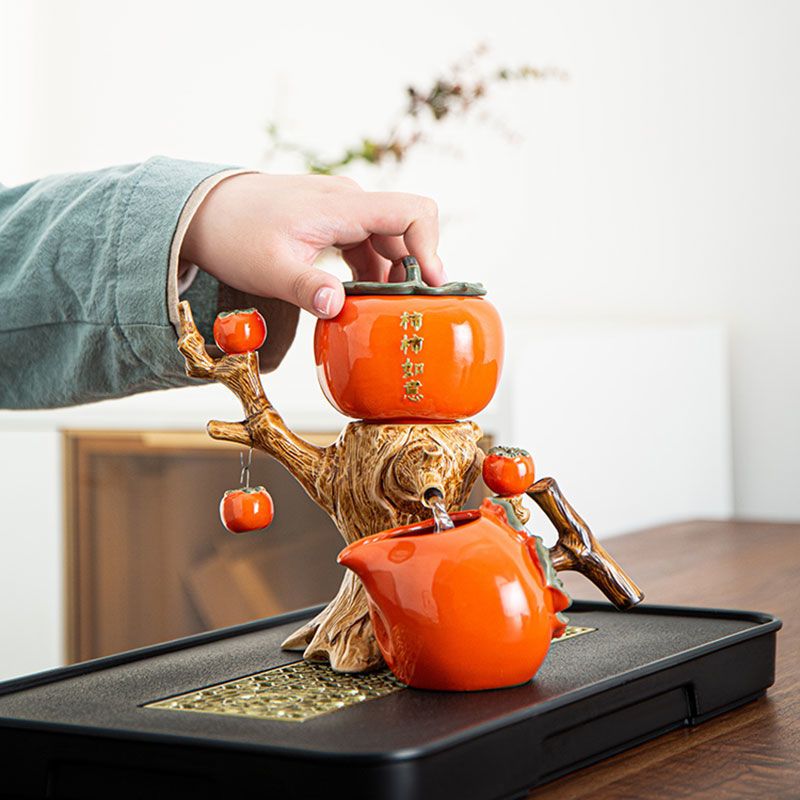
The honest trade-off: an automatic pot like this is overkill for solo or couple use, and the rotating ceramic design is more of a statement piece than a minimalist one. If your kitchen leans clean and modern, it will dominate the counter. If your kitchen leans warm and lived-in, it will look like it has always been there. Mine has earned its spot because I genuinely host, but I wouldn’t recommend it as someone’s only pot. It is a second pot, a hosting pot, a weekend pot.
If you entertain more than once a month, or if your family naturally gathers around the table for tea rather than coffee, this is the category worth exploring. And if you find yourself drawn to the warmth of ceramic for group brewing, our Ceramic Teapot Collection includes several larger pots that aren’t automatic but give you that same generous capacity with a more traditional pour.
The Novelty Pot: When Small Is the Whole Point
There is a category that doesn’t fit neatly into the solo/couple/group framework, and that’s the novelty pot — the small, whimsical piece that lives on your shelf more than on your brewing counter. I resisted these for years, partly because I thought they were unserious and partly because I assumed they wouldn’t brew well. I was wrong on both counts.
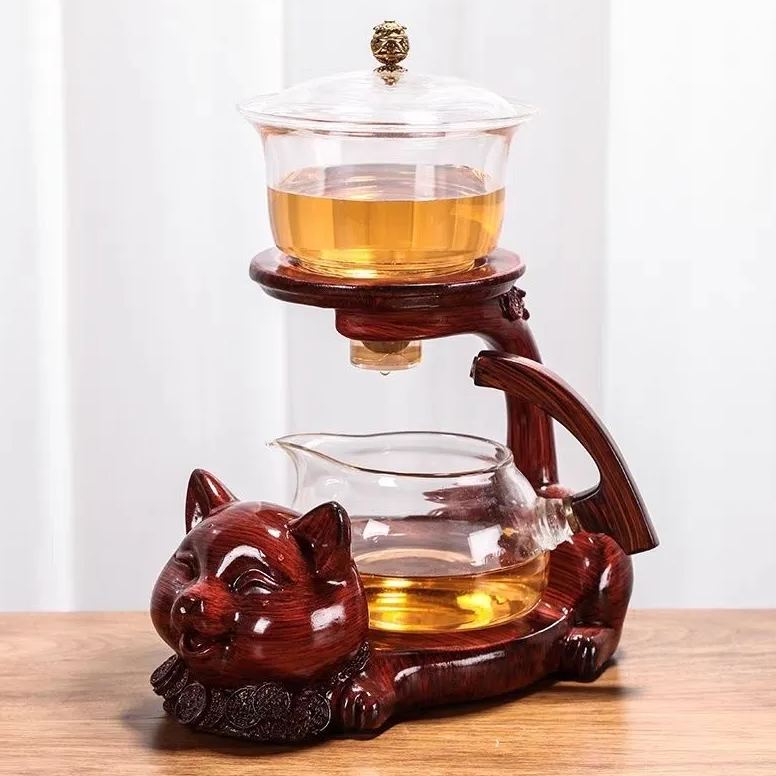
O [espaço em branco no original] oferece uma abordagem diferente para o bule de vidro que enfatiza métodos e estética tradicionais. Enquanto meu equipamento prioriza consistência e conveniência, essa alternativa foca no ritual e no envolvimento do processo de preparação. Ambas têm mérito, e a escolha entre elas depende das prioridades individuais. Chaleira em Formato de Porco was a gift from my sister, and I rolled my eyes at it for about three days before I actually used it. It holds somewhere in the 200–300ml range, which makes it firmly a solo pot. The “magic” part is that it’s semi-automatic — you fill it, set it, and the leaves steep and drain on their own without you holding anything. For a lazy Sunday morning where I want tea but don’t want to think about tea, it is genuinely delightful.
The honest drawback: a novelty pot is not where you learn serious brewing. If this is your first and only teapot, you’ll outgrow it within a year. But as a second or third pot — the one that lives by your reading chair, or the one you use when you’re sick and just want something warm without effort — it has real value. I’d also argue that the playfulness of it makes tea more approachable for people in your life who think of tea as “the stuff my grandmother drinks.” I have converted at least two friends back into tea drinkers with this pot, which is not something my yixing clay pot ever accomplished.
Material Matters, but Only After Size
Once you’ve picked a size, the material conversation actually becomes useful. Before that, it’s a distraction.
Vidro is what I’d recommend for most people starting out. You can see what’s happening, you can tell when the leaves are spent, and there’s no mysterious “seasoning” ritual. The downside is heat retention, which is real. Glass is fine for black tea, oolong, and white, but if you’re drinking delicate green teas that turn bitter quickly, you’ll want to pour faster or consider warming your cups.
Ceramic is the workhorse. It holds heat better than glass, doesn’t demand the careful handling of clay, and comes in enough sizes and shapes that you can find one for any of the three size categories above. Our Ceramic Teapot Collection spans everything from solo gongfu pots up through hosting vessels, and ceramic is what I’d point a beginner toward without hesitation.
Clay (yixing and friends) is wonderful but complicated. It seasons over time, it pairs best with specific teas, and it usually comes in small sizes because that’s what the brewing style demands. If you fall in love with clay later, that’s a whole journey — but I wouldn’t start there.
Cast iron holds heat beautifully and looks dramatic, but it’s heavy, it can rust if you mistreat it, and it’s overkill for most home use. Lovely for the right aesthetic, but rarely the most practical pick.
There is no “best” teapot material. There is only the material that fits the way you brew, and you can’t know that until you know your size.
The Math Nobody Tells You About Teapot Sizing
One more piece of sizing logic that took me embarrassingly long to internalize: the rated volume of a teapot is not the volume of tea you actually drink. A 500ml pot does not give you 500ml of tea. Some of that water stays with the leaves. Some evaporates. Some clings to the walls of a thick ceramic pot. The realistic pour from a 500ml pot is closer to 350–400ml of actual drinkable tea, depending on the infuser design.
This matters because cups vary wildly. A small Chinese tasting cup is 30ml. A Western mug is 250ml or more. If you have one Western mug in mind, a “450ml couple’s pot” is really a one-and-a-half-mug pot, which is the exact awkward size I warned you about earlier.
The mental shortcut I now use: match the rated pot volume to roughly 1.5x to 2x the size of the cup you actually drink from, multiplied by the number of people. So if you and your partner both drink from 250ml mugs, you want a pot in the 750ml to 1L rated range, not the 450ml range. If you drink from smaller cups, the math flips and a 350–450ml pot becomes plenty for two.
This is also why I encourage people to think about their actual cup before buying a teapot. The pot is downstream of the cup, not the other way around.
Os Erros Que Cometi Para Que Você Não Precise Cometê-los
Looking back at ten-plus years of buying teapots — for myself, for friends, for family members I’ve slowly converted — there are a handful of mistakes that come up over and over.
Buying small because it looks elegant. A tiny pot on a shelf looks beautiful. A tiny pot on your counter at 7am when you want tea now looks like a problem. Pretty is not a brewing strategy.
Buying huge because you “might have guests.” The reverse mistake. A 1.2L pot for one person who hosts twice a year is a pot that holds cold tea every other day. The “what if” pot is rarely the right pot.
Treating size as a final detail. People spend hours agonizing over spout shape, lid fit, and handle ergonomics. These matter. But they matter only once the size is right. A perfectly crafted 150ml pot for someone who actually needs 500ml is still the wrong pot.
Ignoring how you clean it. A wide-mouth pot is easier to rinse. A pot with a removable infuser is easier to maintain than one with a built-in strainer you can’t fully reach. I have retired two beautiful pots because I dreaded washing them, and a teapot you dread washing is a teapot you stop using.
Skipping the second pot too long. Once you have a daily driver, you’ll start to notice the moments it doesn’t quite fit. That’s your cue to add a second pot — not to replace the first, but to cover the gap. Most tea drinkers I’ve talked to end up with two or three pots, and each one has a specific job.
What I Actually Keep on My Shelf Now
In the spirit of full honesty, here’s what lives on my counter and shelves today, and what each one does:
- A small clay pot (180ml) for gongfu sessions on weekends when I want to sit with a single oolong for an hour.
- The Modern Magnetic Set (~450ml) for daily brewing with my partner, and for any one-guest situation.
- The Persimmon Tomato Set (~1L) for hosting, dinners, and slow afternoons when the kitchen is full of people.
- The Pig Shaped Teapot for lazy mornings, sick days, and the occasional gift to a friend I’m trying to convert.
That’s four pots, and I’m not remotely apologetic about it. They each earn their place by being the right tool for a specific moment. None of them tries to do everything, and that is exactly why I reach for them all.
Looking back, the original mistake — buying the yixing pot first — wasn’t really about yixing or clay. It was about assuming one pot could be everything. Tea is a daily ritual with at least three or four distinct modes: the quiet solo cup, the shared pot with someone you love, the lively gathering, and the playful treat-yourself moment. Each of those modes wants its own pot. Once you accept that, the buying decisions get dramatically easier.
How to Pick Your First Pot (Without Repeating My Mistake)
If you are starting from zero and want one pot that will carry you through the next year, my honest recommendation is this: figure out your most common tea moment first. Not the moment you wish you had, but the one you actually have, most days, at the time of day you actually drink.
If your honest answer is “alone, with a mug, while I read” — go small. A 150–250ml ceramic pot will serve you beautifully, and you can browse our Ceramic Teapot Collection for solo-friendly options.
If your honest answer is “with my partner, in the afternoon, slowly” — go couple’s size. A 400–500ml glass or ceramic pot is your daily driver, and the Conjunto Magnético Moderno is a particularly good entry point because the magnetic infuser removes one of the small daily frustrations.
If your honest answer is “when friends and family are over, multiple times a month” — start with the hosting pot. A 700ml to 1L automatic or large ceramic pot will save you the running-back-and-forth problem I described earlier, and you can find several good options in our hosting-friendly Coleção de Conjuntos de Matcha and beyond, including the Conjunto Tomate Caqui for a more relaxed serving style.
If your honest answer is “I genuinely don’t know yet” — that’s fine. Get the couple’s size. It is the most forgiving, the most versatile, and the one that will stay useful even as your habits evolve. Then, six months in, you’ll know what gap your second pot needs to fill.
A Final Thought on the Pot You Don’t Buy Yet
There is something almost paradoxical about the right-sized teapot: the better it fits your life, the less you’ll think about it. You’ll just reach for it, brew, pour, drink, and put it back. It will fade into the rhythm of your day. The wrong pot, by contrast, is the one you keep noticing — the one that’s too small, too big, too fiddly, too precious to use on a weekday.
That fading-into-the-background quality is, to me, the real test of a good teapot. Not how beautiful it looks on day one, but how invisible it becomes by month six. The pot you barely think about is the pot that’s earning its place.
If you take one thing from this entire article, take this: start with size, let material follow, and trust the size that matches your Tuesday self, not your Saturday-evening-with-friends self. The pot that gets used every day will always beat the pot that gets admired once and forgotten.
And if you’re not sure where to begin, take a slow browse through the shop. There is no rush, no right first purchase, and very little that a kettle of hot water and a forgiving leaf cannot forgive. The pot is just the tool. The ritual is yours.
 PT
PT  EN
EN  DE
DE  ES
ES  FR
FR  JA
JA