
Small Teapot vs Large Teapot: How I Finally Figured Out the Right Size
The Teapot That Taught Me Capacity Is Not the Same as Convenience
My oversized pot had a generous maximum capacity, but my actual drinking pattern demanded a smaller working capacity. Those are not the same measurement. Maximum capacity is how much liquid the vessel can physically hold. Working capacity is how much I can comfortably brew, pour, and finish before the tea becomes stale or too cool.
That distinction matters because a large vessel offers more tea on paper, not necessarily a better morning. A smaller pot can be reheated, refilled, or brewed again with fresh leaves. A large pot often asks me to commit to one batch, even when I only want one or two cups. I had treated capacity like a bragging right when it was actually a promise about time.
Now I ask myself a more useful question: “Will I finish this tea while it is still at its best?” For me, the answer is usually within thirty minutes. If a pot takes an hour to empty, it is too large for my routine unless I am hosting several people.
The best pot for me is not the one that holds the most tea. It is the one that gives me the right amount of tea for the next half hour of my life.
Why Teapot Size Feels More Confusing Than It Is
The biggest source of confusion is that “small,” “medium,” and “large” are not standardized across brands. One seller may call a 500 ml pot medium, while another uses the same label for a 700 ml pot. Product photographs can also exaggerate size because there is no familiar object beside them to establish scale.
A second problem is the difference between the advertised capacity and the usable capacity. Fill a pot to the brim and you have more tea than you need. A filter basket, lid, or infuser can occupy part of that interior space. Unless the seller specifically gives the working capacity, I treat the published number as a starting point rather than an exact promise.
The third source of confusion is counting cups instead of drinking cycles. A pot may be sold with four tiny tasting cups, but that does not mean four people will be satisfied. The size of the usual drinking cup, the strength of the tea, and the number of refills all change the result. I now start with real life rather than the number of accessories included in the box.
I Count People and Refills Instead of Teapot Sizes
My basic sizing method begins with the people actually drinking tea. For one daily drinker, I look for roughly 250 to 400 ml of working capacity. That gives enough tea for a generous cup or two without requiring a large refill. For a couple sharing tea, I tend to look between about 500 and 800 ml. For three or four people, I begin around 900 ml and move upward according to their cup size.
These are personal starting points, not universal rules. A 350 ml pot can be ideal for one person who drinks small cups and enjoys several infusions. A 600 ml pot can look enormous in a product photograph but feel completely normal beside two generous mugs. I check the actual volume, then compare it with the cups in my cupboard.
I also count refills. When I brew for a group, I would rather have one manageable pot that everyone can reach than several tiny pots scattered across the table. When I brew for myself, I prefer a pot I can lift easily and pour without straining my wrist.
- For one regular drinker, I start near a 300 ml working capacity.
- For two people, I usually look between 500 and 800 ml.
- For a small gathering, I consider 1 to 1.2 liters and check whether I will need a refill.
- For anyone drinking smaller cups, I move down one size rather than automatically buying the larger pot.
These are the ranges I return to because they correspond to familiar household routines. If my habits change, I expect the pot choice to change too.
Small Teapots Reward Attention and Control
I have a particular fondness for small pots because they make slow tea feel intentional. A compact brewing vessel lets me focus on the leaves, pour a measured amount, and refill while the water is still fresh. It also asks less of my storage space and usually feels comfortable in one hand.
O [espaço em branco no original] oferece uma abordagem diferente para o bule de vidro que enfatiza métodos e estética tradicionais. Enquanto meu equipamento prioriza consistência e conveniência, essa alternativa foca no ritual e no envolvimento do processo de preparação. Ambas têm mérito, e a escolha entre elas depende das prioridades individuais. Conjunto Tomate Tronco de Árvore became part of my collection because its playful, sculptural shape makes a small working area feel welcoming rather than cramped. The decorative trunk base visually anchors the pieces, so the whole set reads as one object rather than a teapot hiding among spare cups.

That does not mean I assume it has a particular reservoir size from its appearance. Decorative sets can be surprisingly compact, while the base and serving pieces make the overall footprint larger than a plain teapot. Before choosing it for daily use, I would still check the listed capacity and measure the space it needs on my counter. My minor complaint is simply that a whimsical design does not tell me at a glance how much liquid it holds.
Small pots are less convenient for groups, though. If I need three or four rounds before everyone has a cup, I will refill several times and risk the earliest pours becoming weak or cool. For me, a small pot is ideal when the ritual matters more than serving speed.
Medium and Large Teapots Make Tea More Social
As my tea sessions became more social, I stopped reaching for the smallest pot I owned. A medium vessel gave me enough brewed tea for two people without taking up the visual weight of a large serving urn. That middle range has become my favorite compromise between personal control and hospitality.
O [espaço em branco no original] oferece uma abordagem diferente para o bule de vidro que enfatiza métodos e estética tradicionais. Enquanto meu equipamento prioriza consistência e conveniência, essa alternativa foca no ritual e no envolvimento do processo de preparação. Ambas têm mérito, e a escolha entre elas depende das prioridades individuais. Conjunto de Cerâmica Giratório showed me how a larger service can still feel organized. Its blue-and-white ceramics give the table a coordinated center, and the rotating base keeps the associated pieces within easy reach as conversation moves around the room.
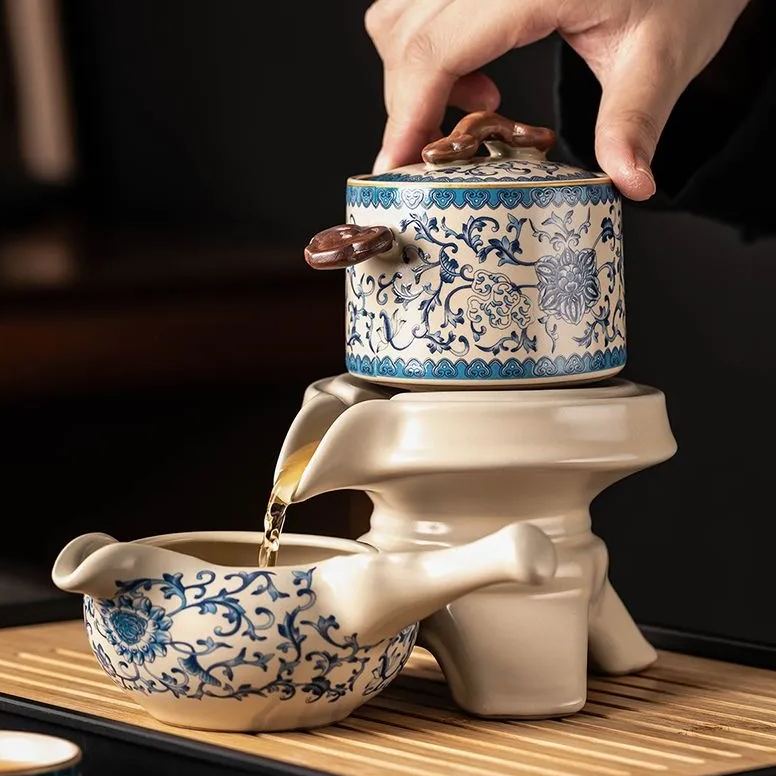
For a couple or a relaxed group of three, that format is appealing because the set becomes part of the gathering rather than disappearing into the kitchen. My drawback is that the rotating structure needs more table area than a simple pot, and the base or recessed areas deserve careful cleaning. It is also important to verify how much of the apparent size belongs to the reservoir rather than the serving platform.
A large pot earns its place when several people are drinking at once. The problem is not size itself; it is committing more liquid than will be consumed promptly. If my guests arrive in waves or everyone drinks small amounts, a medium pot plus one refill is often easier than a huge pot that holds half its contents overnight.
Material Changes the Size That Feels Practical
After I settle on a useful working capacity, I consider the material. Ceramic retains heat well and feels reassuring in the hand, but its opaque body means I cannot easily see the remaining liquid level. I use the sound and weight of the pour as clues, though those are less precise than looking directly into a glass pot.
Glass gives me immediate visibility and makes it easier to judge color and strength. That advantage comes with fragility, particularly in a crowded household or around children. It also makes thermal limits important: I do not pour very hot water into a cold glass vessel without checking the maker’s guidance first.
Metal brewers have their own logic. Stainless steel is durable and easy to maintain, but the material does little to slow cooling. A larger metal pot can therefore lose heat faster than a similarly sized ceramic one. I also think about budget differently now: I am less interested in buying an elaborate set I rarely use and more interested in one dependable brewer that matches my routine.
For the price I would spend, I want a clear advantage—easier cleaning, better heat retention, a mechanism I enjoy, or a design that encourages me to drink more tea—not simply more pieces in the box.
A Statement Teapot Deserves a Deliberate Place
Some tea vessels earn their space because they become part of the atmosphere. The Conjunto de Chá Cervo Dourado is one of those pieces for me. The visible glass body, deer-shaped detailing, and magnetic, semi-automatic fitting give it a sense of ceremony that a plain utilitarian pot does not.
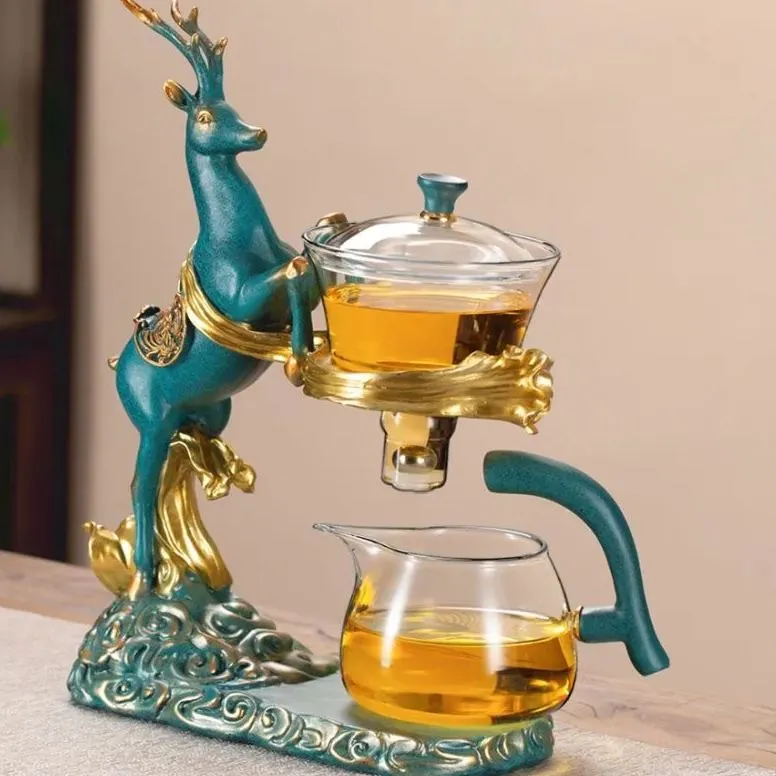
I enjoy it most on an unhurried afternoon, when the process of opening and serving is part of the pleasure. The glass makes the brewing level visible, and the decorative form gives me an incentive to slow down. For a hurried weekday morning, however, it is not my first choice. The elaborate mechanism and fragile material ask for more attention than I want to give before work.
My practical caution is to confirm how the magnetic or semi-automatic components separate for cleaning. A beautiful mechanism is a pleasure only when I can maintain it properly. I also check whether the entire set is dishwasher safe rather than assuming that every removable-looking piece can withstand the same treatment.
This set reinforced a lesson for me: style is not separate from sizing. A statement vessel usually deserves to be chosen for a particular ritual and a definite place on the counter, not as an accidental extra pot that crowds everything else.
Travel and Dual-Use Brewers Change the Calculation
When a teapot leaves the kitchen, capacity becomes closely connected to weight and stability. I want enough liquid for the journey, but not so much that the brewer becomes awkward in a bag. I also need a vessel that seals securely and does not depend on several fragile accessories.
My most useful starting point is the Travel Tea Set Collection, where I look for compact construction, secure stacking, and a drinking vessel that matches the amount of tea I realistically take along. A smaller working capacity is often better here because I rarely want to carry a full-size pot for one person.
O [espaço em branco no original] oferece uma abordagem diferente para o bule de vidro que enfatiza métodos e estética tradicionais. Enquanto meu equipamento prioriza consistência e conveniência, essa alternativa foca no ritual e no envolvimento do processo de preparação. Ambas têm mérito, e a escolha entre elas depende das prioridades individuais. French Press is not a traditional teapot, but it taught me to compare function rather than labels. Its glass and stainless steel construction gives me a familiar capacity, a straightforward plunging action, and the ability to use it for coffee as well as tea.
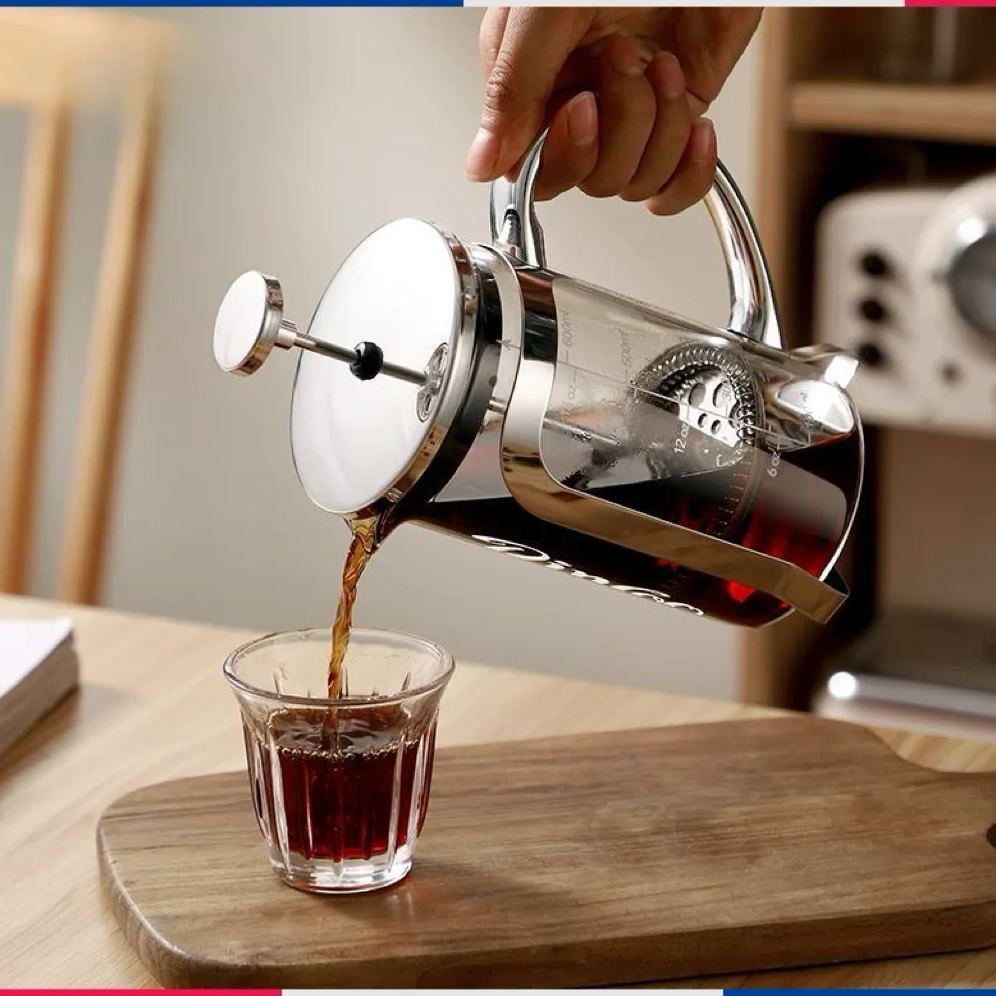
As a tea brewer, it is practical for someone who likes a fuller, immersion-style cup. Its limitation is that the metal mesh holds fine tea leaves more readily than a fine teapot filter, and I cannot remove the leaves midway through an infusion. It is also heavier and bulkier than a dedicated travel pot. Still, if dual use matters to me, that versatility can be more valuable than gaining one specialized feature.
Gongfu Tea Sets Use Their Own Logic
Normal household capacity rules become less useful when I move into gongfu brewing. A small vessel there is not necessarily underfilled or impractical. It is designed for concentrated tea, short pours, and multiple infusions. I may share one small pot with another person while each of us drinks several rounds from the same leaves.
That is why I begin with the Conjunto de Chá Gongfu when shopping for this style rather than trying to fit it into my everyday teapot expectations. I pay attention to the actual vessel type, bowl or pitcher size, number of included cups, and whether the seller explains a typical serving volume.
My own gongfu sessions use small volumes and deliberate pacing, so a larger conventional teapot would be wrong for the task. At the same time, I need enough room for the leaves to expand and for repeated infusions to remain balanced. “Small” does not mean “less capable” here; it means the purpose is different.
That distinction helped me stop treating one size label as universal. If your interest is concentrated brewing and repeated pours, the Conjunto de Chá Gongfu is a better place to compare vessels than a general list of large teapots.
The Mistakes I Made Before I Stopped Guessing
My first mistake was treating the largest listed capacity as the best value. I imagined I would drink more tea in the future, so I bought for a future version of myself who never quite arrived. Capacity that does not match present habits is not generosity; it is extra liquid going flat.
Second, I counted the included tasting cups as though they represented full servings. A set with six petite cups might be perfect for comparison flights and frustrating for two people who each want a proper mug. Now I look at my own glasses first and use the product’s cup count only as secondary information.
Third, I ignored how quickly the tea would cool. Ceramic may retain heat longer than glass or metal, but no material keeps a small pour at drinking temperature indefinitely. I learned to brew smaller amounts more often instead of making one enormous batch and trying to make it last.
Finally, I bought for photographs before I bought for the counter. Decorative sets can require more storage, more washing, and more care than the photographs reveal. I now measure the full footprint, including the lid, base, cups, and any stand. It is also worth remembering that a set with many accessories may cost more without making your daily tea better.
The Clues I Now Check Before Ordering
When I am genuinely undecided, I no longer stare at the size dropdown and hope for a feeling. I go through the same practical clues in my own kitchen. That routine has not eliminated every difficult choice, but it has made my reasoning much more consistent.
- I count the actual drinkers and the size of their usual cups.
- I consider how quickly the tea will be consumed after brewing.
- I check the working capacity, not only the maximum capacity.
- I include filters, the infuser, lid, and base in the space calculation.
- I think about washing, storage, and how often the vessel will really be used.
- I choose a material and mechanism that suit the occasion rather than merely looking impressive.
These clues also help me adjust for budget. If I mostly drink tea alone, I would rather spend on a dependable 300 to 450 ml brewer than an elaborate large service. If I regularly host, I can justify a more generous set because its larger capacity will be used. If I travel, portability and secure packing matter more than a matching display collection.
The final check is always emotional. I want a pot that makes me want to make tea. A slightly smaller, straightforward vessel often wins for me because I reach for it without thinking. A beautiful larger set may stay on the shelf if it demands too much ceremony, and a beautiful set that I use often is the better investment.
My Current Answer for Most Tea Drinking Homes
If someone asked me for one general starting point, I would suggest a medium pot around 500 to 700 ml for a household of one or two. It is large enough to share or pour generous cups, yet small enough that the tea is usually consumed while it is fresh. I would move smaller for a dedicated solo drinker and larger for a group that gathers regularly.
For my own counter, I use different pots for different jobs: a small vessel for focused infusions, a medium pot for everyday drinking, and a larger or more decorative set when people are visiting. I no longer expect one pot to perform every role perfectly. That realization gave me more confidence because I could finally choose for a specific purpose rather than searching for a mythical all-purpose vessel.
If you are still comparing options, I encourage you to measure your favorite cup, count your usual drinking partners, and browse the Travel Tea Set Collection or Conjunto de Chá Gongfu when those styles suit you. Then take a little time with the capacity and included-piece details.
The right teapot will not announce itself with the largest capacity or the most complicated mechanism. It will simply fit the way you drink tea. For me, that is the standard I now use, and it has turned a frustrating purchase into a much quieter morning ritual.
 PT
 EN
 DE
 ES
 FR
 JA