
Best Teapot for Black Tea: 6 Picks for Strong Daily Brews
Okt.
Einführung
The best teapot for black tea is decided before you reach a shop shelf, by two facts about the tea rather than about the pot. Black tea is brewed hotter than any other common tea, at 90 to 98 °C, and it is the tea most often taken with milk (per the Wikipedia black tea reference).
Both facts pull against the pot most people would buy by instinct. A thin glass pot shows the colour of the liquor and throws heat away fast. A heavy ceramic pot holds the heat and hides the colour. Choosing between them is the real decision.
There is a third problem, and it is the one that catches new buyers shopping for the best teapot for black tea. Breakfast blends are usually made from CTC tea, a production method that shreds the leaf into very fine particles. So a best teapot for black tea pick needs a filter fine enough to hold back dust that a slotted spout would wave through. A pot that looks elegant can put a layer of grit in the bottom of your cup.
This best teapot for black tea guide works through the brewing data that constrains the choice, then compares six picks from the Elysian catalogue by mechanism rather than by price. Each pick is given the job it is genuinely good at, and the awkward cases are named too, including the teapots here built for a different kind of tea altogether.
Wichtige Erkenntnisse
- Black tea is brewed in water brought up to 90 to 98 °C for 3 to 5 minutes, and whole-leaf tea or tea served with milk needs the full 4 to 5 minutes, while delicate teas such as Darjeeling need only 3 to 4 minutes (per the Wikipedia black tea reference).
- The reference dose is 0.08 oz, which is 2.26 g of tea, per 8 US fl oz, which is 237 ml, of water (per the Wikipedia black tea reference). A pot that cannot be pre-warmed and cannot be topped up is the problem, not the dose itself, which is why the best teapot for black tea is decided on construction.
- A cold vessel lowers the steep temperature. The brewing notes specify rinsing the vessel with water at 90 °C or above before brewing (per the Wikipedia black tea reference), which is why the best teapot for black tea is often the one with two chambers and a metal or wooden stand rather than a single bare pot.
- Breakfast blends are frequently CTC processed, which cuts and tears the leaf into very fine particles. Tea infusers exist precisely to steep fannings and broken leaf teas, and an infuser with large holes may not catch all the leaves (per the Wikipedia infuser reference).
- The film that forms on black tea is oxidised polyphenols plus calcium carbonate, and it is more pronounced when the tea is brewed with hard water. This is a cleaning argument, and in a best teapot for black tea comparison it belongs in the buying decision rather than in a manual read later.
- Earl Grey is traditionally made from Chinese Keemun and is intended to be served without milk, while British blends and Indian masala chai are drunk with milk. One pot cannot serve both patterns equally well, which is the first fork in every best teapot for black tea decision.
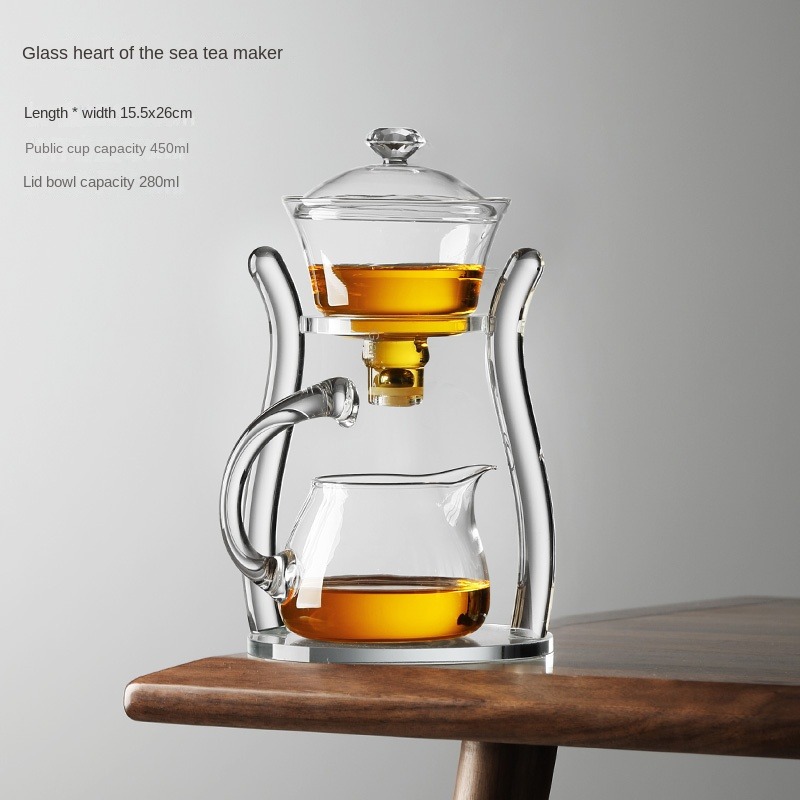
- None of the 43 products in the Elysian catalogue publishes a capacity or a glass grade, so these picks are ranked by mechanism and construction and not by volume. The single exception is Pick 3, whose own product image states a 280 ml brewing chamber and a 450 ml serving pitcher.
Inhaltsverzeichnis
- What Black Tea Demands From a Teapot
- The First Fork: Milk or No Milk
- The Problem With Breakfast Blend Dust
- Four Filter Mechanisms, Ranked for Black Tea
- Side-by-Side: 6 Picks Compared
- Pick 1: The Elegant Glass Tea Brewing Set with Infuser
- Pick 2: The French Press Coffee and Tea Maker in Glass and Stainless Steel
- Pick 3: The Magnetic Semi-Automatic Glass Tea Set
- Pick 4: The Rotating Ceramic Tea Set
- Pick 5: The Magnetic Semi-Automatic Ceramic Tea Set with Metal Frame
- Pick 6: The Tomato Teapot on a Tree Trunk Base Ceramic Tea Set
- Heat Retention: What Actually Keeps a Pot Hot
- Which Teapots in the Catalogue Are Wrong for Black Tea
- 6-Point Checklist for Choosing the Best Teapot for Black Tea
- Our Recommended Teapots for Black Tea
- FAQ
- Endurteil
What Black Tea Demands From a Teapot
Temperature and steep time are not the same variable
The single most useful brewing fact about black tea is that it is the only common tea that wants near-boiling water. It is also the fact that decides the best teapot for black tea. Black tea should be steeped in water brought up to 90 to 98 °C, which is 194 to 208 °F, for 3 to 5 minutes (per the Wikipedia black tea reference). The same reference notes the contrast that matters for pot choice: unlike green teas, which turn bitter when brewed at higher temperatures, black tea is built for it.
Time is a separate variable, and it is where the mistakes cluster in a best teapot for black tea comparison. Whole-leaf black teas, and black teas to be served with milk or lemon, should be steeped for four to five minutes. More delicate black teas such as Darjeeling need three to four minutes, and broken leaf teas need less brewing time than whole leaves because they have more surface area. Steep past the right point and the tea turns bitter, which is a different failure from a weak brew and cannot be corrected by pouring faster.
That gives a four-minute to five-minute window during which the pot has to hold near-boiling temperature. It is a long window. A pot that starts at the top of the brewing range and falls steadily through it spends most of the steep below the temperature the leaf wanted, which reads as weak, flat or thin rather than as badly steeped.
A pot that keeps the heat reads as round and full-bodied. The best teapot for black tea is therefore less about the material than about how much thermal mass sits between the water and the room, which is the working definition of a good black tea pot.
One more caution is worth carrying into the shop before buying a best teapot for black tea. The ISO Standard 3103 defines how to brew tea for sensory testing, and the reference is explicit that this is not a method for general consumption (per the Wikipedia black tea reference). The resulting mix is more than twice as concentrated. Sensory-panel ratios and home ratios are not the same numbers, and a teapot bought to hit the standard ratio will brew tea that tastes like tea concentrate.
Why a cold pot ruins your first cup
The brewing notes address this directly: a cold vessel lowers the steep temperature, and to avoid it the brewing vessel is rinsed with water at a temperature of at least 90 °C before brewing (per the Wikipedia black tea reference). A best teapot for black tea that comes straight out of a cupboard is nowhere near 90 °C. So the first thing poured into it is absorbed by the walls of the pot rather than by the tea. The brew starts cool, the colour comes up pale, and the drinker concludes the pot is faulty.
Glass makes this worse than ceramic, and the material science behind the best teapot for black tea is straightforward. Borosilicate glass has a density of about 2.23 g per cubic centimetre and a mean specific heat capacity of 0.83 J per gram kelvin between 20 and 100 °C, roughly one fifth that of water (per the Wikipedia borosilicate glass reference). A thin-walled glass pot has very little heat to give, so it follows the water down. A thick ceramic pot has considerably more mass and gives its heat back to the brew instead.
This is why the pre-warm instruction is not optional detail in any best teapot for black tea guide. That is why a two-part pot with a separate serving chamber has an advantage over a single glass pot for anyone brewing a full-strength pot to sit with. The serving chamber can be warmed on its own, and the brewing chamber can be rinsed hot, so the brew meets a hot vessel rather than a cold one.
The First Fork: Milk or No Milk
Breakfast blends are built to be drunk with milk
Many teas are traditionally drunk with milk in cultures where dairy products are consumed. The reference names them directly, which is the point that separates one best teapot for black tea from another: Indian masala chai and British tea blends. These tend to be very hearty varieties of black tea that can be tasted through the milk, such as Assams or the East Friesian blend (per the Wikipedia tea reference). The addition of milk to tea in Europe was first mentioned in 1680, and it never went away (per the Wikipedia tea reference).
Assam tea is the clearest example of what a milk-service black tea wants, and therefore of what a best teapot for black tea has to survive. Assam is known for its body, briskness, malty flavour and strong, bright colour, and Assam teas or blends containing Assam are often sold as breakfast teas.
Irish breakfast tea is a maltier and stronger blend built from small-sized Assam leaves (per the Wikipedia Assam tea reference). Strong, bright and malty is a description of a tea that can carry milk, and a tea that can carry milk is brewed stronger than a tea served plain.
The brewing consequence is that the pot has to do two things at once. It has to make a strong brew, and it has to keep that brew hot while the drinker adds milk to the cup. Milk dropped into a lukewarm cup tastes of milk rather than of tea.
Ireland, the second-biggest per capita consumer of tea in the world as of 2016, takes its tea with milk or sugar and brews it longer for a stronger taste, at an annual national average of 2.7 to 4 kg per person (per the Wikipedia tea reference). This is the use case that decides the best teapot for black tea for most households in the target market of this store. That is the case the ceramic picks in this guide are built for.
Earl Grey and Keemun are built to be drunk without it
The opposite case is just as common and it points the other way, which is why a best teapot for black tea cannot be chosen by material alone. Earl Grey was traditionally made from black teas such as Chinese keemun, and was therefore intended to be served without milk. It is sometimes blended with lapsang souchong tea, which lends a smoky character (per the Wikipedia Earl Grey reference). Brewing it needs less time: two to three minutes is the common recommendation, with some drinkers going to five minutes to draw out the citrus aroma.
Served plain, the useful property of the pot is visibility, and it is the one thing a best teapot for black tea with milk cannot give. Black tea builds its strength in the colour of the liquor, and the drinker can read that colour directly through a glass wall, which is something no ceramic pot can offer. A short 2-to-3-minute steep also demands a mechanism that can be stopped on command. The difference between a three-minute and a five-minute Earl Grey is the difference between bright citrus and bitterness.
So the milk fork is real, and it is the first question to answer before any pot is bought. It splits the best teapot for black tea shortlist in two. If the answer is milk, heat retention and pre-warming decide the choice and visibility is a bonus. If the answer is plain, visibility and steep control decide the choice and heat retention is a bonus. Two different pots can both be right, and no single pot is optimal for both.
The Problem With Breakfast Blend Dust
CTC is a production method, not a tea type
There is no black tea called CTC, and understanding why is the difference between a best teapot for black tea that works and one that does not. Black teas are processed in either of two ways, CTC, which stands for crush, tear, curl, or orthodox.
The CTC method produces leaves of fannings or dust grades that are commonly used in tea bags. The method is also used to produce higher broken-leaf grades such as BOP CTC. The orthodox method, which can be done by hand, is the route to the whole-leaf teas that connoisseurs look for (per the Wikipedia black tea reference).
The mechanism is where the problem starts for anyone choosing the best teapot for black tea. CTC machines shred the withered leaf through several stages of contra-rotating rotors with surface patterns that cut and tear the leaves to very fine particles. A black tea sold as a breakfast blend is very often a blend built on that output, which is why the leaf in the bag is small and dark and why the brew goes dark quickly.
Fannings and dust are what reach the cup
The grading terms describe the problem precisely, and they are the terms a buyer should look for when reading a best teapot for black tea listing. Fannings are small particles of tea left over from the production of larger tea varieties. Dusts are the finest particles left over from production of the above varieties, often used for tea bags with very fast and harsh brews (per the Wikipedia black tea reference).
The same reference records that broken leaf teas have more surface area and need less brewing time than whole leaves, which is the same fact seen from the other side: more surface area means more extraction, faster, and more solids in the cup whether you wanted them or not.
This is exactly why tea infusers exist in the form they do, and why the infuser is the most valuable feature to check in a best teapot for black tea. Tea infusers enable one to easily steep tea from fannings and broken leaf teas.
The reference also notes that infusers with large holes may not catch all the leaves, requiring the use of a tea strainer to remove the remaining pieces (per the Wikipedia infuser reference). Filter fineness is not a detail on a spec sheet. For a CTC-forward breakfast blend, it is the difference between a clean cup and a cup with a layer of grit in it.
For anyone still weighing options after this best teapot for black tea comparison, the semi-automatic tea set collection is the fastest way to see the range of brewing mechanisms on sale. The guide to teapots with infusers covers the filter types in more depth than this page can.
Four Filter Mechanisms, Ranked for Black Tea
Every teapot in the picks below solves the same problem in a different way. The four mechanisms rank differently once black tea is the target of a best teapot for black tea comparison. The ranking below is an editorial judgement built from how each mechanism handles fine particles and how precisely it can be stopped. No accelerated wear testing or particle-count measurement was carried out for this comparison, so treat it as a reasoned ordering rather than a laboratory result.
Perforated stainless plate
A fixed perforated plate sits across the base of a brewing chamber, and it is the most reliable answer in a best teapot for black tea comparison for a dust-forward blend. The brew leaves the leaves behind as the liquid drains through the holes. Because the plate is a solid perforated disc rather than an open spout, the aperture can be set much finer than any slotted rim, which is what a CTC blend needs.
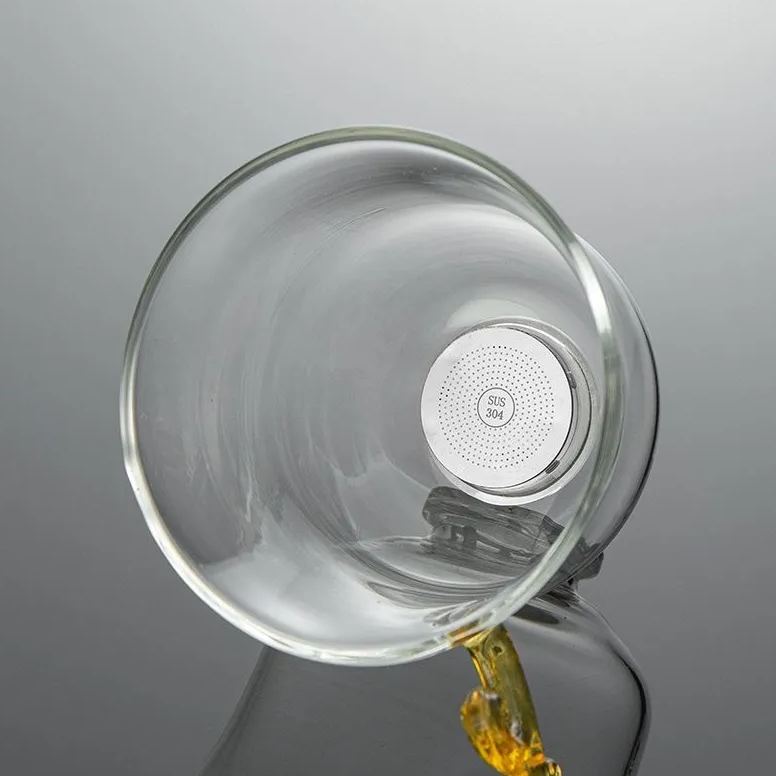
The trade-off is that the drain runs continuously once the water is in, so the steep is governed by how fast the chamber is emptied rather than by a switch. Pick 1 in this guide uses exactly this arrangement, and its filter plate is visibly stamped SUS 304.
Magnetic drain
A magnetic joint holds the brewing chamber closed, and moving the magnet away from the water outlet opens the drain while moving it close stops it. The result is the most flexible pot in this best teapot for black tea guide.
It can be stopped on command, which is the one property that matters when the same vessel has to handle a three-minute Earl Grey and a five-minute Assam. It also allows a separate serving chamber below, so the brewed tea lands in a second vessel rather than sitting in the pot. Pick 3 and Pick 5 both use this arrangement.
Fine steel mesh
A woven or perforated steel mesh in a plunger holds back more than an open spout and less than a fine plate. It comes with the stainless frame and plunger of a French press. The advantage is body, which in a best teapot for black tea comparison is worth trading precision for.
The reference describes the French press as ensuring full-bodied flavour extraction, and a fine mesh with a plunger can hold a leaf in contact with the water for as long as the drinker wants. The limitation is that the mesh cannot be stopped partway through, because pressing the plunger is what separates leaf from liquid. A plunger that goes all the way down is a steep that keeps going until you stop it.
Open slotted spouts
A rotating ceramic set with a pouring channel, or a ceramic pot with a strainer built into the lid, does the opposite trade. Nothing to jam, nothing to break, nothing to learn, and no fine particles held back at all. For a whole-leaf Keemun served at a table, that is entirely sufficient. For an Assam blend bought specifically for its strength, it will let grit into the cup. This is the mechanism where the tea type genuinely has to be checked before the pot is chosen. It is also where a best teapot for black tea recommendation can go wrong.
Side-by-Side: 6 Picks Compared
The comparison below covers the six picks in this best teapot for black tea guide. Capacity is only stated for Pick 3, because that is the only product in the group whose own product image publishes it. Mechanism and material are taken from the product descriptions, and the milk and no-milk columns record which of the two drinking patterns each pot is built for.
| Pick | Material | Filter mechanism | Steep control | Heat retention | Best for |
|---|---|---|---|---|---|
| 1. Glass brewing set with infuser | Clear glass with stainless filter plate | Fixed perforated SUS 304 plate | Drain runs continuously, chamber sets the timing | Low, thin glass walls | CTC breakfast blends where fines must be held back, a best teapot for black tea for dust |
| 2. French press, glass and stainless | Glass beaker with stainless steel frame and mesh | Fine steel mesh in a plunger | Plunger down stops the brew, no partial stop | High, stainless frame and lid | Strong full-bodied brews and masala chai |
| 3. Magnetic semi-automatic glass tea set | Glass with chrome frame, wooden base | Magnetic suction drain with leaf basket | Precise, magnet stops the flow on command | Moderate, 280 ml brewing chamber and 450 ml pitcher | Both patterns in one pot, a best teapot for black tea for two or three cups |
| 4. Rotating ceramic tea set | Cream and black glazed ceramic | Rotating dispenser with pouring channel | Slow, served to the table | High, ceramic body | Milk service to a table of guests, a best teapot for black tea for the family |
| 5. Magnetic semi-automatic ceramic set | Yellow or black ceramic with metal frame | Magnetic suction, brewing and serving separated | Precise, magnet stops the flow | High, ceramic chamber plus metal frame | Breakfast blends with milk, a best teapot for black tea on the table |
| 6. Tomato teapot on a tree trunk base | Orange and teal glazed ceramic | Automatic dispensing through the base | Release on demand, brew held in the pot | High, ceramic throughout | Small households and households with children |
Pick 1: The Elegant Glass Tea Brewing Set with Infuser
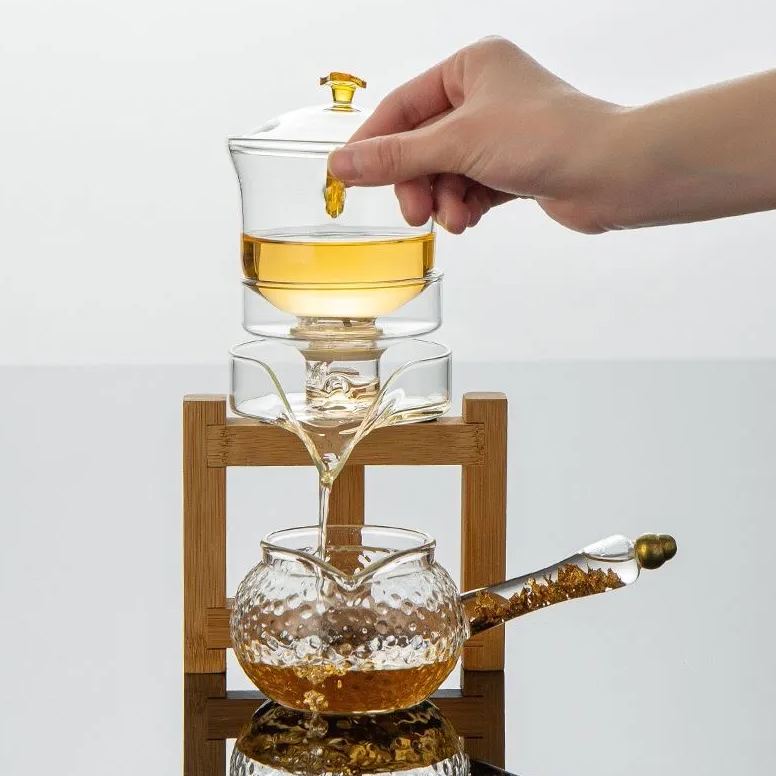
This is the pick for anyone whose black tea arrives as a breakfast blend, and it is the best teapot for black tea when the dust is the problem. The elegant glass tea brewing set with infuser is a two-part arrangement: an upper brewing chamber that holds the leaves and a lower serving pot that receives what drains through. The product description describes the two-tiered system as allowing easy steeping and separation of tea leaves from the brewed tea. The copy calls it ideal for brewing loose leaf teas without sediment.
The photograph of the filter confirms the mechanism rather than the marketing, and it is the reason this set leads the best teapot for black tea guide. Looking down into the brewing chamber shows a perforated stainless steel disc seated across the base. The perforation pattern is dense enough to read as a fine screen, with a centre stamp that reads SUS 304. That is the construction that a CTC-forward Assam blend needs, and it is the reason this set leads the guide rather than the elegant glass alone.
The honest limitation is heat. Glass walls hold very little heat, and this is a thin-walled glass design, so the brew does not stay hot for long once it lands in the lower pot, which is the one weakness in an otherwise excellent best teapot for black tea.
The design answer is to brew a smaller, stronger batch and pour it, which suits a black tea drinker who works in second cups rather than in a full pot sitting on the table. For a drinker who wants one pot to stay hot through a long breakfast, this is not the best teapot for black tea even though its filtration is the strongest of the six.
Pick 2: The French Press Coffee and Tea Maker in Glass and Stainless Steel
Next in the best teapot for black tea guide is the french press coffee and tea maker in glass and stainless steel, which is included because for one kind of black tea it is the right instrument, even though it is not a teapot. The product copy describes a dual-use design for brewing both tea and coffee, a French press design that ensures full-bodied flavour extraction, a durable glass beaker made of clear, heat-resistant glass, and a stainless steel frame and plunger.
For black tea that matters, because full-bodied extraction is exactly what a malty Assam or a spiced masala chai wants. This is the only best teapot for black tea pick in the guide with a built-in fine mesh. The steel mesh retains more leaf and more fines than any open spout. The stainless frame also keeps heat in the way thin glass cannot. The beaker is graduated, with measurement marks printed on the glass, which removes the guesswork from the 2.26 g per 237 ml dose that the brewing notes specify (per the Wikipedia black tea reference).
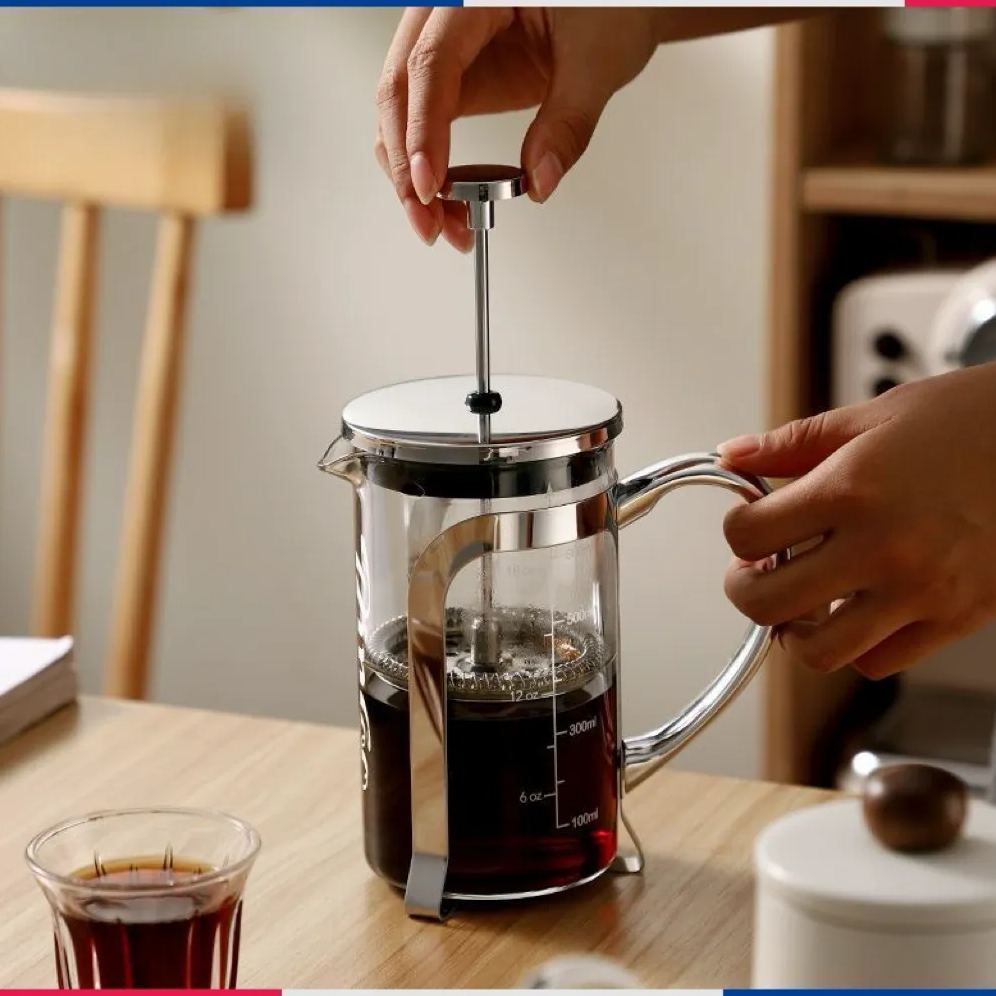
The limitation is equally clear, and it is the trade that separates a specialist from a best teapot for black tea all-rounder. There is no partial stop. A press goes from steeping to separated in one movement, so if the goal is a three-minute Earl Grey beside a five-minute Assam, the press cannot deliver both from the same pour.
Pressing early leaves the leaf in the water. Anyone considering it should read the existing guide to choosing a french press for tea before deciding, and should treat this as the strong-brew specialist rather than as the all-rounder. The guide to cleaning glass teapots covers the metal film that a steel mesh leaves behind on glass.
Pick 3: The Magnetic Semi-Automatic Glass Tea Set
The best teapot for black tea for most households is the magnetic semi-automatic glass tea set. It wins on the one property that black tea needs most: a steep that can be stopped on command, which is why it leads this best teapot for black tea guide. The magnetic joint holds the upper brewing chamber against the lower serving pitcher, and moving the magnet away from the water outlet opens the drain, while moving it close stops it.
The product image that explains the principle is unusually clear, and it is the clearest available evidence for how a best teapot for black tea actually behaves, showing two colourways side by side with the note that the outlet opens when the magnet is close to the water outlet and away from the water stop.
Loose leaf sits in the upper chamber and brewed tea collects in the pitcher below. That arrangement is what makes this pot workable for both patterns. A three-minute steep for a citrus-forward Earl Grey and a five-minute steep for a malty Assam are both achievable without changing vessels, which no other pick in this guide can claim.
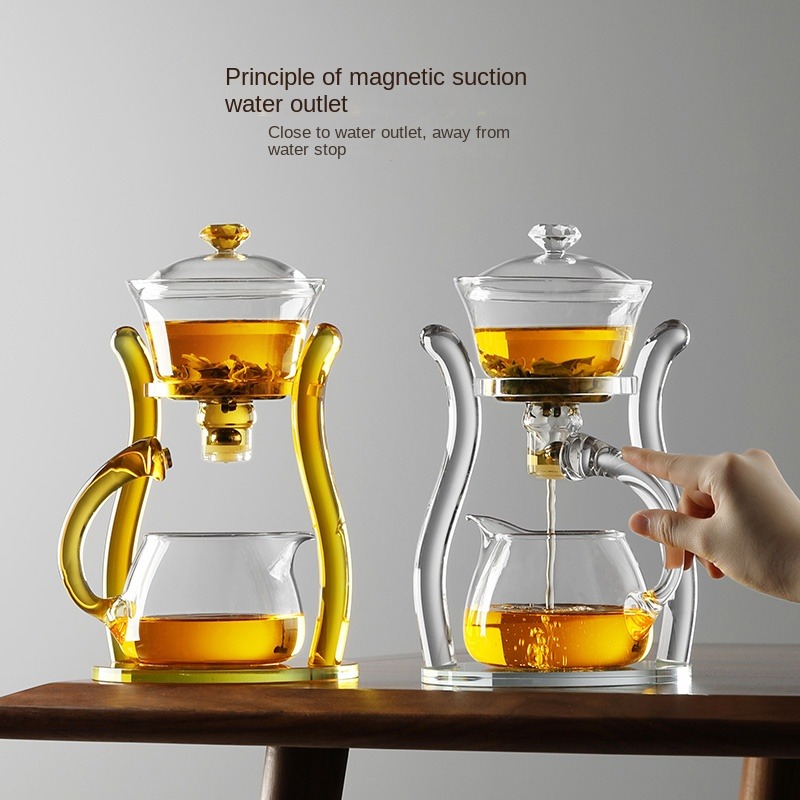
This is also the only product in the whole group that publishes its own dimensions, which is a rarity in a best teapot for black tea comparison and the reason it can be matched to a household. The published numbers are what make that match possible.
The product image states a length and width of 15.5 by 26 cm, a public cup capacity of 450 ml and a lid bowl capacity of 280 ml. A 280 ml brewing chamber produces roughly two cups of strong black tea at the 2.26 g per 237 ml dose. The 450 ml pitcher below gives enough headroom to pour three cups without the last one arriving cold.
Pick 4: The Rotating Ceramic Tea Set
The fourth pick in this guide is the rotating ceramic tea set with multiple colours. It is the answer for a household that drinks breakfast tea together rather than one person at a time, which makes it the best teapot for black tea for a family table. The mechanism is a rotating dispenser: the pot sits on a raised ceramic pedestal with a pouring channel. It is turned to the guest being served rather than lifted and tilted over each cup.
Two properties make this a serious contender for the best teapot for black tea with milk. The first is heat retention, because the body is ceramic rather than glass, and a best teapot for black tea with milk cannot be a thin glass pot.
The second is the serving pattern, because a strong brew made once and served around a table does not need the pot to be lifted, tilted or held. The product copy describes rotating tea dispensing for easy pouring, high-quality ceramic material and multiple colour options across three styles. The styles run from a cream glaze with a brown rim to a dark glazed variant with a decorative band.
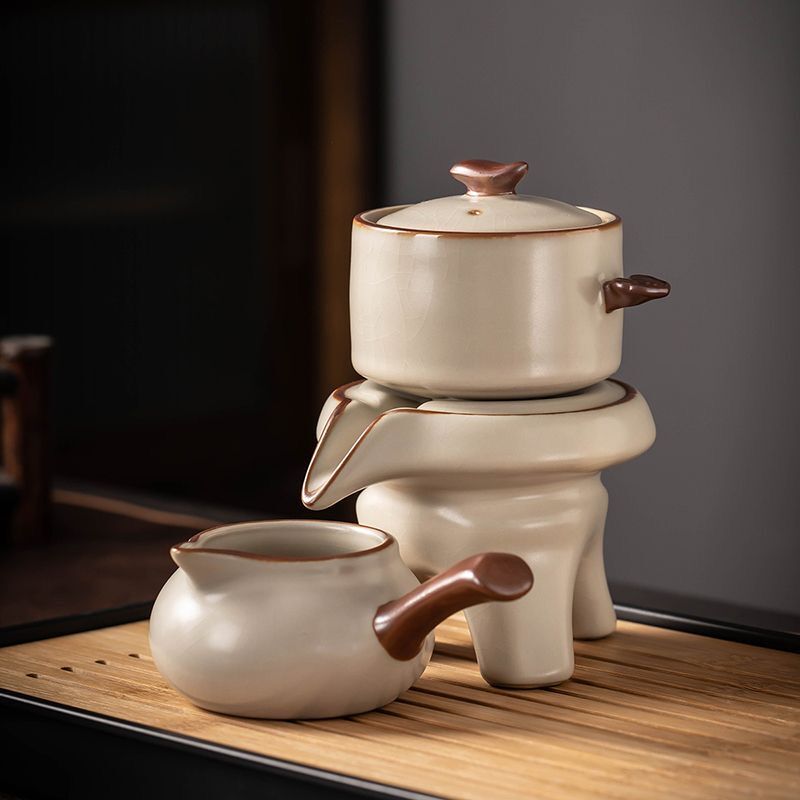
The honest limitation is that the rotating channel is not a fine filter, so this is a best teapot for black tea for whole leaf rather than for dust. It holds back nothing finer than a large leaf. A CTC breakfast blend brewed in this pot will carry its fines into the cup. It is a strong pick for a whole-leaf Keemun or Assam bought as a whole leaf, and a poor one for a dust-forward blend bought in a bag. The next pick solves the same heat problem while keeping a real filter.
Pick 5: The Magnetic Semi-Automatic Ceramic Tea Set with Metal Frame
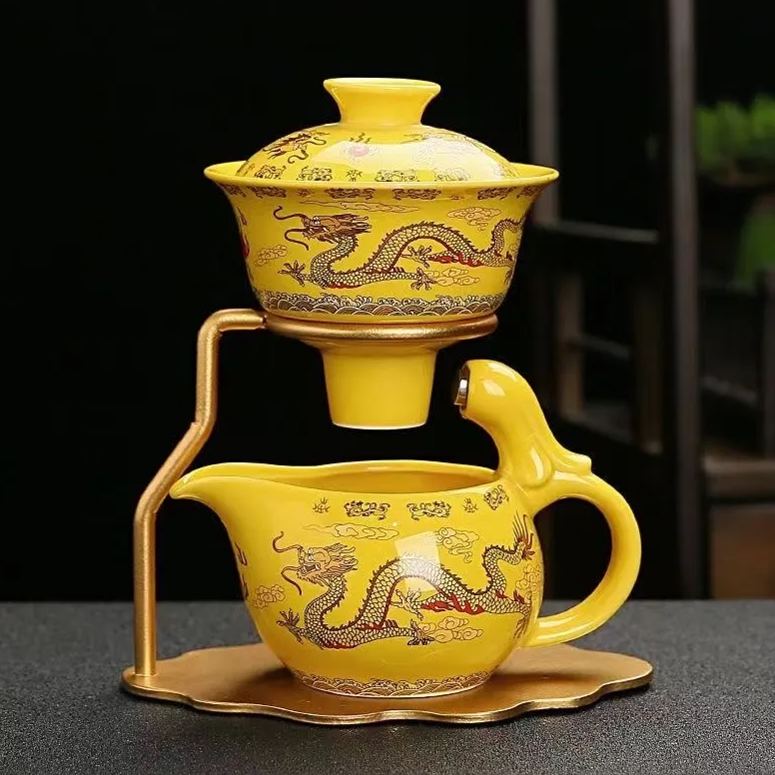
Die [Option] bietet einen anderen Ansatz für Glaskannen, der traditionelle Methoden und Ästhetik betont. Während meine Ausrüstung Konsistenz und Bequemlichkeit priorisiert, konzentriert sich diese Alternative auf das Ritual und die Einbindung in den Zubereitungsprozess. Beide haben ihre Berechtigung, und die Wahl zwischen ihnen hängt von den individuellen Prioritäten ab. magnetic semi-automatic ceramic tea set with metal frame is the pick for a household that wants ceramic heat retention and a filter that can be stopped on command, which makes it the best teapot for black tea with milk. The upper chamber is ceramic, the lower vessel is ceramic, and a gold-toned metal frame holds them in position while the magnetic joint controls the outlet between them.
This is the combination that suits the most common black tea routine in the target market of this store, and it is why this is the best teapot for black tea pick for a household that drinks a strong breakfast blend with milk around the table.
The ceramic body holds the heat that a milk service needs, the separated brewing and serving chambers keep the brew hot while the cup is being prepared. The magnetic outlet gives the same three-minute or five-minute control that Pick 3 provides in glass. The product copy describes magnetic suction for secure and easy assembly, semi-automatic pouring, ceramic construction and a durable metal frame, in four colour styles.
The limitation is care, and it is the one that most affects a best teapot for black tea used every morning. Glazed ceramic with a metal frame is a multi-material object, so the frame and the ceramic want different cleaning treatments. A decorated ceramic glaze does not respond to the same abrasives as glass.
The existing glass teapot cleaning guide covers the abrasive question in detail. The practical note for black tea specifically is the film, because the visible film that forms on black tea is oxidised polyphenols plus calcium carbonate. It is more pronounced when the tea is brewed with hard water.
Pick 6: The Tomato Teapot on a Tree Trunk Base Ceramic Tea Set
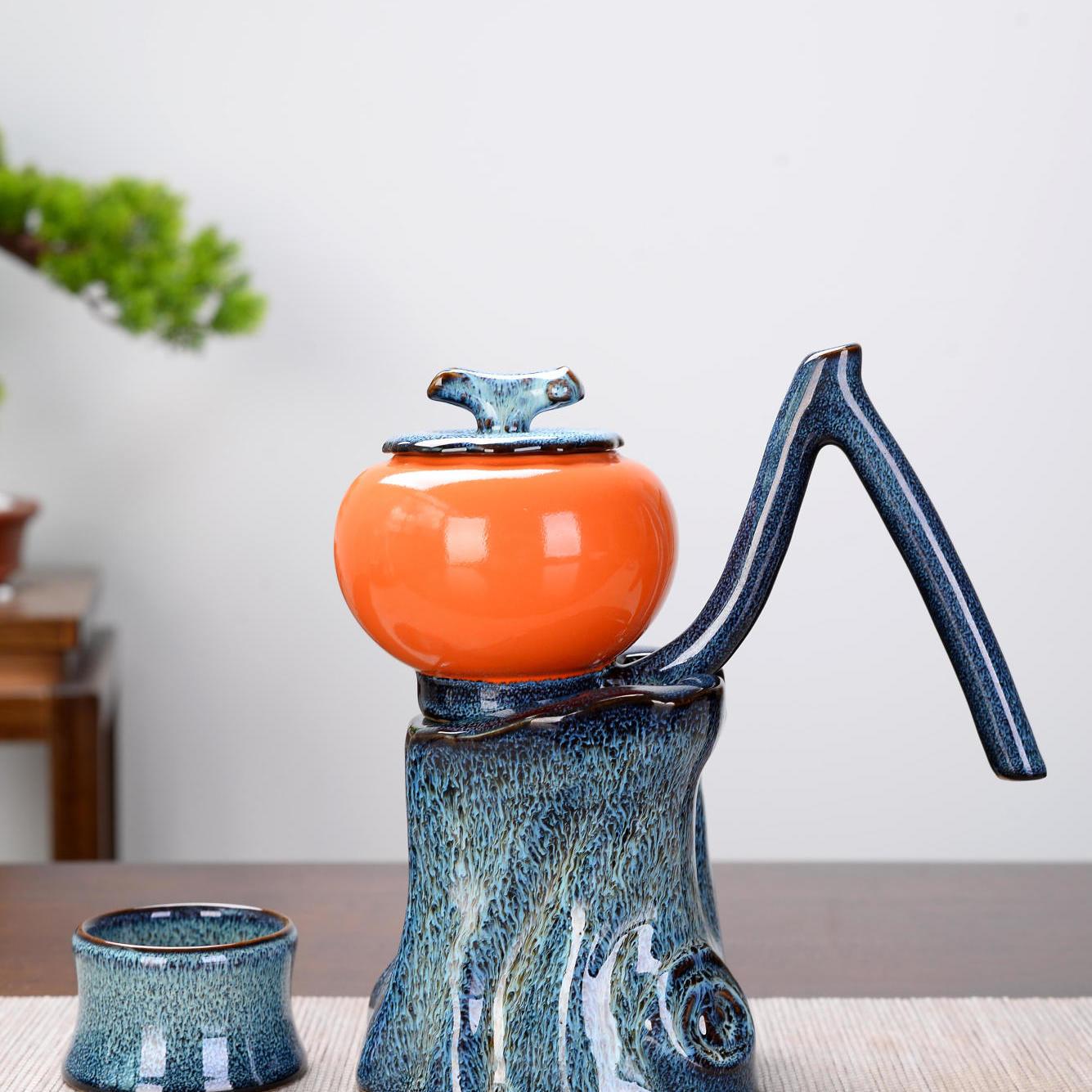
The last pick is the tomato teapot on a tree trunk base ceramic tea set. It earns its place on a point that no other pick in this best teapot for black tea guide addresses: automatic dispensing. The product copy describes a tea dispensing mechanism that releases tea when it is wanted. The pot sits on a rustic tree trunk style serving base, with a matching cup alongside. The brew sits in the pot until it is released, so the strength does not keep developing while it waits.
For black tea this matters in a specific way, and it is the quiet advantage of a best teapot for black tea that dispenses rather than pours. A strong breakfast blend that is left sitting in a pot continues to extract, and the cup poured last is stronger and more astringent than the cup poured first. A pot that holds the brew and releases it on demand gives every cup the same strength, which is the opposite of the usual complaint about a full pot of black tea. The ceramic body also keeps the brew hot while it waits.
The limitation is size, and it should be stated plainly, because a best teapot for black tea that is too small only moves the problem. The set includes a tomato-shaped teapot, a tree trunk style serving base and at least one matching teacup, which makes it a small household set rather than a pot built to serve a table. For two people this is the best teapot for black tea in the guide; for six, it is not. The guide to teapots for two people and the guide to teapots for a group of four cover the capacity axis separately.
Heat Retention: What Actually Keeps a Pot Hot
Heat retention is the property that separates a good black tea pot from a decorative one. It is the second half of every best teapot for black tea decision, and it is worth understanding before spending money, because it is invisible in a photograph. It is a function of mass and conductivity rather than of appearance, which is why a plain cream ceramic set in this guide outlasts a thin glass pot for a milk service. That is why the difference between the two is felt within the four to five minutes that a milk-service steep actually lasts.
Glass has a very low thermal mass compared with ceramic, which is the most misunderstood fact in a best teapot for black tea comparison. Borosilicate glass has a coefficient of thermal expansion of about 3.3 × 10⁻⁶ K⁻¹ at 20 °C, a density near 2.23 g per cubic centimetre and a mean specific heat capacity of 0.83 J per gram kelvin between 20 and 100 °C, roughly one fifth that of water (per the Wikipedia borosilicate glass reference).
A thin glass wall gives its heat to the water very quickly, and then has nothing left to give. Ceramic stores more energy and releases it over the minutes that matter.
There is a second glass property worth knowing, and it is a safety property rather than a brewing one, although it decides whether a best teapot for black tea survives a full kettle. Borosilicate glass is more resistant to thermal shock than any other common glass, and can withstand temperature differentials of about 330 °F, which is 166 °C, without fracturing (per the Wikipedia borosilicate glass reference).
Where soda-lime glass can withstand only about a 100 °F, which is 40 °C, change in temperature (per the Wikipedia borosilicate glass reference). That is why a borosilicate vessel can take boiling water and a cold vessel can shatter on a wet counter.
One point of honesty about the catalogue. The Elysian product pages describe their glass as clear glass or high-quality glass, and one product is described as heat resistant. But no product page in the catalogue states a glass grade such as borosilicate. That is not a criticism so much as a reason to ask, because the best teapot for black tea decision is partly a decision about what the vessel is made of. No catalogue page answers it, and the number to ask a seller for is the coefficient of thermal expansion or a stated grade.
Which Teapots in the Catalogue Are Wrong for Black Tea
A guide that only lists what suits a tea is not much of a guide, and a best teapot for black tea list without exclusions is a sales page. Several teapots in this catalogue are built for a different tea altogether, and the mismatch is worth spelling out, because these sets are frequently the most attractive on the shelf.
The gongfu sets are the clearest case, and they are the most common wrong turn in a best teapot for black tea search. The automatic pouring ceramic gongfu tea set and the semi-automatic pouring gongfu tea set are described in their own product copy as ideal for traditional Chinese tea ceremonies and for traditional Chinese tea preparation.
Gongfu service uses small pots, a high leaf to water ratio and a long run of short infusions, which is a completely different geometry from brewing a breakfast blend for four minutes and then diluting it with milk. The brewing geometry of a gongfu pot does not translate, and a person buying one of these for English Breakfast will get a pot that brews in the wrong direction.
Two other exclusions follow from the same logic, and both matter more to a best teapot for black tea than styling does. A pot with no lid loses heat faster than any pot with one, which is a poor match for a four to five minute steep. A single-chamber pot with no way to separate the leaves gives no answer to the dust problem at all, however attractive it looks on the shelf. The guide to gongfu tea sets explains what that style of service is for.
6-Point Checklist for Choosing the Best Teapot for Black Tea
- Decide the milk question first, because it splits every best teapot for black tea shortlist in two. If the pot will serve milk, prioritise heat retention and a separate serving chamber. If it will serve Earl Grey or Keemun plain, prioritise visibility and a steep that can be stopped on command, because those need two to three minutes rather than four to five.
- Check the filter against the leaf. A perforated plate or fine mesh holds back CTC dust; an open spout or rotating channel does not. Buying a whole-leaf tea and a dust-forward breakfast blend with the same pot is the most common mistake in this category.
- Ask for the glass grade, not just the word glass. A stated grade and a coefficient of thermal expansion are the numbers that determine whether the pot survives a full kettle of boiling water poured into a cold vessel.
- Look for two chambers if the pot will hold a batch, since a best teapot for black tea that holds a batch needs somewhere for the brew to wait. One chamber for brewing and one for serving is what allows the brew to stay hot while the cup is being prepared, and it also allows the brewing chamber to be pre-warmed with 90 °C water on its own (per the Wikipedia black tea reference).
- Confirm the capacity figure rather than guessing from the photograph. In this group only one product publishes it, at a 280 ml brewing chamber and a 450 ml serving pitcher (per the product image for Pick 3), which is enough for two to three cups of strong black tea.
- Plan for the film. The visible film on black tea is oxidised polyphenols plus calcium carbonate, and hard water makes it worse, so a non-abrasive cleaning routine is part of owning a black tea pot rather than an optional extra.
Our Recommended Teapots for Black Tea
If the research above is more than the morning requires, the fastest route to a working setup is to start from the magnetic teapot collection, which is where the drain control that the best teapot for black tea needs is most consistent. Every pick in it uses the drain control that the three-to-five-minute steep depends on. Two notes make the shortlist useful rather than generic.
- For a household that drinks breakfast tea with milk, look at the ceramic tea sets collection, where the body does the heat retention and the pour does not need a second pair of hands.
- For a single drinker who watches the colour of the liquor, the glass tea sets collection is where visibility lives, and a best teapot for black tea for Earl Grey is usually a glass pot. The glass brewing set with infuser in Pick 1 is the one to start from.
- For a pot that must keep a batch hot from breakfast to mid-morning, the semi-automatic tea sets collection and the rotating tea sets collection both hold the brew away from the heat of the burner while it is being served.
- If the pot is for someone who takes black tea without milk, the guide to teapots with warmers covers the case where the brew is made once and then kept hot for an hour.
Request a quote with the tea type, the number of people and the milk habit stated in the enquiry. The best teapot for black tea will be obvious from the answer. That single sentence removes most of the guesswork from the order, and it is what turns a list of six picks into one correct pot. A full browse of every teapot and tea set is there when the decision is still open.
FAQ
What is the best teapot for black tea?
The best teapot for black tea is one that can do two things at once. The second is the one most catalogues ignore: hold near-boiling heat for a four to five minute steep, and separate the leaf from the liquid on command. The magnetic semi-automatic glass tea set in Pick 3 does both, and its own product image publishes a 280 ml brewing chamber and a 450 ml serving pitcher. If the tea is drunk with milk, swap the glass for the ceramic version in Pick 5, which keeps the heat for longer.
Is glass or ceramic better for black tea?
Glass is better when the tea is served plain, because the strength of a black tea is visible in the colour of the liquor and glass shows it, which is why a best teapot for black tea for Earl Grey is usually a glass pot. Ceramic is better when the tea is served with milk, because the body of the pot holds the heat while the drinker prepares the cup, and thin glass holds very little. Neither is better in the abstract, and the milk habit of the household settles the question before the material does.
How long should black tea steep in a teapot?
Three to five minutes is the range for a best teapot for black tea. The reference dose is 0.08 oz, which is 2.26 g, of tea per 8 US fl oz, which is 237 ml, of water (per the Wikipedia black tea reference). Whole-leaf black tea and tea served with milk or lemon should be steeped for four to five minutes, while delicate teas such as Darjeeling need three to four. The pot matters here because the steep has to hold its temperature for the whole of that window, which is where a pre-warmed vessel earns its place.
Do I need a teapot with a built-in filter for black tea?
It depends on the leaf, and the dependency is not obvious, which makes the filter the second most important line in a best teapot for black tea listing. Breakfast blends are commonly CTC processed, which cuts and tears the leaf into very fine particles. A fixed perforated plate or a fine steel mesh is what keeps those particles out of the cup.
A whole-leaf Keemun or Assam bought as a whole leaf needs no filter at all. A slotted spout is therefore a reasonable choice for one tea and a poor choice for another, which is why the filter is the second question to ask after the milk question.
Can I use a teapot for black tea with milk?
Yes, and the better method is to brew strong and dilute in the cup rather than to add milk to the pot. A best teapot for black tea with milk is built for the brew to wait. British blends and Indian masala chai are described as hearty black teas that can be tasted through the milk, and they are brewed accordingly.
The pot needs to hold the heat so the brew stays at temperature while the milk goes in, which is the argument for a ceramic body and a separate serving chamber. It is why the rotating ceramic set in Pick 4 works as a table service for a family breakfast.
Endurteil
The best teapot for black tea is decided by three facts about the tea, not by the pot, and all three are measurable. It is brewed hotter than any other common tea, at 90 to 98 °C (per the Wikipedia black tea reference). It is drunk with milk more often than not.
And it is usually made from leaf that has been cut fine enough to need a real filter. A pot that answers all three at once is a narrow set, and the six picks here each answer two of them very well and give an honest account of the one they do not.
- Pick the magnetic semi-automatic glass tea set if one household drinks both plain black tea and breakfast blends, because the magnetic drain gives a three-minute and a five-minute steep in the same pot, and no other best teapot for black tea pick here does both, and the published 280 ml and 450 ml figures, taken from the product image for Pick 3, make it a two-to-three cup pot.
- Pick the magnetic semi-automatic ceramic tea set with metal frame if the tea goes in with milk and the pot has to hold a batch through a long breakfast, because the ceramic body keeps the heat the glass version gives away.
- Pick the glass brewing set with infuser if the tea is a CTC blend bought in a bag, because the perforated SUS 304 plate is the only filter in this group fine enough to hold back the dust that a breakfast blend produces, and a best teapot for black tea for a CTC blend needs that filter.
- Pick the rotating ceramic tea set if the pot serves a table of people rather than one drinker, because the rotation removes the lifting and tilting from every pour while the ceramic keeps the brew hot, which is the best teapot for black tea for a family table.
- Pick the french press in glass and stainless steel if the priority is a strong, full-bodied cup of Assam or spiced chai and the whole pot is going into one long steep, accepting that it is not a teapot and cannot stop a steep halfway.
- Pick the tomato teapot on the tree trunk base if the household is small and the tea is strong, because the automatic release means the last cup poured tastes the same as the first.
What not to do is buy on the shape of the pot and sort the filter out later. A best teapot for black tea chosen on shape alone is a guess. The plain ceramic gongfu sets in this catalogue are beautiful and are built for a ritual that uses small pots and short infusions, which is not what a five-minute breakfast blend needs. Decide the milk habit, check the filter against the leaf, then choose the body. The full teapot and tea set range is where that decision gets made concrete.
 DE
 EN
 ES
 PT
 FR
 JA