
Magnetic vs Rotating Tea Set: Which One Should You Buy?
Nov.
Einführung
Modern tea sets here do the same job in two ways. Each one separates leaf from liquor and puts the hot drink somewhere you can pour it. The magnetic vs rotating tea set question is really a question about how that separation happens. One family keeps the hot vessel on its stand and opens a valve. The other expects the vessel to be lifted or tilted by hand.
That single difference cascades into everything a buyer actually notices. A magnetic set never asks anyone to pick up a full chamber of near-boiling water. That makes it easier to use one-handed. It also makes a scald much harder to sustain. A rotating set asks for a deliberate lift. In exchange it gives a slow, gravity-fed pour that many people enjoy watching.
There is also a naming problem worth clearing up first. A rotating tea set is usually pictured as a restaurant turntable, a flat tray that spins so a whole table can reach the food in the middle. That object is a lazy Susan. An engineer and soy sauce maker named George Hall redesigned and reintroduced the turntable in the 1950s (per the Wikipedia lazy Susan reference).
The tea sets sold here are a different object. They are vertical stands whose upper chamber drains down into a pitcher, and the catalogue describes them as dispensing automatically when the teapot is lifted or tilted. Confusing the two is the most common reason a magnetic vs rotating tea set comparison misleads.
Wichtige Erkenntnisse
- The magnetic family drains through a magnet-actuated valve built around a rare earth magnet with 12% rare earth content by volume (per the Wikipedia neodymium magnet reference), while the hot chamber stays on its stand. The rotating family drains when the upper chamber is lifted or tilted by hand. That one difference decides scald risk, one-handed use and cleaning.
- Stainless steel is the working part of a magnetic valve. Its corrosion resistance comes from chromium content of 10.5% or more, which forms a self-healing passive film (per the Wikipedia stainless steel reference).
- Glass chambers make the leaf visible, and borosilicate glass has a thermal expansion coefficient near 3.3 × 10⁻⁶ K-1, about a third that of ordinary soda-lime glass, which accounts for 90% of modern manufactured glass (per the Wikipedia borosilicate glass reference).
- Ceramic bodies are fired at temperatures of 1,000 °C to 1,600 °C and carry very little thermal conductivity, so a ceramic chamber holds heat through a long service while a glass chamber lets it fall away quickly (per the Wikipedia ceramic reference).
- A rotating set moves the drink to the middle of the table and lets the host pour without lifting, which suits a group of 3 to 4 guests and a matched service of 6 cups, with the pot standing at the centre of the table (per the catalogue descriptions). A magnetic set pours one cup at a time, which suits a single drinker brewing fast re-steeps.
- No product on this site publishes a capacity or a glass grade, so this magnetic vs rotating tea set comparison states none. The one figure that comes from the maker is a 304 grade stainless steel mesh and valve assembly shown on the product photograph for the detachable glass set (per the product image).
What a Magnetic vs Rotating Tea Set Decision Actually Is
Most tea set comparisons on this site argue about materials, and material arguments are familiar ground. Glass against ceramic, cast iron and stainless steel all come down to heat retention, breakage and how much the vessel adds to the taste. A magnetic vs rotating tea set comparison does not argue about taste at all. It argues about the sequence of physical actions between steeping and serving.
Break the act of serving tea into steps and the difference becomes obvious. Every magnetic vs rotating tea set comparison has to follow those steps in order. Someone heats water, puts it in a chamber with leaf, and waits. Then the hot liquor has to reach a vessel that can be poured into cups. Every automatic tea set solves this by stacking two chambers, one above the other. The upper chamber holds the leaf. The lower chamber holds the drink. The whole difference between the two families sits in the last step: what happens at the join.
In a magnetic set, the join is sealed by a small steel ball that a magnet holds against a conical seat. In a rotating set, the join is an open throat underneath a chamber that the drinker moves by hand. That difference spreads outward into the six practical dimensions compared below. It is why a magnetic vs rotating tea set comparison organised around mechanism beats one organised around looks or price.
It also explains why the two families keep getting mixed up in buyer conversations, which is the specific confusion a magnetic vs rotating tea set comparison exists to correct. A rotating set looks like a drip-through coffee maker. A magnetic set looks like a laboratory separatory funnel. Neither resembles the squat porcelain pot most people picture when they hear teapot. The appearance misleads in both directions. That is why the next two sections cover the mechanics in detail before any product is recommended.
How a Magnetic Tea Set Drains
A magnetic tea set is a two-chamber vessel with a release built into the join. The upper chamber holds loose leaf and hot water. The lower chamber is the serving carafe that receives the brewed liquor. Between them sits a valve. The usual build fixes a neodymium magnet to the underside of the lid, or to the handle that lifts it. Every magnetic vs rotating tea set comparison has to start from that single part.
The magnet and the steel ball
A small steel ball rests in a conical seat at the bottom of the upper chamber, right over the opening into the lower one. No rotating set has a part that behaves this way, and that single fact separates the two families in any magnetic vs rotating tea set comparison. While the magnet touches it, the ball is pulled down against the seat and the join stays sealed, so nothing leaks. Lift the lid and the magnet carries the ball upward with it. That opens the throat.
Gravity then does the work, and the brewed tea falls through the filter into the carafe below. Set the lid back down and the ball reseats itself, stopping the flow without any separate lever or button. That single motion is the whole magnetic mechanism, and it is why a magnetic vs rotating tea set comparison spends so much time on this one joint.
Neodymium magnets make this design practical because they are small and strong. A magnetic vs rotating tea set comparison has to start by asking what actually opens the drain. The magnetic energy of a neodymium iron boron magnet is about 18 times greater than an ordinary ferrite magnet by volume (per the Wikipedia neodymium magnet reference). That is why a palm-sized valve can hold a ball against a smooth seat without a mechanical latch.
That reference also notes a rare earth content of 12% by volume and 26.7% by mass. It also notes that China produces more than 95% of the world’s neodymium (per the Wikipedia neodymium magnet reference). Those supply figures say nothing about how a pot performs. They do explain why the magnet inside a cheap-looking teapot is a more serious part than its size suggests. That is why a magnetic vs rotating tea set comparison should treat it as a structural element rather than a gimmick.
The filter does the real work
The valve decides when the tea moves. The filter decides what moves with it. Both jobs sit in the join, and both are why a magnetic vs rotating tea set comparison keeps returning to this one area.
A tea infuser is a small mesh or perforated container that holds the leaf so it can steep without ending up loose in the pot. The design has been in use since the first half of the 19th century (per the Wikipedia infuser reference). That reference is blunt about the limit. Infusers with large holes may not catch all the leaves, which means a second straining step.
Fine mesh also slows the drain, so a well-designed filter balances two competing needs, passing liquor quickly while holding back broken leaf. A magnetic vs rotating tea set comparison has to keep both facts in view, because the filter is where the two families quietly differ from each other.
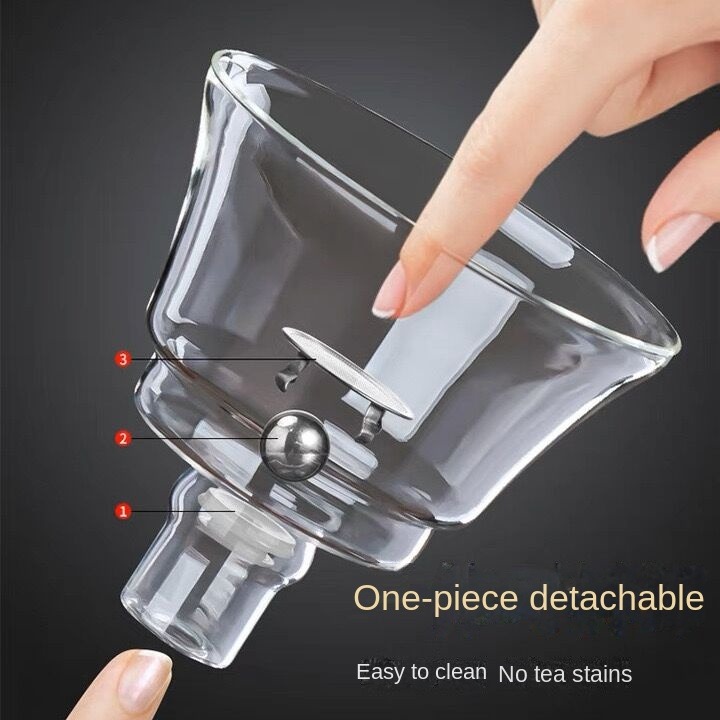
The maker of one magnetic glass set on this site states the material directly on its product photograph, which labels the assembly as 304 stainless steel and calls the chamber one-piece detachable and easy to clean without tea stains (per the product image for the modern design glass set).
That is a figure a magnetic vs rotating tea set comparison can actually check. Stainless steel earns that grade because its corrosion resistance comes from a chromium content of 10.5% or more. That content forms a passive film that can self-heal when exposed to oxygen, and 304 grade sits in the same 18% chromium family (per the Wikipedia stainless steel reference).
A metal mesh also matters thermally, since a steel screen moves heat out of the leaf bed faster than plastic or wood would. That is worth remembering in any magnetic vs rotating tea set comparison, because the working parts are the parts that wear out first.
What never leaves the stand
Here is the payoff of the whole design. The upper chamber stays where it is. The drinker lifts a lid or a handle and the valve opens. The tea falls, the lid goes back, and the valve closes.
There is no moment when a vessel full of near-boiling water hangs in mid-air over a table. For a household with small children, or for anyone pouring with one hand while holding a cup, that removes the most common way a good teapot causes an accident. No rotating set can make that promise, which is why a magnetic vs rotating tea set comparison puts safety first.
There is a second, less obvious benefit. Because the chamber stays seated, the heat stays in the leaf bed for the whole steep. The brewed liquor drops straight into the carafe instead of being poured through air. A magnetic vs rotating tea set comparison should therefore not treat the rotating design as the more traditional or the more authentic option. It is a different trade, and one this guide treats seriously.
How a Rotating Tea Set Drains
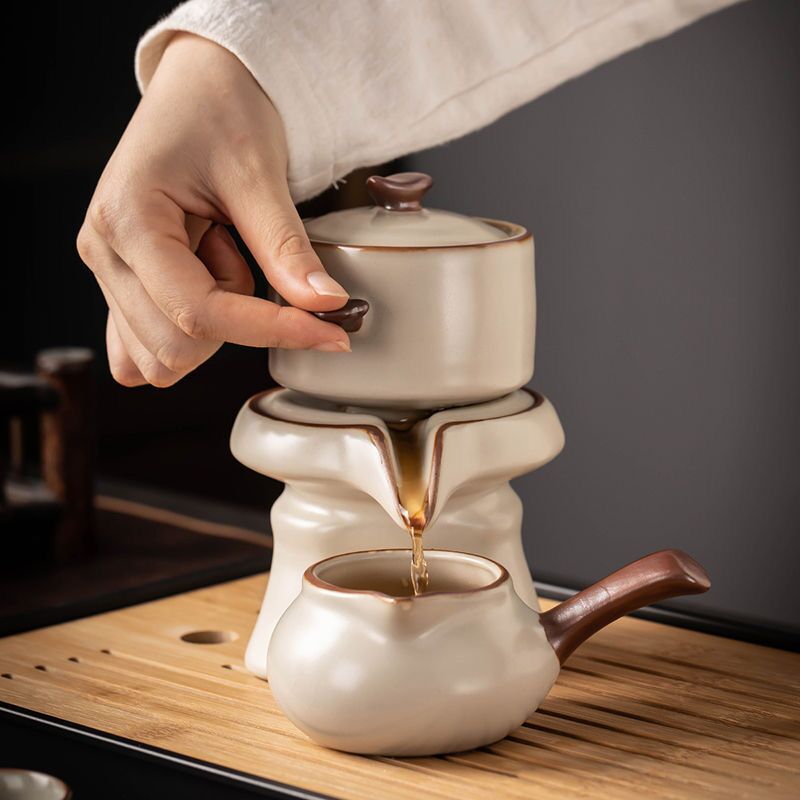
A rotating tea set in this catalogue is a vertical assembly. It is the mirror image of the magnetic arrangement that a magnetic vs rotating tea set comparison starts with. A ceramic upper chamber sits in or above a stand, and a serving pitcher sits below. The catalogue description for the persimmon set is explicit that the mechanism dispenses tea automatically when the teapot is lifted or tilted. The product photographs show the same behaviour, with a hand raising the upper chamber while the brewed liquor runs down the stand’s funnel throat into the pitcher underneath.
Lift or tilt, and the throat opens
There is no magnet and no ball in this arrangement. The upper chamber simply has an open throat at its base. The chamber itself acts as the plug. Raise it a little, or tip it, and the throat unseals.
The weight of the liquid does the rest, running down a funnel moulded into the stand and filling the pitcher below. One of the sets in this guide even shows a small side lever that the drinker presses to start the flow. That is a mechanical variation on the same principle, and a magnetic vs rotating tea set comparison treats it as one.
This design has a quality that no magnetic set reproduces. The pour is slow, visible and continuous, and the drinker controls its speed with the angle of the vessel. The leaf stays behind in the upper chamber while the clean liquor descends. It is closer to watching a river find its way down than to watching a tap open, and it is the strongest argument a magnetic vs rotating tea set comparison can make for the rotating side.
The stand is a pedestal, not a turntable
It is worth repeating the distinction, because the product photographs make it clear. There is no flat spinning tray with cups arranged in a circle around it. The stand is a pedestal. The pitcher sits directly underneath the throat, and the whole assembly is arranged so that one person can pour repeatedly without walking around the table. That is a real service advantage, and it is the reason the rotating family is often bought for hosting rather than for solo brewing. A magnetic vs rotating tea set comparison that calls these turntables would send buyers looking for the wrong object.
Where the lazy Susan comparison does apply is the history, and a magnetic vs rotating tea set comparison needs it there. A rotating tray that lets a whole table reach a dish without passing it around solves the same practical problem, and it carries the same name, imported from Chinese restaurant service where formal dining tables commonly hold one (per the Wikipedia lazy Susan reference). The tea set borrows the idea of removing the reach, not the geometry.
What the hand has to do
Here is the cost, and it should be stated plainly. The upper chamber of a rotating set holds the leaf and the hot water. The drinker must lift or tilt it to serve. That chamber is heavier than it looks once it is full, and it is hot.
The pour is controlled by the angle of the wrist rather than by a valve. So the drinker manages a vessel of near-boiling liquid in mid-air for the few seconds it takes the liquor to run out. That is the price of the visible pour, and a magnetic vs rotating tea set comparison should not hide it.
None of this makes the rotating family a bad choice. It makes the choice a real one. A magnetic vs rotating tea set comparison that only lists features would hide this entirely, and a buyer who wanted a set for a grandmother, or for a table where children move around, would discover the trade only after the box was open.
Six Differences That Decide the Buy
| Dimension | Magnetic tea set | Drehendes Teeservice | Advantage |
|---|---|---|---|
| How the drain opens. | A magnet lifts a steel ball off a conical seat when the lid or handle is raised. | The upper chamber is lifted or tilted by hand, opening an open throat at its base. | Neither. The trigger is the whole difference. |
| Does the hot vessel move. | No. The chamber stays seated on the stand while the valve opens and closes. | Yes. The chamber is raised or tipped by hand to start the pour. | Magnetic, for scald safety and one-handed use. |
| How the pour looks. | A short, controlled release from a fixed spout into the carafe below. | A slow gravity-fed stream down the stand’s funnel into the pitcher. | Rotating, for visual and ceremonial appeal. |
| Who it serves. | One or two drinkers, with fast re-steeps and a single serving vessel. | 3 or 4 guests around a table, with the drink placed centrally. | Rotating for groups, magnetic for solo brewing. |
| Heat behaviour. | Glass chambers show the infusion and lose heat quickly; ceramic versions hold it. | Ceramic bodies, fired at 1,000 °C to 1,600 °C, hold heat through a long service. | Rotating, for keeping tea hot across a sitting. |
| Cleaning. | Detachable glass chambers and steel mesh wash separately; the magnet must be kept dry. | Creamed ceramic is easy to rinse but has no removable valve to disassemble. | Magnetic, for parts that come apart. |
| Breakage risk. | Glass chambers chip or crack if dropped, and borosilicate still shatters under rapid uneven temperature change. | Ceramic is more forgiving of knocks but a fractured glaze still ruins the pot. | Rotating, for a shared table. |
| Breakage cost. | Replacement is straightforward, since the whole chamber is a separate part. | A cracked pedestal often means the whole set is replaced. | Magnetic, for repairability. |
Read across each row and the pattern holds. The magnetic family wins on everything that cuts the effort or the risk of serving. The rotating family wins on everything that improves the shared experience of drinking. A buyer who wants a table to gather around should read the rotating column.
A buyer who wants a pot that works while doing something else should read the magnetic column. That split is the spine of this magnetic vs rotating tea set comparison.
One row deserves attention because it is the most misunderstood. The last row is not about strength, it is about what happens after a mishap. A magnetic glass chamber is a consumable part on a complete set, so a chipped lid costs one part. A ceramic pedestal set is a single object, so a cracked stand costs the set. For a household that expects daily use, that difference in repair cost is worth more than the material argument ever was, and no magnetic vs rotating tea set comparison should leave it out.
Magnetic Picks: Four Sets That Drain on Command
Four picks cover the magnetic side of this magnetic vs rotating tea set comparison. Each one is a complete set with the stand, the chamber and the serving piece. None of them publishes a capacity or a glass grade, and this guide does not invent either. What follows is what the valves and the photographs actually show.
Magnetic Pick 1: the modern design glass set for visible brewing
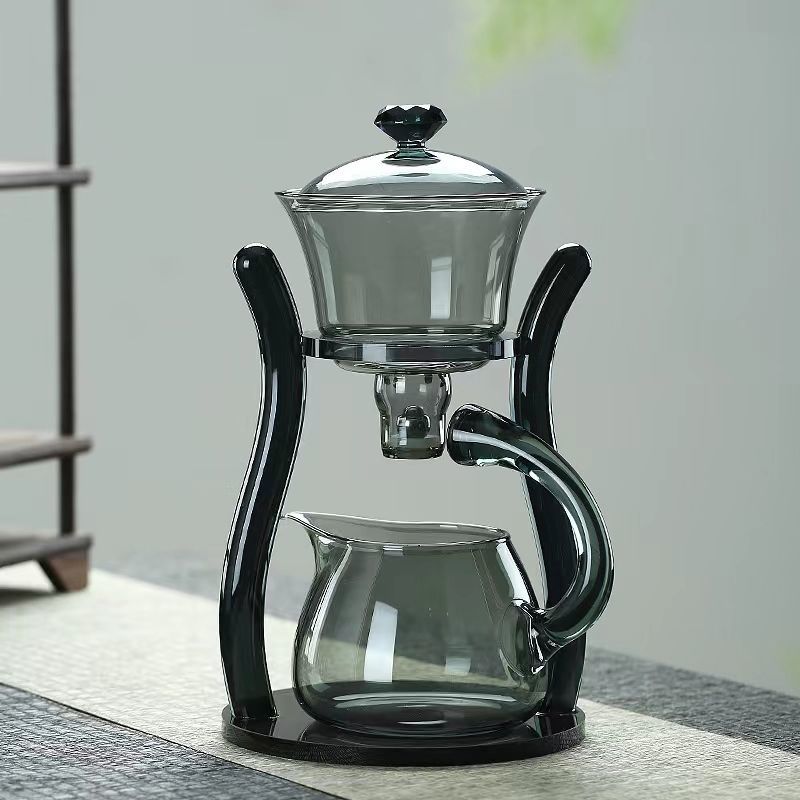
Die [Option] bietet einen anderen Ansatz für Glaskannen, der traditionelle Methoden und Ästhetik betont. Während meine Ausrüstung Konsistenz und Bequemlichkeit priorisiert, konzentriert sich diese Alternative auf das Ritual und die Einbindung in den Zubereitungsprozess. Beide haben ihre Berechtigung, und die Wahl zwischen ihnen hängt von den individuellen Prioritäten ab. magnetic semi-automatic glass tea set in the modern design is the clearest illustration of the valve anywhere on this site, and the best single image for a magnetic vs rotating tea set comparison. The photograph shows the whole geometry in a single frame. A clear upper chamber with a domed lid and a dark finial sits between two curved uprights of a dark frame. The serving carafe is below, with a curved glass spout reaching down towards it.
The frame is the point. Because the chamber is supported rather than held, the whole assembly can sit at the edge of a counter while the drinker works with one hand. The glass body keeps the leaf in view throughout the steep, which matters for anyone learning to read an infusion instead of guessing at a timer. It is the pick a magnetic vs rotating tea set comparison offers for anyone who brews by eye. Three colourways are offered, which makes it straightforward to match an existing kitchen.
It belongs in the magnetic teapot category, where it sits alongside the wider semi-automatic range described in the best semi-automatic tea set guide. A second product photograph of the same set is unusually instructive. It shows the chamber handled close up, with a fine metal mesh disc and a small steel ball visible at the base. The printed instruction reads: press from top to bottom to install. No catalogue copy describes the valve that well, which is the point of building a magnetic vs rotating tea set comparison out of photographs.
That is the valve assembly described earlier, photographed rather than explained, and it is the most direct evidence available that these are ball-seated magnetic valves rather than push-button or lever drains. For a magnetic vs rotating tea set comparison, that kind of photograph is worth more than any spec sheet.
Magnetic Pick 2: the detachable glass set with a 304 stainless steel mesh
Die [Option] bietet einen anderen Ansatz für Glaskannen, der traditionelle Methoden und Ästhetik betont. Während meine Ausrüstung Konsistenz und Bequemlichkeit priorisiert, konzentriert sich diese Alternative auf das Ritual und die Einbindung in den Zubereitungsprozess. Beide haben ihre Berechtigung, und die Wahl zwischen ihnen hängt von den individuellen Prioritäten ab. glass automatic tea set built around a magnetic suction teapot is the pick for anyone whose main concern is cleaning. The maker’s own product image labels the assembly as one-piece detachable and states that the material is 304 stainless steel. The marketing description names the magnetic suction system as the reason pouring and separation are easy. The claim is specific enough to be checkable, which is rare in this category and rare in a magnetic vs rotating tea set comparison.
The mechanics matter more than the styling here.
A detachable chamber means the parts that collect tea residue come apart and get washed one by one, and the steel mesh survives that better than a plastic screen would. The product images include a numbered close-up of the assembly, with the filter disc and the steel ball labelled separately. A detail shot of the resin bracket is described as resin with a retro and elegant grain. For a buyer who will use this every morning, that is the difference between a set that stays clean and one that slowly stains.
Magnetic Pick 3: the ceramic set with a metal frame for heat retention
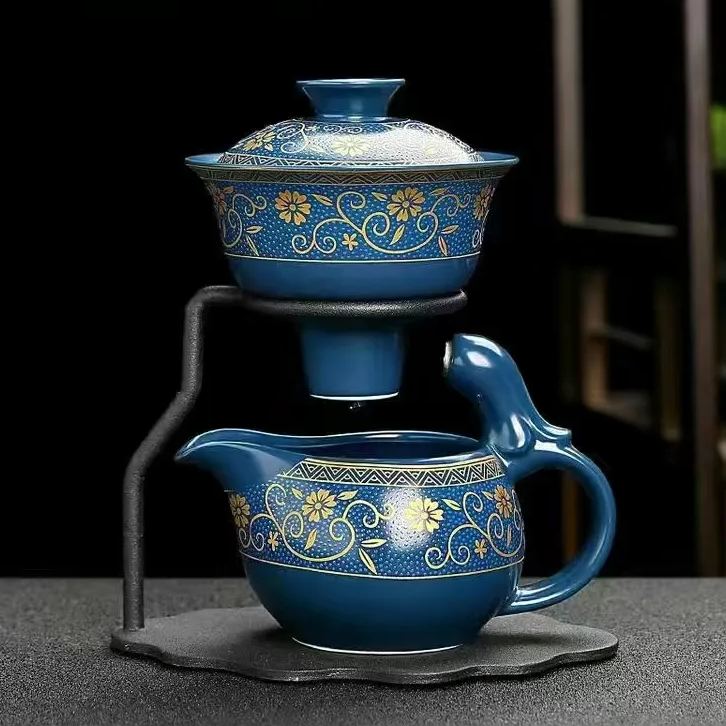
Die [Option] bietet einen anderen Ansatz für Glaskannen, der traditionelle Methoden und Ästhetik betont. Während meine Ausrüstung Konsistenz und Bequemlichkeit priorisiert, konzentriert sich diese Alternative auf das Ritual und die Einbindung in den Zubereitungsprozess. Beide haben ihre Berechtigung, und die Wahl zwischen ihnen hängt von den individuellen Prioritäten ab. magnetic semi-automatic ceramic tea set with a metal frame is the answer for buyers who want the one-handed valve but prefer a body that holds heat. The photograph shows a deep blue ceramic upper chamber with gold floral decoration, sitting above a matching ceramic pitcher. All of it is held in a dark metal frame with a curved support arm and a shaped base plate. Four style variants are offered. In a magnetic vs rotating tea set comparison this is the pick that answers both sides of the heat question.
That ceramic body is doing real thermal work.
Fired ceramic withstands 1,000 °C to 1,600 °C during manufacture, and the finished material carries very little thermal conductivity. That is why ceramic teaware stays hot far longer than glass of the same volume (per the Wikipedia ceramic reference). The trade is visibility. A ceramic chamber hides the leaf, so steeping becomes a matter of timing rather than observation. That single change matters more to some drinkers than the valve itself, and a magnetic vs rotating tea set comparison should say which side of the trade a buyer prefers.
This is also the pick that bridges both halves of the magnetic vs rotating tea set comparison. The frame holds the chamber the same way the ceramic pedestal sets hold theirs, while the valve still does the draining. For a buyer weighing the two families on heat retention alone, it is the fairest test.
Magnetic Pick 4: the sculptural set that doubles as a display piece
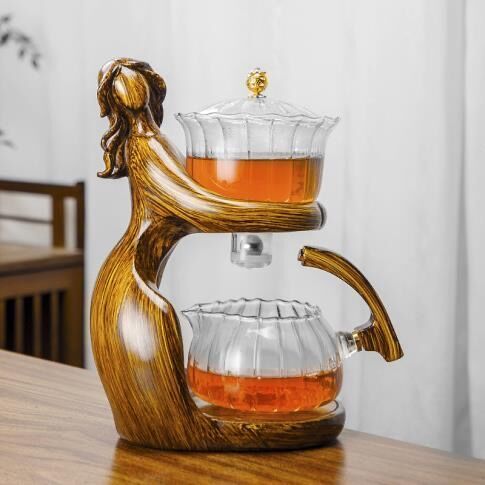
Die [Option] bietet einen anderen Ansatz für Glaskannen, der traditionelle Methoden und Ästhetik betont. Während meine Ausrüstung Konsistenz und Bequemlichkeit priorisiert, konzentriert sich diese Alternative auf das Ritual und die Einbindung in den Zubereitungsprozess. Beide haben ihre Berechtigung, und die Wahl zwischen ihnen hängt von den individuellen Prioritäten ab. artistic magnetic suction automatic tea set with a sculptural kungfu teapot is the pick for a buyer who wants the valve to be part of the room. The photographs show a ribbed glass bowl filled with amber tea above a matching ribbed glass pitcher with a curved spout.
Both sit on a carved wood-grain sculpture of a standing figure, whose raised arm forms the shelf. A second view shows the same sculpture in a darker red-brown finish with a gold finial on the lid. It is the one pick in this magnetic vs rotating tea set comparison chosen for the object itself.
The valve claim is the same one the other magnetic sets make, namely a magnetic suction pouring system that separates tea from leaf cleanly. What differs is that the carved figure is the stand rather than a loose accessory. A buyer who likes the object can keep it on the shelf and use the glass parts daily, which is the argument for including it in a magnetic vs rotating tea set comparison at all.
It is also the pick most likely to sit on a counter as pure decoration, which is a fair reason to buy a tea set. That is worth naming as such in a magnetic vs rotating tea set comparison that otherwise assumes every buyer wants function first.
Rotating Picks: Three Sets That Drain by Tilting
The rotating family on this site is small. The rotating tea set category holds three products, and a fourth design that works the same way, the persimmon set, is filed under the semi-automatic and ceramic categories instead. That narrow range is worth noting in a magnetic vs rotating tea set comparison, because a buyer choosing between families is choosing between twenty magnetic products and three products in the rotating category.
Rotating Pick 1: the multi-colour ceramic set with the best visible pour
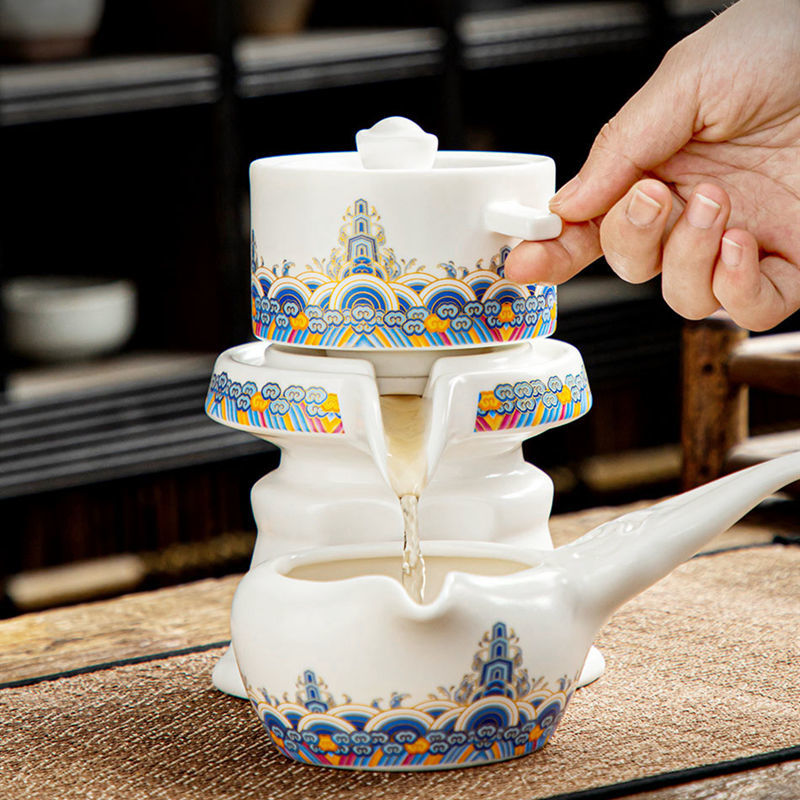
Die [Option] bietet einen anderen Ansatz für Glaskannen, der traditionelle Methoden und Ästhetik betont. Während meine Ausrüstung Konsistenz und Bequemlichkeit priorisiert, konzentriert sich diese Alternative auf das Ritual und die Einbindung in den Zubereitungsprozess. Beide haben ihre Berechtigung, und die Wahl zwischen ihnen hängt von den individuellen Prioritäten ab. rotating ceramic tea set in the easy pour multi-colour design is the clearest of the three, because its product photographs show the valve in three separate states.
One frame shows a hand raising the cream ceramic upper chamber by its knob while the liquor runs down into the cream pitcher below. Another shows a dark body with a teal and gold floral band, while a wooden scoop of loose leaf is tipped into the chamber. The third shows a hand pressing a small side lever on a white and blue version while the tea drains.
Those three frames settle the question that a catalogue description alone cannot. The lever variant is a nice refinement, because it lets the drinker start the pour without tilting the chamber at all.
That cuts the spill risk for anyone filling a table rather than serving one cup. Three colourways are available, and the ceramic body holds heat through a long sitting, which makes this the pick for a host. It is the most complete case in a magnetic vs rotating tea set comparison.
For anyone who has read the rotating guide on this site and wants the valve explained at the level of seals and funnels, the best rotating tea set guide covers the design families and the serving patterns in more detail. This comparison answers a different question, which is whether the rotating valve should be bought at all. Nothing in a magnetic vs rotating tea set comparison settles it faster than seeing the pour in three frames.
Rotating Pick 2: the persimmon set where the filter sits in the opening
Die [Option] bietet einen anderen Ansatz für Glaskannen, der traditionelle Methoden und Ästhetik betont. Während meine Ausrüstung Konsistenz und Bequemlichkeit priorisiert, konzentriert sich diese Alternative auf das Ritual und die Einbindung in den Zubereitungsprozess. Beide haben ihre Berechtigung, und die Wahl zwischen ihnen hängt von den individuellen Prioritäten ab. persimmon tomato shaped rotating ceramic tea set is the most unusual object in this comparison. The catalogue describes it as an automatic lazy tea maker whose rotating valve dispenses tea when the teapot is lifted or tilted.
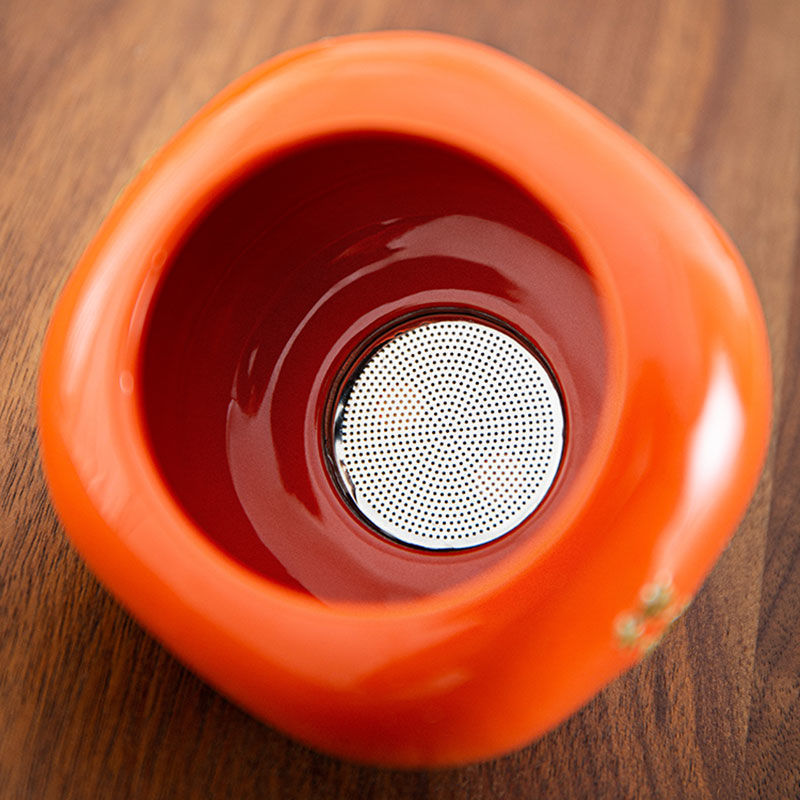
The set includes a teapot, a rotating stand and a serving pitcher. The photographs show the persimmon form in bright orange with a green glazed calyx and leaf on the lid. They also show a top-down view into the body, with a fine stainless steel mesh strainer set into the base of the opening. That detail is the one a magnetic vs rotating tea set comparison should weigh.
That strainer detail is the useful part for a buyer comparing mechanisms. Rather than a side-mounted filter basket, the mesh sits flush in the vessel, so there is no separate component to remove and lose. The shape is also why this set appears in the gift and novelty sections of this site, and the persimmon carries a specific meaning in Chinese contexts, where it is read as a wish for everything to go well. A magnetic vs rotating tea set comparison that treated this pick as a mere novelty would miss that its filter arrangement is a genuine mechanical choice.
Rotating Pick 3: the cat style set with the full cup service
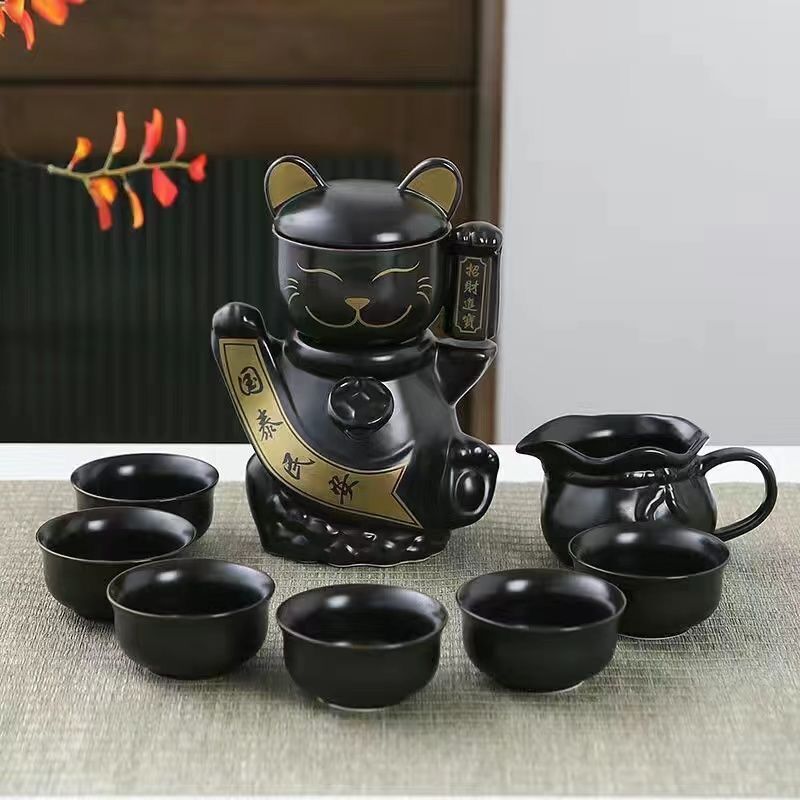
Die [Option] bietet einen anderen Ansatz für Glaskannen, der traditionelle Methoden und Ästhetik betont. Während meine Ausrüstung Konsistenz und Bequemlichkeit priorisiert, konzentriert sich diese Alternative auf das Ritual und die Einbindung in den Zubereitungsprozess. Beide haben ihre Berechtigung, und die Wahl zwischen ihnen hängt von den individuellen Prioritäten ab. rotierendes Katzen-Design Keramik-Teegeschirr is the only one of the three that arrives with a full service of small cups. The photograph shows a black ceramic teapot with a cat’s face, gold whiskers and a raised paw, and a gold collar medallion. Gold characters sit on the shoulder, and six small black cups surround the pot beside a matching black pitcher. Four colourways are offered, including white, yellow, black and cyan. No magnetic set on this site ships with a matching cup service.
The cup count is what makes this the pick for a specific job. Small cups in a matched set of six is the serving pattern of gongfu practice, where a small pot is brewed short and repeatedly rather than brewed large once. The Wikipedia gongfu tea reference describes brewing vessels with a liquid capacity between 60 and 200 ml, traditionally three matching cups of between 25 and 100 ml, and initial pourings as short as 10 to 15 seconds. That is the practice a magnetic vs rotating tea set comparison should point to for anyone who brews this way.
A 6-cup service belongs to that world, and the rotating pedestal then lets the pot sit in the middle of the group without anyone passing it around. Because the vessel is small and the servings are small, the weight of a full chamber is a fraction of what it would be in a large pot. That makes the lift-and-tilt action far easier to manage than the general description of the rotating valve suggests, and it is the one point where a magnetic vs rotating tea set comparison should soften its criticism of the tilting family.
It is worth stating in a magnetic vs rotating tea set comparison that the scald objection applies to capacity, and this pick sits at the small end of it. A buyer who reads only the mechanism table would miss that, which is why a magnetic vs rotating tea set comparison has to carry the weight of the vessel as well as the weight of the valve.
Where Each Mechanism Wins
The magnetic family wins for one drinker
Everything about the magnetic design is built for a single user. The chamber stays seated, so the leaf bed keeps its heat.
The valve opens and closes without the vessel moving, so the drinker can pour with one hand while the other holds a cup. A glass chamber shows the infusion, which means the steep is judged by eye rather than by a timer. For one person brewing four or five fast infusions across a morning, this is the more efficient arrangement of the two. A magnetic vs rotating tea set comparison should lead with this case.
That is also why the magnetic teapot category on this site holds twenty products against three in the rotating one. No magnetic vs rotating tea set comparison is complete without that count, because it explains why a buyer who wants a choice has one family to search and a buyer who wants a table service has the other.
The rotating family wins for a table of guests
The rotating geometry solves a problem no single-vessel teapot solves, getting one pot to four people without anyone lifting it. The drink sits in the middle of the table, and the host pours from a fixed position.
The ceramic body holds the heat through a long sitting, because ceramic carries very little thermal conductivity. A ceramic set for hosting also arrives with the small cups made. That is the difference between a set that works for four and a set that works for one with a jug, and no magnetic vs rotating tea set comparison should skip it.
That is the case a magnetic vs rotating tea set comparison should settle first, because it depends on the household rather than on the mechanism. A family that serves tea at a table every day wants the pedestal. A single drinker at a kitchen counter does not.
The magnetic family wins on cleaning and repair
Detachable chambers, separate steel mesh and separate ball valves mean the parts that collect tea residue can be washed apart rather than scrubbed. A damaged chamber is replaced instead of the whole set. This is the least visible advantage in the comparison and the one that matters most after a year of daily use.
A ceramic pedestal set has no valve to disassemble. That makes it easier to rinse, but it leaves nothing that can be replaced one part at a time. It is the strongest argument in a magnetic vs rotating tea set comparison for the magnetic family.
The rotating family wins on the visible pour
Some buyers care about the pour itself.
A slow gravity stream down a funnel throat, watched by whoever is sitting nearest, is a different experience from a short release from a fixed spout. None of the mechanical arguments in this guide override a preference like that. They only clarify what a buyer is choosing between when they say they want the elegant one. The answer is that the rotating family delivers the visible pour, while the magnetic family delivers the one-handed operation. That is the trade a magnetic vs rotating tea set comparison cannot settle for anyone.
What to Ask Before Buying Either
Five questions settle most of the uncertainty in this magnetic vs rotating tea set comparison, and every one of them can be answered from a product page or a photograph before any money changes hands.
- Does the chamber lift out of the stand, or does it stay seated? A magnetic chamber stays seated. A rotating chamber lifts or tilts.
- Is the filter removable, fixed, or flush? Removable mesh washes cleanly, while a flush strainer has no separate part to lose.
- Is the body glass or ceramic? Glass shows the leaf and loses heat. Ceramic hides the leaf and holds it.
- How many cups are included? A service of small cups changes the brewing style to short repeated infusions rather than one large pot.
- Is a capacity published? Almost none on this site publish one, so treat any capacity claim on a shop page as unverified and ask the seller.
Two more cautions apply to both families. First, borosilicate glass resists thermal shock better than soda-lime glass. Its thermal expansion coefficient is about 3.3 × 10⁻⁶ K-1, against roughly three times that for ordinary glass, and soda-lime glass accounts for around 90% of modern manufactured glass (per the Wikipedia borosilicate glass reference and the Wikipedia soda-lime glass reference). A magnetic vs rotating tea set comparison should carry that caution for both sides.
Even borosilicate can crack or shatter under rapid or uneven temperature change, so no glass chamber should go from a hot rinse straight into cold water. Second, no product here publishes its glass grade, so a claim that a chamber is borosilicate should be treated as marketing until a specification is provided. Both cautions belong in any magnetic vs rotating tea set comparison, because neither family can show a grade for its glass.
When to Skip Both
There are cases where neither family is the answer, and naming them is more useful than another pick.
A buyer who wants a single large pot to brew once and serve four people from a table should look at a conventional teapot instead. Both families are built around a small upper chamber over a receiving vessel, which suits repeated small pours and gongfu pacing rather than one big brew. A buyer who wants to keep tea hot for hours after brewing should look at a warmer, which is covered separately in the guide to the best teapot with warmer. Neither belongs in this magnetic vs rotating tea set comparison.
A buyer who travels with tea should look at a compact glass set with a detachable chamber, since the fragility argument in the table above decides that purchase. There is also a category of buyer for whom the valve is the wrong question entirely. If the priority is flavour purity, the material frameworks in the guide to the best material teapot for daily use and the glass versus cast iron comparison cover the ground more directly. That is the point at which a magnetic vs rotating tea set comparison should stop.
Häufig gestellte Fragen
Is a rotating tea set the same thing as a lazy Susan?
No, and this is the most common confusion in the magnetic vs rotating tea set comparison. A lazy Susan is a flat rotating tray used to pass food around a Chinese restaurant table, a design with its own documented history and its own name (per the Wikipedia lazy Susan reference). The rotating tea sets sold here are vertical stands whose upper chamber drains down into a pitcher, and the catalogue describes them as dispensing automatically when the teapot is lifted or tilted. The borrowing is conceptual, from the shared goal of removing the reach, not geometric.
Which is easier to use with one hand?
The magnetic set, clearly, and by a wide margin. Nothing leaves its stand. The drinker raises a lid or a handle and the valve opens by itself, so the second hand stays free to hold a cup or a phone. A rotating set needs a hand to support and tilt the upper chamber, which in most builds means both hands are occupied for the few seconds the pour takes. For a household where the person brewing is also doing something else at the same time, that is the deciding factor in any magnetic vs rotating tea set comparison.
Which mechanism keeps tea hot longer?
Neither valve controls heat retention on its own, because heat retention is a property of the body rather than of the drain. Ceramic carries very low thermal conductivity and holds heat through a long sitting, while glass loses it faster and borosilicate resists the sudden changes that cause cracking. That is why the rotating picks on this site are all ceramic, and why a glass chamber is usually the right answer for a visible infusion instead. A magnetic vs rotating tea set comparison has to separate the vessel from the valve to make that point.
The magnetic family covers both, which is why it offers the larger range and why a magnetic vs rotating tea set comparison ends with the material question rather than the valve question. A buyer who wants heat retention has to choose a ceramic body, whichever mechanism carries it.
Do the two mechanisms make tea taste different?
No. Both families separate leaf from liquor without dissolving anything into it, and neither adds a note to the cup. Taste differences between teapots come from material and brewing practice, not from how the drain opens. A metal mesh does move more heat out of the leaf bed than a plastic or wooden one would, which can change extraction slightly. That is a small effect compared with water temperature and steep time, and a magnetic vs rotating tea set comparison should not overstate it.
Is one of them easier to clean?
The magnetic family, and the reason is mechanical rather than cosmetic. Its parts come apart: the chamber detaches, the mesh lifts out, the ball and seat separate for rinsing, and the magnet wants to stay dry. A ceramic rotating set rinses easily at the sink but has no valve to disassemble, so residue sits in the throat and the moulded funnel. For daily use, detachable parts win. For occasional use, the ceramic set is simpler, and that trade-off is the one a magnetic vs rotating tea set comparison cannot settle on the buyer’s behalf.
Which one is better for a gift?
For a gift, the valve matters less than the object, and the shape of the vessel is what the recipient will actually see. The sculptural magnetic set and the persimmon rotating set are both chosen for what they look like on a shelf, and each keeps the practical qualities of its family, since the magnetic version keeps the one-handed valve and the rotating version keeps the visible pour. That is where a magnetic vs rotating tea set comparison stops and the gift guides begin.
One caution applies to gifts specifically: a magnetic gift for a household with small children should be checked for the magnet, and a rotating gift for anyone with limited wrist strength is worth testing in person first, because the lift-and-tilt action asks more of the hand. A magnetic vs rotating tea set comparison that skips this ends up recommending the wrong box for the wrong household.
Endurteil
Pick magnetic if the tea is brewed by one person who also wants to do something else while it brews. The chamber stays on its stand, the valve opens under a lid, the glass shows the leaf, and the parts come apart for cleaning. Pick 1 if the set will be used every day, because a chamber that lifts out and a steel mesh that rinses clean are worth more over a year than any styling difference. That is the conclusion this magnetic vs rotating tea set comparison reaches.
Pick rotating if the pot is going to sit in the middle of a table with 3 or 4 people around it. The ceramic holds the heat, the gravity pour is visible and controlled, and the matching small cups make it a complete service rather than a single vessel. Pick 2 if the recipient likes small repeated infusions, and pick 3 if the shape of the pot matters more than the brewing style. The mechanism only matters once the table size is settled, which is the order a magnetic vs rotating tea set comparison should take them in.
Pick neither if the real requirement is one large brew poured into four mugs, or a pot that stays hot for hours after brewing. Those are different problems with different answers. Pick both only if a household genuinely serves one person most days and hosts several people at once, which is the arrangement that makes a magnetic vs rotating tea set comparison worth reading to the end rather than skimming.
For a shorter path through the range, the magnetic teapot category holds the larger selection, the rotating tea set category holds all three of the tilting designs, and the guide to using a magnetic teapot covers the valve in practical detail. The semi-automatic tea set category is where the two families overlap, since a rotating set that dispenses automatically is filed under both labels. That is the whole of this magnetic vs rotating tea set comparison, and the two catalogue pages are the fastest way to check which side fits the table.
 DE
 EN
 ES
 PT
 FR
 JA