
What Is Gongfu Tea? A Practical Definition for Beginners
Okt.
Einführung
If you have searched what is gongfu tea and ended up on a dozen results that use the phrase “Chinese tea ceremony” interchangeably, you have been given a label that obscures more than it explains. The setup looks ceremonial — small clay pot, fairness pitcher, three tasting cups, bamboo tray, hot water — but the practice underneath is closer to a brewing technique than a ritual. What is gongfu tea in its native Chinese context is shorthand for a specific method of making tea that originated in southern China, not a codified ceremony with prescribed movements, robes, or invocations. The English-language confusion has been amplified by decades of travel writing that translated 工夫茶 as “Chinese tea ceremony” and writers repeated the translation without checking the original term. Once you strip that translation error away, the practical answer emerges as we lay it out below.
That distinction matters because when the gongfu method is described as ceremony, beginners expect rituals and miss the actual mechanics: a small vessel (60-200 ml), a high leaf-to-water ratio (about 1:15 to 1:25 by weight), brewing temperatures tuned to the tea type (70-100 °C), and a sequence of 8 to 15 short infusions lasting 5 to 45 seconds each. Strip those five parameters away and “ceremony” is just a word. Bring them back and you have a method that any home brewer can run on a kitchen counter without special equipment beyond the small vessel.
This guide is the practical answer to what is gongfu tea, written for readers who want a working definition they can act on, not a cultural postcard. We will trace the etymology of the term, lay out the five brewing parameters that define the method, compare it head-to-head with Western brewing and the Japanese matcha ceremony, walk through the eight teaware pieces used in a standard setup, and spell out the 5-step procedure so you can run your first session this weekend. Where appropriate we link to specific picks at teapotsetshop.com ceramic tea sets and our related guides on what is a gongfu teaset, how to use a gongfu tea set, and the best gongfu tea set picks so you can build out a setup that fits your tea experience and budget.
Wichtige Erkenntnisse
- What is gongfu tea in one line: a Chinese brewing method that uses a small vessel (60-200 ml), a high leaf-to-water ratio (~1:15 to 1:25 by weight), and 8-15 short infusions lasting 5-45 seconds each — not a ritual ceremony.
- The literal meaning of gongfu (工夫 or 功夫) is “effort” or “skill with patience,” and cha (茶) is tea — so the term translates as “tea made with effort,” not “tea ceremony,” which is why what is gongfu tea is fundamentally a brewing question rather than a ritual one.
- Five parameters define the method: vessel capacity (60-200 ml), leaf-to-water ratio (1:15-25 by weight), water temperature (70-100 °C depending on tea type), number of infusions (8-15), and individual infusion time (5-45 sec). When experienced brewers explain what is gongfu tea to newcomers, these five parameters are the entire answer.
- Gongfu originated in the Chaoshan region of Guangdong and the Wuyi Mountains of Fujian in the 18th century, and was inscribed on the UNESCO Intangible Cultural Heritage list in November 2022 as part of “Traditional Tea Processing Techniques and Associated Social Practices” — the closest thing to an official ruling on what is gongfu tea at international scale.
- Gongfu is closer to “espresso for tea” than to ceremony: every infusion extracts a distinct flavor slice, and the total drink volume from one session is roughly the same as a Western pot despite using far more leaf.
- A standard gongfu setup uses eight teaware pieces — brewing vessel, fairness pitcher, three small cups (25-100 ml each), tea tray, tea towel, scale, and timer — though a home brewer can skip the last three with little loss.
- The method works best for oolong, pu-erh, black tea, and aged white tea; delicate green teas and herbal tisanes lose nuance under the high leaf ratio and may scald at 85-95 °C, even though what is gongfu tea in the abstract would seem leaf-type-agnostic.
Quick Reference: What Gongfu Tea Is at a Glance
The table below compresses the seven dimensions that distinguish gongfu brewing from a Western teapot. Each row answers one practical question a beginner asks within the first session. The numbers are tuned for typical oolong or pu-erh — adjust temperature and infusion time by ±10 °C and ±5 sec when brewing other tea types.
| Dimension | Gongfu Spec | Western Brewing Baseline | Why It Matters |
|---|---|---|---|
| Vessel capacity | 60-200 ml (typical 100-150 ml) | 500-1200 ml | Small vessel = high leaf per sip = concentrated extraction you taste across many infusions. |
| Leaf-to-water ratio | ~1:15 to 1:25 by weight (e.g. 5 g leaf to 75-125 ml water) | ~1:50 to 1:100 by weight | The 2-4x concentration is what gives the first infusion its flavor intensity. |
| Water temperature | 70-100 °C (set by tea type: green 70-85, oolong 80-90, pu-erh 95-100) | 95-100 °C for almost everything | Each tea type gives up its best flavors in a narrow temperature band; hotter is not always better. |
| Number of infusions | 8-15 short infusions per session | 1 long infusion (3-5 min) | Multiple short infusions reveal flavor shifts that one long steep averages into a single note. |
| Per-infusion time | 5-45 seconds (typical 10-20 sec for first, longer for later) | 180-300 seconds | Short steeps prevent tannin extraction while still pulling the first wave of aroma compounds. |
| Cup size | 25-100 ml (traditionally three matching cups) | 180-250 ml | Smaller cups keep each sip at drinking temperature, so you taste each infusion fresh. |
| Standard teaware count | 8 pieces (vessel, pitcher, cups, tray, towel, scale, timer, thermometer) | 2-4 pieces (pot, cups, kettle) | The extra pieces — pitcher, tray, scale — give the method its repeatability rather than mystique. |
What “Gongfu” Literally Means — and Where the Practice Comes From
The English word gongfu is the romanization of two Mandarin characters: 工夫 (gōngfū) or, in the Cantonese-adjacent Chaoshan spelling, 功夫 (gōngfu). Both share the same pronunciation and a closely related meaning: time and effort applied skillfully over patience. The character 工 means “work” or “craft,” while 夫 (or 工夫中的夫) functions as a suffix indicating the worker or domain — together, “someone who works with craft.” Adding 茶 (chá, tea) makes the full phrase 工夫茶 (gōngfū chá), literally “tea made with craft and effort” (per the Wikipedia Gongfu tea entry). The phrase conveys a brewing technique that rewards practice, not a ceremony that rewards performance.
Translating gongfu cha as “Chinese tea ceremony” is a frequent shorthand in English-language guides, but the Wikipedia article explicitly flags the translation as a misnomer: “It is sometimes called a ‘tea ceremony,’ though this is a misnomer, as gongfu cha is more accurately described as a specialised technique of brewing tea rather than a ritualised ceremony.” The confusion comes partly from surface aesthetics — a wooden tray, multiple small cups, deliberate pouring gestures — and partly from confusion with the Japanese chanoyu (or chadō) tradition, which is a codified ceremony with prescribed movements, scrolls, and seasonal awareness. Chanoyu and gongfu cha share tea and methodical pacing, but the Japanese tradition is rooted in Zen Buddhist ritual while gongfu cha is rooted in southern-Chinese brewing pragmatism.
The practice likely began in the 18th century, with two origin theories documented in the Wikipedia Gongfu tea entry. The first ties the method to the Wuyi Mountains in northern Fujian, where oolong tea production for export began and the small vessels suited to repeated short infusions were first refined. The second ties the method to the Chaoshan region of eastern Guangdong, where the term gongfu is pronounced in a Teochew dialect that more directly maps to the characters’ rural-Chaozhou meaning. Both theories converge on the same practical insight: gongfu emerged in regions where high-oxidized oolong tea was the dominant leaf, and the method was tuned to draw out the layered flavor those teas release across many short steepings.
On 29 November 2022, UNESCO inscribed “中国传统制茶技艺及其相关习俗” — Chinese Traditional Tea Processing Techniques and Associated Social Practices — onto its Representative List of the Intangible Cultural Heritage of Humanity. The filing included gongfu cha explicitly among the teas and practices recognized, citing Chaozhou gongfu tea as the regional school most often associated with the method (per Wikipedia Gongfu tea references, including the Guangdong Provincial Department of Culture and Tourism release). For international readers this inscription matters because it confirms what is gongfu tea is not a marketing rebranding of Western pour-over but a recognized regional brewing practice with three centuries of documented history.
The Five Brewing Parameters That Define Gongfu
Five measurable parameters define what is gongfu tea in practice. None is a rule of ritual; each is a number you can set on a scale, a thermometer, or a timer. Beginners who internalize these five numbers can run a first session without a teacher — they will know they are doing what is gongfu tea when those parameters fall in range, not when they perform prescribed movements. Below we walk through each parameter with the operating range and the gauge a beginner uses to stay inside it.
Parameter 1: Vessel Capacity (60-200 ml)
The brewing vessel — whether a Yixing clay pot, a Jingdezhen porcelain gaiwan, a small thick-walled glass pot, or a semi-automatic magnetic-drain pot — holds between 60 and 200 ml of water at a time, with 100-150 ml being the most common size (per the Wikipedia Gongfu tea reference). The small capacity is not arbitrary: it forces a high leaf-to-water ratio that would be impossible in a 1-liter Western pot. A 100 ml vessel with 5 grams of leaf is 1:20 by weight, roughly 4x the leaf density of a 500 ml pot brewed with the same 5 grams.
Parameter 2: Leaf-to-Water Ratio (~1:15 to 1:25 by Weight)
Standard what is gongfu tea practice uses 4-7 grams of dry leaf per 100 ml of water, depending on the tea’s density and oxidation. A rolled oolong like Tieguanyin needs closer to 5 g per 100 ml because the tightly-rolled balls do not expand as much as a flat white tea leaf. A loose pu-erh shou (ripe) at 5 g per 100 ml yields a deep amber infusion that stands up to 12-15 short steepings without becoming flat. Beginners should start at 5 g per 100 ml and adjust ±1 g based on whether the first infusion reads thin or aggressive. When people ask what is gongfu tea in one phrase, this 1:20 ratio is the operational answer: about 4x the leaf density of a Western pot.
Parameter 3: Water Temperature (70-100 °C by Tea Type)
Per the Wikipedia Gongfu tea temperature guide, each tea type has a narrow optimal range. Green teas are best at 70-85 °C (typical 80 °C); white teas at 75-90 °C (typical 85 °C); oolong teas at 80-90 °C (typical 85 °C); black (red) teas at 90-95 °C (typical 90 °C); dark and pu-erh teas at 95-100 °C with the upper end reserved for aged raw sheng pu-erh and ripe shou pu-erh. Going hotter than the tea’s range will scald the leaf, producing a bitter, astringent cup; going cooler will under-extract and leave the cup flat and grassy. A kitchen thermometer is helpful for the first month; experienced brewers gauge by ear — the “crab eyes” 3 mm bubble stage at 75-85 °C versus the “fish eyes” 8 mm bubble stage at 90-95 °C gives an audible cue (per Wikipedia Gongfu_tea). For a deeper read on temperature band rationale, our best teapot for pu-erh cover narrows the pu-erh end of the spectrum in more detail; for the white-tea end, best teapot for white tea opens up the lower-temperature end.
Parameter 4: Number of Infusions (8-15 per Session)
A typical what is gongfu tea session runs 8 to 15 infusions on the same leaf. The first one is often a rinse — a 5-second pour that opens the leaf and rinses away any leaf dust from compressed or rolled teas. The subsequent infusions lengthen incrementally as the leaf unfurls, with infusion 2 lasting 10-15 seconds, infusion 3 lasting 15-20 seconds, and so on until the leaf is spent (typically when the color drops below the strength of an early infusion). This is the dimension most alien to Western brewing, which optimizes for one cup; the answer to what is gongfu tea being so different from Western brewing lies in this evolution across the session — every infusion extracts a distinct slice of the leaf’s range.
Parameter 5: Individual Infusion Time (5-45 Seconds)
Each individual infusion runs 5 to 45 seconds, with the duration climbing as the leaf opens and releases its later-stage compounds (per the Wikipedia Gongfu procedure section). For a typical oolong, infusion 1 (after the rinse) is 10-15 seconds, infusion 2 is 15-20, infusion 3 is 20-25, and later infusions can stretch to 30-45 seconds as flavor thins. The hard ceiling is around 60 seconds — beyond that, tannin extraction overwhelms the leaf’s flavor, and the cup turns bitter regardless of how well-tuned the temperature was. The answer to what is gongfu tea involves this per-infusion time just as much as it involves the vessel — extend one infusion to 3 minutes and the cup reads like a Western over-steep.
Gongfu vs Western Brewing vs Japanese Matcha Ceremony
Three brewing methods dominate the English-language tea world: Western infusion (common in the UK, US, Australia), Japanese matcha ceremony (chanoyu or chadō), and Chinese gongfu. They look superficially different but each is rooted in a specific answer to the same question — how to extract the tea’s character with the tools available. The differences below are practical, not cultural: anyone cross-shopping the three will land on what is gongfu tea when they want flavor complexity per gram of leaf, on Western infusion when they want volume for a family meal, and on chanoyu when they want a codified ritual with cultural weight.
Western infusion uses a large pot (500-1500 ml), a low leaf-to-water ratio (about 1:50 to 1:100 by weight), full boil water (95-100 °C for almost everything), and one long infusion of 3-5 minutes. Western brewing optimizes for volume and consistency — one pot makes 4-6 cups, all the same strength, brewed in a single steep. It is well suited to black tea blends, breakfast-style Assam, and the high-volume social contexts of family meals and office kitchens. It under-extracts subtle oolongs and pu-erhs: those teas release layered flavors across many short infusions that one long steep averages into a single flat note. So when readers land on what is gongfu tea after a frustrating Western brewing session with an expensive oolong, the practical contrast below is the heart of the answer they came for.
Japanese matcha ceremony (chanoyu) uses powdered leaf whisked into hot water (about 70-80 °C, well below boiling) with a bamboo chasen whisk, typically in a 400-500 ml ceramic bowl. The leaf is consumed in suspension rather than filtered out, so the entire dose of caffeine and catechin enters the cup. Chanoyu is rooted in Zen Buddhist ritual with prescribed movements, scroll hangings, and seasonal awareness codified in the Urasenke tradition. It is a ceremony in the true sense — practice, aesthetic, and form integrated — and practiced at home, it runs longer per session (30-60 minutes) than gongfu (5-15 minutes).
Gongfu cha sits between the two extremes. It shares the small vessel and focused attention of chanoyu but optimizes for extracting variable flavors from the same leaf across many infusions — closer to a wine tasting than a ceremony. The Red Blossom Tea source quoted in our web search called gongfu brewing “an espresso for tea”: concentrated, layered, repeatable. Total session volume ends up similar to a Western pot (a 100 ml vessel × 10 infusions = 1 liter of brewed tea, roughly equivalent to two 500 ml Western pots), but the flavor experience is layered across the infusions rather than averaged into one note.
The Eight Standard Teaware Pieces in a Gongfu Setup
A standard gongfu setup combines eight teaware pieces (per the Wikipedia Gongfu teaware list). Beginners can run a session with as few as three pieces; the additional pieces refine repeatability. Below is each piece and its function, ordered by roughly how often it appears in a session. If you are still asking what is gongfu tea in operational terms — meaning, what hardware do I actually need — the answer starts with the brewing vessel plus two accessories and grows from there as your consistency demands it.
Piece 1: Brewing Vessel (Teapot or Gaiwan)
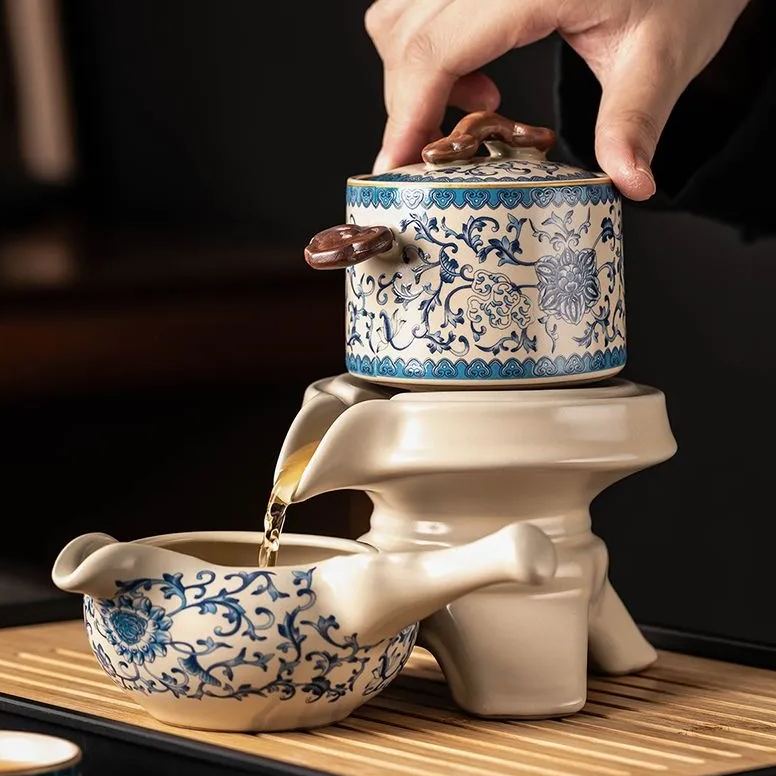
The brewing vessel holds the leaf and water during infusion and is the single most visible answer to what is gongfu tea in gear terms. Common options include Yixing clay teapots (unfired, semi-porous, used for one tea type per pot to avoid cross-flavoring), porcelain gaiwans (lidded cups with a saucer, neutral in flavor), thick-walled borosilicate glass (lets you see the leaf unfurl), and modern semi-automatic pots with magnetic drains (simplifies the separation step). Capacity is 60-200 ml, with 100-150 ml being the most common starting point. Beginners often confuse what is gongfu tea with the vessel — the vessel is the container, the method is the parameters you set within it.
Piece 2: Fairness Pitcher (Cha Hai)
Die [Option] bietet einen anderen Ansatz für Glaskannen, der traditionelle Methoden und Ästhetik betont. Während meine Ausrüstung Konsistenz und Bequemlichkeit priorisiert, konzentriert sich diese Alternative auf das Ritual und die Einbindung in den Zubereitungsprozess. Beide haben ihre Berechtigung, und die Wahl zwischen ihnen hängt von den individuellen Prioritäten ab. cha hai (literally “sea of tea”) or gong dao bei (fairness cup) is a small pitcher that receives the brewed tea after each infusion before distributing to cups. This step matters because it stops the steep the instant the infusion time elapses, preventing the last cup from being over-extracted while the first is poured. Decanting through the fairness pitcher also equalizes strength — every cup poured from the pitcher receives tea at the same concentration. The cha hai is the single piece that converts a small-vessel steep into a multi-cup session with consistent strength.
Piece 3: Three Small Cups (25-100 ml each)
Traditional gongfu uses three small tasting cups per session, sized between 25 and 100 ml each. The small size keeps each sip at drinking temperature so the full aroma profile reaches the nose and palate fresh. White thin-walled porcelain is the most popular material because it diffuses heat away from the drinker’s hand and shows the tea’s color clearly. Modern sessions often use 1-2 cups at a time for solo brewing, but the three-cup setup is the reference because it equalizes the volume across guests when brewing socially.
Piece 4: Tea Tray or Tea Boat (Cha Pan)
The tea tray catches overflow, rinse water, and any spills from pouring. Most gongfu trays are bamboo or wood with a slotted top surface that drains into a reservoir underneath, so spills drain away rather than pooling. Beginners can substitute a small saucer or plate; the tray’s value scales with session length — a 15-infusion session can drip enough water that a reservoir matters.
Piece 5: Tea Towel (Dark-Colored)
A small dark-colored tea towel wipes the vessel exterior between pours and absorbs drips on the tray. Dark colors hide tea stains that accumulate over months of use, and the cloth stays soft enough to clean a 100 ml vessel rim without scratching. Beginners can use any clean cotton cloth; the dark-color convention is aesthetic.
Piece 6: Scale (Optional, Accurate to 0.1 g)
A scale accurate to 0.1 grams is the single biggest upgrade a beginner can make. Without it, gongfu’s leaf-to-water ratio cannot be set precisely — most beginners eyeball 5 g of leaf and end up between 3 and 7 g, an error range that pushes the first infusion either thin or aggressive. A 0.1 g-accurate scale runs about $15-25 USD and pays back within a week of use. The Wikipedia Gongfu tea reference lists the scale as optional, but for beginners it is closer to essential until muscle memory takes over.
Piece 7: Timer (Optional)
A timer (kitchen timer, phone stopwatch, or built-in on the kettle) tracks per-infusion time precisely. Without a timer beginners over-steep the first infusion by 10-20 seconds, which throws off the entire sequence (since later infusions depend on the leaf’s residual openness from prior steeps). Experienced brewers gauge infusion time by the color of the pour — a deep amber hit at 10 sec versus a lighter hit at 5 sec. Beginners should use a timer for the first 10 sessions, then taper.
Piece 8: Thermometer (Optional, in the Absence of a Temperature-Controlled Kettle)
A kitchen thermometer or temperature-controlled kettle lets you hit the per-tea-type temperature band precisely. The Wikipedia Gongfu tea reference lists it as optional but redundant when you have a variable-temperature kettle, which most modern kettles ship with. Without one, the “crab eyes” (75-85 °C) versus “fish eyes” (90-95 °C) bubble cues give an audible proxy. At altitude, water boils below 100 °C — at 1500 m the boiling point is about 95 °C — so a thermometer becomes more useful to dial in the typical values cited above.
A practical home setup compresses to three pieces: brewing vessel + fairness pitcher + one cup. Optional pieces (tray, towel, scale, timer, thermometer) refine consistency and repeatability. Beginners should treat the optional pieces as upgrades rather than prerequisites — buy a vessel and start, then add a scale in week two and a timer in week three as you commit to the method.
The 5-Step Brewing Procedure
The standard what is gongfu tea procedure runs in five steps, repeated across 8-15 infusions (per the Wikipedia Gongfu procedure section). Beginners can run a session start to finish on this sequence without a teacher, and after running it twice they will know what is gongfu tea hands-on rather than as a textbook description. The same five steps apply to oolong, pu-erh, black tea, and aged white tea; green tea and herbal tisanes require tweaking noted at the end of this section.
Step 1: Rinse and Preheat the Vessel
Pour hot water at the target brewing temperature into the empty vessel, swirl, and discard. Two purposes: the porcelain or clay warms up so the first infusion is not chilled on contact, and any manufacturing dust or compressed-tea fragments at the bottom get rinsed away. The preheat water should be the same temperature you plan to brew at — pouring 95 °C water into a cold 100 ml Yixing pot drops the pot’s interior by 8-12 °C, which then chills the first infusion. A preheated vessel holds the leaf within 2-3 °C of the target temperature.
Step 2: Add Leaf and Rinse Infusion
Place 4-7 grams of dry leaf into the preheated vessel (5 g per 100 ml is the most common starting ratio). Pour hot water at the target temperature over the leaf to fill the vessel. Wait 5 seconds. Decant fully into the fairness pitcher. This is the rinse infusion — most gongfu practitioners discard it, especially for compressed teas like pu-erh cakes where surface dust can affect flavor. For rolled oolong, the rinse opens the leaf balls so the first drinkable infusion extracts from a fully unfurled leaf.
Step 3: Time and Pour the First Real Infusion
Fill the vessel with hot water at the target temperature and start the timer. For a 5 g / 100 ml oolong, the first real infusion runs 10-15 seconds; for pu-erh, 10-20 seconds; for white tea, 15-25 seconds. When the timer fires, decant fully into the fairness pitcher — full, fast pour so the leaf stops steeping the moment the last drop leaves the pot. Pour from the pitcher into the small cups, then drink. The first infusion often shows the tea’s highest aromatic notes and cleanest color.
Step 4: Repeat With Incrementally Longer Infusions
Refill the vessel with hot water at the same target temperature and start the timer again. Increase the per-infusion time by 3-5 seconds each round, so infusion 2 runs 15-20 sec, infusion 3 runs 18-23 sec, infusion 4 runs 22-27 sec, and so on. The increase tracks the leaf’s residual openness — each prior infusion has pried the leaf open a bit more, so later infusions extract faster and need less total contact time to reach the same strength. Decant each infusion fully into the fairness pitcher and pour into cups before drinking.
Step 5: End When Flavor Falls Below Threshold
A well-tuned gongfu session ends naturally when the leaf is spent — typically 8-12 infusions for an oolong, 12-18 for a ripe pu-erh, 8-10 for a black tea. The visual cue is the pour’s color: when an infusion’s color drops below the strength of infusion 4, the leaf is approaching its limit and continuing adds water without flavor. At that point, dump the wet leaf onto the tea tray or into a leaf basin, rinse the vessel with hot water, and let it air-dry before next session. Refilling with fresh leaf for a second tea type without a full rinse will cross-flavor the next session.
Which Teas Work Best for Gongfu — and Which Don’t
Not every tea benefits from gongfu brewing. The method’s high leaf-to-water ratio plus short infusions extracts differently than Western brewing, and some teas are tuned for the opposite approach. For readers still calibrating what is gongfu tea against their own tea collection, the chart below maps the four tea categories that work best and the three that do not — pick from the left column for your first session and the right column for daily-driver bagged blends, leaving the bottom row for tender greens you already brew Western-style.
Best Tea Types for Gongfu
Oolong (especially Wuyi rock tea and Anxi Tieguanyin) is the canonical gongfu tea. The partial oxidation (30-70%) and rolled leaf structure release floral, fruity, or mineral notes across 8-15 infusions in a way that Western brewing averages into one flat note. Temperature 80-90 °C, vessel 100 ml, 5 g leaf, infusions starting at 10-15 seconds and increasing by 5 sec each round.
Pu-erh (both shou ripe and sheng raw, especially aged) was the leaf gongfu was tuned around in Chaoshan. Ripe pu-erh at 5 g per 100 ml and 95-100 °C yields 12-18 infusions with deep, earthy, sweet-caramel evolution across the session. Aged raw pu-erh at 95-100 °C gives more astringency in early infusions and more honey-sweetness in later ones. Young raw pu-erh needs cooler water (90 °C, per Wikipedia Gongfu_tea) to avoid bitterness.
Black (red) tea — high-end single-origin like Keemun, Yunnan Dianhong, or Assam GFOP works well at 90-95 °C and a starting 10-15 sec infusion. Commercial English Breakfast blends at 1:50 ratio and 4-minute infusion benefit more from Western brewing; the cheaper leaf’s flavor compounds are exhausted by the time gongfu gets to infusion 8.
Aged white tea (Shou Mei, aged Bai Mu Dan) at 85-90 °C and 5 g per 100 ml yields 10-12 infusions with honey and dried-fruit notes that Western brewing under-extracts. Fresh Silver Needle is too delicate for the method; brew it Western-style at 1:80 ratio and 4-5 minutes instead.
Tea Types That Do Not Benefit From Gongfu
Delicate green teas (Longjing, Bi Luo Chun, Japanese sencha) lose their grassy and umami notes at the 70-85 °C gongfu range. The high leaf ratio overwhelms their flavor compounds, and the short infusion time leaves astringency without sweetness. Brew them at 1:80 ratio and 1-2 minutes Western-style, or use the Japanese method at 70 °C and 30 seconds with a lower leaf ratio (3 g per 100 ml).
Herbal tisanes (chamomile, peppermint, rooibos) lack the oxidation and rolling needed to release new flavors across multiple infusions. They give up most of their flavor compounds in one long steep and yield flat second or third infusions. Brew them Western-style at 1:50 to 1:80 and a 5-7 minute single infusion.
Mass-market tea bags (Lipton, Tetley, supermarket blends) are blended for one-shot Western brewing. The cut-tear-curl leaf is too broken for gongfu’s multiple infusions, and the blend is calibrated for a 4-minute steep. Use gongfu for any single-origin loose leaf, and use Western infusion for daily-driver bagged blends.
Our Recommended Teaware for First-Time Gongfu Brewing
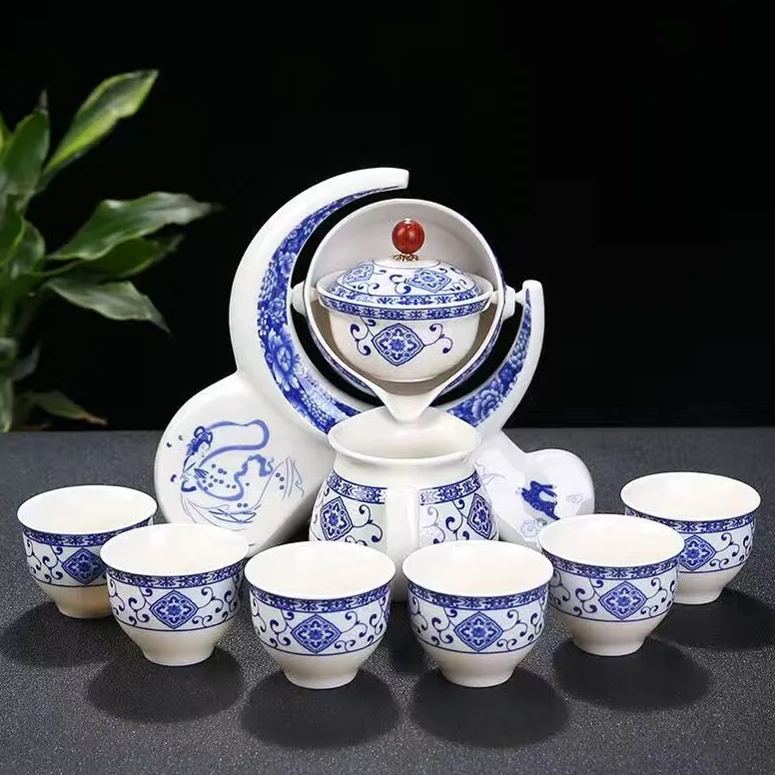
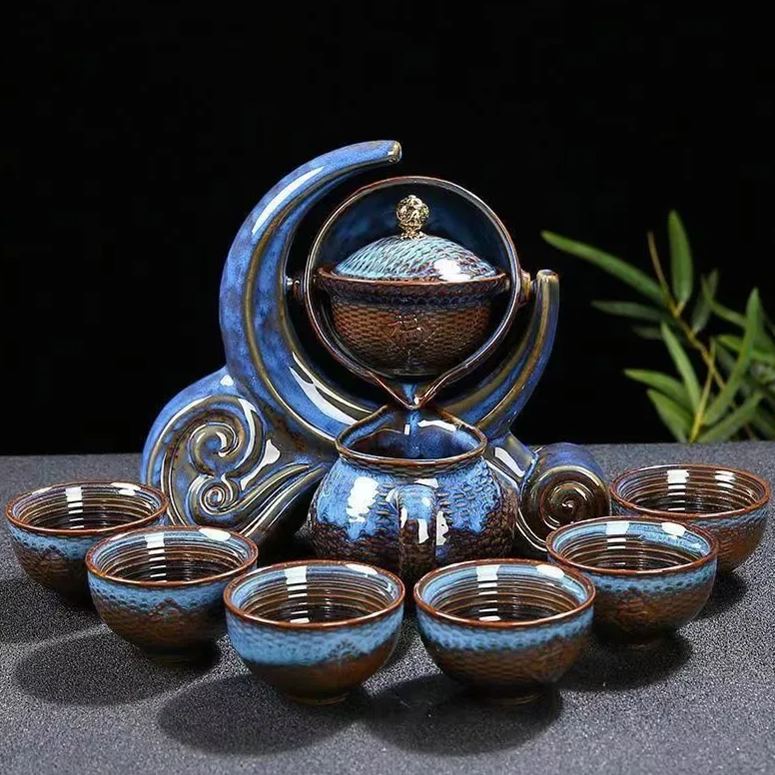
If you want to skip the manual gear-shopping process and just buy one set to start, the picks below cover three teaware setups that satisfy what is gongfu tea at the gear level: porcelain, semi-automatic, and white-and-blue. Each ships as the brewing vessel plus most of the eight-piece teaware most beginners end up building out within the first month. We have linked the picks to specific products at teapotsetshop.com ceramic tea sets, semi-automatic tea sets, and glass tea sets so you can build out a setup by category rather than by individual piece — and so you know what is gongfu tea looks like in physical form before you commit.
- Traditional Porcelain Gaiwan Pick — Automatic Pouring Ceramic Gongfu Tea Set – Multiple Styles (id 373). Jingdezhen porcelain, 100 ml vessel, automatic pouring lever, six style options. Best for first-timers who want a neutral vessel that does not absorb any tea’s flavor across sessions. Pairs with all oolong, pu-erh, black, and white tea gongfu brewing.
- Modern Semi-Automatic Pick — Semi-Automatic Pouring Gongfu Tea Set – Multiple Colors (id 288). Magnetic drain, 100 ml vessel, six color options. Best for beginners who want the brewing rhythm simplified — magnetic drain handles the separation, so you do not need to time the decant manually. Pairs with all tea types because the inner vessel is porcelain (flavor-neutral).
- White-and-Blue Porcelain Pick — Elegant White & Blue Ceramic Tea Set – Automatic Pouring Tea (id 188). Blue-and-white Jingdezhen porcelain pattern with 1000 ml automatic-pouring vessel (sized for family-style, scalable down with a smaller vessel). Best for hosts who want a single piece that doubles as both gongfu vessel and Western pot.
For deeper picks across 6 vessels (porcelain / semi-auto / glass / Yixing) at 100-200 ml gongfu-specific sizes, our best gongfu tea set guide covers 6 picks plus an 8-15 short infusion framework. For step-by-step procedure help after you choose a vessel, our how to use a gongfu tea set guide expands on the 5-step procedure above with per-tea-type timing charts. For teapot material background before committing, our what is a gongfu teaset guide covers vessel anatomy and material differences in detail.
FAQ: Gongfu Tea Questions Answered
Is gongfu tea the same as the “Chinese tea ceremony”?
No, though they are frequently conflated in English-language writing — and that conflation is exactly why what is gongfu tea searches surface so many off-target results. Gongfu tea is a brewing method using a small vessel, high leaf ratio, and many short infusions. The “Chinese tea ceremony” phrasing is a translation error that has stuck — the Wikipedia Gongfu tea reference explicitly flags it as a misnomer. The Japanese tea ceremony (chanoyu) is a true ceremony with codified movements rooted in Zen Buddhism; gongfu is a brewing technique with practical roots in 18th-century Chaoshan and Fujian. If a guide describes gongfu with prescribed gestures, robes, or seasonal scrolls, it is conflating the two — the actual answer is much closer to “espresso for tea” than to a ceremony.
What’s the difference between gongfu and the Japanese tea ceremony?
Three differences matter for someone trying to decide between them. First, gongfu steeps whole or rolled leaf and filters it out between infusions; Japanese ceremony whisks powdered matcha in suspension and consumes it whole. Second, gongfu uses 8-15 short infusions to map flavor evolution; Japanese ceremony drinks one bowl at a time in shared silence. Third, gongfu has no codified ritual — different teachers show different rhythms — whereas chanoyu is a centuries-old tradition with set movement patterns, scroll rotations, and seasonal timing. Both reward attention; gongfu rewards attention to flavor, chanoyu rewards attention to form.
What’s the minimum gear for a beginner?
Three pieces: a 100-150 ml brewing vessel (porcelain gaiwan or small clay pot), a small fairness pitcher (any 150-250 ml pitcher works), and one small tasting cup (50-100 ml). That gets you to a runnable session. Add a kitchen scale accurate to 0.1 g in week two and a timer in week three — both are inexpensive and pay back quickly. A tea tray and thermometer are nice-to-have but not required for the first five sessions.
Does the water type matter for gongfu?
Yes, more than most beginners expect. Per the Wikipedia Gongfu_tea water chemistry section, filtered spring water at moderate mineral content (50-150 ppm total hardness) gives the cleanest extraction. Distilled or extremely soft water lacks the minerals that help flavor compounds dissolve, producing a flat cup. Very hard water (above 250 ppm) over-mineralizes the brew and rounds off subtle flavors. Avoid distilled, and if your tap water is hard, run it through a simple carbon filter or use bottled spring water for gongfu sessions.
How long does a gongfu session take?
A typical 10-infusion session takes 15-20 minutes. Each infusion cycle (fill, time, decant, pour, drink) runs 90-120 seconds including a slow drink. The cumulative session is closer to a slow tasting than a quick cup, which is why gongfu is most often a weekend or evening practice rather than a morning routine. Brewing two sessions back-to-back (with a 5-minute cleanup between) takes about 45 minutes total and is the typical weekday evening format for hobbyists.
Is gongfu more expensive than Western brewing?
Per cup, what is gongfu tea costwise? Significantly cheaper than Western brewing of the same high-end tea. A 100 ml vessel with 5 g of leaf yields 1 liter of brewed tea across 10 infusions — the same volume as a 1-liter Western pot — but uses 5-8 grams of leaf versus the 10-15 grams the Western pot would need to hit the same strength. So per session, leaf cost is roughly half. The gear cost is the offset: a starter gongfu setup at $30-80 versus a Western pot at $15-30. Over the first 6 months the gear cost is recovered and gongfu becomes cheaper per cup. For the budget-conscious reader who has just figured out what is gongfu tea and now wants to know what it costs, the long-run economics favor gongfu — paying back the gear in 4-6 months on premium oolong.
Final Verdict: Picking the Right Path Into Gongfu Brewing
Understanding what is gongfu tea lands you on three practical choices. Pick porcelain gaiwan (such as the Automatic Pouring Ceramic Gongfu Set) if you want a flavor-neutral vessel that crosses tea types without cross-flavoring, accept the manual pour-then-decant rhythm, and plan to brew many tea categories over months. Pick semi-automatic magnetic-drain (such as the Semi-Automatic Pouring Gongfu Set) if you want the timing simplified by a magnetic separation mechanism, prefer faster sessions, and value repeatability over the meditative manual rhythm. Pick Yixing clay pot if you have already committed to one tea type (typically a Wuyi rock oolong or a ripe pu-erh) and want the material’s flavor-absorbing patina to evolve across years of daily use.
Each path runs the same five brewing parameters; the gear difference is the speed at which you converge on a repeatable rhythm. Beginners who commit to one session per week for a month land on consistent brewing regardless of the vessel they chose. The harder part — the five parameters and the 8-15 short infusions — is the same across all three paths and is the answer to what is gongfu tea in operational terms. Read our how to use a gongfu tea set guide before your first session so you have the 5-step procedure committed to memory, then run your first session with whichever vessel you have on hand. After one or two sessions the phrase what is gongfu tea stops being an abstract question and becomes a feel — a rhythm of small-vessel preparation, high leaf ratio, short infusion, fairness-pitcher decant, three small sips.
 DE
DE  EN
EN  ES
ES  PT
PT  FR
FR  JA
JA