
Teapot vs Electric Kettle: Which One Should You Buy?
Nov
Introduction
A kettle boils water. A teapot steeps tea in it. For a person who drinks one bag of tea every morning that is a difference of almost nothing. For a person who brews a different tea at a different temperature every evening, it decides everything. The answer to a teapot vs electric kettle question is not that one device wins, but that the two devices control two different variables.
Look at the temperature spread inside one tea type. Korean green tea comes in grades, and the ideal steeping temperature differs for each: ujeon at 50 °C, sejak at 60–70 °C, jungjak at 70–80 °C and daejak at 80–90 °C (per the Wikipedia green tea reference). One tea, four grades, a spread of 40 °C.
The other half of the process is an infusion, in which plant material is left suspended in a solvent over time. That is distinct from a decoction, where the material is boiled, and from a percolation, where water is pushed through it (per the Wikipedia infusion reference). A teapot is an infusion vessel. A kettle plus a mug is closer to a percolation.
One more thing belongs at the front of this guide. This shop sells teapots and tea sets, and it does not sell kettles. Nothing here is a kettle recommendation, and no kettle brand is named. Where the kettle side of a teapot vs electric kettle comparison needs a number, it comes from a cited reference.
Points clés à retenir
- The kettle controls water temperature, and the teapot controls steeping time. A single green tea type already spans 50 °C to 90 °C across four grades (per the Wikipedia green tea reference), while an infusion needs the leaf held in water for a set period (per the Wikipedia infusion reference). A teapot vs electric kettle choice is really a choice about which of those two variables matters more.
- A modern electric kettle is not a small appliance. Its heating element is fully enclosed and its power rating is 2–3 kW, which draws a current of up to 13 A, against a home main fuse that varies between 20 and 100 A (per the Wikipedia kettle reference). A kettle changes the electrical load of a kitchen, and a teapot changes nothing. A variable-temperature kettle can hold 60 °C for a delicate green tea while drawing exactly the same current (per the Wikipedia green tea reference).
- The kettle became automatic in stages, and every step removed a judgement from the brewer’s hands. Electric kettles were sold as early as 1891, and in 1922 Leslie Large at Bulpitt & Sons of Birmingham built an element of wire wound around a core and sheathed in a metal tube, which could be immersed directly into the water and made the kettle far more efficient than a stovetop model (per the Wikipedia kettle reference). The same idea now reaches 60–70 °C, which is what a sincek green tea asks for (per the Wikipedia green tea reference).
- Automatic tea kettles already exist, and they already do the teapot’s job. They bring the water to the specific temperature for a given kind of tea, add the tea, steep it for the appropriate amount of time, often beep when it is ready, and maintain the temperature afterwards (per the Wikipedia kettle reference). A unit set to 60 °C handles a sincek green tea without guesswork (per the Wikipedia green tea reference). In a teapot vs electric kettle comparison, this is the version of the kettle that competes with a teapot directly.
- Glass is the material that makes a teapot worth owning. Soda-lime glass accounts for about 90% of manufactured glass, while borosilicate glass has a thermal expansion coefficient of about 3 × 10 −6 K −1 at 20 °C, making it more resistant to thermal shock than any other common glass (per the Wikipedia soda-lime glass reference and the Wikipedia borosilicate glass reference). Which of the two a teapot is made of decides whether boiling water is safe in it.
- Only one product in this shop’s catalogue publishes its own dimensions, and that fact is quoted from the maker’s photograph rather than from any text. The magnetic glass tea set in Pick 1 is labelled 15.5 × 26 cm, with a public cup capacity of 450 ml and a lid bowl capacity of 280 ml (per the product image). No capacity, weight or glass grade is printed on any other product page here, so none is claimed.
- Most tea drinkers will not need either device. Tea bags arrived in the United Kingdom in 1953, and instant tea had already been commercialised by Nestlé in 1946 (per the Wikipedia tea reference). In the United States, 80% of tea is consumed as iced tea (per the Wikipedia tea reference). If the reader drinks a bag in a mug, a teapot vs electric kettle comparison is a distraction, and the honest advice is to keep using the mug.
What the Two Devices Actually Do
The word kettle covers two very different machines. A stovetop kettle is a metal vessel with a flat bottom, heated on a hob, and it is still the standard way to boil water in much of the world. An electric kettle is a small kitchen appliance with an internal heating element, used to boil water without a hob (per the Wikipedia kettle reference).
Both boil. Only one of them can be told what temperature to reach. Both boil, and only one can be asked to boil to a number, which is the first fact to fix in a teapot vs electric kettle comparison.
A teapot is defined much more narrowly. It is a vessel used for steeping tea leaves or a herbal mix in boiling or near-boiling water, and for serving the resulting infusion, usually into a cup (per the Wikipedia teapot reference). It has an opening with a lid for the dry leaf and the hot water, a handle for holding, and a spout for serving. It is the vessel, and it is what a teapot vs electric kettle comparison is really about.
Many also carry a small air hole in the lid, placed there to stop the spout from dripping and splashing when the tea is poured (per the Wikipedia teapot reference). That narrow definition is why a teapot vs electric kettle question has two halves rather than one.
Variable temperature is the kettle’s real advantage
The plain kettle has one setting: boil. That is why the automatic tea kettle became a separate product category. An automatic tea kettle is meant to make tea brewing easier, and it is built to bring the water to the specific temperature for preparing a given kind of tea, add the tea, and steep the tea for the appropriate amount of time (per the Wikipedia kettle reference). That single setting is the whole gap on the kettle side of a teapot vs electric kettle comparison.
When the tea is ready, it often beeps, and it maintains the temperature of the drink afterwards (per the Wikipedia kettle reference). A single setting is the whole of the problem on one side of a teapot vs electric kettle comparison.
That is a complete brewing system in one appliance, and it is the reason the teapot vs electric kettle question cannot be answered with a rule about gadgets. An automatic tea kettle is closer to a teapot than a plain kettle is. The comparison below uses the ordinary kettle, because that is what most households own, and it notes where the automatic version changes the answer.
Tea volume is the second thing people get wrong
A kettle is built to heat a body of water in one go. A teapot is built to hold a brew in one go. The two numbers rarely match, which is why so many households end up with both devices and no idea which one does what. The kettle wins on volume and speed. The teapot wins on control over what happens after the water is hot. Neither number is a matter of taste. They are a matter of workflow. The output gap between the two is the number that settles most teapot vs electric kettle comparisons.
Tea habits differ by market, and the difference shows up in the statistics. In the United Kingdom, 63% of people drink tea daily (per the Wikipedia tea reference). Ireland was the second-biggest per capita consumer of tea in the world as of 2016, after Turkey (per the Wikipedia tea reference).
In the United States, 80% of tea is consumed as iced tea (per the Wikipedia tea reference). None of that makes one device correct. It does mean the right default differs from house to house. Market habits also decide which device a household ends up owning, which matters more in a teapot vs electric kettle comparison than the marketing does.
Two questions decide any teapot vs electric kettle comparison. The first is whether the temperature of the water matters for the tea being made. The second is whether the leaf has to be watched while it works. A tea bag makes both questions irrelevant, which is why the bag deserves its own answer. Loose leaf makes both of them live, and a teapot vs electric kettle choice only has a useful answer once both questions have been asked in that order.
Test 1: Water Temperature
This is the test where the kettle wins most clearly, and it wins because of physics rather than marketing. An electric kettle with a variable-temperature control can hold water at a chosen temperature, from 50 °C for the coolest green tea grade to 90 °C for the warmest (per the Wikipedia green tea reference). A teapot does not set a temperature at all. It receives the water and manages the second half of the process. It is the clearest win for the kettle anywhere in this teapot vs electric kettle guide.
The spread of ideal temperatures inside one tea type is the part most product pages leave out. Korean green tea grades carry their own target: 50 °C for ujeon, 60–70 °C for sejak, 70–80 °C for jungjak and 80–90 °C for daejak (per the Wikipedia green tea reference).
The same source describes daejak as a tea usually made into tea bags or used in cooking (per the Wikipedia green tea reference). A household that drinks one grade does not need this. A household that buys a tin of each does. That spread is the strongest single number in the whole teapot vs electric kettle argument.
Where the kettle loses the temperature test
A single-setting kettle loses it. It boils, and it stops. Pouring boiling water over a green tea that wants 70 °C is not a compromise, it is a different drink (per the Wikipedia green tea reference), and the usual fix is to let the pot sit and cool, which is a guess rather than a setting. This is the practical gap between a plain kettle and an automatic tea kettle, and it is the gap the second product type closes. A reader who wants both outcomes needs both halves of a teapot vs electric kettle comparison.
A teapot can also be fed water at the right temperature. Anyone who uses a variable-temperature kettle can pour from it straight into a teapot and get both benefits at once. That combination is the strongest argument in a teapot vs electric kettle comparison, and it is the reason the picks below are described by what they let a person control rather than by what they heat.
Checking the kettle side means checking one line on the box. A single-setting unit lists a wattage and a boiling time and nothing else. A variable-temperature unit lists a temperature range and a hold function. That one line is the whole difference between a teapot vs electric kettle decision that has already been made and one that still has to be made, and it costs nothing to read before buying anything.
Test 2: Steeping Time and Leaf Separation
Here the teapot wins, and the margin is wide. Infusion means leaving the plant material suspended in the solvent for an appropriate period before removing it, and the time depends on what is being infused. Infusion times can range from seconds for some kinds of Chinese tea to hours, days or months for liqueurs such as sloe gin (per the Wikipedia infusion reference). A kettle has no opinion about any of that. A teapot is the vessel in which the decision happens. It is the widest margin on either side of this teapot vs electric kettle comparison.
The gongfu method makes the point precisely. Early teapots, like those still used in modern gongfu tea ceremonies, were small by Western standards and meant for individual consumption. They use a higher ratio of leaves to water, which lets the brewer control the brewing variables and create several small infusions. That is the hardest limit on the teapot side of a teapot vs electric kettle comparison.
After brewing, the tea is decanted into a separate vessel, distributed into the small cups of several drinkers, and brewed again, so that the flavour changes across the infusions can be experienced (per the Wikipedia teapot reference). No kettle on the market performs that sequence. No kettle takes part in that sequence, which is the hardest limit on the teapot vs electric kettle comparison.
A useful way to size a teapot for a teapot vs electric kettle comparison is to count infusions rather than cups. One pot, one charge of leaf and a plan for eight short pours is different equipment from one pot, one charge and one long pour. The kettle answers neither, because it only heats the water and cannot express a plan that exists in the tea.
Leaf separation decides how many times a brew can run
Stopping a steep means removing the leaf. The available tools are named in the same reference: metal steepers that look like clamps, tea infusers that act as strainers, and French presses, which are commonly used to infuse water with various teas and coffee (per the Wikipedia infusion reference). The kettle has no part in it, which is the asymmetry in any teapot vs electric kettle comparison.
A teapot with a built-in filter handles the leaf removal as part of pouring. A kettle plus a mug leaves the leaf in the cup until it is fished out with a spoon, which is why a bag is the usual answer there. That is the part of a teapot vs electric kettle comparison with no equivalent on the kettle side.
This is also the axis along which the product pages in this shop separate from each other. The best teapot with infuser guide sets out four infuser types, and the magnetic versus rotating tea set guide compares two ways of ending a brew without touching the leaf. A teapot vs electric kettle comparison has no equivalent on the kettle side, because the kettle does not hold the leaf at all.
Test 3: Seeing the Infusion
The third test is visual, and it is the one that separates a glass teapot from every other vessel. If the walls are clear, the colour of the brew is visible from the start, the leaf expansion can be watched, and the strength of the tea can be judged without touching the lid. A stainless kettle is opaque. A glass teapot is not. Every pick in the glass tea set category below is chosen with that test in mind. It is the test that a teapot vs electric kettle comparison cannot resolve in the kettle’s favour.
Glass also sets the safety ceiling, and here the two glass types are not interchangeable. Soda-lime glass accounts for about 90% of manufactured glass, and the finished product contains about 70 to 74% silica by weight (per the Wikipedia soda-lime glass reference). Borosilicate glass is the specialist option, composed at approximately 80% silica, 13% boric oxide, 4% sodium oxide or potassium oxide and 2–3% aluminium oxide (per the Wikipedia borosilicate glass reference). It is the part of the teapot vs electric kettle comparison where the kettle has no position at all.
The practical difference is the thermal expansion coefficient. Borosilicate glass has a coefficient of about 3 × 10 −6 K −1 at 20 °C, which makes it more resistant to thermal shock than any other common glass (per the Wikipedia borosilicate glass reference). Its density of 2.23 g/cm 3 is lower than typical soda-lime glass (per the Wikipedia borosilicate glass reference). For a teapot vs electric kettle decision, this is the part worth asking a seller about, because pouring 100 °C water into a cold vessel is exactly the moment that tests a glass.
No product page in this shop states the glass grade of any teapot, so this guide does not claim that any of them are borosilicate. What can be said is that borosilicate glass and soda-lime glass are different materials with different thermal behaviour, and that the number to ask for is the borosilicate one. The glass versus stainless steel teapot guide covers the other side of the same material question. It is the most useful question in a teapot vs electric kettle comparison.
Visibility has a second use that is less obvious. Colour is a proxy for strength, and a glass wall shows the colour changing while it happens. That is the difference between taking the lid off to check and watching the brew through the side of the vessel. In a teapot vs electric kettle comparison, this is the one capability that no amount of kettle specification can replace.
Test 4: Batch Size and Speed
The kettle wins this test in plain arithmetic. Its job is to bring a large body of water to boiling point quickly, and the engineering is built around that. The heating element is typically fully enclosed, and a typical power rating is 2–3 kW, which means a current draw of up to 13 A. That is a significant share of the current available in many homes, where the main fuse varies between 20 and 100 A (per the Wikipedia kettle reference). It is the row where the teapot vs electric kettle comparison is least close.
After boiling, the kettle deactivates itself. In modern designs, once the water has reached its boiling point, the kettle automatically deactivates, which prevents the water from boiling away and damaging the heating element (per the Wikipedia kettle reference). That is a safety feature no teapot has and no teapot needs, because a teapot is never asked to hold water at a rolling boil unattended. That safety case is one of the few places where a teapot vs electric kettle comparison ends in the kettle’s favour.
Why batch size decides the whole household setup
The teapot side has its own numbers, and in this catalogue they come from the maker’s photographs rather than from any description text. The magnetic glass tea set in Pick 1 is labelled with a public cup capacity of 450 ml and a lid bowl capacity of 280 ml, and with dimensions of 15.5 × 26 cm (per the product image). The kettle side has its own, and they come from the same kind of reference.
The French press in Pick 5 carries printed marks from 100 ml to 300 ml, alongside an ounce scale running from 4 oz to 10 oz (per the product image). They are the numbers to check first in any teapot vs electric kettle comparison.
Read those numbers against a household size and the answer becomes obvious. A 450 ml pot serves two people generously and four people once each, and a 300 ml press is a single-cup device (per the product images). A kettle that heats a full jug in one pass serves eight people without a second round. That gap, and not any difference in taste, is why the batch-size test in a teapot vs electric kettle comparison tends to favour the kettle for families and the teapot for individuals.
The related guide on picking by size covers the same arithmetic for one, two and four people, and the guide on small apartments covers what happens when the counter space for a kettle base is the problem rather than the water. The same arithmetic drives any teapot vs electric kettle decision made for a family.
Batch size is arithmetic, and it is worth doing before buying. A 450 ml public cup serves two people generously, and a 300 ml press serves one (per the product images). Multiply by the number of people and by the number of rounds in a day, and the required output appears. That number decides whether a teapot vs electric kettle answer leans towards a kettle, and no aesthetic preference should override it.
Test 5: Power, Placement and Working Off Grid
This test is where a teapot quietly wins, and it is a test about the kitchen rather than about the tea. A kettle needs a socket, a base, and a place to stand that is not the counter you use for anything else. A teapot needs a trivet, and in many cases nothing else at all. It is the quietest win on the teapot side of a teapot vs electric kettle comparison.
It also wins in places with no mains power. The Wikipedia kettle reference lists a solar-powered kettle and a Kelly kettle, the latter designed to use the heat of a small fire in a chamber at the base, among the forms the device has taken (per the Wikipedia kettle reference). That is the case most teapot vs electric kettle comparisons never make.
The same reference shows a glass teapot being warmed by a tealight, a practice captured in Kashgar in Xinjiang (per the Wikipedia teapot reference). A glass teapot on a tealight is slower than a kettle on mains power. It also needs no circuit, no plug and no element to descale. A teapot vs electric kettle comparison that assumes a kitchen socket is missing that case.
Heat retention, and what a warmer is for
Teapots are good at holding heat for a reason that is written into the material. Clay is a popular material for teapots, as they tend to retain heat very well (per the Wikipedia teapot reference). The same reference notes that a thermally insulating cover called a tea cosy may be used to enhance the steeping process or to prevent the contents of the teapot from cooling too rapidly (per the Wikipedia teapot reference).
The guide on teapots with warmers covers the powered version of the same idea. It is a material fact rather than a feature, which is why it holds up in a teapot vs electric kettle comparison.
A kettle holds temperature too, and an automatic tea kettle holds it deliberately, maintaining the temperature of the beverage after preparation (per the Wikipedia kettle reference). The difference is the mechanism. A kettle keeps water hot with a heater drawing mains current. A teapot keeps tea hot with the mass of the vessel and the lid on top of it. In a teapot vs electric kettle comparison, the second option costs nothing to run, and that matters more than it sounds in a room with no socket.
Counter space deserves a paragraph of its own, because it decides more purchases than taste does. An electric kettle needs a base that stays on the surface, and the surface has to be near a socket. A teapot needs a trivet the size of a coaster. In a teapot vs electric kettle comparison for a small kitchen, that footprint often settles the question before any feature is weighed.
Test 6: Maintenance, Limescale and Breakage
Both devices carry a cost of ownership, and the costs are of different kinds. The kettle’s cost is mineral. The teapot’s cost is breakage and washing. Neither is free, and the honest comparison does not pretend otherwise. A teapot vs electric kettle comparison is fairer once both costs are named.
The kettle’s problem is that it heats the same water repeatedly in the same vessel. Tea is not the issue here; ordinary water is enough. The issue is that an enclosed element has to be descaled, and the descaling cycle is a chore that has to be repeated. The kettle’s own history shows how much engineering has gone into avoiding the opposite failure, the water boiling away and damaging the heating element (per the Wikipedia kettle reference). That is the maintenance half of a teapot vs electric kettle comparison.
The teapot’s problem is physical. A glass teapot is breakable, and a glass teapot that is dropped while full is a serious hazard rather than a broken cup. That is a real argument for the kettle in a house with children on the floor or a crowded worktop, and it belongs in any teapot vs electric kettle comparison that wants to be taken seriously.
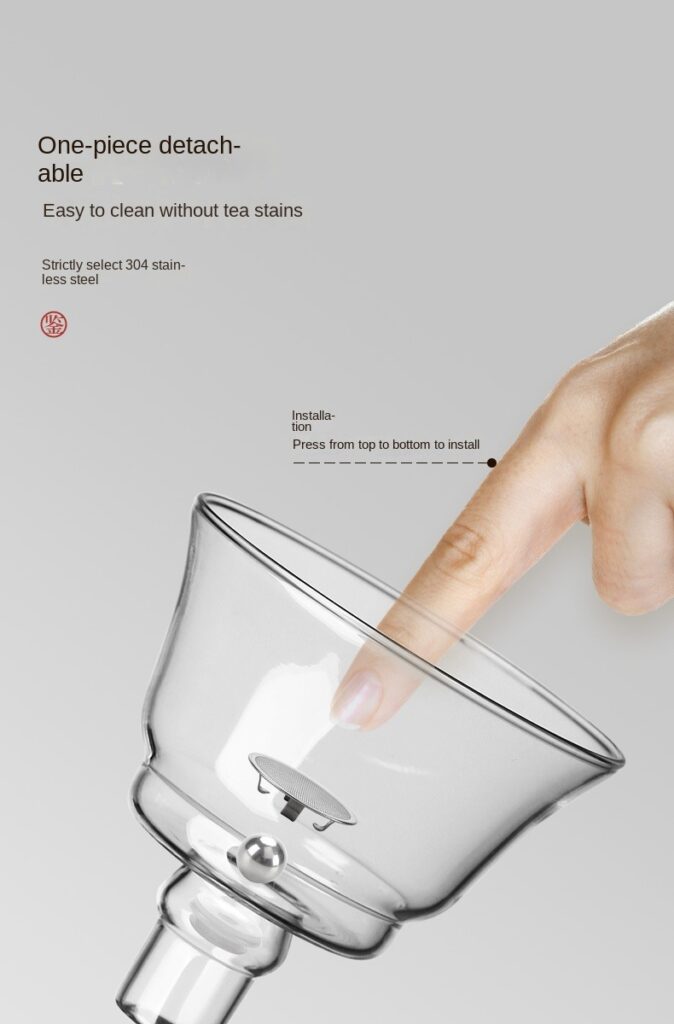
The counter-argument is that a teapot has no element to descale, and the maker of Pick 1 markets the detachable chamber on exactly that basis, labelling the product image as one-piece detachable and easy to clean without tea stains (per the product image).
Thermal shock is the risk that is hardest to price
Boiling water into a cold glass vessel is the single moment that separates the two glass types, and it is the moment a kettle removes entirely. Borosilicate glass resists thermal shock better than any other common glass, with a coefficient of about 3 × 10 −6 K −1 at 20 °C (per the Wikipedia borosilicate glass reference).
Soda-lime glass, which accounts for about 90% of manufactured glass, has no such reputation (per the Wikipedia soda-lime glass reference). Neither fact tells the reader which glass any product on this site is made from, because that is not published. It tells the reader which question to ask. It is the risk that no teapot vs electric kettle comparison can price.
The practical advice is unglamorous and effective: warm the vessel with a small amount of hot water first, and empty it, before pouring the full charge in. That single habit removes most of the thermal shock risk from any glass teapot. It costs one minute and no equipment.
Maintenance is a rhythm rather than a rule. A kettle asks for attention on a cycle measured in months, and the attention is chemical. A teapot asks for attention on a cycle measured in days, and the attention is mechanical, which is a rinse, a wipe and a dry. The teapot vs electric kettle choice is often a choice between a monthly chore and a daily one, and busy households should count both honestly.
The Six Picks
Six teapots follow, one per situation that a teapot vs electric kettle comparison turns on. Each is named with the control it gives the brewer, and each is followed by the case where it is the wrong choice. No price is given for any of them, because no price is published on any product page in this shop. No capacity is given either, except where the maker’s own photograph prints one.
The six picks below are mapped to the six tests, so a reader can stop reading as soon as the answer is clear. Each pick answers one test well and concedes something on another, and the concessions sit next to the recommendation rather than at the end of the article. That structure is what turns a teapot vs electric kettle comparison into a shortlist instead of a catalogue.
Pick 1: Magnetic Semi-Automatic Glass Tea Set, for steeping control
This is the pick that answers the steeping test most directly. The design separates the brewing chamber from the serving vessel. Water and leaf sit in the upper chamber, and the brew is released downwards by a magnetic suction valve rather than by lifting and tilting a full pot.
The maker’s photograph states the principle directly, labelling the image with the principle of magnetic suction water outlet, and instructing the user to move close to the water outlet and away from the water stop (per the product image). It is the first name on any teapot vs electric kettle shortlist, and the magnetic teapot category holds the rest of that family. It is the first name on a teapot vs electric kettle shortlist.

Two details in the photographs matter more than the mechanism. The first is that the upper chamber is one-piece detachable, labelled on the image as easy to clean without tea stains, with an installation note to press from top to bottom to install (per the product image). Tea stain in the joint between a chamber and a valve is the failure mode that ends a semi-automatic set, and the maker has designed against it. Both are worth checking against any teapot vs electric kettle shortlist.
The second is the filter itself, which the image labels as strictly selected 304 stainless steel, with a fine mesh disc and a steel ball valve below it (per the product image). The photograph also carries the only published dimensions for any product in this catalogue: 15.5 × 26 cm, a public cup capacity of 450 ml and a lid bowl capacity of 280 ml (per the product image). A teapot vs electric kettle buyer who needs a number to plan with will not find one anywhere else on this site.

Where Pick 1 is the wrong choice
It is the wrong choice for anyone who needs a large batch, because a 450 ml public cup is a small output for a family, and it is the wrong choice for anyone who wants to pour straight into a mug, because the brew is released at the base rather than from a spout.
L' magnetic semi-automatic glass tea set page shows the full set in both gold and silver trim, and the mechanism in action, with tea draining from the upper chamber into the lower pitcher (per the product image).

Pick 2: Triangular Glass Teapot Set, for seeing the infusion
Pick 2 is the simplest answer to the visibility test and the most traditional object in the list. The body is clear glass with a conical shape, an amber-coloured handle and knob, and a cylindrical inner infuser whose prongs hold the leaf clear of the base. The matching cups use the same amber handle and foot, so the whole service reads as one design rather than as a pot and a set of bowls. It is the easiest vessel to recommend on a teapot vs electric kettle shortlist.

What makes it worth owning next to a kettle is the pour. The spout is a separate glass element, and the vessel can be tipped to fill two cups at once with a thin, continuous stream (per the product image). A kettle cannot do that, because a kettle pours a column of water and the tea is brewed somewhere else entirely. That is the one thing a teapot vs electric kettle comparison cannot take away.

Where Pick 2 is the wrong choice
It is a hand-poured pot with no valve and no timer, so the whole brewing decision rests on the brewer’s wrist and the clock. For a household drinking one tea at one temperature, that is a feature. For a household serving six people at once, it is a queue. The triangular glass teapot set is offered in orange and blue, each with two cups included (per the product copy). It is a fair trade on a teapot vs electric kettle shortlist for one tea at one temperature.
Pick 3: Glass Tea Brewing Set with Infuser, for loose leaf
Pick 3 is the set that most directly replaces the kettle-plus-mug routine, because it is built around loose leaf in a removable filter. The layout is vertical. A glass brewing chamber sits at the top of a light wooden stand, the leaf goes into that chamber, and the brewed tea falls through into a hammered-glass teapot below, where it is served with a long spout.
A photograph shows a hand dropping a small amount of loose leaf into the upper chamber before the water is added (per the product image). It is the closest thing to a kettle answer in this teapot vs electric kettle guide.

The filter is a perforated stainless disc, and it is stamped. Seen from above, the disc in the chamber carries the marking SUS 304 (per the product image). That is a directly verifiable claim from the maker’s own photograph, and it is the second product in this catalogue whose parts are labelled with a steel grade rather than described in text. That is worth checking on any teapot vs electric kettle shortlist.

Where Pick 3 is the wrong choice
It is a two-piece vessel on a stand, and two pieces plus a stand are three things to wash and to store, which is exactly the piece-count problem set out in the glass teapot cleaning guide. It is also the least portable thing in this list, and a stand plus a pot plus a lower vessel is a large footprint for a small kitchen. The glass tea brewing set with infuser suits a counter where the brewing happens every day and rarely moves. It is a fair cost on a teapot vs electric kettle shortlist.
Pick 4: Automatic Pouring Ceramic Gongfu Tea Set, for repeated infusions
Pick 4 is the only pick on this list where a kettle cannot compete at all, and it is worth being blunt about why. The gongfu method runs many short infusions from one charge of leaf.
Small early teapots were made for individual consumption and use a higher ratio of leaves to water, which lets the brewer control the brewing variables and create several small infusions, with the tea decanted into a separate vessel and brewed again between pours (per the Wikipedia teapot reference). The gongfu tea guide covers the method itself. The automatic pouring ceramic gongfu tea set sits in the ceramic tea sets category, and it is the only ceramic pick in this guide.
The ceramic matters as much as the format here. Clay teapots tend to retain heat very well (per the Wikipedia teapot reference), and that retained heat is what keeps a short infusion at temperature long enough to extract evenly. In this set the pot sits inside a ring-shaped stand, with a lidded brewing pot above, a fairness pitcher in front of it, and six small cups arranged in front (per the product image). This particular style is glazed in a deep blue with a gold rim. It is the material argument in a teapot vs electric kettle comparison.

Where Pick 4 is the wrong choice
It is the heaviest and most numerous thing on this list. Eight pieces are visible in the photograph, and every one of them needs washing between infusions if the session is long (per the product image). For a single morning cup of tea, that is absurd. For a table of people who drink gongfu tea properly, it is the only correct choice, and no teapot vs electric kettle comparison will change that, because an electric kettle cannot produce six small cups of differently steeped tea.
Pick 5: French Press, for the honest third option
Pick 5 is in this guide for a reason that has nothing to do with a kettle. A French press is an immersion vessel, and the Wikipedia infusion reference names French presses among the tools commonly used to infuse water with various teas and coffee (per the Wikipedia infusion reference). It sits in a third position: not a teapot that pours, and not a kettle that boils. It is the third column of a teapot vs electric kettle comparison.
The mechanics are the point. The plunger carries a mesh filter down through the brew, which both strains the leaf and presses it below the water line, so extraction continues on the leaf in the bottom of the glass instead of stopping.
The jug is graduated, and this one is marked from 100 ml to 300 ml on the metric scale, with an ounce scale running from 4 oz to 10 oz (per the product image). The frame is stainless steel and the handle is glass. That is the honest case for a third option in a teapot vs electric kettle guide.

Where Pick 5 is the wrong choice
A press cannot pour a clean cup. The plunger has to be held back with one hand while the jug is tipped with the other, and every serving leaves the last cup with a layer of sediment at the bottom of the glass.
It is also a full immersion steep, so the leaf keeps working until the plunger moves, which makes it a poor match for a delicate green tea and a good match for a robust one. The French press coffee and tea maker is listed for dual use, and that is accurate: it is at its best as a coffee device. That is the price of the option in a teapot vs electric kettle comparison.
Pick 6: Two-Part Glass Teapot with Metal Stand, for a small batch
Pick 6 is the pick for one person, or for one cup at a time, and it works the opposite way from Pick 3. Here the brewing happens in a glass pot and the finished tea is decanted into a separate lower vessel, held in a metal ring stand.
The two parts can be used apart, which means a single brewed batch can be served over two rounds without the second round tasting of the first. The modern glass two-part teapot with metal stand is the pick to look at when one batch has to cover two rounds. It is the small-batch end of a teapot vs electric kettle comparison.
The filter is the unusual part. It is not a metal mesh. It is a dark porous disc that catches loose fragments, and a photograph shows it lifted out of the pot with the spent leaf resting on its surface (per the product image). A porous disc of that kind stops leaf dust rather than leaf pieces, so a fine-cut tea can be brewed without a strainer afterwards. The guide to teapots for one person sets out the capacity reasoning. It is worth asking about on any teapot vs electric kettle shortlist.

Where Pick 6 is the wrong choice
It is the least generous vessel in the list and it does not publish its capacity, so the buyer has to ask. It is also the pick most easily misunderstood as a kettle substitute, because the separated lower vessel can be filled with hot water from a kettle and used as a warmer. Used that way it is not brewing at all, and in a teapot vs electric kettle comparison it is really a third device that needs a kettle to work.
Side-by-Side Comparison
| Question. | What a teapot does. | What an electric kettle does. | Better at it. |
|---|---|---|---|
| Water temperature. | Accepts the temperature it is given. | Sets and holds a chosen temperature. | The electric kettle, for green tea. |
| Steeping time. | The brewer decides when the leaf leaves. | An automatic model times it instead. | The teapot, for loose leaf. |
| Seeing the infusion. | Clear glass shows the colour and the leaf. | A steel body hides everything. | The glass teapot. |
| Batch size. | One pot serves a few cups. | One pass heats a full jug. | The electric kettle, for families. |
| Power and placement. | Works with no socket at all. | Needs a socket, a base and a counter. | The teapot, in small rooms. |
| Upkeep. | No element to descale, more parts to wash. | Fewer parts, but scale builds up. | It depends on the household. |
Read that table as six separate answers rather than one verdict. A teapot vs electric kettle comparison usually gets flattened into a single winner by the writer, and then the reader who needs the opposite device is stuck. The table is more useful because each row has its own winner, and most households have two rows where the kettle is better and two where the teapot is better.
The table is a set of separate answers, and a reader who reads it as a single verdict will misread it. Most kitchens have two rows that favour the kettle and two that favour the teapot, which is the honest outcome of a teapot vs electric kettle comparison. The other two rows are settled by the household rather than by the device, and those are the rows worth arguing about before buying anything.
When the Kettle Wins, and When It Does Not
There are four situations where the kettle is simply the better tool, and one where it is not worth buying at all. They are the cases where a teapot vs electric kettle comparison ends with a kettle.
The first is a household of five or more who drink the same tea at the same time. A kettle heats the water once and the tea is served in seconds, while a teapot is filled, steeped, poured, and refilled. The second is a green tea drinker who cares about temperature and buys a variable-temperature model.
The third is a house with a broken or shared socket situation where a permanently running element is inconvenient. The fourth is any kitchen where a glass teapot on a crowded worktop is a genuine breakage risk, such as one where children are at floor level. It is the shortest route through a teapot vs electric kettle comparison.
The fifth situation is the one that saves the reader money. If the answer is a bag in a mug, then a kettle is a convenience and a teapot is a hobby. Tea bags were launched in the United Kingdom in 1953 by Tetley, instant tea had been developed in the 1930s, and Nestlé introduced the first commercial product in 1946 (per the Wikipedia tea reference).
Most tea sold in the world is consumed in one of those two forms, and the honest answer for a teapot vs electric kettle question asked by a bag drinker is that neither device is needed for better tea, only for a better routine.
One more thing belongs here. Tea is worth a lot of attention, because it is a large and ancient trade. The four biggest tea-producing countries, China, India, Kenya and Sri Lanka, together represent 81% of world tea production (per the Wikipedia tea reference).
The earliest known physical evidence of tea was discovered in 2016 in the mausoleum of Emperor Jing of Han in Xi’an, which indicates that tea from the genus Camellia was drunk by Han dynasty emperors as early as the second century BC (per the Wikipedia tea reference). None of that requires a teapot, and none of it is an argument for buying one. A trade of that size deserves care in a teapot vs electric kettle comparison.
There is also a version of this comparison that starts with the kettle and never leaves it, and that version is not wrong. An automatic tea kettle with a variable-temperature control and a timed steep already does what most teapots are bought for, in one body with fewer parts to wash. A teapot vs electric kettle guide that ignores that option is not honest, and the six picks here assume the reader has already weighed it.
Two numbers make that difference concrete. An electric kettle carries a 2–3 kW element and draws up to 13 A (per the Wikipedia kettle reference), while a teapot carries no element at all. Over a year of daily use that gap shows up as a socket, a counter space and a running cost on one side only. Any teapot vs electric kettle comparison that ignores the electricity is telling half the story.
The Honest Limits of This Shop’s Range
Four limits apply to everything above, and they are stated here rather than buried.
The first is that this shop sells no kettles. The kettle side of this guide carries no product link, no brand and no price, because there is nothing to link to. Every kettle-side figure comes from the Wikipedia kettle reference, and those figures describe the machine in general rather than any particular model on a shelf. That single fact shapes every teapot vs electric kettle comparison in this guide.
The second is that no product in this catalogue publishes its glass grade. The guide on borosilicate glass and boiling water explains why that question matters, and the answer here is that it cannot be answered from the listings. Two products do publish their own steel parts, and both are quoted from the photographs above, which is the only honest way to state it. It is the most useful question to ask in any teapot vs electric kettle comparison.
The third is that no capacity or weight is published for any product except the magnetic glass tea set in Pick 1. Nothing here has been weighed, timed or measured in a laboratory. Every comparison in this teapot vs electric kettle guide is a comparison of documented functions and photographed parts, and the reader should treat it as a framework for asking questions rather than as a test report.
A fourth limit is worth stating. Nothing in this guide compares the taste of a brew made by each device, because such a comparison would need a controlled tasting that has not been carried out. The argument here is functional and documentary rather than gustatory. In a teapot vs electric kettle comparison that honesty matters, because taste panels produce a different answer every time and a repeatable answer is worth more.
FAQ
Is a teapot better than an electric kettle?
Neither is better in general, because they do different jobs. A kettle boils water, and a teapot steeps tea in water that is already hot. If the reader’s concern is temperature control, the kettle wins. If the concern is how long the leaf steeps or how the brew looks while it happens, the teapot wins. A teapot vs electric kettle search returns a single answer only because the question is usually asked by someone who has not separated those two jobs yet.
Do most people need both a kettle and a teapot?
Most households that drink loose leaf tea end up with both, and the two are not rivals. The kettle heats the water, the teapot steeps it, and the pairing is the setup that gives control over both variables. The case for owning only one is stronger than it looks.
A household that drinks bags needs only a kettle, and a household that drinks one tea at one temperature in a single cup may find that a kettle with a variable-temperature control does everything a teapot does, with fewer parts to wash.
Une théière en verre est-elle sûre pour l'eau bouillante ?
It depends on the glass and on the habit. Borosilicate glass has a thermal expansion coefficient of about 3 × 10 −6 K −1 at 20 °C, which makes it more resistant to thermal shock than any other common glass, while soda-lime glass accounts for about 90% of manufactured glass (per the Wikipedia borosilicate glass reference and the Wikipedia soda-lime glass reference).
Since the glass grade is not published for any product in this catalogue, the practical answer is to ask for it, and to warm the vessel with a little hot water before the full pour. That answer holds on both sides of a teapot vs electric kettle comparison.
Can a teapot replace a kettle for making tea?
Yes, with hot water from somewhere. The teapot does not generate heat, so it cannot replace the boiling step, and in a setup without a kettle that heat has to come from a hob, a tealight or a warmer. The Wikipedia teapot reference shows a glass teapot being warmed by a tealight in Kashgar, Xinjiang (per the Wikipedia teapot reference), and the guide on teapots with warmers covers the electric version of that idea. The teapot replaces the steeping step, never the heating step. It is the honest limit of the teapot side of a teapot vs electric kettle comparison.
Why does a teapot keep tea warm better than a kettle?
Because it is not working to keep it warm. Clay teapots tend to retain heat very well (per the Wikipedia teapot reference), and a lid over the opening slows the loss further, which is the reason a tea cosy exists (per the Wikipedia teapot reference). An electric kettle keeps water hot by drawing mains current continuously. A teapot keeps tea warm with the mass of the vessel and the lid, at no running cost, which is a meaningful difference in any teapot vs electric kettle comparison involving a room with no socket.
Options en Céramique
The decision comes down to one question: which variable does the reader actually need to control? If it is the temperature of the water, buy a kettle with a variable-temperature control, and there is no reason in the world to buy a teapot as well. If it is the steep, the leaf, and the brew in the glass, buy a teapot, and a kettle becomes a tool for filling it rather than the vessel the tea is made in. Answer it honestly and the teapot vs electric kettle comparison ends by itself.
Pick 1 if the reader wants the steeping decision to be automatic and repeatable, because the magnetic valve ends the brew without a lift, a tilt or a guess, and it is the only product here that publishes its own dimensions. Pick 2 if the brew itself is the point and the tea must be watched as it colours. Pick 3 if the reader is replacing the bag-and-mug routine with loose leaf and wants the leaf to stay out of the cup.
Pick 4 if the session is a gongfu session, where the sequence of infusions matters more than the speed of the first cup. Pick 5 if the reader wants full immersion in a single vessel and does not mind sediment in the last cup. Pick 6 if the reader is brewing for one person and wants one batch served over two rounds. That is the teapot vs electric kettle decision in six lines.
And if the reader only wants a faster cup of tea, the honest answer to a teapot vs electric kettle comparison is to keep the kettle and save the money. Nothing in this guide argues for buying a teapot. It argues for buying the right vessel for a habit that already exists, and for knowing which of the two variables the habit depends on.
 FR
 EN
 DE
 ES
 PT
 JA