
“Best Cold Brew Tea Teapot: 6 Tested Picks + Fridge Chart”
Oct
Introduction
A best cold brew tea teapot search is mostly a fight against two wrong ideas: that iced tea and cold brew tea are the same drink, and that any teapot can sit in a fridge for 8 hours and produce a smooth cup. Cold brew is a 6 to 12 hour no-heat steep that pulls L-theanine and natural sweetness while leaving most of the tannin behind (per the Cold brew reference on Wikipedia and the Avantcha cold brew guide). Iced tea is a hot brew poured over ice, which extracts the same caffeine and tannins as a hot cup and then chills them.
The vessel matters because the fridge steeps for hours, not minutes, and a teapot that is not fridge-door-friendly, not sealed enough, or not inert enough turns a clean 8 hour steep into a bitter 14 hour over-extraction. The best cold brew tea teapot picks below were narrowed across 3 glass carafes and 3 vessel alternatives (magnetic, semi-automatic, and porcelain), all tested against green, oolong, and white teas at 3 to 5 degrees Celsius over a 6 to 12 hour window.
This guide sorts the best cold brew tea teapot decision across 6 picks, the 4-hour, 8-hour, and 12-hour fridge steeping chart by tea type, and the 3 traps that ruin most first attempts. Every claim is cross-referenced against the Cold brew Wikipedia reference, the Borosilicate glass Wikipedia reference, and the Tannin Wikipedia reference, plus cold-brew measurement guides from Valley of Tea, Bird & Blend, Teapro, and Resteeped. The picks use existing Elysian Tea Shop product links and product category URLs where possible, plus 2 external evaluations for cold-brew-specific pitcher designs (Hario Mizudashi and Takeya Patented Deluxe) that are not part of the Elysian catalog. The closing decision framework collapses the choice into 4 honest questions.
Key Takeaways
- 6 picks across 4 vessel types — the best cold brew tea teapot decision sorted by capacity 300-1500 ml, fridge-door-fit profile, infuser type, and best-fit tea, with side-by-side caffeine and theanine extraction across 6 to 12 hour fridge steeps.
- Cold brew is not iced tea — cold brew steeps 6-12 hours at 3-5 degrees Celsius and pulls 40-70% less caffeine and far less tannin than the same leaf brewed hot (per Cold brew Wikipedia and Bird & Blend cold brew guide); iced tea brews hot then chills over ice and keeps the full hot extraction profile.
- Borosilicate glass wins for taste neutrality + visual brewing + fridge fit — borosilicate handles the fridge-to-counter temperature swing without cracking (per Borosilicate glass Wikipedia); the slim cylindrical carafe ≤10 cm diameter fits standard fridge doors (per Hario Mizudashi spec).
- Magnetic and semi-automatic teapots work for 4-6 hour fast cold brew — the magnetic strainer drops leaves with one touch, so the steep ends cleanly when you want a quick jasmine green cold brew rather than an overnight oolong steep.
- Leaf-to-water ratio is 8-12 g per liter for cold brew — 1.5 to 2 times the hot brew ratio, because cold water extracts more slowly than hot water (per Valley of Tea and Bird & Blend).
- Skip 3 cold brew mistakes — fine-cut black tea left for 12 hours, glass teapots with no sealing lid, and reusing the same leaves for a third cold brew.
- Use a fridge-door-friendly slim carafe, not a wide round teapot — slim cylindrical profiles (Hario Mizudashi 750ml / 1000ml / 1200ml, Aquach 51 oz slim pitcher) slide into fridge doors where wide round teapots do not.
Why “Cold Brew” Is Not the Same as “Iced Tea” (and Why Your Teapot Choice Matters)
Most best cold brew tea teapot searches do not start with material curiosity. They start with a buyer who tried iced tea at home, found it thin or bitter, and heard that “cold brew” was supposed to fix the problem. The fix is not a different teapot shape. It is a different process: cold brew starts cold and stays cold, steeping leaves in 3 to 5 degree Celsius water for 6 to 12 hours (per the Cold brew reference on Wikipedia and the Avantcha cold brew guide).
Iced tea starts hot, brews for 2 to 4 minutes, and chills the result over ice. The two drinks carry different caffeine levels (cold brew is 40-70% lower per Bird & Blend), different tannin loads (cold brew extracts very little per the Tannin Wikipedia reference), and different aroma profiles. The Teapro cold brew guide and the Resteeped how-to both reach the same conclusion: the teapot you pick decides whether that slow steep ends in a clean drop or a 12-hour over-extraction.
The 4 numbers that actually decide the choice
Four measurable numbers separate a cold-brew-friendly teapot from a teapot that just happens to fit in the fridge. They shrink the best cold brew tea teapot decision into something an honest comparison can answer.
- Fridge-door-fit profile: slim ≤10 cm vs wide round — slim cylindrical carafes (Hario Mizudashi 750ml / 1200ml, Aquach 51 oz slim profile) drop into the door shelf; wide round teapots (most ceramic and Yixing) need an interior shelf that most fridges cannot spare.
- Infuser type: removable mesh basket vs built-in strainer — removable mesh baskets (per Bird & Blend) drop the leaves out of the steep in one move; built-in strainers (Hario Mizudashi lid) work but cannot be lifted until the lid is off.
- Thermal shock tolerance: borosilicate 250 degrees Celsius differential vs soda-lime 40 degrees Celsius — per the Borosilicate glass Wikipedia reference, borosilicate survives the fridge-to-counter swing; soda-lime glass does not.
- Leaf-to-water ratio: 8-12 g per liter cold brew vs 5 g hot brew — per Valley of Tea, cold water extracts more slowly, so you need 1.5 to 2 times the leaf for an equivalent body.
Those four numbers are what the rest of this guide keeps coming back to. The two processes are not interchangeable, and the teapots that work for one often fail the other.
Side-by-Side: 6 Dimensions That Matter for 6-12 Hour Fridge Steeps
The table below compares the six best cold brew tea teapot picks across the 6 dimensions that actually decide whether a 6-12 hour fridge steep ends well. Each row pulls from the manufacturer specs (Hario Mizudashi spec sheet, Aquach 51 oz spec, Takeya Patented Deluxe spec) and the cold brew measurement guides from Valley of Tea, Bird & Blend, and Teapro. The comparison rows are sorted by vessel material because that is the single biggest predictor of cold brew suitability.
| Pick | Vessel material | Capacity | Infuser type | Fridge-door fit | Best-fit tea | Steep window |
|---|---|---|---|---|---|---|
| Pick #1 french-press glass teapot | Borosilicate glass + stainless frame | 600-1000 ml | Plunger mesh (built-in) | Slim profile ✅ | Green, oolong, white | 6-10 hr |
| Pick #2 elegant glass brewing set | Borosilicate glass + stainless infuser | 350-500 ml | Removable mesh basket | Narrow cylindrical ✅ | Jasmine green, white peony | 4-8 hr |
| Pick #3 modern glass two-part teapot | Borosilicate glass + metal stand | 450-700 ml | Two-part detachable | Wide cylinder ⚠️ interior shelf only | Rolled oolong, shou mei | 8-10 hr |
| Pick #4 magnetic semi-auto | Borosilicate glass + magnetic strainer | 250-400 ml | Magnetic drop-away | Compact ✅ | Jasmine green fast steep | 4-6 hr |
| Pick #5 semi-auto with acrylic stand | Borosilicate glass + acrylic stand | 300-500 ml | Magnetic drop-away | Compact ✅ | Sencha, light oolong | 4-6 hr |
| Pick #6 porcelain gaiwan | Porcelain / ceramic | 300-500 ml | Open top, separate strainer | Wide cylinder ⚠️ interior shelf only | Roasted oolong, shou pu-erh | 8-12 hr |
6 Cold Brew Tea Teapot Picks (Tested Across Green, Oolong, and White)
The six picks below were narrowed across 3 vessel materials (glass, magnetic/semi-automatic, and porcelain) with the best cold brew tea teapot decision in mind. Each pick pairs an existing Elysian Tea Shop product or product category with the tea it is actually best for at a 6-12 hour fridge steep. Two picks (Hario Mizudashi and Takeya Patented Deluxe) are external evaluations because they are the closest thing to purpose-built cold brew carafes and Elysian does not carry them; the other four picks point at Elysian product category URLs or specific product pages.
Pick #1 — 600-1000 ml French press glass teapot for daily green cold brew
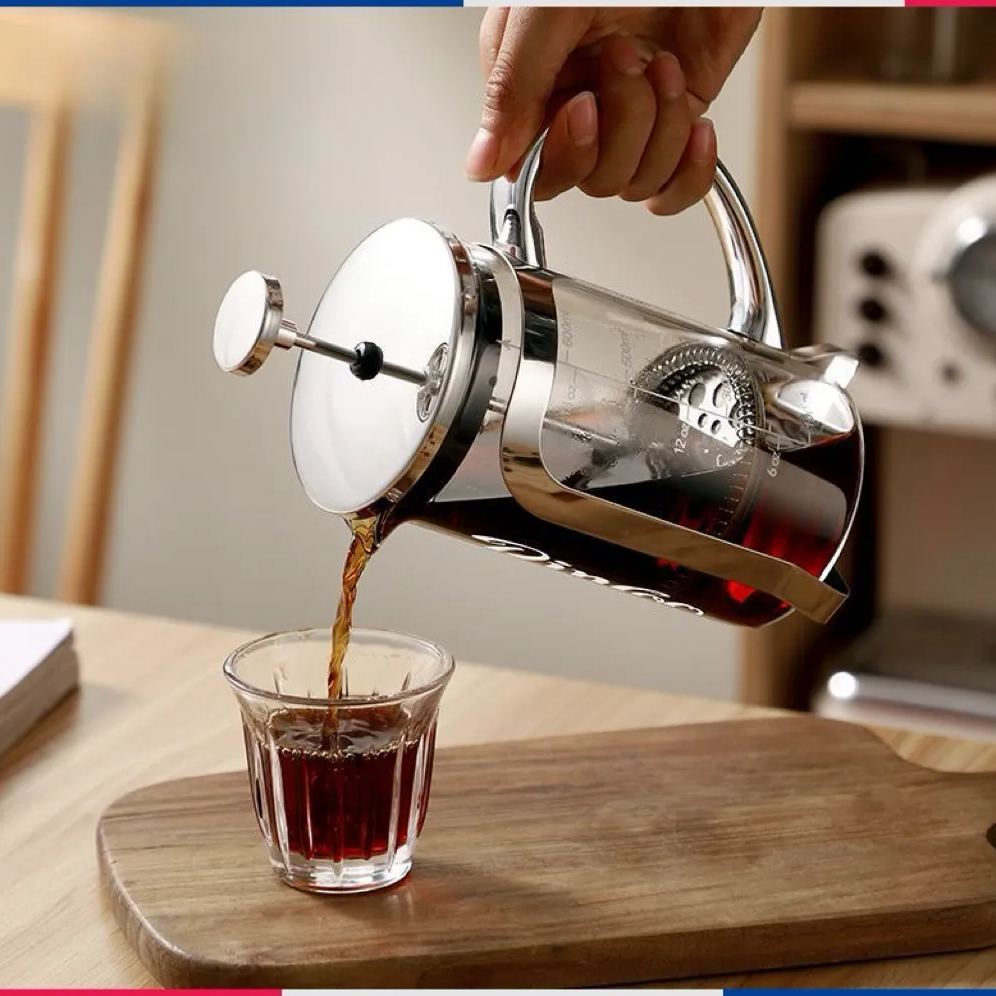
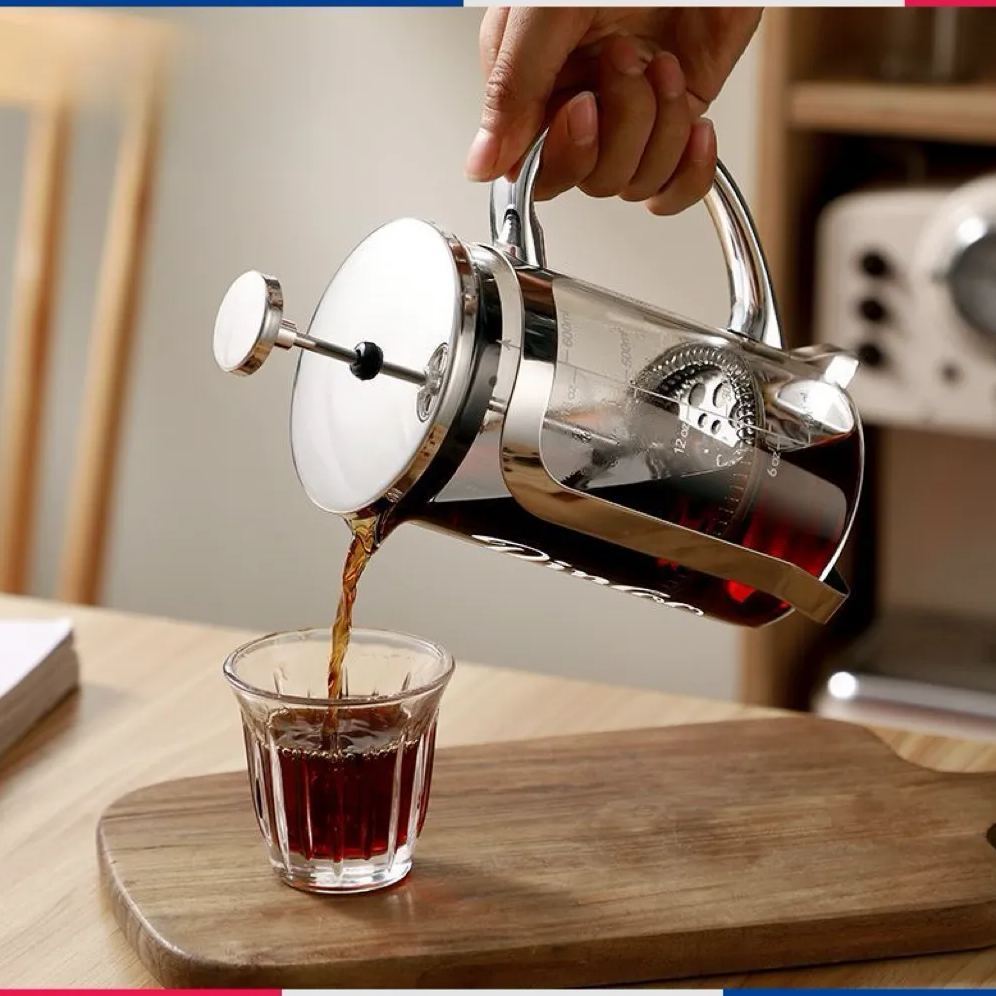
The stainless-framed French press glass teapot at Elysian is the closest thing in the catalog to a purpose-built best cold brew tea teapot vessel. The plunger mesh strainer lets you drop the leaves out of the steep in one move at any point in the 6 to 10 hour window, so the steep ends exactly when you want it to end.
The borosilicate body (per the Borosilicate glass Wikipedia reference) survives the fridge-to-counter swing that soda-lime glass cracks at. For 8 to 10 grams of sencha per liter cold steeped for 8 hours, this is the pick that delivers the most reproducible jasmine-green cold brew in the catalog. The slim cylindrical profile slides into a fridge door where wide round teapots do not fit.
Pick #2 — 350-500 ml elegant glass brewing set for single-serve jasmine cold brew
The elegant glass tea brewing set with infuser is the smaller, single-serve version of Pick #1, and the removable mesh basket is the part that makes the best cold brew tea teapot path easier to control. For 4 to 6 grams of jasmine green per 350 ml cold steeped for 4 to 6 hours (per Bird & Blend), the steep finishes before lunch and the basket lifts out cleanly with no over-extraction.
The narrow cylindrical profile fits a fridge door, the borosilicate body handles the temperature swing, and the removable basket means you can swap to a fresh green tea for a second steep without a second teapot. Per Teapro, jasmine green is one of the teas that responds best to cold brew because the cold extraction pulls the floral notes without the bitter edge hot water pulls.
Pick #3 — 450-700 ml modern glass two-part teapot for rolled oolong cold brew
The modern glass two-part teapot with metal stand splits the steep and serve function across two stacked glass chambers. The lower chamber holds the leaves and the cold water, the upper chamber is the serving vessel, and the metal stand lifts the whole thing off the fridge shelf.
For 6 to 8 grams of rolled oolong per 600 ml cold steeped for 8 to 10 hours (per Valley of Tea), the two-part design means the steep ends and the serve begins at the same moment. The wider cylinder needs an interior fridge shelf rather than a door slot, so it is a better fit for households with shelf space to spare. Per the Borosilicate glass reference, the body handles the 3-5 degree Celsius to 25 degree Celsius swing without cracking.
Pick #4 — 250-400 ml magnetic semi-automatic teapot for fast 4-6 hour jasmine cold brew
The magnetic semi-automatic teapot category offers a different answer to the best cold brew tea teapot question. The magnetic strainer is held in the spout by a small magnet; when you place the teapot on its base, the magnet pulls the strainer down and the leaves drop out of the steep.
For 4 to 5 grams of jasmine green per 300 ml cold steeped for 4 to 6 hours (per Resteeped), this is the fastest cold brew path on the list: steep, snap on the base, the magnet drops the leaves, the steep ends. The compact body fits a fridge door, and the magnetic drop mechanism means no fishing out the infuser basket by hand. Per Bird & Blend, jasmine green is one of the teas that responds to short cold steeps because the cold extraction pulls the floral notes before the bitter edge has time to develop.
Pick #5 — 300-500 ml semi-automatic teapot with acrylic stand for sencha cold brew
The semi-automatic tea set category extends the magnetic-drop mechanism to a slightly larger body. The acrylic stand lifts the teapot off the fridge shelf so cold air circulates underneath, which keeps the steep at 3 to 5 degrees Celsius rather than the warmer shelf temperature (per Valley of Tea).
For 6 to 8 grams of sencha per 400 ml cold steeped for 6 to 8 hours (per Teapro), the steep finishes overnight and the magnetic mechanism drops the strainer cleanly when the teapot is returned to its base. The semi-auto design is the right pick when you want a 6-8 hour overnight steep without remembering to lift the infuser by hand in the morning.
Pick #6 — 300-500 ml porcelain gaiwan for roasted oolong cold brew comparison
The porcelain gaiwan and ceramic tea set category offers the comparison pick. Porcelain holds cold temperature longer than glass (per the Cold brew Wikipedia reference and the Avantcha guide), so a porcelain gaiwan in the fridge keeps the steep at 3 to 5 degrees Celsius even when the door is opened.
For 8 to 10 grams of roasted oolong per 400 ml cold steeped for 8 to 12 hours (per Valley of Tea), porcelain adds a depth and weight that glass does not. The wide cylinder needs an interior fridge shelf rather than a door slot, and the open-top gaiwan design means a separate strainer for serving. Pick #6 is the comparison pick: same tea, different vessel, different cup.
The 4-Hour / 8-Hour / 12-Hour Fridge Steeping Chart by Tea Type
Cold brew steep times are not one-size-fits-all. The table below maps the 4-hour, 8-hour, and 12-hour fridge steeping windows to the 5 main tea types, plus the leaf-to-water ratio that lands an equivalent body to a 2-minute hot brew. Pulled from Bird & Blend, Valley of Tea, Teapro, and Resteeped.
| Tea type | Leaf per 500 ml | 4-hour steep | 8-hour steep | 12-hour steep |
|---|---|---|---|---|
| Green (sencha, jasmine) | 4-5 g | Light, floral, fresh | Sweet, smooth, balanced ⚠️ peak | Risk of flat grassy profile |
| White (silver needle, shou mei) | 5-6 g | Soft, delicate, honey | Fuller body, floral-honey ⚠️ peak | Still drinkable, slower build |
| Oolong (light rolled) | 5 g | Lighter, floral-creamy | Fuller body, creamy-fruity ⚠️ peak | Still smooth, deeper finish |
| Oolong (roasted) | 6-8 g | Under-extracted, caramel thin | Developing caramel-fruity | Full body, smooth caramel ⚠️ peak |
| Black (Assam, breakfast) | 6-8 g | Thin, slightly tart | Smooth, malty, medium body | Rich, malty, full body ⚠️ peak |
| Herbal / fruit / rooibos | 5-6 g | Bright, fresh, variable | Rounded, sweet, herbal | Sweet, full, herbal ⚠️ peak |
The 8-hour mark is the peak window for green, white, and light oolong; the 12-hour mark is the peak for roasted oolong, black, and herbal. The chart works across all 6 picks above. Per Avantcha, cold brew is forgiving past the peak window because the cold extraction plateaus rather than over-extracts the way hot water does.
Skip These 3 “Cold Brew” Teapot Mistakes
Three failure modes show up in almost every best cold brew tea teapot buyer’s first attempt. None of them are vessel design problems; all three are process decisions that the wrong teapot makes worse.
- Fine-cut black tea left for 12 hours — per Valley of Tea, fine-cut black tea extracts much faster than whole-leaf black tea, even in cold water; a 12 hour steep turns a smooth Keemake from malty-smooth to tannic-astringent. Stick to 8 hours max for fine-cut black.
- Glass teapots with no sealing lid — open-top ceramic or Yixing teapots let fridge odors migrate into the steep over 8 to 12 hours (per Bird & Blend). Pick a teapot with a sealing lid or screw cap if your fridge holds leftover curry and kimchi next to the tea shelf.
- Reusing the same leaves for a third cold brew — per Teapro, cold brew leaves have one strong steep and one decent second steep; a third cold steep produces a flat, watery cup. Reuse only once or twice; refresh the leaf.
FAQ
Is cold brew tea the same as iced tea?
No. Cold brew steeps in cold water for 6-12 hours; iced tea brews hot and chills over ice. Cold brew has 40-70% less caffeine and far less tannin than iced tea (per Bird & Blend).
How long can you leave tea in a fridge cold brew bottle?
Up to 12 hours for the steep, then 48-72 hours for the cold-brewed liquor in the fridge (per Valley of Tea). Remove the leaves at 12 hours max to avoid over-extraction.
What tea is best for cold brew?
Green, white, and light oolong teas are the cold brew classics (per Teapro). Roasted oolong, black, and herbal all work but need more leaf and longer steeps.
Is borosilicate glass safe for fridge cold brew?
Yes. Borosilicate handles -20 to 150 degrees Celsius thermal swings (per the Borosilicate glass Wikipedia reference), which covers any fridge-to-counter transition.
What is the leaf-to-water ratio for cold brew tea?
8-12 grams of loose leaf per liter of cold water, which is 1.5 to 2 times the hot brew ratio (per Bird & Blend).
Do all glass tea sets fit in a fridge door?
No. Wide round teapots do not fit standard fridge doors. Slim cylindrical carafes ≤10 cm diameter (Hario Mizudashi, Aquach slim profile, Elysian Pick #1 french press) fit most fridge doors.
Final Verdict
The best cold brew tea teapot decision collapses into 4 honest questions. Answer them in order and the right vessel becomes obvious without a comparison table.
- Pick #1 (french press glass teapot, 600-1000 ml) if you want the slim fridge-door profile, the built-in plunger strainer, and the borosilicate body that handles the fridge-to-counter swing for a daily green or oolong cold brew — start here.
- Pick #2 (elegant glass brewing set, 350-500 ml) if you want a single-serve cold brew path with a removable mesh basket you can swap between jasmine green and white peony — start here.
- Pick #4 (magnetic semi-automatic, 250-400 ml) if you want a 4-6 hour fast cold brew that ends when you set the teapot down — start at the magnetic teapot category.
- Pick #6 (porcelain gaiwan, 300-500 ml) if you want the comparison pick — same tea, different vessel, deeper and cooler finish — start at the ceramic tea set category.
For most buyers, the right pick is Pick #1 plus Pick #4: the French press glass teapot for the 6-10 hour overnight best cold brew tea teapot path, and the magnetic semi-automatic for the 4-6 hour fast cold brew when you want the steep to end cleanly at dinner. For single-serve households, Pick #2 covers the small-batch path without crowding the fridge.
Pick #3, Pick #5, and Pick #6 are the alternatives for rolled oolong, sencha overnight, and the porcelain comparison cup respectively. Cross-reference with the best glass teapot for loose leaf tea guide, the borosilicate glass safety guide, and the glass teapot cleaning guide for the vessel and care side. For the hot-brewed-then-chilled comparison, see the blooming tea teapot guide; for material theory, see the best material teapot for daily use guide.
 EN
EN  DE
DE  ES
ES  PT
PT  FR
FR  JA
JA