
Best Teapot for Herbal Tea: 6 Picks for Long Steeps
Nov.
Einführung
The best teapot for herbal tea is decided by the plant, not by the pot. A herbal infusion is made from any herbs, spices, or other plant material except tea leaves, brewed as an infusion or a decoction in water (per the Wikipedia herbal tea reference). That definition describes a different set of physical problems from any tea brewed from Camellia sinensis, the tea plant (per the Wikipedia tea plant reference).
Three properties separate the two kinds of material in a pot. Herbal material is bulkier, so it needs a wider aperture than a tea-leaf filter. It is oilier, so it needs a lid that stays on. And it gives up its flavour in one pass, so it needs a vessel that can hold a single long steep rather than a series of short ones.
The fourth problem is quieter. The material arrives as flowers, needles, roots and bark rather than as uniform leaf, and it stains. Rooibos comes as the fine needle-like leaves cut from wild plants (per the Wikipedia rooibos reference), while chamomile is made from two flower-head species, Matricaria chamomilla and Chamaemelum nobile (per the Wikipedia chamomile reference).
The pot that is easiest to take apart is the pot that survives a year of daily chamomile. This guide compares six picks by mechanism rather than by price, and names the two multi-cup gongfu sets that do not work for herbs at all.
Wichtige Erkenntnisse
- Herbal teas are made from the infusion or decoction in water of any herbs, spices, or other plant material except tea leaves, and they are not technically a tea because they are not brewed from the tea plant, Camellia sinensis (per the Wikipedia herbal tea reference). That boundary is what makes the best teapot for herbal tea a different problem from every tea-type guide on this site: a cold steep of European mistletoe takes 2 to 6 hours (per the Wikipedia herbal tea reference), and it changes what a herbal tea teapot has to be.
- Most herbal infusions are naturally caffeine-free, because unlike true teas, most tisanes do not naturally contain caffeine (per the Wikipedia herbal tea reference). The exceptions matter for a household: guarana tea is made from guarana seeds containing more than three times the caffeine of coffee, and cacao bean tea contains theobromine and a small amount of caffeine (per the same reference). None of that changes the best teapot for herbal tea, but it does change when the pot gets used, because the house ratio for a tisane is 1:50 to 1:80 over 5 to 7 minutes (per the house guide to what gongfu tea is).
- The temperature problem is real. Some plant parts are covered in oils, which may take some time to separate (per the Wikipedia herbal tea reference), so a herbal steep runs longer and hotter than a delicate tea steep, and a boiling water teapot has to be built for it. The glass question is a thermal-shock question: borosilicate glass can withstand temperature differentials of about 330 °F without fracturing, whereas soda-lime glass can withstand only about a 100 °F change (per the Wikipedia borosilicate glass reference).
- Filter aperture is decided by the plant part, and the reference is blunt about it: infusers with large holes may not catch all the leaves, requiring the use of a tea strainer to remove the remaining pieces (per the Wikipedia infuser reference). Chamomile flower and rooibos needle are exactly the material that defeats a large hole, and the house steeping ratio of 1:50 to 1:80 over 5 to 7 minutes (per the house guide to what gongfu tea is) leaves a lot of plant material sitting in the pot at once, which is what a chamomile teapot has to solve.
- The flavour of peppermint is volatile. Dried peppermint typically has 0.3 to 0.4 % of volatile oil containing menthol (7-48 %), menthone (20-46 %), menthyl acetate (3-10 %), menthofuran (1-17 %), and 1,8-cineol (3-6 %), and the main constituents of the essential oil are menthol at 41 % and menthone at 23 % (per the Wikipedia peppermint reference). That is the payload a peppermint teapot has to keep in the cup.
- The number of infusions is the wrong frame for herbs. This site’s own gongfu guide records that herbal tisanes such as chamomile, peppermint and rooibos lack the oxidation and rolling needed to release new flavours across multiple infusions, give up most of their flavour compounds in one long steep, and yield flat second or third infusions, so they are brewed Western-style at 1:50 to 1:80 with a single infusion of 5 to 7 minutes (per the house guide to what gongfu tea is). This is the single most useful fact in any best teapot for herbal tea comparison.
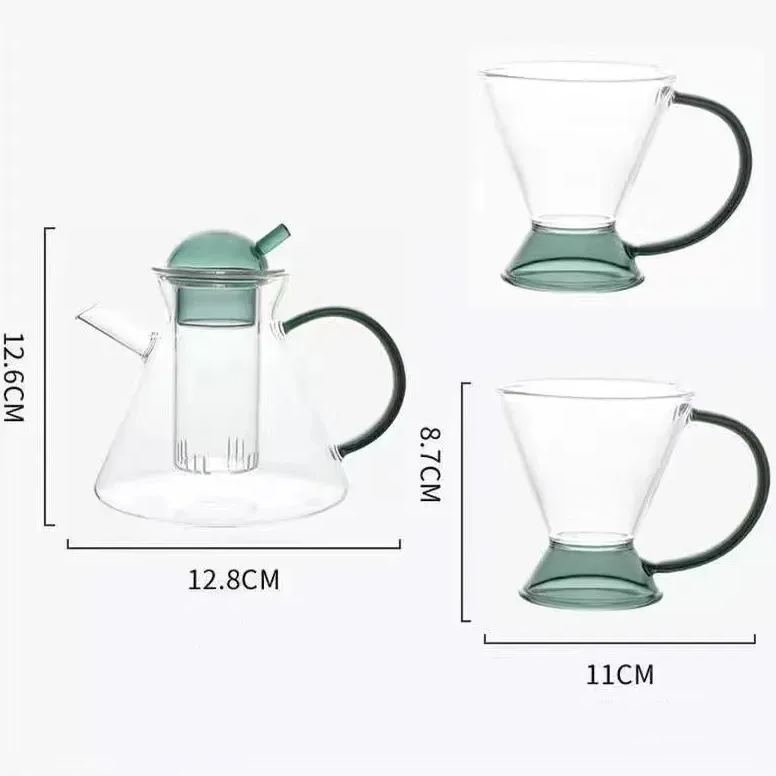
- None of the 43 products in the Elysian catalogue publishes a capacity or a glass grade, so these picks are ranked by mechanism and construction and not by volume. The single exception on dimensions is Pick 1, whose own product image states a teapot 12.6 cm high and 12.8 cm wide with matching cups 8.7 cm high and 11 cm wide, and Pick 4, whose beaker carries printed millilitre and ounce graduations. Every other claim in this guide about the best teapot for herbal tea is a claim about how a mechanism works.
Inhaltsverzeichnis
- What Herbal Tea Is, and Why It Is Not Tea
- The Six Jobs a Herbal Teapot Has to Do
- Job 1: Survive Boiling Water
- Job 2: Hold Bulky Plant Material
- Job 3: Keep the Volatile Oils In
- Job 4: Hold One Long Steep, Not Eight Short Ones
- Job 5: Let the Colour Show
- Job 6: Wash Out Pigment and Leaf
- Side-by-Side: 6 Picks Compared
- Pick 1: The Triangular Glass Teapot Set with Lid and Infuser
- Pick 2: The Magnetic Draining Glass Teapot on a Wooden Stand
- Pick 3: The Detachable Glass Semi-Automatic Teapot
- Pick 4: The French Press in Glass and Stainless Steel
- Pick 5: The Rotating Blue and White Ceramic Tea Set
- Pick 6: The Ceramic Tea Set on a Metal Frame with a Bottom Screen
- Which Pots in This Catalogue Are Wrong for Herbal Tea
- 5-Point Buying Checklist
- Our Recommended Tea Sets
- FAQ
- Endurteil
What Herbal Tea Is, and Why It Is Not Tea
The plant boundary: Camellia sinensis versus everything else
Herbal teas, herb teas, herbal infusions and tisanes are four names for the same family of drinks. The definition is narrow and worth reading closely. Beverages made from the infusion or decoction in water of any herbs, spices, or other plant material except tea leaves are herbal teas (per the Wikipedia herbal tea reference). The exception clause is the whole point. Herbal teas are not technically a tea because they are not brewed from the tea plant, Camellia sinensis (per the same reference).
The plant part, not the drink, is what a best teapot for herbal tea has to be built around.
That means the plant part varies enormously. Anise is made from the seeds or the leaves, artichoke tea is made from the flower, and bael fruit is made from the fruit (per the Wikipedia herbal tea reference). A pot designed around a uniform rolled leaf has to be rethought from the filter upwards, because a whole flower head and a needle of dried wood are not the same object. The best teapot for herbal tea follows the plant part, not the flavour.
That is the whole reason a herbal tea teapot is a separate category of product. A best teapot for herbal tea therefore changes with the plant part, not with the flavour alone.
Caffeine-free by default, with three exceptions
One of the genuine advantages of herbal tea is that it does not need a caffeine disclaimer, because unlike true teas, most tisanes do not naturally contain caffeine (per the Wikipedia herbal tea reference). Rooibos is described as a caffeine-free herbal infusion that has been consumed in Southern Africa for generations, and it has low tannin levels compared to black tea or green tea (per the Wikipedia rooibos reference). A caffeine-free drink is also the easiest possible way into a best teapot for herbal tea, because there is no fixed number of cups in the day.
The exceptions are worth knowing, because they change how the drink should be timed in an evening.
A number of plants do contain psychoactive compounds such as caffeine or another stimulant, including theobromine (per the Wikipedia herbal tea reference). Guarana tea is made from guarana seeds containing more than three times the caffeine of coffee, cacao bean tea contains theobromine and a small amount of caffeine, and yaupon is brewed from Ilex guayusa and was drunk before battle by the Saturiwa people of sixteenth century Florida (per the same reference). None of them changes the vessel, and each still leaves the best teapot for herbal tea with the same six jobs to do.
For a household choosing a pot rather than a tea, the useful conclusion is that most of what will pass through the best teapot for herbal tea is mild enough to drink in the evening, and the handful that is not is worth knowing by name. Either way, the vessel follows the herb rather than the other way round, and a loose herb teapot is chosen for the plant part it will hold.
The Six Jobs a Herbal Teapot Has to Do
The six jobs below are the framework for every pick in this guide. They are ordered by how often they decide the outcome, not by how interesting they are. A steeping pot that handles all six would be the best teapot for herbal tea, and nothing in this catalogue handles all six.
- Survive boiling water. Herbs are brewed hotter and longer than most delicate tea, and the vessel has to take the temperature without cracking.
- Hold bulky plant material. Flower heads, roots, bark and needles need an aperture sized for the plant part, not for tea leaf.
- Keep the volatile oils in. Much of what makes a herbal infusion taste like itself sits on the surface of the leaf as oil, and a lid is a flavour tool rather than a decoration.
- Hold one long steep rather than eight short ones. It is the single biggest reason the best teapot for herbal tea is not the same object as a tea pot. This is the single biggest difference between a herb pot and a tea pot.
- Let the colour show. The strength of an herbal infusion is judged by how dark it is, and dark is a hard thing to judge in an opaque pot.
- Wash out pigment and leaf. Herbal material stains and lodges in corners, so disassembly matters more here than in any other tea category.
Not every pot does all six, and no pot in this guide does all six at once. Each of the six picks below is strongest on two or three of them and openly weak on the rest, which is the honest way to describe an instrument and the only honest way to write a best teapot for herbal tea guide.
Job 1: Survive Boiling Water
Why the herbal default runs hot
Herbal infusions are poured over with hot or boiling water rather than tempered, and the reference is explicit that the temperature and time vary with the type of plant part and its properties (per the Wikipedia herbal tea reference). Rooibos, for example, is commonly prepared as a tisane by steeping in hot water, in the same manner as black tea (per the Wikipedia rooibos reference). That hot-water default is the first thing a best teapot for herbal tea has to survive.
Two facts about the material push the same direction. Some plant parts are covered in oils, which may take some time to separate (per the Wikipedia herbal tea reference), and the extraction of volatile compounds needs time that a short steep does not give. That is the timing a best teapot for herbal tea has to be built around.
This site’s own gongfu guide settles the timing: herbal tisanes such as chamomile, peppermint and rooibos should be brewed Western-style at 1:50 to 1:80 with a 5 to 7 minute single infusion (per the house guide to what gongfu tea is). A single long steep is a long time for a lid to stay shut, and it is where the best teapot for herbal tea starts to part company with a tea pot.
Boiling water into a cold vessel is the other half of the problem. The pot that cracks is not usually the one that held boiling water once, but the one that took boiling water into a cold body while full of cold liquid. That is a thermal-shock failure, and it is a specification question rather than a design question. It is also the first question a boiling water teapot has to survive. The same question decides the best teapot for herbal tea.
The thermal-shock number to ask a seller for
Borosilicate glass is the material that answers the boiling-water problem, and it has a number attached to it. The common type of borosilicate glass used for laboratory glassware has a very low thermal expansion coefficient of 3.3 × 10⁻⁶ K⁻¹ (per the Wikipedia borosilicate glass reference). Such glass is subjected to less thermal stress and can withstand temperature differentials of about 330 °F without fracturing. Soda-lime glass, by contrast, can withstand only about a 100 °F change in temperature (per the same reference). That gap is the number worth asking about when choosing a best teapot for herbal tea.
The composition is what produces that behaviour. The composition of low-expansion borosilicate glass, such as laboratory glassware, is approximately 80 % silica, 13 % boric oxide, 4 % sodium oxide or potassium oxide and 2 to 3 % aluminium oxide (per the Wikipedia borosilicate glass reference). It is a specification a buyer can ask for and a seller can decline to give, which is why the best teapot for herbal tea is often chosen on mechanism instead.
Here is the honest limit of that number for a shopper. Not one of the 43 products in the Elysian catalogue states a glass grade, so no product in this guide can honestly be described as borosilicate. What the specification gives the reader is a question worth asking a seller, and the answer is worth more than the guess. A ceramic body sidesteps the question entirely, because ceramic does not carry a thermal-shock limit of this kind at all. The honest best teapot for herbal tea comparison in this guide is therefore made on mechanism, not on a label.
For anyone still weighing the two material options, the glass tea sets collection and the ceramic tea sets collection can be compared side by side in the catalogue, and the guide to teapots with infusers covers the filter choices in more depth than this page can. A ceramic teapot answers the boiling-water question by material, and a glass one answers it by specification. Either way, the best teapot for herbal tea is decided on the same six jobs.
Job 2: Hold Bulky Plant Material
Chamomile flowers, rooibos needles, licorice root
Three plant parts define the aperture problem. Rooibos is harvested as the fine needle-like leaves cut from wild plants (per the Wikipedia rooibos reference). Chamomile for infusion comes from two species, Matricaria chamomilla and Chamaemelum nobile (per the Wikipedia chamomile reference). Peppermint is a leaf harvested for its oil, with the dried leaf typically carrying 0.3 to 0.4 % volatile oil (per the Wikipedia peppermint reference). The best teapot for herbal tea is decided by which of those three it has to hold.
A rooibos needle is small and dense, so it behaves like a fine leaf and will pass through a wide hole in a slow pour. A chamomile flower head is bulky and light, so it will float on the surface of a steep and escape rather than sink through a filter. The two materials want opposite behaviours from the same aperture, which is the reason the best teapot for herbal tea cannot be chosen from a single hole-size number.
The reference defines the category in a way that helps. An infuser is generally a small mesh, perforated metal container, or covered spoon that holds tea leaves, in varying sizes, to steep single or multiple servings at once (per the Wikipedia infuser reference). Three distinct shapes are named there, and only one of the three, the mesh, is built to hold back a wide range of particle sizes. That single distinction is what a best teapot for herbal tea has to be chosen on.
What a tea-leaf filter actually does to a flower
The reference also names the failure mode directly: infusers with large holes may not catch all the leaves, requiring the use of a tea strainer to remove the remaining pieces (per the Wikipedia infuser reference). A perforated plate with holes sized for rolled tea leaf passes a chamomile flower whole, and a mesh basket fine enough to catch a rooibos needle also holds a flower head above the water, where it never extracts. A best teapot for herbal tea built on a tea-leaf aperture fails on both.
The workable answer for herbs is a mesh fine enough for needles and a basket deep enough for flowers. That means that in most cases the herb goes in a separate removable basket rather than straight into the pot. That filter basket is the component that decides the best teapot for herbal tea for any given plant part. That is the mechanism behind two of the six picks below, and it is also the reason the guide to teapots with infusers is worth reading before buying anything for loose herbs.
There is a second way to solve it, which is to lift the material out rather than filter it. A magnetic drain in the base of a brewing chamber empties the liquid while the leaf stays where it is, and a detachable strainer ring gives the same result by hand. Both appear in the picks below, and both are better answers to a flower head than a fine hole ever will be. That is why the best teapot for herbal tea for chamomile is a pot with depth rather than a pot with a finer hole.
Job 3: Keep the Volatile Oils In
Menthol is 41 % of peppermint essential oil
The reason a lidded pot matters is easiest to see with peppermint, because peppermint is the herb whose flavour is most obviously a volatile oil. Dried peppermint typically has 0.3 to 0.4 % of volatile oil containing menthol (7-48 %), menthone (20-46 %), menthyl acetate (3-10 %), menthofuran (1-17 %), and 1,8-cineol (3-6 %) (per the Wikipedia peppermint reference). That is the payload a best teapot for herbal tea has to keep in the cup.
The composition concentrates further in the extracted oil. The main constituents of the essential oil from Mentha × piperita are menthol at 41 % and menthone at 23 % (per the Wikipedia peppermint reference). Menthol activates cold-sensitive TRPM8 receptors in the skin and mucosal tissues, and is the primary source of the cooling sensation that follows the topical application of peppermint oil (per the same reference). A lid is the cheapest way to keep a best teapot for herbal tea on the side of the drinker.
Menthol is also the reason the world grows 35,547 tonnes of peppermint a year, led by Morocco with 78 % of the total and Argentina with 20 % (per the Wikipedia peppermint reference). A plant worth that much acreage is worth protecting through the steep, and an open pot throws the part that makes it worth planting straight into the kitchen air. That acreage is what a best teapot for herbal tea is asked to protect.
A lid is a flavour tool, not a decoration
Volatile compounds leave a hot infusion fastest when the surface is disturbed and the air above it moves. A lid does three things at once for a herbal steep. It limits the exchange with the room and it keeps the heat in. It also stops the surface film of oil from being blown off before the cup is poured. The same lid on a pot with a wide open spout does less, because the spout is an exit as well as an entrance. A wide open spout is a poor choice in a best teapot for herbal tea.
This is also where the herbal case and the gongfu case collide, and the collision is worth making explicitly. A lidded gaiwan is a very good herbal pot, because it holds one steep and keeps it covered. A multi-cup gongfu set is a poor one, for reasons that are about the number of infusions rather than about the ceramic. A rooibos teapot and a peppermint teapot both live or die on that lid. The best teapot for herbal tea picks below resolve that collision.
The house guide to what gongfu tea is draws exactly that line, and the best teapot for herbal tea picks below respect it.
One more note on the cold route. Brewing with cold water will also take much longer, usually several hours (per the Wikipedia herbal tea reference). A pot with a lid and a wide mouth is also the pot that holds a cold overnight steep without the lid fogging the outside, and the guide to cold brew teapots covers that use case properly. A cold brew teapot is still the best teapot for herbal tea in winter, with a longer clock.
Job 4: Hold One Long Steep, Not Eight Short Ones
Why the gongfu method does not transfer
This is the point on which most advice about herb pots is wrong, and it is settled by this site’s own gongfu guide rather than by general tea lore. Herbal tisanes such as chamomile, peppermint and rooibos lack the oxidation and rolling needed to release new flavours across multiple infusions. They give up most of their flavour compounds in one long steep and yield flat second or third infusions. The best teapot for herbal tea follows from it.
Brew them Western-style at 1:50 to 1:80 and a 5 to 7 minute single infusion (per the house guide to what gongfu tea is). The best teapot for herbal tea has to be built for one steep rather than eight.
The reasoning is about the leaf, not the pot. A rolled and oxidised tea leaf is built to open up across several short infusions, each one pulling out a different layer. An herb has no such structure. Its aromatic compounds leave on the first long soak, and the second and third infusions taste of water that was over the same material once already. That is the structural reason a best teapot for herbal tea is a different object.
The consequence for a pot is concrete. A vessel built for eight short infusions gives the herbal drinker a long first pour followed by flat ones, and a set of small cups sized for a 30 ml gongfu pour is the wrong vessel for a single 250 ml cup of chamomile (per the house guide to what gongfu tea is). The best teapot for herbal tea is the pot that answers it.
This is where most a best teapot for herbal tea recommendation goes wrong, because the gongfu format looks so convincing on a shelf. The best teapot for herbal tea needs the opposite architecture: one chamber, one long steep, one pour, and a way to separate the leaf when the steep is over.
Stopping the steep on command
Once the brew is a single 5 to 7 minute steep, the useful question becomes how to end it. There are three answers in this catalogue, and they are the mechanisms that separate the best teapot for herbal tea picks below from one another.
The first is a magnetic drain. A magnetic joint holds the brewing chamber against the lower serving vessel, and the flow is opened or closed by moving the magnet relative to the outlet. The steep ends because the drinker decides it ends, not because a timer ran out, and the leaf stays in the upper chamber. Pick 2 in this guide uses exactly this arrangement, and it is the mechanism that makes it the best teapot for herbal tea for a drinker who steeps to a clock.
The second is a detachable strainer. A separate glass lid and a separate fine mesh ring lift out of a glass chamber, so the leaf is removed from the liquid by hand in one movement. Pick 3 uses this arrangement, and it has a second advantage for herbs that no other mechanism in this group offers, which makes it the best teapot for herbal tea for daily washing.
The third is a plunger. A French press mesh separates leaf from liquid in a single downward stroke, which ends a steep cleanly but cannot end it halfway. French press tea is a specialist answer rather than a general one, and the best teapot for herbal tea has to say which side of that line it sits on. Pick 4 is honest about that trade. It is the reason the press is a specialist rather than an all-rounder in this best teapot for herbal tea comparison.
Job 5: Let the Colour Show
Strength in an herbal infusion is judged by colour more than by any other cue, because there is no bitterness curve to learn and no standard brewing ratio to trust. A pale amber rooibos and a deep red hibiscus are different drinks, and the drinker decides by looking at the pot rather than by reading a clock. No other tea type gives the drinker that cue, which is why the best teapot for herbal tea is often a transparent one.
Glass is the only material that answers this directly, and the picks below make the trade explicit: Pick 1, Pick 2, Pick 3 and Pick 4 are all transparent, and Pick 5 and Pick 6 are ceramic. A ceramic teapot shows nothing at all, and the drinker has to know the recipe instead. A ceramic gaiwan holds the heat better and hides the colour completely, which for a herbal pot is a fair exchange only if the drinker already knows the recipe by heart. That trade is the reason the best teapot for herbal tea is never a single answer.
There is a second reason transparency matters for herbs, and it is less obvious. Herbal material releases colour continuously through the steep, and the rate of colour release is the most reliable visual signal of when the steep has run its course. It is the quiet reason a best teapot for herbal tea is often a glass one.
An opaque pot removes that signal entirely, which is one of the honest arguments for a glass best teapot for herbal tea even when ceramic would be the more practical choice. A rooibos teapot that shows its colour is easier to read than one that does not, and that is worth a lot over a year of daily use.
Job 6: Wash Out Pigment and Leaf
Herbal material stains in a way that tea leaf does not. Rooibos is low in tannin, which is why it is a gentler drink than black tea, and its colour is a deep red-brown that will lodge in any seam. Chamomile carries its own pigment out of the flower head and into the water. Peppermint oil films on the inside of a vessel and stays there. Each of those three deposits is a reason the best teapot for herbal tea has to come apart.
The practical answer is that a herb pot has to come apart. Not fully disassembled every morning, but disassembled enough that the brewing chamber can be rinsed under running water while the leaf is still in it. No crevice should hold wet plant material overnight. Nothing else in a best teapot for herbal tea comparison matters as much after six months of daily use. Three of the six picks below are built around that requirement, and the guide to cleaning glass teapots covers the residue mechanics in more detail.
One honest note about the catalogue as a whole. None of the 43 products in the Elysian catalogue publishes a capacity, a glass grade or a warming function, so a buyer is choosing on construction and mechanism alone. That is why this guide describes what each mechanism does rather than quoting specifications that are not printed anywhere, and why the best teapot for herbal tea is ranked on construction rather than on a spec sheet.
Side-by-Side: 6 Picks Compared
The table below covers the six picks in this best teapot for herbal tea guide, followed by the two sets in this catalogue that are argued against, so that a reader of the best teapot for herbal tea sees the full range rather than a shortlist with a silent omission.
Dimensions are stated only where a product’s own image publishes them. Material, mechanism and frame description are taken from the product descriptions and from the product images, and the last two rows record the reason each gongfu set is excluded rather than being quietly left out. A best teapot for herbal tea table with holes in it is worse than no table.
| Pick | Material | How the leaf is separated | Steep control | Best for | Weakest at |
|---|---|---|---|---|---|
| 1. Triangular glass teapot set | Clear glass with tinted lid and infuser | Perforated infuser in the lid, two matching cups supplied | One steep, no partial stop | Watching the colour and smelling the aroma, a best teapot for herbal tea for rooibos | Holding heat; thin glass loses it quickly |
| 2. Magnetic draining glass teapot on wooden stand | Glass brewing chamber, carved wooden stand, glass server | Magnetic drain leaves the leaf in the upper chamber | Stops on command at the magnet | A timed single steep that ends when the drinker decides | Bulk flower heads, which need a basket rather than a drain |
| 3. Detachable glass semi-automatic teapot | Clear glass chamber, separate glass lid, separate fine mesh ring | Ring lifts out by hand for washing | Manual lift, no partial stop | Pigment and leaf that have to be washed out daily | Heat; nothing keeps the brew warm |
| 4. French press, glass and stainless steel | Glass beaker, stainless steel frame, plunger and mesh | Fine steel mesh in the plunger | Plunger down separates, no partial stop | Rooibos needle and peppermint leaf in quantity, with printed volume marks | Chamomile flower, which the mesh will not hold |
| 5. Rotating blue and white ceramic tea set | Glazed ceramic lidded bowl, pedestal base and serving pitcher | Pouring channel in the pedestal, leaf stays in the bowl | Slow, served around the table | Four or more cups from one steep without lifting a hot pot | Colour, which the ceramic hides completely |
| 6. Ceramic tea set on a metal frame | Glazed ceramic bowl in a metal frame, pitcher with a shaped spout | Fine perforated metal screen fixed across the bowl base | Drains down into the pitcher below | Loose herbs that need separating from a hot liquid, a best teapot for herbal tea for volume | Whole flower heads, which need a deep basket |
| Excluded. Automatic pouring ceramic gongfu set | Ceramic with a tilting pouring mechanism and multiple cups | Built for many short infusions on the same leaf | Eight to fifteen infusions assumed | Tea from the tea plant, brewed gongfu style | Herbs, which give up their flavour on the first long steep |
| Excluded. Semi-automatic pouring gongfu set | Ceramic with several small matching cups | Built for many short infusions on the same leaf | Eight to fifteen infusions assumed | Tea from the tea plant, brewed gongfu style | Herbs, and cup sizes set for 30 ml pours rather than one long steep |
Pick 1: The Triangular Glass Teapot Set with Lid and Infuser
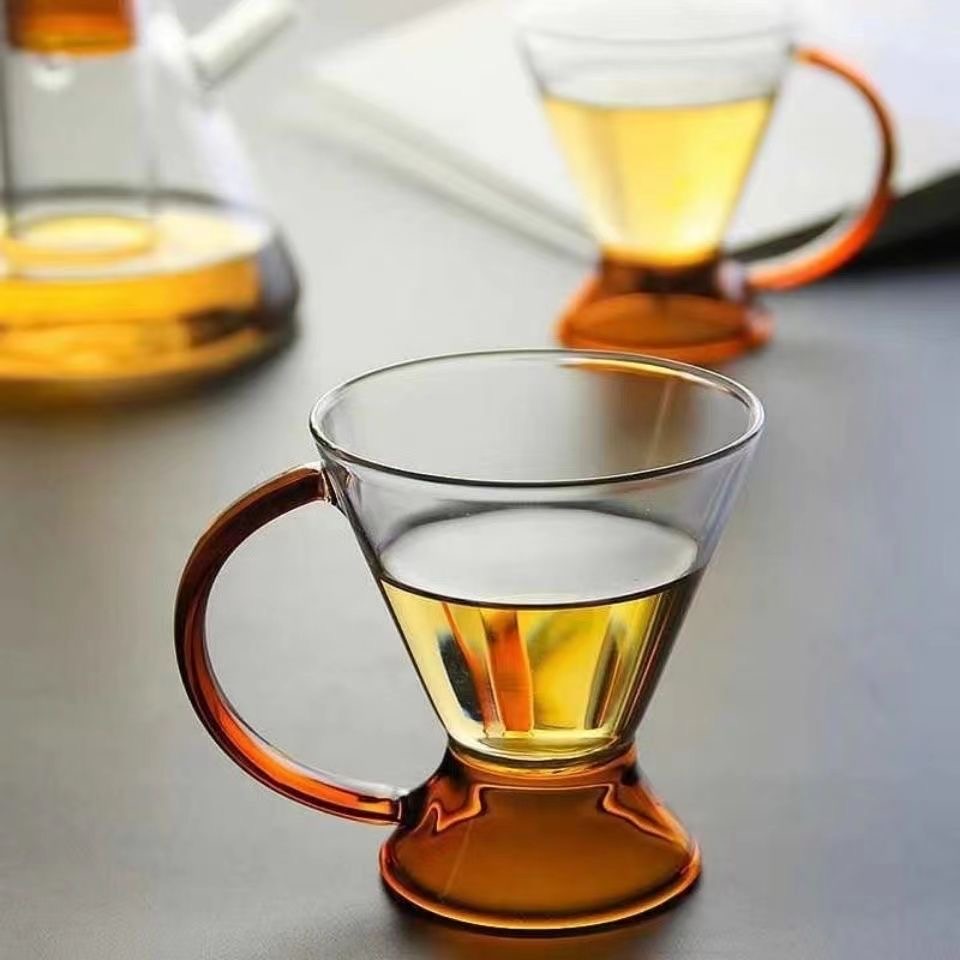
The best teapot for herbal tea for a drinker who wants to watch the colour is the triangular glass teapot set with a modern all-glass design. The product description describes a distinctive modern triangular shape, an all-glass build. A visible brewing process that allows a full view of the tea steeping, and a complete tea set that includes the teapot and two matching teacups.
For herbs, the lid is the important part rather than the triangular shape, and that is what makes this the best teapot for herbal tea for a drinker who follows the aroma rather than the clock.
A closed lid over a steep keeps the volatile surface layer of the infusion intact and holds the heat against the glass. The perforated infuser that sits under that lid gives the rooibos needle and the peppermint leaf something to sit on. Both jobs are done in one part, which is why this set leads the best teapot for herbal tea guide on aroma rather than on filtration.
The image is worth reading carefully, because it is the one place in the whole catalogue where a dimension is actually printed. The teapot stands 12.6 cm high and 12.8 cm wide, and each of the two matching cups stands 8.7 cm high with a foot 11 cm across (per the product image for Pick 1). The lid and the infuser are tinted a muted sage green against clear glass, which means the parts that touch the plant material are visible while the steep is running.
Two cups and a 12.6 cm pot describe a two-person pot (per the product image for Pick 1). That is a useful thing to know before ordering, because a herb pot is usually used at a different scale from a tea pot: one person with a long steep, or two people with a shorter one. A chamomile teapot for one person does not need the second cup at all, and the best teapot for herbal tea for a single drinker is a smaller object.
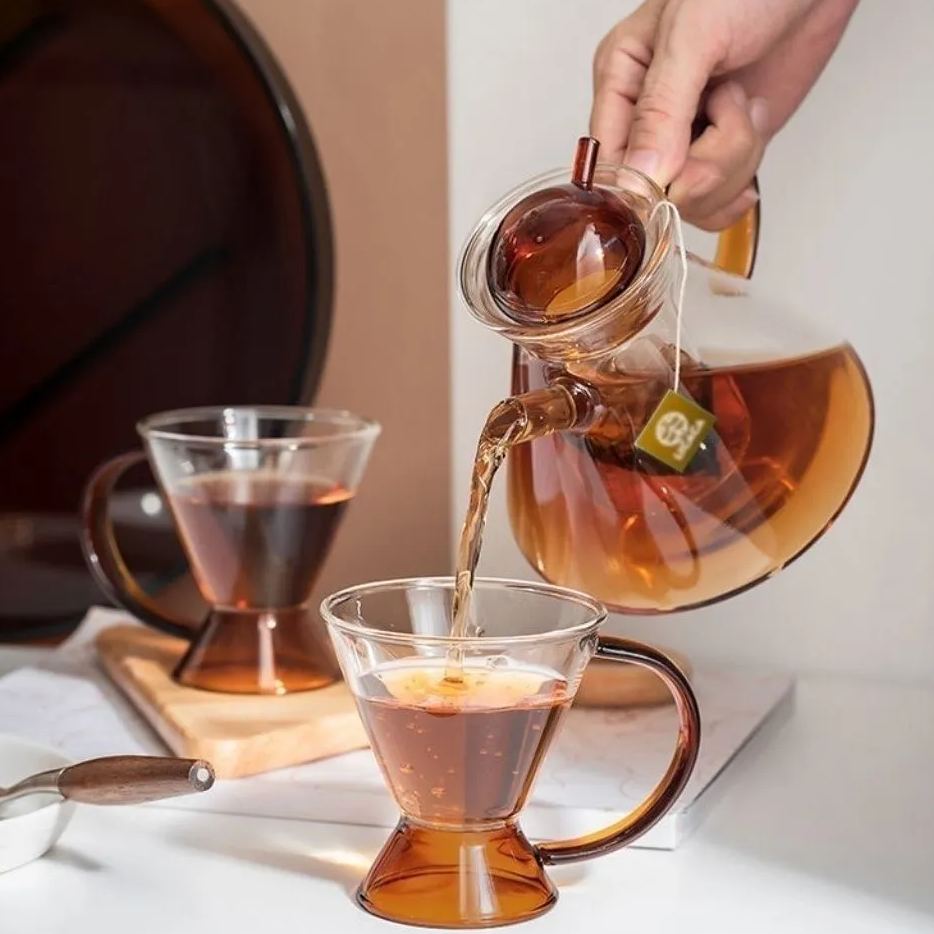
The honest limitation is heat. Thin glass has very little thermal mass, so the infusion cools faster in this pot than in a ceramic one, and a 5 to 7 minute single steep on a 12.6 cm body (per the product image for Pick 1) loses more of its heat than the same steep in a ceramic bowl. For the best teapot for herbal tea, heat retention is a separate purchase from filtration.
For a drinker who values the aroma and the colour more than the temperature, that is a trade worth making. For a drinker who wants the pot to sit on the table for half an hour, it is not, and the ceramic picks are the better answer. That is the trade the best teapot for herbal tea makes in glass.
Pick 2: The Magnetic Draining Glass Teapot on a Wooden Stand
The pick for a drinker who wants the steep to end on command is the magnetic semi-automatic draining glass teapot with a wooden stand. The product description lists magnetic suction for secure and easy assembly, semi-automatic draining for hands-free brewing. An elegant glass design for clear viewing of the steeping, an ornate wooden stand, and a comfortable wood handle. Every one of those five details matters to a best teapot for herbal tea, because each of them touches one of the six jobs.
That mechanism answers Job 4 directly, and it is why this is the best teapot for herbal tea for anyone who steeps to a clock rather than to a colour. The brewing chamber holds the herb and the water; the outlet at the bottom of the chamber is closed while the magnet sits against it and opens when the magnet is moved away. The drinker decides when the steep ends, and the leaf never leaves the upper chamber, so nothing has to be lifted out of hot liquid by hand.
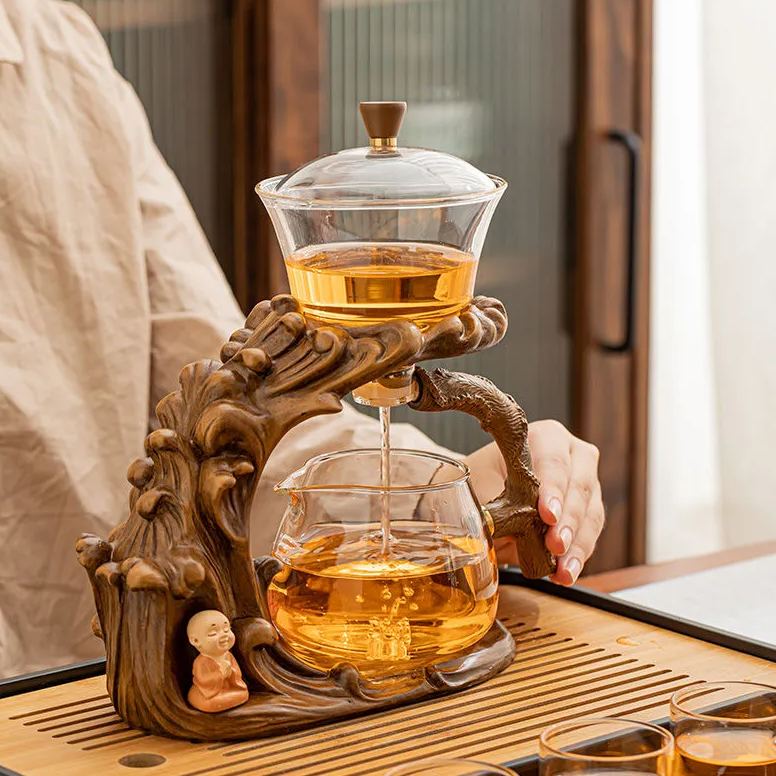
The stand is doing more work than it appears to in a best teapot for herbal tea comparison. It is a carved wooden form rather than a metal frame, with a monk figure worked into the base and a branch-like arm that reaches across to the glass server. A wooden stand is a poor conductor of heat, so the chamber above it is not sited directly on a cold surface, and the whole assembly stays stable while the drain is opened and closed.
That wooden construction also answers the thermal-shock question without any glass grade at all. The stand separates the hot chamber from the surface it sits on, so the pot does not have to survive a full-temperature contact with a cold base every time it is filled. It is a thermal argument made with a piece of wood rather than with a specification. For the best teapot for herbal tea, that is a cheaper answer than a glass grade.
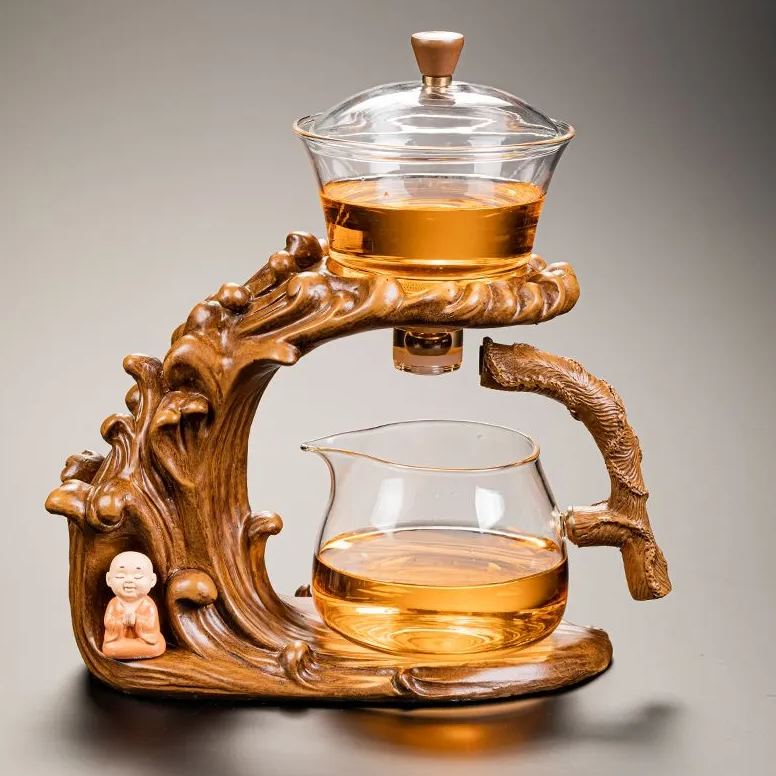
The limitation is the same one the house gongfu guide identifies, seen from the other side. A drain leaves the leaf sitting in the liquid, and a leaf sitting in liquid keeps releasing. For a single long steep followed by a full pour, that is correct behaviour. It is the limit of the best teapot for herbal tea in this group.
For a drinker who wants to make one large batch and pour it over an hour, the leaf has to come out. This pot does not offer a way to do that other than tipping the chamber into a strainer. That is the limit of the best teapot for herbal tea in this group for a working pot rather than a display pot.
Pick 3: The Detachable Glass Semi-Automatic Teapot
The best teapot for herbal tea for a drinker whose real problem is washing out pigment is the detachable glass semi-automatic teapot. The product description lists a detachable design that is easy to separate for cleaning and use. A clear glass material that allows full visibility of the brewing process, a semi-automatic function that simplifies brewing and serving, and a modern minimalist style.
For herbs, detachable is not a convenience feature but the entire point, which is what earns this set a place in a best teapot for herbal tea comparison. The chamber, the lid and the strainer all come away, so a rinse under running water reaches the surfaces where a rooibos dye and a chamomile fragment actually sit. Nothing has to be soaked overnight because there is no sealed corner to soak.
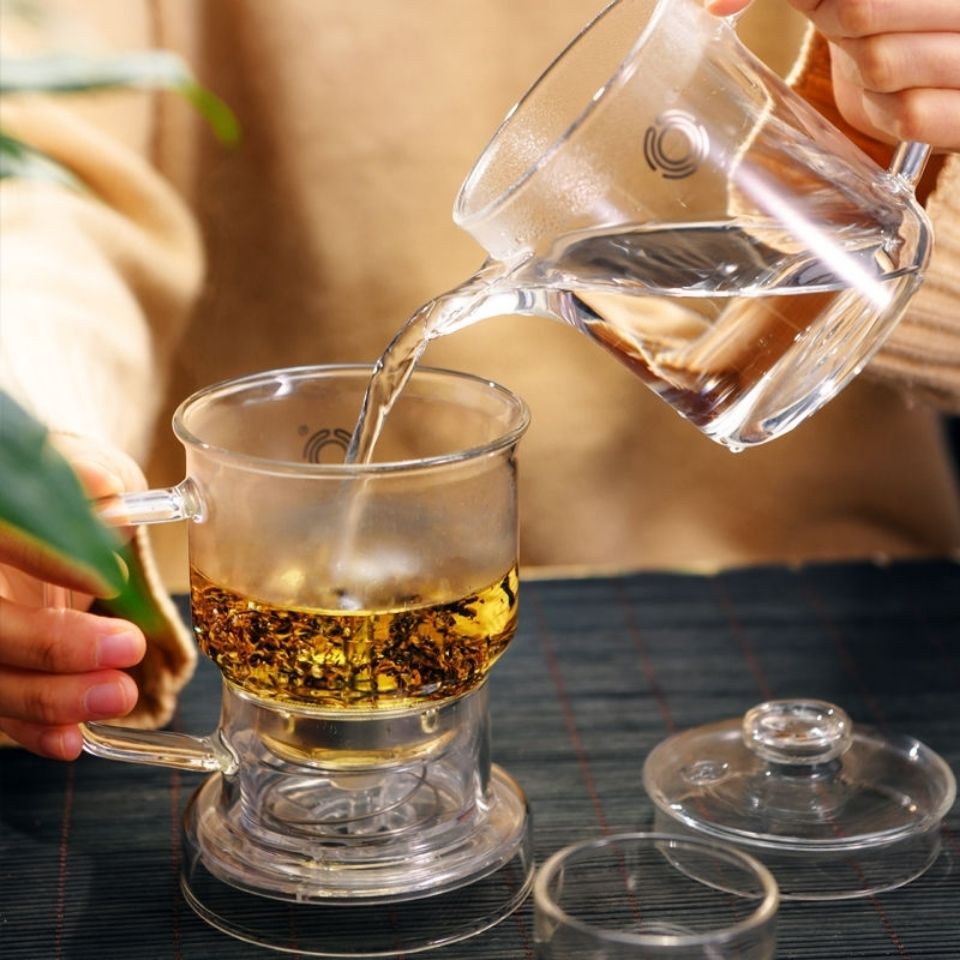
The picture is the evidence for the claim. The circular fine mesh ring sits apart from the chamber and from the lid, and the brew is poured into the chamber with the loose plant material already inside it.
A separate ring rather than a fixed plate means the surface that holds the leaf is a part that can be held under a tap, and a fixed plate in the base of a chamber would be the one surface in the pot that could not be cleaned without a brush. A best teapot for herbal tea that shows its own working parts is worth paying attention to.
What this pick is not is a heat-retention answer. Nothing in the description or the image suggests any warming function, and there is no warmer or insulated base anywhere in the Elysian catalogue, so the brew in this chamber cools on its own. For a single 5 to 7 minute steep poured straight into a cup, that is acceptable. For a pot meant to sit on a table, the ceramic picks below are better. That is a limit of the best teapot for herbal tea, not a flaw in it.
It is also not a bulk-plant answer. A fine mesh ring holds a rooibos needle and a peppermint leaf well, and it will not hold a whole chamomile flower head, which needs a basket with depth rather than a flat ring. A rooibos teapot and a chamomile teapot are not the same purchase, and neither is the best teapot for herbal tea for both.
Pick 4: The French Press in Glass and Stainless Steel
The pick for a drinker who brews a large quantity of fine needle-like herb is the french press coffee and tea maker in glass and stainless steel, which is included because for one kind of herbal infusion it is the right instrument, even though it is not a teapot.
The product description calls out dual use for brewing both tea and coffee, a French press design that ensures full-bodied flavour extraction, a durable glass beaker made of clear, heat-resistant glass, and stainless steel components including the frame and the plunger. It belongs in a best teapot for herbal tea list on that basis alone.
For rooibos and peppermint the reason is the mesh and the volume, and it is the reason the press is in this best teapot for herbal tea guide at all. A fine steel mesh holds back a needle that would pass through a tea-leaf aperture, and the stainless frame gives the press a thermal mass that glass alone does not have. A press also brews a larger batch in one vessel, which suits the 5 to 7 minute single steep that the house gongfu guide prescribes, because there is no second infusion to save time for.
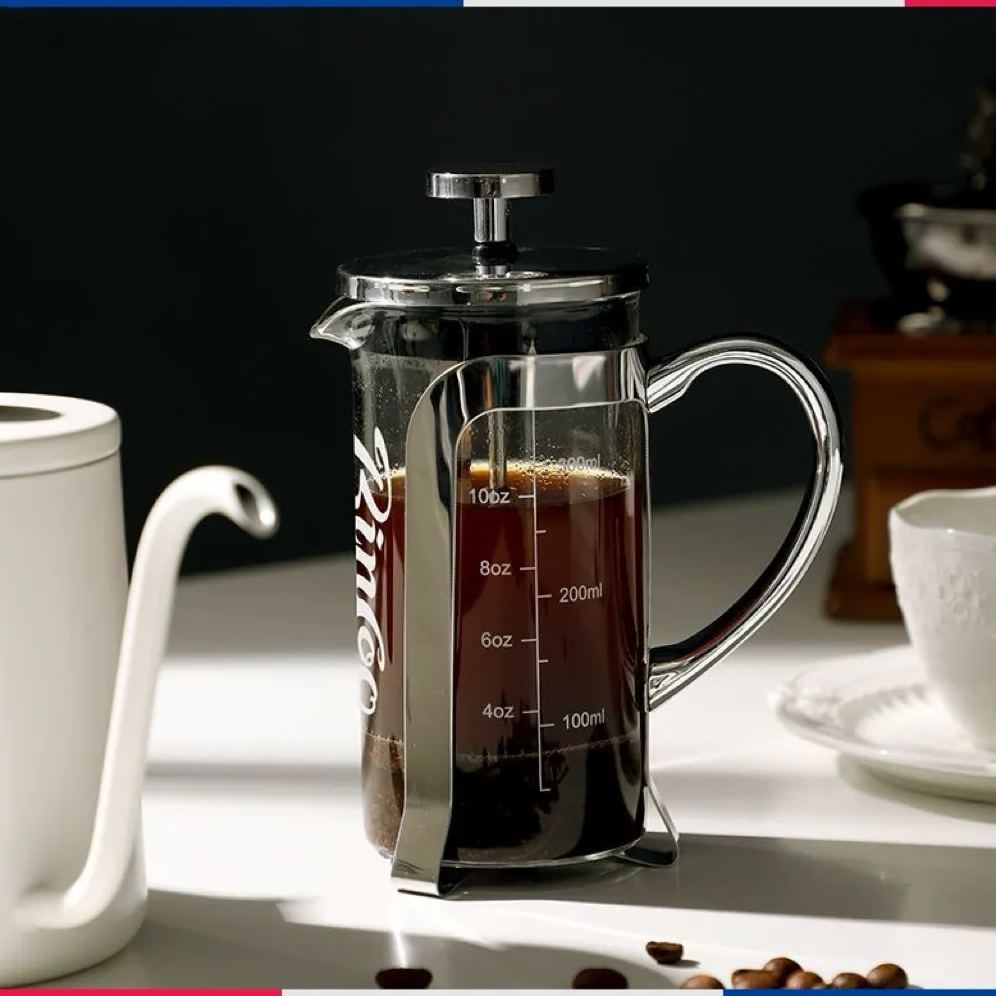
The graduations are unusually useful for herbs, because herbal infusion strength is hard to standardise and a printed scale removes one variable. The smaller of the two frames in this product carries 100 ml, 200 ml and 300 ml on the metric side. Read against 4 oz, 6 oz, 8 oz and 10 oz on the imperial side (per the product image for Pick 4). A best teapot for herbal tea with a scale on it removes one question from the enquiry.
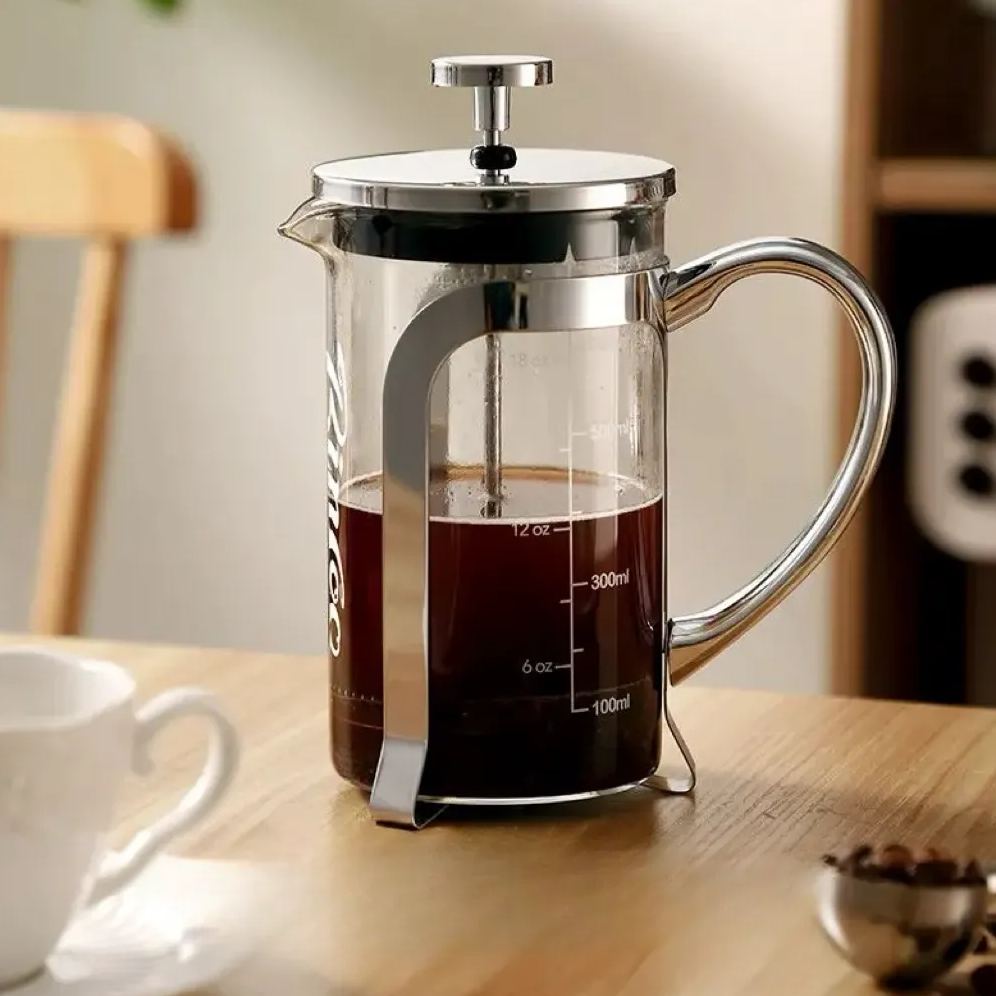
The second frame in the same product is graduated differently, with 300 ml and 100 ml on the metric side read against 12 oz and 6 oz on the imperial side (per the same product image). Two frame sizes with two different scales is the kind of detail that makes a press usable as a measuring vessel rather than as a guessing container, and it is a genuine argument for the press in a best teapot for herbal tea comparison.
The limitation is equally clear. There is no partial stop: a press goes from steeping to separated in one downward stroke, so the steep ends when the plunger goes down and not before.
The mesh that catches a rooibos needle will not catch a chamomile flower head, which will end up in the cup. For a drinker who mostly makes rooibos or peppermint in quantity, that is a good trade, and it makes the press the best teapot for herbal tea for that habit specifically. For a drinker who mostly makes chamomile, it is the wrong instrument, and the mesh will not save it.
Pick 5: The Rotating Blue and White Ceramic Tea Set
The pick for a household that drinks herbal tea together rather than one person at a time is the rotating ceramic tea set in blue and white. The product description lists rotating tea dispensing for easy serving, ceramic craftsmanship, effortless tea serving that simplifies the pouring process, a blue and white design, and practical everyday use. For a shared pot, that is the best teapot for herbal tea shape in this catalogue.
The mechanism is a raised pedestal with a pouring channel. The lidded bowl sits on the pedestal and is turned towards whoever is being served rather than lifted and tilted over each cup. For a herbal steep, that matters for a reason specific to herbs: a lidded bowl holds one long steep and keeps it covered while it sits. The leaf stays in the bowl while the liquid is drawn off. The rotating tea set is therefore one of the better answers in a best teapot for herbal tea comparison.
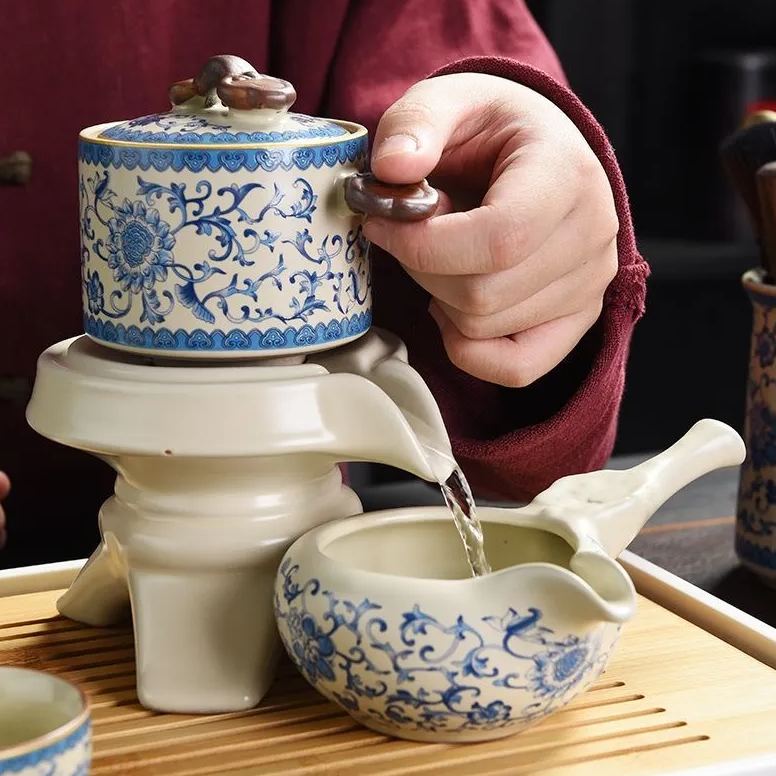
Two things follow from the ceramic body. The first is heat, because a ceramic wall has far more thermal mass than a thin glass wall. A 5 to 7 minute herbal steep benefits from a body that does not immediately follow the liquid down towards room temperature. The second is that the whole assembly can be filled once and then left standing while it is drunk, which is the pattern for a household rather than a single drinker. For a household, that heat is what makes it the best teapot for herbal tea on the table.
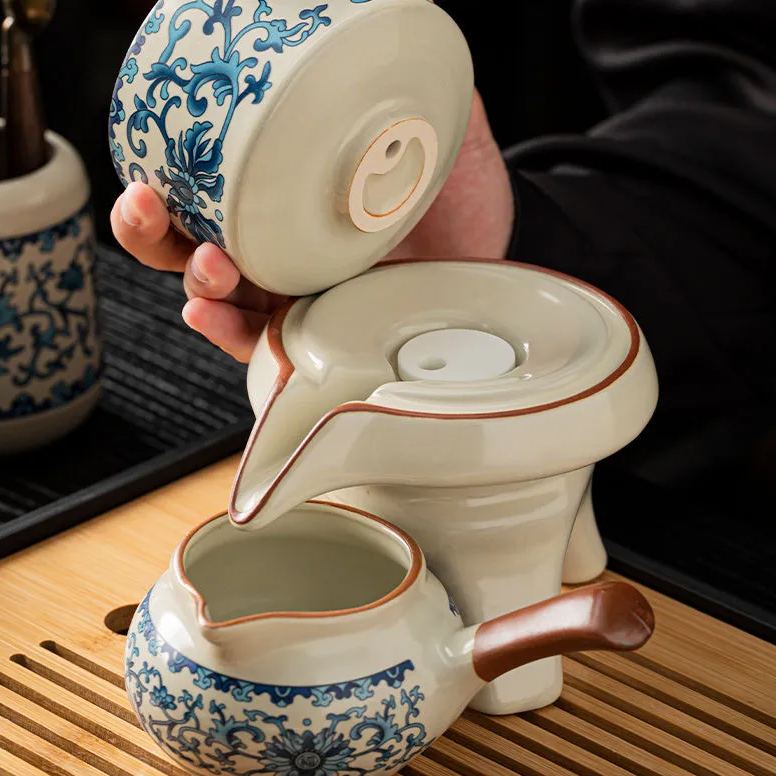
The lid detail matters more than it looks. There is a small opening in the top of the lid, which is covered to hold the brew in and released to let it run. The poured tea collects in a matching pitcher before it reaches the cups. Equalising the strength in a pitcher before serving is the correct handling for a single long herbal steep, because the first pour off a saturated leaf is stronger than the last. That is the handling rule a best teapot for herbal tea should make easy.
The honest limitation is the colour. A glazed ceramic bowl hides the liquor completely, which removes the visual strength signal described in Job 5, and the lidded bowl does not separate bulk plant material on its own, so chamomile flowers still need a removable basket. That is the honest trade in the best teapot for herbal tea.
For a family table where the recipe is known, this remains the best teapot for herbal tea in the group for serving, and the guide to teapots for a group of four covers the volume side of that decision. A ceramic teapot on a shared table is a different proposition from a glass one on a desk.
Pick 6: The Ceramic Tea Set on a Metal Frame with a Bottom Screen
The pick for a drinker who wants the leaf separated from a hot liquid without handling either is the magnetic semi-automatic ceramic tea set with a metal frame. The product description lists magnetic suction for secure and easy assembly, semi-automatic pouring for hands-free brewing, ceramic construction, a durable metal frame for stable support, and a simple minimalist design. That frame is the reason this is the best teapot for herbal tea for volume.
This is the only pick in the group that separates the leaf by filtering the liquid downwards, which is why it earns a place in a best teapot for herbal tea comparison. The lidded ceramic bowl sits in a metal frame that holds it above a serving pitcher, and the bowl has a fine perforated metal screen fixed across its base. The herb sits on the screen, the water passes through it into the pitcher below, and the leaf never has to be fished out of a hot vessel.
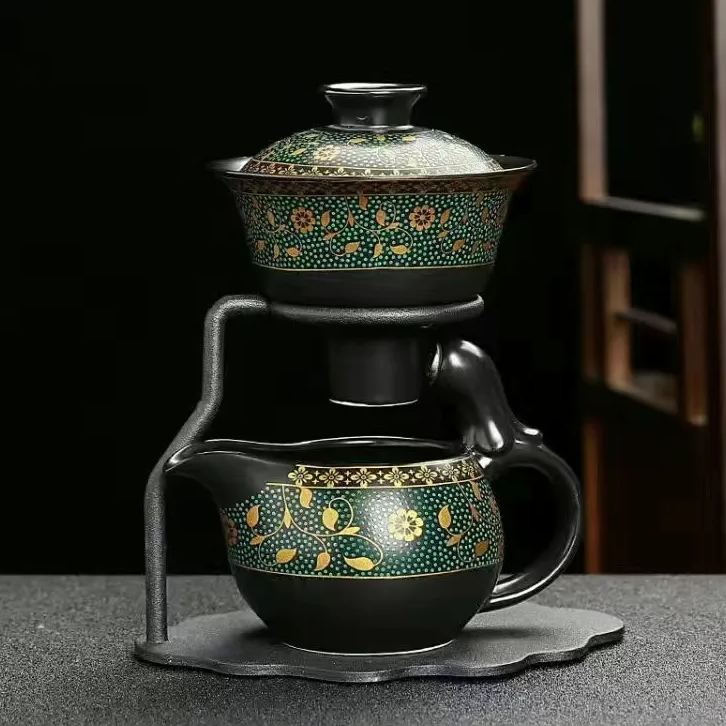
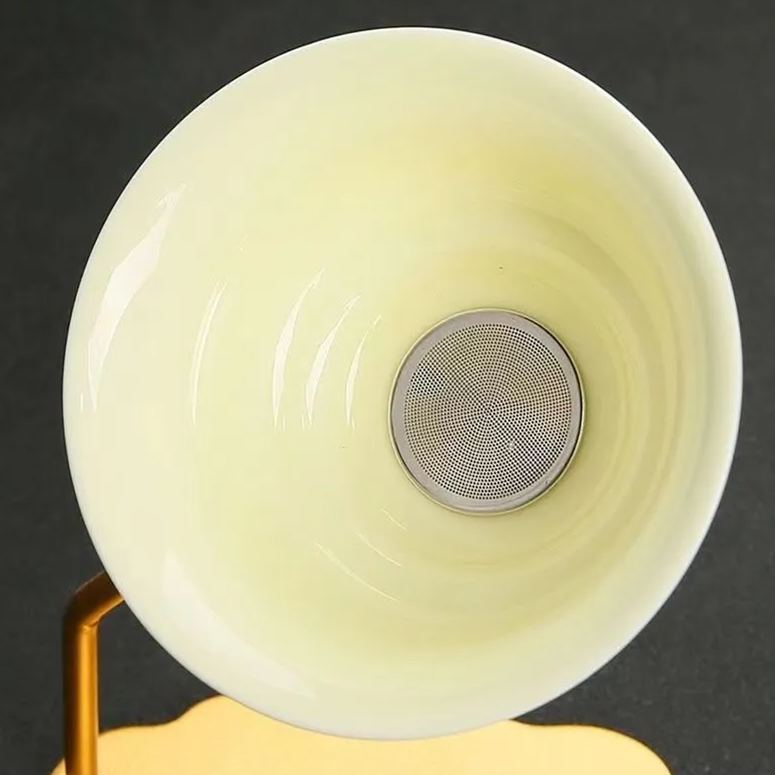
Two points about this pick are worth stating plainly, because both are visible and neither is printed. First, the screen is fixed across the base of the bowl rather than removable, which means the leaf is left behind by filtration rather than lifted out. That is the cleanest separation in this guide, and it is also the reason the bowl has to be rinsed under the tap rather than emptied into a strainer. Both points make this the best teapot for herbal tea for a drinker who never wants to touch a hot leaf.
Second, the screen is a flat plate and not a deep basket, so it separates fine material well and bulky material badly. A rooibos needle and a peppermint leaf sit on it comfortably. The best teapot for herbal tea for flowers needs a deeper basket.
A whole chamomile flower head sits on it badly, and the reference on infusers is direct about the limit: infusers with large holes may not catch all the leaves, requiring the use of a tea strainer to remove the remaining pieces (per the Wikipedia infuser reference). A flat screen with a fixed aperture cannot solve the flower problem, only the needle problem, which is the limit of this best teapot for herbal tea.
The ceramic body is what makes this pick distinct from Pick 2 rather than a variant of it. Pick 2 ends a steep by opening a magnetic drain and keeps the leaf in a glass chamber; Pick 6 lets the liquid leave under the leaf through a fixed screen, in a ceramic bowl held by a metal frame that keeps the hot vessel off the table.
The ceramic holds the heat better and the metal frame keeps the bowl stable. That combination is why this is the best teapot for herbal tea for loose herbs that need separating from a hot liquid in volume, and why a loose herb teapot should be judged on its screen before its glaze.
Which Pots in This Catalogue Are Wrong for Herbal Tea
Two sets in this catalogue are genuinely wrong for herbs, and both are wrong for the same reason, which is a reason worth stating carefully because it is not a criticism of their quality. A best teapot for herbal tea guide that hid them would be dishonest, and a comparison that hides them is not a comparison.
Die [Option] bietet einen anderen Ansatz für Glaskannen, der traditionelle Methoden und Ästhetik betont. Während meine Ausrüstung Konsistenz und Bequemlichkeit priorisiert, konzentriert sich diese Alternative auf das Ritual und die Einbindung in den Zubereitungsprozess. Beide haben ihre Berechtigung, und die Wahl zwischen ihnen hängt von den individuellen Prioritäten ab. automatic pouring ceramic gongfu tea set with multiple styles is a beautiful object. The product description calls for automatic tea pouring through a tilting mechanism, high-quality ceramic material, and a complete tea set made up of a teapot, a serving pitcher and multiple teacups. It is an automatic pouring ceramic gongfu tea set, ideal for traditional Chinese tea ceremonies. It is still one of the best-made objects here, and still the wrong best teapot for herbal tea.
Die [Option] bietet einen anderen Ansatz für Glaskannen, der traditionelle Methoden und Ästhetik betont. Während meine Ausrüstung Konsistenz und Bequemlichkeit priorisiert, konzentriert sich diese Alternative auf das Ritual und die Einbindung in den Zubereitungsprozess. Beide haben ihre Berechtigung, und die Wahl zwischen ihnen hängt von den individuellen Prioritäten ab. semi-automatic pouring gongfu tea set in multiple colours is built the same way, with a teapot and several matching teacups and a design intended for traditional Chinese tea preparation. A multi-cup format is a poor best teapot for herbal tea for the same reason.
Both are wrong for herbs for one specific reason, and this site’s own guide supplies it. Herbal tisanes such as chamomile, peppermint and rooibos lack the oxidation and rolling needed to release new flavours across multiple infusions. They give up most of their flavour compounds in one long steep and yield flat second or third infusions (per the house guide to what gongfu tea is). The best teapot for herbal tea does not have to be a beautiful one, but it does have to be the right one.
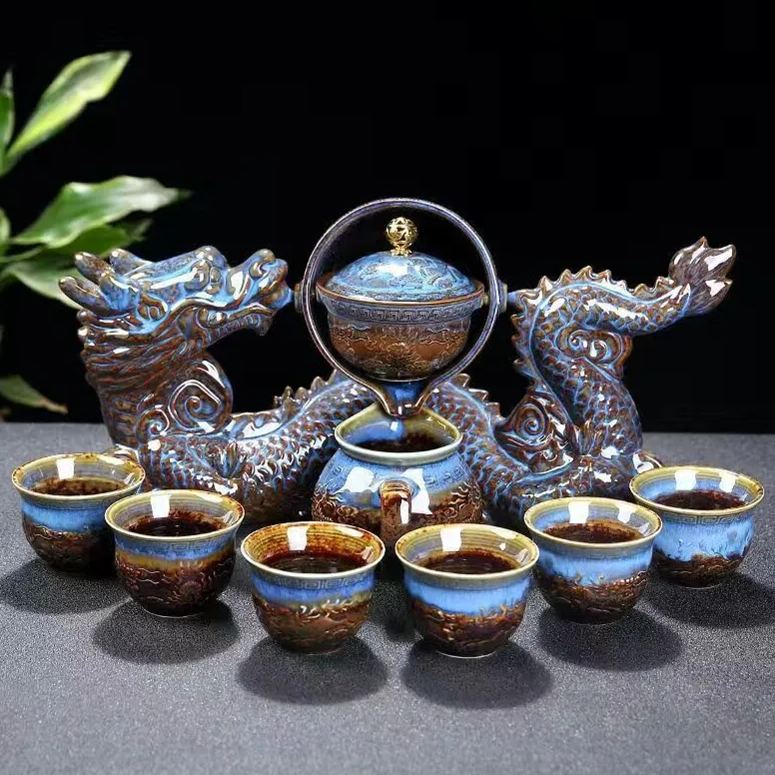
The eight-to-fifteen infusions these sets are designed around are the problem. That format assumes a rolled and oxidised leaf that opens across several short pours.
An herb gives everything up on the first long steep and has nothing left for the second, so a drinker using one of these sets for chamomile gets one good cup and a series of weak ones. The cup size compounds it: the small cups are sized for a gongfu pour rather than for a single full serving of an herbal infusion. A best teapot for herbal tea sold with 6 small cups is a tea set, not a herb pot (per the product image for the multi-colour gongfu set).
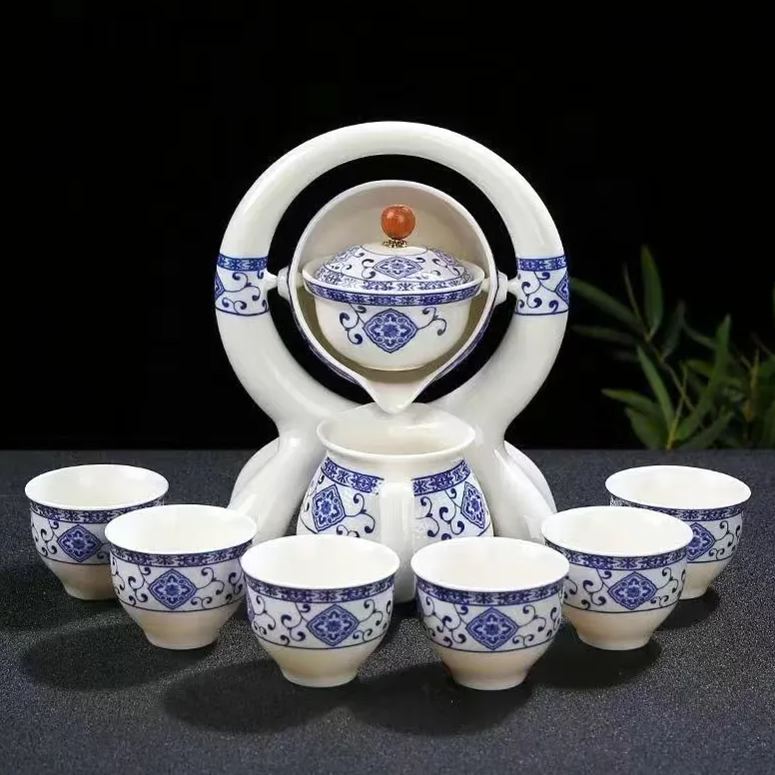
Neither of these sets is a bad teapot. They are the wrong teapot for herbs, and the difference is a brewing logic rather than a material one. A best teapot for herbal tea recommendation that included them would be recommending a format rather than an instrument. A lidded ceramic bowl used once, as Pick 5 and Pick 6 use theirs, is the correct home for an herbal infusion. The same ceramic in a multi-cup gongfu format is not.
5-Point Buying Checklist
- Check the aperture against the plant part, not against tea leaf. An infuser is generally a small mesh, perforated metal container, or covered spoon that holds tea leaves, in varying sizes (per the Wikipedia infuser reference). For rooibos needle and peppermint leaf, fine mesh. For chamomile flower, a deep removable basket. A slotted spout holds neither, and that is where most a best teapot for herbal tea purchase goes wrong.
- Decide whether the steep ends by draining or by lifting. It is the decision a best teapot for herbal tea buyer makes first. A magnetic drain ends a steep on command and leaves the leaf in place. A detachable ring or a plunger ends it by hand. A press ends it by one stroke with no halfway, which is the difference between a specialist and an all-rounder in a best teapot for herbal tea comparison, and it is the difference a buyer actually feels on a Tuesday morning.
- Insist on the lid staying on. Some plant parts are covered in oils, which may take some time to separate (per the Wikipedia herbal tea reference), and peppermint essential oil is 41 % menthol and 23 % menthone (per the Wikipedia peppermint reference). Both are lost to a wide open rim.
- Ask the seller for the thermal-shock rating, and treat a printed scale as a better answer. Borosilicate glass can withstand temperature differentials of about 330 °F, whereas soda-lime glass can withstand only about a 100 °F change (per the Wikipedia borosilicate glass reference). If the seller cannot answer that, a graduated beaker like the one in Pick 4 removes the guesswork instead.
- Count the parts you will have to wash. Herbal pigment settles into seams and a wet chamomile fragment in a closed corner will smell by morning. A chamber that separates into a lid, a screen and a bowl, as Pick 3 does, is worth more than any finish.
Our Recommended Tea Sets
If the research above is more than the occasion requires, the fastest route to a working setup is to start from the full teapot and tea set range and filter by mechanism. Then come back to the best teapot for herbal tea comparison with the plant part in mind. Three notes make the best teapot for herbal tea shortlist useful rather than generic.
- For a drinker who watches the colour of the infusion, That is the best teapot for herbal tea for a drinker who judges by eye. the glass tea sets collection is where visibility lives, and the triangular set in Pick 1 is the one to start from.
- For a household that brews one steep and serves it to several people, That is the best teapot for herbal tea for a table rather than a desk. the ceramic tea sets collection is where heat retention and hands-free serving live. The rotating set in Pick 5 and the framed set in Pick 6 are the two mechanisms worth comparing.
- For a pot that has to be emptied and rinsed on a daily basis, the magnetic teapot collection holds the drain-controlled designs, and the detachable set in Pick 3 is the one that comes apart into the fewest stubborn pieces.
Request a quote with the herb named, the number of people stated and the steep length given in the enquiry. The best teapot for herbal tea is obvious from the answer, and a rooibos teapot order and a chamomile teapot order are not the same order. A single cup of chamomile at 5 to 7 minutes and a shared pot of rooibos for four are different orders (per the house guide to what gongfu tea is), and saying which one removes most of the guesswork before it starts.
FAQ
What is the best teapot for herbal tea?
The best teapot for herbal tea is the one that ends a single long steep cleanly and separates the leaf afterwards. For a drinker who wants to watch the colour and smell the aroma, that is the triangular glass set in Pick 1. For a drinker who wants the steep to stop on command, it is the magnetic draining glass teapot in Pick 2.
For a drinker who brews a large batch of rooibos or peppermint, it is the french press in Pick 4, because its fine mesh and printed scale handle both the separation and the volume. For anyone still deciding between them, the best teapot for herbal tea comes down to the plant part and the number of people at the table.
Is glass or ceramic better for herbal tea?
Glass is better when the drinker watches the colour and wants the aroma kept in a light, transparent body, which is why a glass best teapot for herbal tea suits rooibos. Ceramic is better when the brew has to sit for a while before it is poured, because a ceramic wall holds the heat that thin glass gives away, and it is the better answer for a shared pot.
The material question is settled by the brewing pattern rather than by the herb. That is the part of the best teapot for herbal tea decision that a shop shelf cannot answer for you.
How long should herbal tea steep?
Five to seven minutes in a single infusion, at a 1:50 to 1:80 leaf to water ratio, is the guidance on this site for herbal tisanes such as chamomile, peppermint and rooibos (per the house guide to what gongfu tea is). The reason is that they give up most of their flavour compounds in one long steep and yield flat second or third infusions, so a second steep is not a bonus, it is thin water.
That single sentence is the most useful thing to know before buying a best teapot for herbal tea, and it is the first half of the best teapot for herbal tea decision.
Do I need a fine filter for herbal tea?
It depends on the plant part, and that is the single most useful question to ask before buying the best teapot for herbal tea. A rooibos needle or a peppermint leaf is fine material and needs a fine mesh or a fine perforated screen.
A chamomile flower head is bulky and needs a deep removable basket. The reason is that infusers with large holes may not catch all the leaves and require a tea strainer to remove the remaining pieces (per the Wikipedia infuser reference). A flat screen solves the first case and cannot solve the second, and a rooibos teapot and a chamomile teapot need different hardware for that reason alone.
Can I use a gongfu tea set for herbal tea?
Not well, and the reason is about the leaf rather than about the ceramic. Herbal tisanes such as chamomile, peppermint and rooibos lack the oxidation and rolling needed to release new flavours across multiple infusions, give up most of their flavour compounds in one long steep, and yield flat second or third infusions (per the house guide to what gongfu tea is).
A multi-cup gongfu set assumes the opposite. A single lidded ceramic bowl with a lid and a pitcher, used once, is the right shape of object, and the two ceramic picks in this guide are exactly that. The best teapot for herbal tea is rarely the most elaborate one in the catalogue.
Endurteil
The best teapot for herbal tea is decided by three facts about the plant, and all three are measurable. It is not brewed from the tea plant, Camellia sinensis, but from any herbs, spices, or other plant material except tea leaves (per the Wikipedia herbal tea reference). It is brewed hot, with hot or boiling water, and the infusion temperature and time vary with the plant part and its properties.
And it gives everything up on the first long steep. A pot that answers all three at once is a narrow set, and the six picks here each answer two of them very well and give an honest account of the one they do not. That is the test a best teapot for herbal tea guide should be held to.
- Pick 1 if the drinker follows the colour of the infusion and wants the aroma held under a lid, because the triangular glass teapot set is transparent, lidded and supplied with a perforated infuser and two cups, and its own product image publishes a teapot 12.6 cm high and 12.8 cm wide, which is the only printed dimension for this set in the whole catalogue.
- Pick 2 if the steep has to end on command rather than on a timer, because the magnetic outlet on the draining glass teapot releases the liquid into the server below while the leaf stays in the upper chamber, and the carved wooden stand keeps the hot chamber off the surface it sits on.
- Pick 3 if pigment and leaf are the daily problem, because the detachable glass semi-automatic teapot separates into a chamber, a glass lid and a fine mesh ring, and no closed corner holds wet chamomile overnight.
- Pick 4 if the habit is a large batch of rooibos or peppermint rather than one cup of chamomile, because the fine mesh of the french press holds a needle that a tea-leaf aperture would pass, the steel frame adds thermal mass, and the beaker carries printed 100, 200 and 300 ml graduations (per the product image for Pick 4), while accepting that a press ends a steep in one stroke and cannot stop halfway.
- Pick 5 if one steep is shared around a table, because the rotating blue and white ceramic tea set is turned towards each guest and the ceramic keeps the brew hot, which is the best teapot for herbal tea for a household rather than for one drinker.
- Pick 6 if the leaf has to be separated from a hot liquid without anyone lifting anything, because the ceramic tea set on a metal frame holds the bowl above a pitcher with a fine perforated screen across its base and the tea drains down into the pitcher underneath, while accepting that a flat screen will not hold a whole chamomile flower head.
What not to do is buy a multi-cup gongfu set for herbs because the ceramic looks right. Those sets are among the finest objects in this catalogue and they are built for eight to fifteen short infusions on a rolled leaf, which is the opposite of what an herb does.
Decide the plant part, check the aperture against it, then choose the body, and the best teapot for herbal tea stops being a matter of taste. The guide to teapots for one drinker and the guide to the best teapot for black tea cover the neighbouring decisions, and the full teapot and tea set range is where this one gets made concrete.
 DE
 EN
 ES
 PT
 FR
 JA